
BuddhistCatholicContemplativeEvangelicalGeneral ChristianHinduJewishLatter-day SaintMuslimNew VisionsProgressive Christian
Beliefs
- Buddhist
- Catholic
- Contemplative
- Evangelical
- General Christian
- Hindu
- Jewish
- Latter-day Saint
- More Voices
- Muslim
- New Visions
- Pagan
- Progressive Christian
Topics
- Religion News
- Food and Religion
- Sports and Religion
- Religious Art
- Religious Music and Entertainment
- Religious Events
- History and Religion
- Style and Religion
- Politics and Religion
- Women in Religion
- Recreation Outdoors and Religion
- Business Finance and Religion
- Careers Workplace and Religion
- Education and Religion
- Family Parenting and Religion
- Health Fitness and Religion
- Home and Religion
- Relationships and Religion
- Technology and Religion
- Travel and Religion
Columnists
- Buddhist Columnists
- Business Finance and Religion Columnists
- Careers Workplace and Religion Columnists
- Catholic Columnists
- Contemplative Columnists
- Education and Religion Columnists
- Evangelists Columnists
- Family Parenting and Religion Columnists
- General Christian Columnists
- Health Fitness and Religion Columnists
- Hindu Columnists
- History and Religion Columnists
- Home and Religion Columnists
- Jewish Columnists
- More Voices Columnists
- Latter Day Columnists
- Muslim Columnists
- New Visions Columnists
- Nonreligious Columnists
- Pagan Columnists
- Politics and Religion Columnists
- Progressive Columnists
- Recreation Outdoors and Religion Columnists
- Relationships and Religion Columnists
- Religion News Columnists
- Religious Art Columnists
- Religious Events Columnists
- Religious Music and Entertainment Columnists
- Sports and Religion Columnists
- Style and Religion Columnists
- Technology and Religion Columnists
- Travel and Religion Columnists
- Women in Religion Columnists
Resource Library
- 2026 Calendar
- Library of World Religions
- The 100 Most Holy Places on Earth
- Patheos Answers
- Podcasts
- Videos
- Faith Leaders Database
- Anglican Episcopalian
- Bahai
- Baptist
- Buddhism
- Christianity
- Confucianism
- Eastern Orthodoxy
- Hinduism
- Holiness and Pentecostal
- ISKCON
- Islam
- Judaism
- Lutheran
- Methodist
- The Church of Jesus Christ of Latter-day Saints
- New Age
- Paganism
- Presbytarian and Reformed
- Protestantism
- Religion Behind the Scenes
- Roman Catholic
- Scientology
- Shia Islam
- Sikhism
- Sufism
- Sunni Islam
- Taoism
- Zen
- See all religions
Research Tools
 Ad-Free & Subscriber Log-In Subscription Support
Ad-Free & Subscriber Log-In Subscription Support
Follow Patheos 

- Trending:
- Forgiveness
- |
- Marriage
- |
- Consciousness
- |
- Death Penalty
- |
- Election
- |
- Halloween
 Fare Forward
- Home
- Evangelical
- Orthodoxy Has Won?
Orthodoxy Has Won?
Last updated on: May 9, 2013 at 10:06 am by Jake Meador
Orthodoxy Has Won? 2013-05-09T10:06:56-04:00 Jake Meador
Patheos Explore the world's faith through different perspectives on religion and spirituality! Patheos has the views of the prevalent religions and spiritualities of the world.
In an interesting read from Time Magazine, Mary Eberstat, author of this new book on secularism, argues that “in the war over Christianity, orthodoxy is winning.” She uses a fight over an Episcopalian church in Virginia, in which a breakaway traditional group in the church lost its legal battle with the mainline sect for ownership of the church’s physical property, as an example of how orthodoxy is “winning”:
That traditionalist breakaway congregation in Virginia is larger than the one on the legally winning side — as in, much. Membership on the “losing” side, by one estimate, includes some 2,000 souls, as opposed to some 174 in the congregation moving in. And though exact numbers may not always be available, the larger trend is clear: this numerical division between traditionalists and reformers is also seen around the world. It’s the stricter Christian churches that typically have stronger and more vibrant congregations — as has been documented at least since Dean M. Kelley’s 1996 book, Why Conservative Churches Are Growing.
At this point, one cannot reasonably doubt that the future of Christianity is orthodox (little o) rather than liberal (which is one of the many reasons I find the push amongst liberal Catholics to basically become mainline protestants so puzzling). Yet there’s a deeper critique that needs to happen as well that is implied by the broader argument being made in the piece linked above.
While it’s obvious that within the church orthodoxy has won, it is equally obvious that in terms of broader cultural projects the mainline has won. Liberal Christianity—and I don’t mean that as a political term, but as a very specific description of 20th century western Christianity in Europe and portions of the American church—embraces a functional materialism while maintaining an openness to a sort of noumenal reality that can’t be reduced to blunt materiality. If this calls to mind much of the “spiritual but not religious,” rhetoric so common today, then we’re on the same page.
Additionally, the ethic embraced by liberal Christianity has often emphasized individual freedom and the importance of inclusiveness—defined not in Christian terms, but in the terms of a more secular, materialistic culture—as the center of Christian faith and practice. Indeed, to read some liberal Christians is to discover that the only group that ought not be included are those skeptical of blanket inclusiveness.
In other words, the famed “nones” who do not have any religious affiliation are the second or third generation consequence of 20th century liberal Christianity. One point seldom mentioned in discussing the nones is that they hardly vindicate the new atheists. Of all the nones, 55% say they are either “religious” or “spiritual but not religious.” The nones are simply the consequence of a theology that marginalizes the church and distances itself from the hard edges of Christian faith matures.
What does this mean for the future of Christian faith? Several points seem most important:
First, orthodox Christians ought not be too triumphalistic as they consider the death of liberal Christianity. That death simply represents the triumph of mainline Christianity and the rise of an irreligious culture—hardly things orthodox Christians ought to celebrate.
Second, it is more important than ever that Christians ground their daily Christian life in the local church and that we recognize the church as a separate and distinct political body. Here the works of Hauerwas, Cavanaugh, and O’Donovan will be essential, I think. (Yes, they are all radically different theologians, but the basic insight shared by all is that the church is a polis.)
Third, and most hopeful, as orthodox Christians ground their daily practice within their church communities and embrace a way of life that stands opposed to the consumption and materialism of the outside world, there is reason to hope that this may drive distinct Christian bodies closer together and closer toward unity. The Time article raises that very point when it mentions that the evicted Anglicans of The Falls Church have more in common with conservative Catholics and evangelicals than they do with the Episcopalian church. Indeed, we’ve already seen this in Europe with the Roman church’s provision for receiving Anglican churches into fellowship. I think a similar spirit animates American ecumenical groups ranging from Evangelicals and Catholics Together to The Gospel Coalition, a network of Reformed evangelical Christians created by Presbyterian pastor Timothy Keller, Baptist minister John Piper, and evangelical free seminary professor D.A. Carson. (Evangelical free churches have their roots in the Lutheran tradition, which means TGC could be said to represent the first steps toward reunion of the three main branches of the Protestant reformation—Reformed, Lutheran, and Anabaptist.)
So on the one hand, orthodox western Christians should not be too eager to pat themselves on the back. The “victory” over the mainline is largely pyrrhic because the mainline has achieved precisely what one would expect it to achieve in terms of broader cultural projects. That said, the drawing of a harder line between the popular mainstream culture of the contemporary west and the culture of the church is good news for us because it allows the contours of the gospel to be more easily discerned. As Chesterton noted in the introduction to one of his books—I believe it was The Everlasting Man—the next best thing to being in the church is to be completely outside it. It is when we occupy that middle ground in which we stand outside the church but not far enough outside to realize it that confusion occurs and the unique claims of the Gospel are lost.
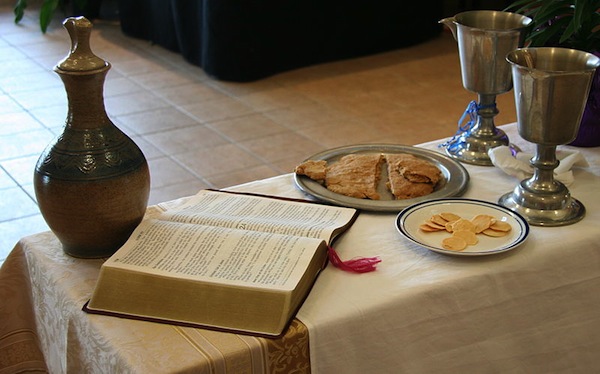
[Image of Communion Table Courtesy of Wikipedia]


Next Post

May 11, 2013 Because Science
Browse Our Archives
Select a Category ambition art beauty bible bios body Book Review cheap grace church community consumer church cultural liturgy culture deep practice desire dualisms economics education evangelicalism events faith family fare forward Film Review friendship games Gospel happiness hipster Christianity humility identity institutions irony issue previews Jesus just church justice Lent Letters to the Editor liberal arts liberal christianity literature liturgy love march madness mental health metaphysics misotheism moralism morality Movie Review music narrative naturalism new atheism passions philosophy place political theology Pope Francis power prayer privilege providence reading reason relationship remembering self resurrection science secular faiths secularism sexuality sin Social Media spirituality Sport suburbs suffering table of contents technology the future of faith the new apologetic the virtues theology thick doctrine transcendence Trinity truth tv Uncategorized violence Virtue vocation war work
Select a Month August 2014 July 2014 June 2014 May 2014 April 2014 March 2014 February 2014 January 2014 December 2013 November 2013 October 2013 September 2013 August 2013 July 2013 June 2013 May 2013 April 2013 March 2013 February 2013
Follow Us!
TAKE THE
Religious Wisdom Quiz
I asked for wisdom above all else, and God granted me riches and honor as well. Who am I?
Select your answer to see how you score.
Josiah Hezekiah Solomon David
Related posts from Fare Forward

Machen, Evangelicalism, and Worldviews


TRENDING AT PATHEOS Evangelical

The REST of Your Life: A Creative Wrestles...
This week I had a conversation with a good friend from church....

How the author of the world's best hymn...
I've been working with John Newton for a while now. This makes...

Long before this Lectio Divina, Psalm 130 - the song - started...

What About the Trees? Another Living Parable
After I finished writing the last article about falling leaves as a...

Why Classical Education Is a Conversation, Not a...
Come and Read: Joy in Classical Education When I was a little...

Cornell University has received a great deal of negative publicity and intense...
view all Evangelical blogs
Ad-Free & Subscriber Log-In Subscription Support
- About Us
- 2026 Calendar
- Videos
- Podcasts
- Library of World Religions
- Faith In Media Tracker
- Advertise With Us
- Write for Us
- Privacy Policy
- Terms of Service
- Do Not Sell My Data
- Contact Us
- Radiant Digital
- Manage Newsletter Subscriptions
- Unsubscribe From Notifications
- Sitemap
Copyright 2008-2026, Patheos. All rights reserved.
Subscription Support Ad-Free & Subscriber Log-In
Follow Patheos