
BuddhistCatholicContemplativeEvangelicalGeneral ChristianHinduJewishLatter-day SaintMuslimNew VisionsProgressive Christian
Beliefs
- Buddhist
- Catholic
- Contemplative
- Evangelical
- General Christian
- Hindu
- Jewish
- Latter-day Saint
- More Voices
- Muslim
- New Visions
- Pagan
- Progressive Christian
Topics
- Religion News
- Food and Religion
- Sports and Religion
- Religious Art
- Religious Music and Entertainment
- Religious Events
- History and Religion
- Style and Religion
- Politics and Religion
- Women in Religion
- Recreation Outdoors and Religion
- Business Finance and Religion
- Careers Workplace and Religion
- Education and Religion
- Family Parenting and Religion
- Health Fitness and Religion
- Home and Religion
- Relationships and Religion
- Technology and Religion
- Travel and Religion
Columnists
- Buddhist Columnists
- Business Finance and Religion Columnists
- Careers Workplace and Religion Columnists
- Catholic Columnists
- Contemplative Columnists
- Education and Religion Columnists
- Evangelists Columnists
- Family Parenting and Religion Columnists
- General Christian Columnists
- Health Fitness and Religion Columnists
- Hindu Columnists
- History and Religion Columnists
- Home and Religion Columnists
- Jewish Columnists
- More Voices Columnists
- Latter Day Columnists
- Muslim Columnists
- New Visions Columnists
- Nonreligious Columnists
- Pagan Columnists
- Politics and Religion Columnists
- Progressive Columnists
- Recreation Outdoors and Religion Columnists
- Relationships and Religion Columnists
- Religion News Columnists
- Religious Art Columnists
- Religious Events Columnists
- Religious Music and Entertainment Columnists
- Sports and Religion Columnists
- Style and Religion Columnists
- Technology and Religion Columnists
- Travel and Religion Columnists
- Women in Religion Columnists
Resource Library
- 2026 Calendar
- Library of World Religions
- The 100 Most Holy Places on Earth
- Patheos Answers
- Podcasts
- Videos
- Faith Leaders Database
- Anglican Episcopalian
- Bahai
- Baptist
- Buddhism
- Christianity
- Confucianism
- Eastern Orthodoxy
- Hinduism
- Holiness and Pentecostal
- ISKCON
- Islam
- Judaism
- Lutheran
- Methodist
- The Church of Jesus Christ of Latter-day Saints
- New Age
- Paganism
- Presbytarian and Reformed
- Protestantism
- Religion Behind the Scenes
- Roman Catholic
- Scientology
- Shia Islam
- Sikhism
- Sufism
- Sunni Islam
- Taoism
- Zen
- See all religions
Research Tools
 Ad-Free & Subscriber Log-In Subscription Support
Follow Patheos 

- Trending:
- Advent
- |
- Forgiveness
- |
- Thanksgiving
- |
- Election
- |
- Seasonal Holidays
- |
- Marriage
 Fare Forward
- Home
- Evangelical
- How Civil Religion Competes with Christianity
How Civil Religion Competes with Christianity
Last updated on: March 9, 2013 at 11:12 am by Cole Carnesecca
How Civil Religion Competes with Christianity 2013-03-09T11:12:38-05:00 Cole Carnesecca
Patheos Explore the world's faith through different perspectives on religion and spirituality! Patheos has the views of the prevalent religions and spiritualities of the world.
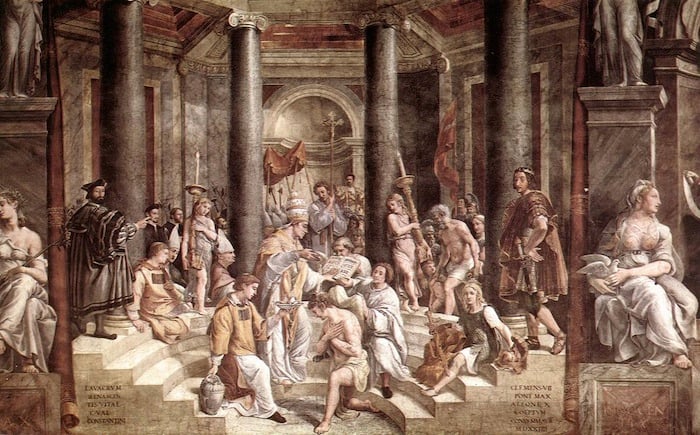 The Baptism of Constantine
In prepping for a recent interview with Robert Bellah about his upcoming visit to Notre Dame, I spent some time thinking about one of Bellah’s most significant contributions to the study of religion: a nuanced understanding of civil religion. Bellah’s argument for considering “American Civil Religion” (our public religion expressed in the religious language of politics and national rituals) a “real” religion like any other draws on a long history of theorizing about the public role of religion. Bellah follows the sociologist Émile Durkheim in seeing religious symbols and rituals as crucial elements in the development of social solidarity. Bellah’s “American Civil Religion” and the curiously successful construction of State Shintoism in Meiji Japan are perhaps the two best examples of public religions in the era of nation-states.
But the more curious aspect of civil religion that Bellah draws attention to is how certain Christian groups use the concept to position Christianity as a national religion in a way that evokes a dangerous triumphalist-exceptionalism. America, such arguments run, is God-ordained to become a Christian theocracy that would act as the “City-on-a-hill” beacon that the Puritans intended.
I don’t draw attention to this vision to argue against it. To a certain extent religion and politics cannot be divided empirically and ought not be viewed as totally distinct theoretically. But the church has too often operated under an intense naiveté about how such mergers work themselves out, particularly in nation-states. Bellah’s argument is that American Civil Religion is neither Christianity nor political life sprinkled with Christian cultural artifacts, but rather a whole separate religion – one that draws on but operates distinct from Christianity.
Political institutions, as with any institution, are covered over in cultural meanings and systems of belief that legitimate and propagate the importance of that institution. In the American context, the Church too often looks to political institutions in the vain hope that they will, at some point, champion its interests. Even in the best moments of cooperation, political institutions are always in narrative competition with sacred ones, and this is a reality that the Church should remember.
Previous Post

March 7, 2013
March Madness Fare Forward Edition
Next Post

March 11, 2013 Minimalism is Good, but Grace Isn't Cheap
Browse Our Archives
Select a Category ambition art beauty bible bios body Book Review cheap grace church community consumer church cultural liturgy culture deep practice desire dualisms economics education evangelicalism events faith family fare forward Film Review friendship games Gospel happiness hipster Christianity humility identity institutions irony issue previews Jesus just church justice Lent Letters to the Editor liberal arts liberal christianity literature liturgy love march madness mental health metaphysics misotheism moralism morality Movie Review music narrative naturalism new atheism passions philosophy place political theology Pope Francis power prayer privilege providence reading reason relationship remembering self resurrection science secular faiths secularism sexuality sin Social Media spirituality Sport suburbs suffering table of contents technology the future of faith the new apologetic the virtues theology thick doctrine transcendence Trinity truth tv Uncategorized violence Virtue vocation war work
Select a Month August 2014 July 2014 June 2014 May 2014 April 2014 March 2014 February 2014 January 2014 December 2013 November 2013 October 2013 September 2013 August 2013 July 2013 June 2013 May 2013 April 2013 March 2013 February 2013
Follow Us!
TAKE THE
Religious Wisdom Quiz
Who was the prophet who pronounced doom on Jezebel and Ahab?
Select your answer to see how you score.
Hosea Isaiah Elisha Elijah
Related posts from Fare Forward
The New Privacy: How the NSA Protects Our...

Persuading Isn't Just about Argumentation

Literature Alone Won't Save Us
TRENDING AT PATHEOS Evangelical

When you hear the word riches, what comes to mind? For most...

Don’t Miss the Parents: A Creative Christmas Meditation
As we enter the Advent Season, I see many people trying to...

Making Stones Into Bread: Choosing the “Right” Work
I was on my online arts ministry Zoom meeting with the International...

Ukraine’s exhausted Christians face fifth winter of war
By Julian Lukins The full-scale war in Ukraine is taking “a serious...

Russell Brand's Conviction is not anti-Christian Persecution
How do we shed the reputation that the Church is OK with...

Have you ever caught yourself saying, “I’ll do it tomorrow,” or “Now...
view all Evangelical blogs
Ad-Free & Subscriber Log-In Subscription Support
- About Us
- 2026 Calendar
- Videos
- Podcasts
- Library of World Religions
- Faith In Media Tracker
- Advertise With Us
- Write for Us
- Privacy Policy
- Terms of Service
- Do Not Sell My Data
- Contact Us
- Radiant Digital
- Manage Newsletter Subscriptions
- Unsubscribe From Notifications
- Sitemap
Copyright 2008-2026, Patheos, part of the Radiant Digital network of media brands. All rights reserved.
Subscription Support Ad-Free & Subscriber Log-In
Follow Patheos