
BuddhistCatholicContemplativeEvangelicalGeneral ChristianHinduJewishLatter-day SaintMuslimNew VisionsProgressive Christian
Beliefs
- Buddhist
- Catholic
- Contemplative
- Evangelical
- General Christian
- Hindu
- Jewish
- Latter-day Saint
- More Voices
- Muslim
- New Visions
- Pagan
- Progressive Christian
Topics
- Religion News
- Food and Religion
- Sports and Religion
- Religious Art
- Religious Music and Entertainment
- Religious Events
- History and Religion
- Style and Religion
- Politics and Religion
- Women in Religion
- Recreation Outdoors and Religion
- Business Finance and Religion
- Careers Workplace and Religion
- Education and Religion
- Family Parenting and Religion
- Health Fitness and Religion
- Home and Religion
- Relationships and Religion
- Technology and Religion
- Travel and Religion
Columnists
- Buddhist Columnists
- Business Finance and Religion Columnists
- Careers Workplace and Religion Columnists
- Catholic Columnists
- Contemplative Columnists
- Education and Religion Columnists
- Evangelists Columnists
- Family Parenting and Religion Columnists
- General Christian Columnists
- Health Fitness and Religion Columnists
- Hindu Columnists
- History and Religion Columnists
- Home and Religion Columnists
- Jewish Columnists
- More Voices Columnists
- Latter Day Columnists
- Muslim Columnists
- New Visions Columnists
- Nonreligious Columnists
- Pagan Columnists
- Politics and Religion Columnists
- Progressive Columnists
- Recreation Outdoors and Religion Columnists
- Relationships and Religion Columnists
- Religion News Columnists
- Religious Art Columnists
- Religious Events Columnists
- Religious Music and Entertainment Columnists
- Sports and Religion Columnists
- Style and Religion Columnists
- Technology and Religion Columnists
- Travel and Religion Columnists
- Women in Religion Columnists
Resource Library
- 2026 Calendar
- Library of World Religions
- The 100 Most Holy Places on Earth
- Patheos Answers
- Podcasts
- Videos
- Faith Leaders Database
- Anglican Episcopalian
- Bahai
- Baptist
- Buddhism
- Christianity
- Confucianism
- Eastern Orthodoxy
- Hinduism
- Holiness and Pentecostal
- ISKCON
- Islam
- Judaism
- Lutheran
- Methodist
- The Church of Jesus Christ of Latter-day Saints
- New Age
- Paganism
- Presbytarian and Reformed
- Protestantism
- Religion Behind the Scenes
- Roman Catholic
- Scientology
- Shia Islam
- Sikhism
- Sufism
- Sunni Islam
- Taoism
- Zen
- See all religions
Research Tools
 Ad-Free & Subscriber Log-In Subscription Support
Ad-Free & Subscriber Log-In Subscription Support
Follow Patheos 

- Trending:
- Forgiveness
- |
- Marriage
- |
- Consciousness
- |
- Death Penalty
- |
- Election
- |
- Halloween
 Fare Forward
- Home
- Evangelical
- The Shock of Benedict’s Resignation
The Shock of Benedict’s Resignation
Last updated on: February 15, 2013 at 2:34 pm by Justin Hawkins
The Shock of Benedict’s Resignation 2013-02-15T14:34:13-05:00 Justin Hawkins
Patheos Explore the world's faith through different perspectives on religion and spirituality! Patheos has the views of the prevalent religions and spiritualities of the world.
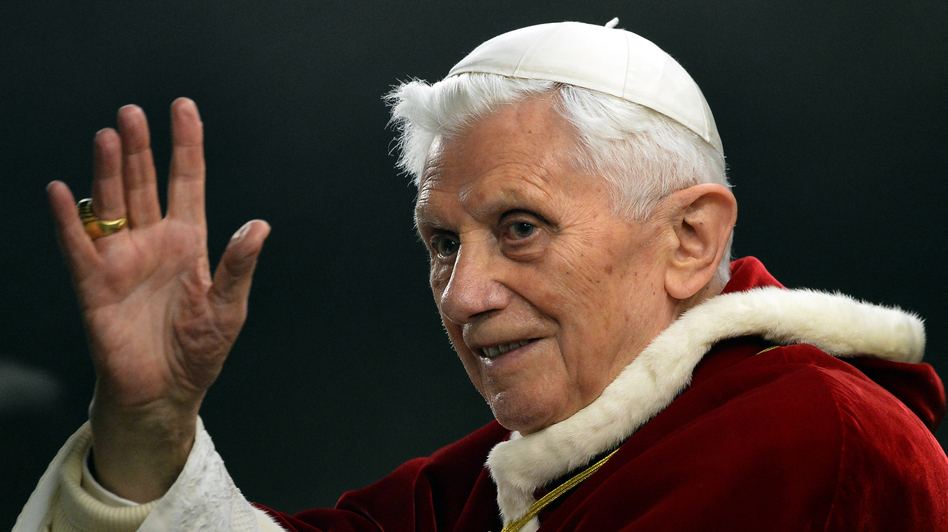
Two days ago, on Ash Wednesday the faithful all over the world conducted their business with an ashen cross on their foreheads to remind them that from dust we were made, and to dust we shall return. This is a jarring and almost grotesque practice to a culture where youth and vitality are purchased at a high price, and embargoes against discussing death are one of the only social taboos remaining. Yet only a few days prior, on February 11, the world was given an even more high-profile reminder of the limitations of our humanity. Pope Benedict XVI is well acquainted with his frailty, and it was a deep knowledge of that frailty that caused him to be the first Roman Pontiff to resign his office willingly in over 700 years.
This was aptly described as “a shock,” and rightfully so, though for different reasons than those for which we are most often shocked today. Scandal rarely shocks us anymore. Our collective memory has no dearth of celebrities, politicians, and athletes who have, through some personal foible, fallen from grace and forfeited their once enormous power and influence. These have become so numerous as to be banal. What has truly scandalized the world this week was the resignation of Pope Benedict XVI not for an illicit love affair or a lurid conflict of interest, but simply because he recognized his own frailty.
In his resignation statement, Benedict said, “[I]n order to steer the ship of Saint Peter and proclaim the Gospel, both strength of mind and body are necessary, strength which in the last few months, has deteriorated in me to the extent that I have had to recognize my incapacity to adequately fulfill the ministry entrusted to me.” That such a beloved pontiff would make such a statement shocked those inside the Vatican, but to those outside of the Christian faith, the most shocking thing that there simply was no attendant scandal. Media commentators in the early hours after the announcement speculated about possibility ulterior motivations for the resignation, and op-ed pieces ranged from the restrained to the embarrassing in their analysis and their revisiting of the unaddressed blemishes on the visage of the Church, from sex abuse scandals to financial scandals. But in the end, it was Pope Benedict’s explanation that was most insightful: from dust he was made, and to dust he will return.
This is not to downplay or minimize the significance of those scandals. They mar the testimony of the Roman Catholic Church and obstruct the proclamation of the gospel, and therefore ought to grieve the faithful within the Church even more than they do the observers outside of it. The remaining corruptions of the Vatican are deeply troubling, doubly so because of their long pedigree. The story recounted by Boccaccio in his Decameron about Abraham, the Jewish merchant, who visits Rome in curiosity of converting still rings true. His Christian friend Jehannot despairs at the lost possibility of Abraham’s conversion when Abraham “goes to the court of Rome and sees the iniquitous and foul life which the clergy lead there.” Yet Abraham returns, desirous to receive Baptism and the Eucharist, and explains his decision thus:
“To the best of my judgment, your Pastor, and by consequence all that are about him devote all their zeal and ingenuity and subtlety to devise how best and most speedily they may bring the Christian religion to naught and banish it from the world. And because I see that what they so zealously endeavor does not come to pass, but that on the contrary your religion continually grows, and shines more and more clear, therein I seem to discern a very evident token that it, rather than any other, as being more true and holy than any other, has the Holy Spirit for its foundation and support.”
Boccaccio’s hyperbole notwithstanding, the flaws of today’s Vatican provide undesired fodder to the Roman Catholic Church’s critics. In addition to furthering the New Evangelization, attempting to revitalize the Church in the West, and guiding an emergent, newly-Christian Global South, the next pontiff would do well to make clear his intentions to address and resolve these problems.
Yet Benedict’s retirement is still without scandal, an anomaly among world leaders. His retirement plans are even more shocking. Descending from one of the most powerful positions in the world, Joseph Ratzinger will not take the desk of talk show or be the face of a lucrative new advertising campaign; he will not make millions from a book or movie deal. Instead, he backs quietly out of the public and international eye in order to be “hidden to the world,” a retirement spent in solemn prayer in a Vatican convent. Such a decision, soberly and freely made, itself embodies the Christian wisdom that earthly power is not to be grasped and hoarded as a supreme good of human life. Though lamentably few Christians realize the full implications of that doctrine, it is undoubtedly a doctrine that touches the major chords of Christianity, for it comes from Christ himself “who, being in the form of God, did not count equality with God a thing to be grasped, but emptied himself and took upon himself the form of a servant” (Phil. 2:6-7). Here is the humility more shocking than any scandal; here is the essence of the Christian hope.
Previous Post

February 15, 2013
Lent: Why the Language of Self-Control Falls Short
Next Post
February 16, 2013 Do We Like Bonhoeffer For the Right Reasons?
Browse Our Archives
Select a Category ambition art beauty bible bios body Book Review cheap grace church community consumer church cultural liturgy culture deep practice desire dualisms economics education evangelicalism events faith family fare forward Film Review friendship games Gospel happiness hipster Christianity humility identity institutions irony issue previews Jesus just church justice Lent Letters to the Editor liberal arts liberal christianity literature liturgy love march madness mental health metaphysics misotheism moralism morality Movie Review music narrative naturalism new atheism passions philosophy place political theology Pope Francis power prayer privilege providence reading reason relationship remembering self resurrection science secular faiths secularism sexuality sin Social Media spirituality Sport suburbs suffering table of contents technology the future of faith the new apologetic the virtues theology thick doctrine transcendence Trinity truth tv Uncategorized violence Virtue vocation war work
Select a Month August 2014 July 2014 June 2014 May 2014 April 2014 March 2014 February 2014 January 2014 December 2013 November 2013 October 2013 September 2013 August 2013 July 2013 June 2013 May 2013 April 2013 March 2013 February 2013
Follow Us!
TAKE THE
Religious Wisdom Quiz
According to Romans, what is the gift of God?
Select your answer to see how you score.
The Holy Spirit Eternal life in Christ Jesus Salvation Grace
Related posts from Fare Forward


Privilege, Repentance, Forgiveness

The Summer Pop Culture Found Religion
Father Brown and the Reality of Sin
TRENDING AT PATHEOS Evangelical

The REST of Your Life: A Creative Wrestles...
This week I had a conversation with a good friend from church....

How the author of the world's best hymn...
I've been working with John Newton for a while now. This makes...

Long before this Lectio Divina, Psalm 130 - the song - started...

What About the Trees? Another Living Parable
After I finished writing the last article about falling leaves as a...

Why Classical Education Is a Conversation, Not a...
Come and Read: Joy in Classical Education When I was a little...

Cornell University has received a great deal of negative publicity and intense...
view all Evangelical blogs
Ad-Free & Subscriber Log-In Subscription Support
- About Us
- 2026 Calendar
- Videos
- Podcasts
- Library of World Religions
- Faith In Media Tracker
- Advertise With Us
- Write for Us
- Privacy Policy
- Terms of Service
- Do Not Sell My Data
- Contact Us
- Radiant Digital
- Manage Newsletter Subscriptions
- Unsubscribe From Notifications
- Sitemap
Copyright 2008-2026, Patheos. All rights reserved.
Subscription Support Ad-Free & Subscriber Log-In
Follow Patheos