
BuddhistCatholicContemplativeEvangelicalGeneral ChristianHinduJewishLatter-day SaintMuslimNew VisionsProgressive Christian
Beliefs
- Buddhist
- Catholic
- Contemplative
- Evangelical
- General Christian
- Hindu
- Jewish
- Latter-day Saint
- More Voices
- Muslim
- New Visions
- Pagan
- Progressive Christian
Topics
- Religion News
- Food and Religion
- Sports and Religion
- Religious Art
- Religious Music and Entertainment
- Religious Events
- History and Religion
- Style and Religion
- Politics and Religion
- Women in Religion
- Recreation Outdoors and Religion
- Business Finance and Religion
- Careers Workplace and Religion
- Education and Religion
- Family Parenting and Religion
- Health Fitness and Religion
- Home and Religion
- Relationships and Religion
- Technology and Religion
- Travel and Religion
Columnists
- Buddhist Columnists
- Business Finance and Religion Columnists
- Careers Workplace and Religion Columnists
- Catholic Columnists
- Contemplative Columnists
- Education and Religion Columnists
- Evangelists Columnists
- Family Parenting and Religion Columnists
- General Christian Columnists
- Health Fitness and Religion Columnists
- Hindu Columnists
- History and Religion Columnists
- Home and Religion Columnists
- Jewish Columnists
- More Voices Columnists
- Latter Day Columnists
- Muslim Columnists
- New Visions Columnists
- Nonreligious Columnists
- Pagan Columnists
- Politics and Religion Columnists
- Progressive Columnists
- Recreation Outdoors and Religion Columnists
- Relationships and Religion Columnists
- Religion News Columnists
- Religious Art Columnists
- Religious Events Columnists
- Religious Music and Entertainment Columnists
- Sports and Religion Columnists
- Style and Religion Columnists
- Technology and Religion Columnists
- Travel and Religion Columnists
- Women in Religion Columnists
Resource Library
- 2026 Calendar
- Library of World Religions
- The 100 Most Holy Places on Earth
- Patheos Answers
- Podcasts
- Videos
- Faith Leaders Database
- Anglican Episcopalian
- Bahai
- Baptist
- Buddhism
- Christianity
- Confucianism
- Eastern Orthodoxy
- Hinduism
- Holiness and Pentecostal
- ISKCON
- Islam
- Judaism
- Lutheran
- Methodist
- The Church of Jesus Christ of Latter-day Saints
- New Age
- Paganism
- Presbytarian and Reformed
- Protestantism
- Religion Behind the Scenes
- Roman Catholic
- Scientology
- Shia Islam
- Sikhism
- Sufism
- Sunni Islam
- Taoism
- Zen
- See all religions
Research Tools
 Ad-Free & Subscriber Log-In Subscription Support
Ad-Free & Subscriber Log-In Subscription Support
Follow Patheos 

- Trending:
- Forgiveness
- |
- Marriage
- |
- Consciousness
- |
- Death Penalty
- |
- Election
- |
- Halloween
 FaithWalkers
- Home
- Evangelical
- Pistol Packin’ Jesus: A Response to Shane Claiborne
Pistol Packin’ Jesus: A Response to Shane Claiborne
Last updated on: December 15, 2015 at 8:06 am by Bill Blankschaen
Pistol Packin’ Jesus: A Response to Shane Claiborne 2015-12-15T08:06:40-07:00 Bill Blankschaen
Patheos Explore the world's faith through different perspectives on religion and spirituality! Patheos has the views of the prevalent religions and spiritualities of the world.
Jesus’ message was the Kingdom of God (Mt. 4:17, 23; Lk. 8:1). The Kingdom of God is the rule of God in the earth. [1]
Near the heart of that kingdom-rule lies justice (=righteousness, [Mt. 6:33; Heb. 1:8]). That justice includes (as I intend briefly to show) the defense, including lethal defense, if necessary, of judicially innocent life. [2]
Therefore, Jesus, by implication, would have supported — and does support — carrying firearms to defend that life.
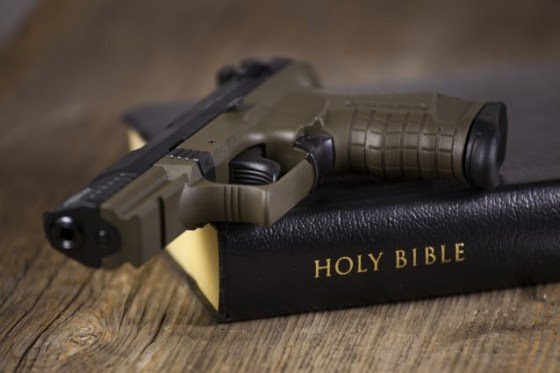
The fact that this line of reasoning should pose controversy shows how far justice and the Kingdom of God have been relegated to the periphery in the thinking of today’s world, including among many Christians.
Concealed-carry Jerry
For instance: Jerry Falwell Jr., president of Liberty University, the largest Christian university in the country, raised eyebrows and ire when he told the students in chapel, “If more good people had concealed carry permits, then we could end those [San Bernardino terrorist] Muslims before they walked in.”
This thoroughly Christian assertion unsurprisingly elicited a firestorm from the usual suspects over on the Left. But even some evangelicals got into the act, like student leaders at the mildly conservative Wheaton College.
One of the more widely distributed Christian objections emerged from Shane Claiborne in Jonathan Merritt’s column at the prominent Religion News Service. Merritt has been known as a “celibate gay evangelical,” and his writing tips distinctly Leftward.
The latter is equally true of Claiborne.
Shane, please read your Bible — all of it
Claiborne tries to make the case, not so much that Falwell was socio-politically mistaken, but that Jesus himself would oppose violence in defending life: violence is never appropriate for a Christian.
In other words, Claiborne is a pacifist, and he enlists Jesus Christ in his pacifist crusade. He writes:
As I listened to the words of Mr. Falwell, I could not help asking, “Are we worshipping the same Jesus?”
The Jesus I worship did not carry a gun. He carried a cross. Jesus did not tell us to kill our enemies. He told us to love them.
No one would confuse Claiborne’s views with the product of theological reflection. Jesus indeed carried a cross and not a gun, but there were no guns in the first century, and Jesus’ requirement to love our enemies has no essential bearing on the question of self-defense.
It is possible that Jesus would have carried both a cross and a gun (had there been guns), and that possibility cannot be eliminated merely by a pious aphorism.
In fact, Claiborne’ highly selective use of the Gospels refutes his bald assertion. He somehow missed this commission Jesus gave to his disciples:
He said to them, “But now let the one who has a moneybag take it, and likewise a knapsack. And let the one who has no sword sell his cloak and buy one.” (Lk. 22:36)
That sword Jesus required his disciples to carry wasn’t for carving pork. It was for self-defense.
Claiborne elaborates:
Jesus blessed peacemakers and the merciful. He encouraged responding to evil, not with more evil, but with love. And he modeled that enemy-love on the cross as he prayed, “Father, forgive them,” crying out in mercy even for the terrorists who nailed him to the cross. I see in Jesus a God of scandalous grace, who loves evil-doers so much he dies for them — and for us….
In fact, it is Jesus who scolds his own disciple, Peter, for standing his ground when the soldiers come to arrest Jesus. Peter defensively picked up a sword to protect Jesus, cutting off the ear of one of the persecutors. As he stood up for Jesus, he had the ultimate case for self-defense. And how does Jesus respond? He scolds Peter, telling him to but his sword away. Then he heals the wounded persecutor and reattaches his ear… only to be arrested and led to his execution.
Claiborne’s errors abound.
He seems not to have considered our Lord’s redemptive work as a unique historical situation that necessitated unique responses. Jesus Christ knew his calling was to die, and he would not be deterred from that agonizing death (Lk. 9:51), even by well-intentioned friends like Peter.
Our Lord was not laying down a pacifist ethic; he was assuring that there would be no impediments to his sacrificial death for humanity.
This is why, while Jesus did command Peter to sheath his sword when the Romans came to arrest him, Peter was in fact carrying a sword.
Jesus obviously wasn’t prohibiting lethal self-defense, only that action in this unique redemptive situation: “Keep your sword, Peter, just don’t use it right now.” Jesus was in his temporary state of humiliation for the specific purpose of dying for the world’s sin.
He is no longer in that state.
Past humiliation and present glory
The Son of God has existed in three modes: his pre-incarnate mode of glory with the Father (Jn. 17:20–24), his incarnate mode of humiliation on earth (Phil. 2:4–8), and his present resurrection mode of glory in his reign (Jn. 7:39; Phil. 2:9–11).
It is in this last, glorified mode that we read of him:
Then I saw heaven opened, and behold, a white horse! The one sitting on it is called Faithful and True, and in righteousness he judges and makes war. His eyes are like a flame of fire, and on his head are many diadems, and he has a name written that no one knows but himself. He is clothed in a robe dipped in blood, and the name by which he is called is The Word of God. And the armies of heaven, arrayed in fine linen, white and pure, were following him on white horses. From his mouth comes a sharp sword with which to strike down the nations, and he will rule them with a rod of iron. He will tread the winepress of the fury of the wrath of God the Almighty. On his robe and on his thigh he has a name written, King of kings and Lord of lords. (Rev. 19:11-16)
Interestingly, Claiborne did not mention this righteously wrathful mode of our Lord’s existence, even though it is the one he presently (and will henceforth) occupy. To draw attention to this present life of our Lord would seriously impair, if not completely destroy, Claiborne’s pacifism. [3]
Jesus and life-depriving justice
Claiborne is entirely correct that Jesus Christ relishes peacemaking, love, mercy, and forgiveness. These are intrinsic to the Kingdom of God.
In fact, they are precisely what necessitate using guns for self-defense, even lethal self-defense, if necessary.
Why? Jesus’ ethics are grounded in the Scriptures. This meant — and means — the Old Testament:
“Do not think that I have come to abolish the Law or the Prophets; I have not come to abolish them but to fulfill them. For truly, I say to you, until heaven and earth pass away, not an iota, not a dot, will pass from the Law until all is accomplished. Therefore whoever relaxes one of the least of these commandments and teaches others to do the same will be called least in the kingdom of heaven, but whoever does them and teaches them will be called great in the kingdom of heaven. For I tell you, unless your righteousness exceeds that of the scribes and Pharisees, you will never enter the kingdom of heaven. (Mt. 5:17-20)
And the Old Testament justifies committing violence in self-defense. In fact, in Exodus 22:2–3, violence in defense of property is justified. If this is the case, then violence in defense of judicially innocent persons, who are of much greater value to God than property, is certainly warranted.
This is why we later read these sober requirements:
“… Rescue the weak and the needy; deliver them from the hand of the wicked.” (Ps. 82:4)
If you faint in the day of adversity, your strength is small. Rescue those who are being taken away to death; hold back those who are stumbling to the slaughter. If you say, “Behold, we did not know this,” does not he who weighs the heart perceive it? Does not he who keeps watch over your soul know it, and will he not repay man according to his work? (Prov. 24:10-12)
Jesus affirms the commands of the Old Testament, which requires us when it is in our power to rescue those who are in mortal danger. If we disobey God by not using lethal self-defense to protect judicially innocent life, we are not acting in love and forgiveness, but perpetrating injustice and evil.
In short: if Claiborne had access to a handgun while his mother or wife or sister was being hacked by saws or gang-raped, would he get on his knees in their presence and pray for the perpetrators, or would he use the gun to stop and possibly kill them?
If he would not, he would be committing a nearly unforgivable evil, and God would require of him the blood of the innocent.
Christian love requires protecting innocent life
Love means defending, with lethal force if necessary, those unjustly drawn to death.
Lovelessness means not defending them with lethal force. In that scenario, not to kill is not to love.
Jesus does not permit personal vengeance, which he reserves to himself and to the civil government (Rom. 12:19; 13:1–5). But protection, including lethal protection, of judicially innocent life in imminent danger is not vengeance.
Pistol Packin’ Jesus
Therefore, if Jesus were on earth today in the United States, we have no reason to believe he would not support the Second Amendment (framed, let us remember, by Christians or those shaped by Christian truth), and he would be quite happy for his disciples to carry firearms — and require them to use those firearms, if necessary, to defend judicially innocent life.
Jesus Christ demands of us life-protecting justice.
Today’s post is a guest post from my friend P. Andrew Sandlin, President of The Center for Cultural Leadership and author of numerous book related to Christian cultural issues.
[1] George E. Ladd, Crucial Questions About the Kingdom of God (Grand Rapids: Eerdmans, 1952), 77–81.
[2] By “judicially innocent life” I distinguish those who do not deserve to die at the hands of man from those, like murderers or violent attackers in the act, who do deserve to die.
[3] Nor were the Romans who crucified Jesus “terrorists.” They were duly constituted civil authorities whose evil consisted precisely in the monstrously unjust perversion of their divinely stamped office.
Previous Post

November 26, 2015
Rubio Is Right: Obey God, Not the Supreme Court
Next Post

December 17, 2015 3 Ways to Help Syrian Refugees Right Now
Browse Our Archives
Select a Category Book Reviews Christian Living Church Culture FaithWalkers Family Guest Posts In Your Church Interviews Leadership Movie Reviews Politics Spotlight Uncategorized
Select a Month November 2017 August 2017 July 2017 May 2017 March 2017 January 2017 July 2016 June 2016 May 2016 April 2016 March 2016 February 2016 January 2016 December 2015 November 2015 October 2015 September 2015 May 2015 April 2015 February 2015 January 2015 November 2014 August 2014 April 2014 March 2014 February 2014 January 2014 December 2013 November 2013 October 2013 September 2013 August 2013 July 2013 June 2013 May 2013 April 2013 March 2013 February 2013 January 2013 December 2012 November 2012 October 2012 September 2012 August 2012 July 2012 June 2012
Follow Us!
TAKE THE
Religious Wisdom Quiz
What principle does "love covers a multitude of sins" teach?
Select your answer to see how you score.
Jealousy wins Pride is good Forgiveness and mercy Revenge is best
Related posts from FaithWalkers

Is Everyone Clear About Why Your Business Exists?

Evangelicals Respond to Rob Bell Attack on Bible...

Not a Day Care: Why the College Snowflake...

Is Shame the New Silent Killer in America?
TRENDING AT PATHEOS Evangelical

How the author of the world's best hymn...
I've been working with John Newton for a while now. This makes...

Long before this Lectio Divina, Psalm 130 - the song - started...

What About the Trees? Another Living Parable
After I finished writing the last article about falling leaves as a...

Why Classical Education Is a Conversation, Not a...
Come and Read: Joy in Classical Education When I was a little...

Falling Leaves: A Living Parable on Letting Go
I’ve spent the vast majority of my life in the southeast corner...

Cornell University has received a great deal of negative publicity and intense...
view all Evangelical blogs
Ad-Free & Subscriber Log-In Subscription Support
- About Us
- 2026 Calendar
- Videos
- Podcasts
- Library of World Religions
- Faith In Media Tracker
- Advertise With Us
- Write for Us
- Privacy Policy
- Terms of Service
- Do Not Sell My Data
- Contact Us
- Radiant Digital
- Manage Newsletter Subscriptions
- Unsubscribe From Notifications
- Sitemap
Copyright 2008-2026, Patheos. All rights reserved.
Subscription Support Ad-Free & Subscriber Log-In
Follow Patheos