
BuddhistCatholicContemplativeEvangelicalGeneral ChristianHinduJewishLatter-day SaintMuslimNew VisionsProgressive Christian
Beliefs
- Buddhist
- Catholic
- Contemplative
- Evangelical
- General Christian
- Hindu
- Jewish
- Latter-day Saint
- More Voices
- Muslim
- New Visions
- Pagan
- Progressive Christian
Topics
- Religion News
- Food and Religion
- Sports and Religion
- Religious Art
- Religious Music and Entertainment
- Religious Events
- History and Religion
- Style and Religion
- Politics and Religion
- Women in Religion
- Recreation Outdoors and Religion
- Business Finance and Religion
- Careers Workplace and Religion
- Education and Religion
- Family Parenting and Religion
- Health Fitness and Religion
- Home and Religion
- Relationships and Religion
- Technology and Religion
- Travel and Religion
Columnists
- Buddhist Columnists
- Business Finance and Religion Columnists
- Careers Workplace and Religion Columnists
- Catholic Columnists
- Contemplative Columnists
- Education and Religion Columnists
- Evangelists Columnists
- Family Parenting and Religion Columnists
- General Christian Columnists
- Health Fitness and Religion Columnists
- Hindu Columnists
- History and Religion Columnists
- Home and Religion Columnists
- Jewish Columnists
- More Voices Columnists
- Latter Day Columnists
- Muslim Columnists
- New Visions Columnists
- Nonreligious Columnists
- Pagan Columnists
- Politics and Religion Columnists
- Progressive Columnists
- Recreation Outdoors and Religion Columnists
- Relationships and Religion Columnists
- Religion News Columnists
- Religious Art Columnists
- Religious Events Columnists
- Religious Music and Entertainment Columnists
- Sports and Religion Columnists
- Style and Religion Columnists
- Technology and Religion Columnists
- Travel and Religion Columnists
- Women in Religion Columnists
Resource Library
- 2026 Calendar
- Library of World Religions
- The 100 Most Holy Places on Earth
- Patheos Answers
- Podcasts
- Videos
- Faith Leaders Database
- Anglican Episcopalian
- Bahai
- Baptist
- Buddhism
- Christianity
- Confucianism
- Eastern Orthodoxy
- Hinduism
- Holiness and Pentecostal
- ISKCON
- Islam
- Judaism
- Lutheran
- Methodist
- The Church of Jesus Christ of Latter-day Saints
- New Age
- Paganism
- Presbytarian and Reformed
- Protestantism
- Religion Behind the Scenes
- Roman Catholic
- Scientology
- Shia Islam
- Sikhism
- Sufism
- Sunni Islam
- Taoism
- Zen
- See all religions
Research Tools
 Ad-Free & Subscriber Log-In Subscription Support
Ad-Free & Subscriber Log-In Subscription Support
Follow Patheos 

- Trending:
- Forgiveness
- |
- Marriage
- |
- Consciousness
- |
- Death Penalty
- |
- Election
- |
- Halloween
 FaithWalkers
- Home
- Evangelical
- Where Have All the Children Gone in Your Church?
Where Have All the Children Gone in Your Church?
Last updated on: March 31, 2014 at 5:11 am by Bill Blankschaen
Where Have All the Children Gone in Your Church? 2014-03-31T05:11:19-06:00 Bill Blankschaen
Patheos Explore the world's faith through different perspectives on religion and spirituality! Patheos has the views of the prevalent religions and spiritualities of the world.
“But where have all the children gone?” The classic film Chitty Chitty Bang Bang portrays the rather bizarre kingdom of Vulgaria in which children have been outlawed, banished to hide underground, separated from the world of the adults. The zany plot describes how sweet treats get offered to entice stray children into captivity.
It’s weird. It’s a bit disturbing.
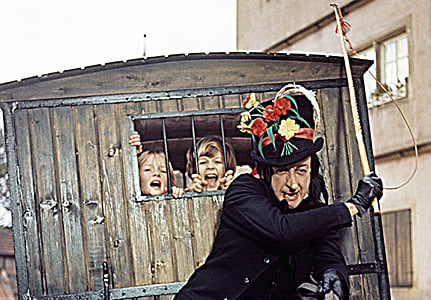
It also describes the worship services of many evangelical churches.
Of course, I add the usual caveat, not all of your churches do this. But a lot of them do.
What does it look like?
No, they don’t chase children into underground grottoes with nasty nets, but they are banished just the same. Here are a few ways it happens in evangelical churches:
- Children’s church. This approach splits off kids from parents so each can have “age appropriate” worship experiences. Often the sessions are segregated even further into elementary, middle school, and high school services. The entire approach reminds me of our popular assembly-line approach to modern education that isn’t working out so well for us anymore anyways. It’s not uncommon for sweet treats to be added to entice more kids into these services. No nets. Yet. That’s good.
- Protective policies. One mega-church I attended briefly actually included a blurb in the bulletin suggesting that we place our younger children in child care when attending the worship service. They recorded the sermons for use in a radio broadcast and didn’t want a crying child to disturb the audio quality. I think this approach well-meaning. The sermons at that church? Excellent. The radio program? High impact! But something about excluding young children from worship leaves me wondering if the end truly justified the means.
- Polite suggestions. With six children, we have often had kind parishioners — meaning no offense, mind you — notify us that separate services are available for our children. I think they assumed we obviously didn’t know about that option because our children were still with us. I love the kind gesture. It’s the subtle reasoning behind the polite suggestion that concerns me — as if everyone would be better off if children weren’t with parents in the worship service.
I suspect the reason we — as the evangelical church — do this is to keep our kids from becoming bored during the service. We think that if they are bored, they won’t want to come to church. At least if they’re coming for the candy, they want to come. My friend John Saddington (you really should follow his blog) notes here that “bored” simply means “not fun.” So true. Rather than questioning our own assumptions, we try to convince kids that church is, in fact, always a fun and exciting place to be.
Even if it’s not. We remake it to better suit their fun-palette at the moment.
This urge to attract kids to church by pushing their fun-button is not new, of course. I recall similar efforts growing up in fundamentalist Protestant circles — bubble-gum-blowing contests, the world’s largest chocolate bar giveaway, and dunking the pastor in a water tank to name a few. Few of those kids who came then even claim to be Christ-followers now. Even fewer go to church.
Jesus calls us — all of us, of all ages — to worship God in spirit and in truth, not in trendy panda or pirate curriculum with themed snacks and the world’s largest chocolate bars — as good as that might sound to some of us Ghirardelli lovers.
3 Forgotten Things
I suggest that when we segregate worship based on age, we forget three key things:
- A Promise. When Peter first preached the gospel at Pentecost, he argued that “the promise is for you and for your children….” (Acts 2:38-39 ESV) We can all disagree about the implications of that statement on the precise place of children in the visible body of Christ, but we can’t deny the tightly woven connection between preaching, parents, and their children in God’s eyes. The very first gospel appeal given after Christ’s ascension at the start of the Church culminated in a call to action for parents AND their children.
- A Warning. “Let the little children come to me and do not hinder them, for to such belongs the kingdom of heaven.” (Matthew 19:13-15 ESV) Jesus said that wherever two or three are gathered together in His name, he would be present in a special way. (Matthew 18:20) If worship service is the place we gather expecting to experience the presence of our Lord, don’t we come dangerously close to imitating the short-sighted disciples when we discourage children from coming to experience His presence?
- A Process. Scripture tells us that our children will be moved to question us as part of their learning process. When they see the things we do in worshipping God, they will ask us about it. And they will learn. “When your children say to you, ‘What do you mean by this service?’ you shall say….” (Exodus 12″21-28 ESV) If they’re not present to experience the Lord’s Supper, for example, the New Testament passover, how will they ever be moved to ask about it? How will they learn? How will they know? (You’re right. Better move on. That sounded dangerously like an ’80s Madonna song.) The church we presently attend does a fine job of encouraging this learning process, by the way, offering helpful sermon guides just for the kids. We appreciate it.
We may not like it, but our children are the future. There’s no way around it. Assuming Christ does not return, we will die. All of us.
What then? Will our children even know what church is as they reemerge from their segregated grotto? Or will they simply do what we’ve modeled for them and banish their own children back underground enticed by sweet treats.
If, that is, they’re still going to church at all.
Have you seen this age segregation in evangelical churches or even within other faith traditions? Do you agree or disagree with my concerns? Thanks for leaving a comment here so we can all grow.
Previous Post

July 19, 2012
Feeling Frustrated? Maybe You Should Quit Trying
Next Post
July 24, 2012 Colorado Evil: A Father's Reluctant Response to Gun Control
Browse Our Archives
Select a Category Book Reviews Christian Living Church Culture FaithWalkers Family Guest Posts In Your Church Interviews Leadership Movie Reviews Politics Spotlight Uncategorized
Select a Month November 2017 August 2017 July 2017 May 2017 March 2017 January 2017 July 2016 June 2016 May 2016 April 2016 March 2016 February 2016 January 2016 December 2015 November 2015 October 2015 September 2015 May 2015 April 2015 February 2015 January 2015 November 2014 August 2014 April 2014 March 2014 February 2014 January 2014 December 2013 November 2013 October 2013 September 2013 August 2013 July 2013 June 2013 May 2013 April 2013 March 2013 February 2013 January 2013 December 2012 November 2012 October 2012 September 2012 August 2012 July 2012 June 2012
Follow Us!
TAKE THE
Religious Wisdom Quiz
What is the Christian view about material possessions?
Select your answer to see how you score.
Riches guarantee happiness They are the most important thing Seek them after righteousness They are temporary
Related posts from FaithWalkers

Evangelicals Respond to Rob Bell Attack on Bible...

Teach from Love: Sam Sorbo Delivers Superb School...

One Proven Way to Control Technology Overload

Preschooler Made to Care about LGBT Agenda in...
TRENDING AT PATHEOS Evangelical

The REST of Your Life: A Creative Wrestles...
This week I had a conversation with a good friend from church....

How the author of the world's best hymn...
I've been working with John Newton for a while now. This makes...

Long before this Lectio Divina, Psalm 130 - the song - started...

What About the Trees? Another Living Parable
After I finished writing the last article about falling leaves as a...

Why Classical Education Is a Conversation, Not a...
Come and Read: Joy in Classical Education When I was a little...

Cornell University has received a great deal of negative publicity and intense...
view all Evangelical blogs
Ad-Free & Subscriber Log-In Subscription Support
- About Us
- 2026 Calendar
- Videos
- Podcasts
- Library of World Religions
- Faith In Media Tracker
- Advertise With Us
- Write for Us
- Privacy Policy
- Terms of Service
- Do Not Sell My Data
- Contact Us
- Radiant Digital
- Manage Newsletter Subscriptions
- Unsubscribe From Notifications
- Sitemap
Copyright 2008-2026, Patheos. All rights reserved.
Subscription Support Ad-Free & Subscriber Log-In
Follow Patheos