
BuddhistCatholicContemplativeEvangelicalGeneral ChristianHinduJewishLatter-day SaintMuslimNew VisionsProgressive Christian
Beliefs
- Buddhist
- Catholic
- Contemplative
- Evangelical
- General Christian
- Hindu
- Jewish
- Latter-day Saint
- More Voices
- Muslim
- New Visions
- Pagan
- Progressive Christian
Topics
- Religion News
- Food and Religion
- Sports and Religion
- Religious Art
- Religious Music and Entertainment
- Religious Events
- History and Religion
- Style and Religion
- Politics and Religion
- Women in Religion
- Recreation Outdoors and Religion
- Business Finance and Religion
- Careers Workplace and Religion
- Education and Religion
- Family Parenting and Religion
- Health Fitness and Religion
- Home and Religion
- Relationships and Religion
- Technology and Religion
- Travel and Religion
Columnists
- Buddhist Columnists
- Business Finance and Religion Columnists
- Careers Workplace and Religion Columnists
- Catholic Columnists
- Contemplative Columnists
- Education and Religion Columnists
- Evangelists Columnists
- Family Parenting and Religion Columnists
- General Christian Columnists
- Health Fitness and Religion Columnists
- Hindu Columnists
- History and Religion Columnists
- Home and Religion Columnists
- Jewish Columnists
- More Voices Columnists
- Latter Day Columnists
- Muslim Columnists
- New Visions Columnists
- Nonreligious Columnists
- Pagan Columnists
- Politics and Religion Columnists
- Progressive Columnists
- Recreation Outdoors and Religion Columnists
- Relationships and Religion Columnists
- Religion News Columnists
- Religious Art Columnists
- Religious Events Columnists
- Religious Music and Entertainment Columnists
- Sports and Religion Columnists
- Style and Religion Columnists
- Technology and Religion Columnists
- Travel and Religion Columnists
- Women in Religion Columnists
Resource Library
- 2026 Calendar
- Library of World Religions
- The 100 Most Holy Places on Earth
- Patheos Answers
- Podcasts
- Videos
- Faith Leaders Database
- Anglican Episcopalian
- Bahai
- Baptist
- Buddhism
- Christianity
- Confucianism
- Eastern Orthodoxy
- Hinduism
- Holiness and Pentecostal
- ISKCON
- Islam
- Judaism
- Lutheran
- Methodist
- The Church of Jesus Christ of Latter-day Saints
- New Age
- Paganism
- Presbytarian and Reformed
- Protestantism
- Religion Behind the Scenes
- Roman Catholic
- Scientology
- Shia Islam
- Sikhism
- Sufism
- Sunni Islam
- Taoism
- Zen
- See all religions
Research Tools
 Ad-Free & Subscriber Log-In Subscription Support
Ad-Free & Subscriber Log-In Subscription Support
Follow Patheos 

- Trending:
- Forgiveness
- |
- Marriage
- |
- Consciousness
- |
- Death Penalty
- |
- Election
- |
- Halloween

- Home
- Progressive Christian
- Politics and Religion
- Are We Complicit in Others’ Suffering?
Are We Complicit in Others’ Suffering?
Last updated on: June 4, 2026 at 10:12 am by Melanie Springer Mock
Are We Complicit in Others’ Suffering? 2026-06-01T14:36:53-07:00 Melanie Springer Mock
Patheos Explore the world's faith through different perspectives on religion and spirituality! Patheos has the views of the prevalent religions and spiritualities of the world.
Your war is causing us to suffer, too.
We were sitting with our tour guide, eating chicken tagine in a restaurant somewhere in the Atlas Mountains on day five of our Morocco journey. We’d already spent two weeks in Spain and Portugal: twenty college students, one faculty co-leader, and me, and now a tour guide from Marrakech had joined the group to teach us about his beautiful country.
When conversation turned to the United States’ war with Iran and our country’s corrupt leadership, the tour guide explained that gas prices, global instability, and the threat of violence was causing people to suffer in Morocco as well.
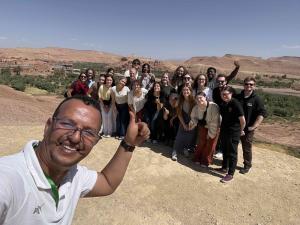
Our Moroccan guide and tour group outside of Ouarzazate, Morocco. Photo by the author.
Your War, he said, is causing us to suffer.
I cringed, and immediately tried to insist that the United States’ war with Iran was not my fault. I hadn’t voted for President Donald Trump, and hated the destruction he’s wrought around the world, I told the tour guide. The president’s impetuous decision to bomb Iran in late February was never one I would have made, and I’m so grieved that President Trump has caused so much suffering: in Iran, in Lebanon, in Palestine, in places where people are dying because USAID was defunded.
In the United States, too, our president has caused suffering. I didn’t say that, of course, though it’s true. Immigrants are living in fear, being arrested because of their skin color, facing cruel treatment in detention centers like Delany Hall and Dilley. Women are losing reproductive rights, bleeding out in hospital parking lots and emergency rooms for want of appropriate medical treatment. Our president is going after his enemies, trying to silence dissent, moving to sell off our public lands.
Your war is causing us to suffer. Your war. Your president. Your country.
President Trump and his sycophants like to insist that America has regained its former greatness—that we are now leaders on the world stage again, after the incompetence of Presidents Obama and Biden. “We’re respected by everybody, and that’s the way we’re going to keep it,” he said in early April, “We are the most respected country anywhere in the world.”
Trump repeats these lines ad nauseum, in press conferences, at rallies, on his Truth Social posts. There’s even a page on the White House website, titled “America is RESPECTED again, all over the world.” This, of course, is a lie, like so many other claims from the Trump administration.
According to polls over the last few months, the United States has lost its standing on the world stage. Pew Research reports that “Majorities in most countries also express little or no confidence in Trump’s ability to handle specific issues, including immigration, the Russia-Ukraine war, U.S.-China relations, global economic problems, conflicts between Israel and its neighbors, and climate change. When asked about Trump’s personal characteristics, most describe him as arrogant and dangerous, while relatively few see him as honest.”
In February, Pew reported that although support for President Trump is softening among white evangelicals, it remains strong; in late January, almost 70 percent of white evangelicals continued to support President Trump’s efforts. Last month’s “Rededicate 250” celebration on the National Mall reflected evangelicals’ insistence that President Trump is the “most Christian” leader in our nation’s history. President Trump did not attend the event, though a video of him reading scripture during the celebration was put forth as evidence that he values “One Nation Under God.”
You are causing me to suffer.
This is what I heard in the tour guide’s words. Not with mal intent or anger, but because this is the reality: The country where I was born afforded me a comfortable life, but has caused suffering to countless others. And millions and millions of my fellow Christians seem to be okay with that, certain that what matters most to God is a collection of white Christians singing praise songs on the National Mall. Offering up prayers of Thanksgiving for President Trump whose godliness is so great that, according to Eric Metaxas, “It’s hard to believe that it would take two centuries for the Lord to raise up a great man to bring that ballroom finally to stand where it needs to stand.”
God cares more about a ballroom than the lives of 160 school children in Iran. Or the lives of almost 25,000 children in Gaza. Or the lives of 2.5 million children who are anticipated to die before 2030 because of USAID’s dismantling.
In Morocco, we spent long days riding a bus through the countryside, and I listened to Jemar Tisby’s excellent book, The Color of Compromise: The Truth about the American Church’s Complicity in Racism. He writes compellingly about the ways American Christians have allowed racism to bloom, from our 400-year heritage of slavery, to Jim Crow, to the current age, when white supremacy is so endemic to our churches that a faith rally on the national mall deems a corrupt president “godly.”
Tisby says that “The refusal to act in the midst of injustice is itself an act of injustice. Indifference to oppression perpetuates oppression.” In other words, in my inaction,
I am causing others to suffer.
It’s easy to feel overwhelmed and paralyzed by this reality. It’s easy to feel dispirited because so many Christ-followers are unable to see how their support for this administration is anathema to the Gospels, to Jesus’ insistence that we love God by loving others, which means to help people not to suffer.
As a Christian, though, I continue to live in hope, exemplified by the meal shared with Idir, our tour guide, by the week we spent in Morocco, and the two weeks we spent in Spain and Portugal. I wrote last May about how international travel can help shift our perspectives, can help deepen our faith, can allow us human connection with others who are completely different than us, yet reflect God’s image brilliantly to us.
During this year’s travel with students, I felt profoundly how important those human connections can be. How they can help us see our shared humanity, despite cultural differences. How sharing a meal, especially with people who have so much less than we do, can challenge us to open-hearted hospitality. How our actions have repercussions, even with people we will never know, thousands and thousands of miles away.
Christians who see Christ’s work in a ballroom, but not in the face of a Muslim child, desperate for her next meal; or an immigrant parent, longing for her child’s safety; or a Palestinian seeking shelter amidst rubble, need to recognize that they are causing others to suffer.
Christ have mercy on us all. May we find ways every day to move beyond our indifference, so we will not be complicit in other people’s suffering.
General Christian
Travel and Religion
Previous Post

May 12, 2026
When Christian Nationalists Took Over Our School Board
Next Post

July 1, 2026 Bible-Infused School Standards are not Christ-Like
Recent Comments
Browse Our Archives
Select a Category Uncategorized
Select a Month October 2026 September 2026 July 2026 June 2026 May 2026 April 2026 March 2026 February 2026 January 2026 December 2025 November 2025 October 2025 September 2025 August 2025 July 2025 June 2025 May 2025 April 2025 March 2025 February 2025 January 2025 December 2024 November 2024 October 2024 September 2024 August 2024 July 2024
Follow Us!
TAKE THE
Religious Wisdom Quiz
What did Israel ask Samuel for despite his warnings?
Select your answer to see how you score.
A new Tabernacle A king A prophet A palace
Related posts from Faith in the Town Square

When the Disinformation Machine Comes to Your Hometown

Christian Nationalism Finds the Campus Quad

Protecting Title IX's Life-Giving Legislation
Bible-Infused School Standards are not Christ-Like
TRENDING AT PATHEOS Progressive Christian

I was strolling through the top floor of the brand new Parthenon...

What Does Gêvâh Mean For Kimberley Guifoyle &...
This week, a lot of the news is focused on Kimberly Guilfoyle....

INNER CIRCLE: Profound Mystery (Of Christ In All...
Ephesians 5:31-32 “For this reason, a man will leave his father and...

Do Not Rejoice When Your Enemy Falls: The...
Turning an execution into a public spectacle is a disturbing expression of...

'The Chosen' S6 Trailer: The Passion Gets Very...
Not many watching 'The Chosen' worry about spoilers, but just because they...

The purpose-driven labor priest
A labor activist reads Rick Warren and it gets me wondering about...
view all Progressive Christian blogs
What Are Your Thoughts?leave a comment
Ad-Free & Subscriber Log-In Subscription Support
- About Us
- 2026 Calendar
- Videos
- Podcasts
- Library of World Religions
- Faith In Media Tracker
- Advertise With Us
- Write for Us
- Privacy Policy
- Terms of Service
- Do Not Sell My Data
- Contact Us
- Radiant Digital
- Manage Newsletter Subscriptions
- Unsubscribe From Notifications
- Sitemap
Copyright 2008-2026, Patheos. All rights reserved.
Subscription Support Ad-Free & Subscriber Log-In
Follow Patheos