
BuddhistCatholicContemplativeEvangelicalGeneral ChristianHinduJewishLatter-day SaintMuslimNew VisionsProgressive Christian
Beliefs
- Buddhist
- Catholic
- Contemplative
- Evangelical
- General Christian
- Hindu
- Jewish
- Latter-day Saint
- More Voices
- Muslim
- New Visions
- Pagan
- Progressive Christian
Topics
- Religion News
- Food and Religion
- Sports and Religion
- Religious Art
- Religious Music and Entertainment
- Religious Events
- History and Religion
- Style and Religion
- Politics and Religion
- Women in Religion
- Recreation Outdoors and Religion
- Business Finance and Religion
- Careers Workplace and Religion
- Education and Religion
- Family Parenting and Religion
- Health Fitness and Religion
- Home and Religion
- Relationships and Religion
- Technology and Religion
- Travel and Religion
Columnists
- Buddhist Columnists
- Business Finance and Religion Columnists
- Careers Workplace and Religion Columnists
- Catholic Columnists
- Contemplative Columnists
- Education and Religion Columnists
- Evangelists Columnists
- Family Parenting and Religion Columnists
- General Christian Columnists
- Health Fitness and Religion Columnists
- Hindu Columnists
- History and Religion Columnists
- Home and Religion Columnists
- Jewish Columnists
- More Voices Columnists
- Latter Day Columnists
- Muslim Columnists
- New Visions Columnists
- Nonreligious Columnists
- Pagan Columnists
- Politics and Religion Columnists
- Progressive Columnists
- Recreation Outdoors and Religion Columnists
- Relationships and Religion Columnists
- Religion News Columnists
- Religious Art Columnists
- Religious Events Columnists
- Religious Music and Entertainment Columnists
- Sports and Religion Columnists
- Style and Religion Columnists
- Technology and Religion Columnists
- Travel and Religion Columnists
- Women in Religion Columnists
Resource Library
- 2026 Calendar
- Library of World Religions
- The 100 Most Holy Places on Earth
- Patheos Answers
- Podcasts
- Videos
- Faith Leaders Database
- Anglican Episcopalian
- Bahai
- Baptist
- Buddhism
- Christianity
- Confucianism
- Eastern Orthodoxy
- Hinduism
- Holiness and Pentecostal
- ISKCON
- Islam
- Judaism
- Lutheran
- Methodist
- The Church of Jesus Christ of Latter-day Saints
- New Age
- Paganism
- Presbytarian and Reformed
- Protestantism
- Religion Behind the Scenes
- Roman Catholic
- Scientology
- Shia Islam
- Sikhism
- Sufism
- Sunni Islam
- Taoism
- Zen
- See all religions
Research Tools
 Ad-Free & Subscriber Log-In Subscription Support
Ad-Free & Subscriber Log-In Subscription Support
Follow Patheos 

- Trending:
- Forgiveness
- |
- Marriage
- |
- Consciousness
- |
- Death Penalty
- |
- Election
- |
- Halloween

- Home
- Progressive Christian
- Politics and Religion
- For Epstein’s Victims, Language Matters
For Epstein’s Victims, Language Matters
Last updated on: November 20, 2025 at 10:39 am by Melanie Springer Mock
For Epstein’s Victims, Language Matters 2025-11-19T13:42:47-08:00 Melanie Springer Mock
Patheos Explore the world's faith through different perspectives on religion and spirituality! Patheos has the views of the prevalent religions and spiritualities of the world.
The way we use language matters.
A number of years ago, at our university’s faculty retreat, an engineering professor was sharing with a roomful of colleagues the challenges he was facing, getting the girls in his class to engage with the material. The men had no problem answering questions, but the girls were mostly silent, he said, and he wondered what he could do to get the girls more invested in their learning.
Another faculty member raised her hand, then offered him this advice: “It might help if you stopped calling them girls.” The engineering professor was flustered and defensive, unable to see how that small change had anything to do with his struggle. But I wanted to applaud, to raise my fist in solidarity; and now, almost two decades later, I think of my peer’s brave comment each time I see her, even though she’s been long retired now.
Every year, I have a similar conversation with journalism students, and with the college newspaper staff I advise. When referring to people over age 18, we call them women and men; under 18, they are girls and boys. Those distinctions matter, I tell them, especially because language shapes our perception of the world, and when students write about girls’ dorms and men’s dorms, for example, we are implicitly diminishing the stature of women on our campus, and elevating the stature of men.
Sometimes, students seem to get it. Sometimes, they must think I’m a raving feminist, willing to die on a petty linguistic molehill.
But the way we use language matters.
I was reminded of this notion again last week, in light of the significant discourse about the Epstein Files, and the ways some politicians have tried to reshape public understanding of what was a horrific crime—and an equally horrific coverup. What already-available court documents, victim testimonies, and emails tell us is that billionaire Jeffrey Epstein and countless wealthy, powerful people sexually assaulted and trafficked girls; and that most having escaped accountability for the violence they perpetuated on vulnerable children.
In some reporting, though, journalists have written about Epstein et al.’s victims as “underage women,” a rhetorical slight that seems to suggest the children being trafficked and assaulted were older, perhaps less innocent, than they actually were. Underage women are girls, after all, and describing them as women is another kind of cover up, as it makes the crimes seem less heinous than they are.
Former Fox and Today Show host Megyn Kelly, now on Sirius XM, attempted her own apologia for Epstein, arguing that while his victims were girls, they weren’t little girls, and so somehow this makes his predation less vile. She said, “But he [Epstein] liked the very young teen types that could pass for even younger than they were, but would look legal to a passerby . . . There’s a difference between a 15-year-old and a 5-year-old, you know.”
Kelly has been relentlessly dragged on social media for this comment, including by actresses like Melissa Gilbert, but she’s definitely not alone in believing that Epstein’s victims are somehow complicit in the crimes committed against them. The girls have been described as whores and prostitutes, as if those types of women are somehow more deserving or culpable for the crimes committed against them. (Indeed, in 2008, Epstein accepted a plea deal for one count of prostitution, rather than face trial for raping and trafficking a multitudes of girls.)
Language matters.
This kind of word choices effectively diminishes the crimes committed by powerful, wealthy men (and a few women, like Ghislaine Maxwell), just one more way the victims have been disempowered. Hearing victims’ statements; or watching Tuesday’s press conference on the U.S. Capitol steps with victims and a few stalwart congresspeople; or reading Virginia Giuffre’s extraordinary memoir, Nobody’s Girl, released last month, it’s clear that the trafficked girls have been silenced for years, decades even.
The world’s wealthy and powerful, including the U.S. president, have played a significant role in assuring that their witness against the evils of men will never be heard. Perhaps that’s what is so stunning to me about the Epstein case: That so many people were complicit in the girls’ abuse. That so many people knew about the abuse, but did nothing. That so many people are willing to let girls, now women, suffer in silence, rather than hold accountable the powerful people who did so much irrevocable harm.
Including our government’s leaders. Especially our government’s leaders.
In another excellent memoir, Rachael Denhollander describes the abuse hundreds of girls experienced from Larry Nassar, the team physician for U.S. Gymnastics. Nassar was finally deemed guilty of his many crimes in 2017, but for a long while, people looked the other way as he abused girls, including Denhollander herself. Her book asks “What is a girl worth?” The Nassar case, and the Epstein case, suggest that a girl is not worth much, not when so many powerful people can get away with abusing them indiscriminately.

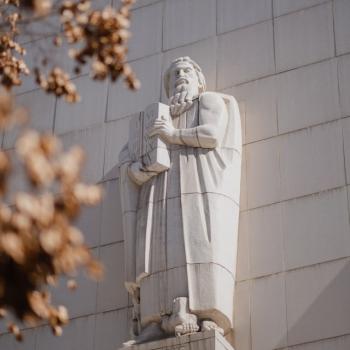
Photo provided by Brett Jordan at Unsplash.
Language Matters.
And the language they use shows their disregard for the Imago Dei, reflected in each one of the victims.
In a time when the world’s most powerful men are caught abusing the most powerless, and when others use performative Christianity as a cover for this abuse, it might seem silly to quibble about whether someone should be called a girl or a woman. But language matters, as it helps shape our perception about the world, and our place in it, and the place of the most vulnerable—the very ones Jesus calls us to protect.
This weekend, President Trump told a reporter on Air Force One that she needed to be quiet. He called her “piggy,” stepping toward her in a stance that can only be described as aggressive. Some pundits have already justified this moment as a joke or a second of diminished inhibition in a stressed, tired leader.
More likely, the language used by our president reflected what President Trump sees of the world, where girls are women, and women are girls, and all of them are pigs, easily overpowered because they are, in his eyes, less that human.
And still, I have hope that one day we will be able to answer Denhollander’s question about what a girl is worth differently. Justice for Epstein’s victims, and holding powerful men accountable for their vile behavior, might be one place to start.
General Christian
Women in Religion
Previous Post

October 29, 2025
Why Gen Z Feels Hopeless—and What Gives Them Hope
Next Post

December 11, 2025 Shalom and the Problem of Fake Peace Prizes
Recent Comments
Browse Our Archives
Select a Category Uncategorized
Select a Month October 2026 September 2026 July 2026 June 2026 May 2026 April 2026 March 2026 February 2026 January 2026 December 2025 November 2025 October 2025 September 2025 August 2025 July 2025 June 2025 May 2025 April 2025 March 2025 February 2025 January 2025 December 2024 November 2024 October 2024 September 2024 August 2024 July 2024
Follow Us!
TAKE THE
Religious Wisdom Quiz
What king was killed by an arrow in battle, fulfilling Elijah's prophecy?
Select your answer to see how you score.
Jeroboam Ahaziah Joash Ahab
Related posts from Faith in the Town Square

When the Disinformation Machine Comes to Your Hometown

Christian Nationalism Finds the Campus Quad

Protecting Title IX's Life-Giving Legislation
Bible-Infused School Standards are not Christ-Like
TRENDING AT PATHEOS Progressive Christian

The Sermon on the Mount, Part I: Matthew...
The Sermon on the Mount, Part I (Matthew 4:12-5:12) St. Matthew moves...

What's up from Crossway: Reviewing some of their latest A few weeks...

Janie Learns the Way of the Cross: A...
Teaching children about Jesus' Passion can be challenging. Many parents and educators...

Looking For Good Catholic Writing - October 2026
He alone extends the heavens, and he walks upon the waves of...

In "Irreplaceable," our book on vocation and technology, Trevor Sutton and I...

I was strolling through the top floor of the brand new Parthenon...
view all Progressive Christian blogs
What Are Your Thoughts?leave a comment
Ad-Free & Subscriber Log-In Subscription Support
- About Us
- 2026 Calendar
- Videos
- Podcasts
- Library of World Religions
- Faith In Media Tracker
- Advertise With Us
- Write for Us
- Privacy Policy
- Terms of Service
- Do Not Sell My Data
- Contact Us
- Radiant Digital
- Manage Newsletter Subscriptions
- Unsubscribe From Notifications
- Sitemap
Copyright 2008-2026, Patheos. All rights reserved.
Subscription Support Ad-Free & Subscriber Log-In
Follow Patheos