
BuddhistCatholicContemplativeEvangelicalGeneral ChristianHinduJewishLatter-day SaintMuslimNew VisionsProgressive Christian
Beliefs
- Buddhist
- Catholic
- Contemplative
- Evangelical
- General Christian
- Hindu
- Jewish
- Latter-day Saint
- More Voices
- Muslim
- New Visions
- Pagan
- Progressive Christian
Topics
- Religion News
- Food and Religion
- Sports and Religion
- Religious Art
- Religious Music and Entertainment
- Religious Events
- History and Religion
- Style and Religion
- Politics and Religion
- Women in Religion
- Recreation Outdoors and Religion
- Business Finance and Religion
- Careers Workplace and Religion
- Education and Religion
- Family Parenting and Religion
- Health Fitness and Religion
- Home and Religion
- Relationships and Religion
- Technology and Religion
- Travel and Religion
Columnists
- Buddhist Columnists
- Business Finance and Religion Columnists
- Careers Workplace and Religion Columnists
- Catholic Columnists
- Contemplative Columnists
- Education and Religion Columnists
- Evangelists Columnists
- Family Parenting and Religion Columnists
- General Christian Columnists
- Health Fitness and Religion Columnists
- Hindu Columnists
- History and Religion Columnists
- Home and Religion Columnists
- Jewish Columnists
- More Voices Columnists
- Latter Day Columnists
- Muslim Columnists
- New Visions Columnists
- Nonreligious Columnists
- Pagan Columnists
- Politics and Religion Columnists
- Progressive Columnists
- Recreation Outdoors and Religion Columnists
- Relationships and Religion Columnists
- Religion News Columnists
- Religious Art Columnists
- Religious Events Columnists
- Religious Music and Entertainment Columnists
- Sports and Religion Columnists
- Style and Religion Columnists
- Technology and Religion Columnists
- Travel and Religion Columnists
- Women in Religion Columnists
Resource Library
- 2026 Calendar
- Library of World Religions
- The 100 Most Holy Places on Earth
- Patheos Answers
- Podcasts
- Videos
- Faith Leaders Database
- Anglican Episcopalian
- Bahai
- Baptist
- Buddhism
- Christianity
- Confucianism
- Eastern Orthodoxy
- Hinduism
- Holiness and Pentecostal
- ISKCON
- Islam
- Judaism
- Lutheran
- Methodist
- The Church of Jesus Christ of Latter-day Saints
- New Age
- Paganism
- Presbytarian and Reformed
- Protestantism
- Religion Behind the Scenes
- Roman Catholic
- Scientology
- Shia Islam
- Sikhism
- Sufism
- Sunni Islam
- Taoism
- Zen
- See all religions
Research Tools
 Ad-Free & Subscriber Log-In Subscription Support
Ad-Free & Subscriber Log-In Subscription Support
Follow Patheos 

- Trending:
- Forgiveness
- |
- Marriage
- |
- Consciousness
- |
- Death Penalty
- |
- Election
- |
- Halloween

- Home
- Progressive Christian
- Politics and Religion
- The Threats and Promises of Religious Freedom
The Threats and Promises of Religious Freedom
Last updated on: January 14, 2025 at 12:33 pm by Melanie Springer Mock
The Threats and Promises of Religious Freedom 2025-01-14T12:33:52-08:00 Melanie Springer Mock
Patheos Explore the world's faith through different perspectives on religion and spirituality! Patheos has the views of the prevalent religions and spiritualities of the world.
This week I begin my 48th semester as a college instructor at a faith-based institution. (I also taught as a graduate student at state schools, so my total teaching tally is nearer to 60 semesters.) At George Fox University, we are encouraged—required, even—to bring our Christian faith to the classroom, and I have cherished the opportunity to openly express my love for Jesus in the vocational space I’ve inhabited for several decades now.
The integration of my faith with learning has been a vibrant part of my life as a teacher and a scholar; and reading and writing through a lens of faith has also helped me become a better Christian and a better human. I’m grateful for the opportunity to teach in the same institution for so long, and to be challenged each day to grow deeper in my understanding of Jesus alongside an understanding of my discipline.
Still, despite (or maybe because of) the benefits I’ve reaped from working in Christian education, I believe ardently, fiercely, in the freedom of religious expression codified by the Constitution. And because I believe ardently in this, I also am certain that Christian faith has no place in public education.
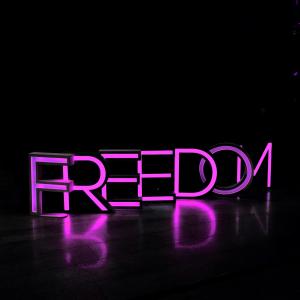
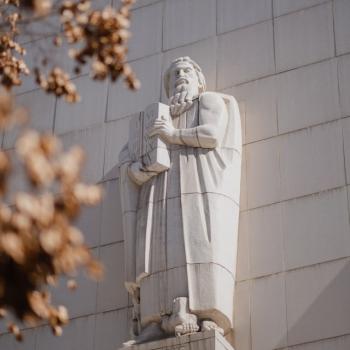
Photo credit: Kristina V. of Unsplash
Religious Freedom Faces Threats
There was a time when this seemed an acceptable, perhaps mainstream, position to hold. Even though my fourth-grade teacher taught us scripture memorization at the public school I attended, this was not the norm; by the time I reached high school, in the mid-1980s, we couldn’t have a school-sponsored baccalaureate ceremony, because doing so implied no separation between faith and public education.
Of course those are just anecdotal examples. Damon Maryl has traced the history of church/state separation in public education over the last 60 years, noting that “American education has been governed by a policy of ‘strict separation’ of church and state that formally disallowed both the teaching of religion in public schools, and public funding for religious schools.” Despite occasional attempts to bring (primarily Christian) faith into the public classroom, Maryl writes that it was only more recently that the church/state separation has become fractured completely, thanks to Supreme Court rulings and, I would add, to the concurrent ascendency of Christian nationalism.
So that now, a high school football coach can pray at the 50-yard line alongside his players after a game, and he is heralded a hero by the Christian right. Ryan Waters, state superintendent of Oklahoma public schools, can ask taxpayers for $3 million to assure that every classroom in his state has a Bible, and can order 500 Trump Bibles to be placed in Advanced Placement Government classes. In Louisiana last summer, Governor Jeff Landry decreed that every public school classroom display the ten commandments. And President-elect Trump has vowed to “bring back prayer to public schools,” part of his plan to rebuild public education.
In my hometown, there have been some efforts to erase the wall between church/state separation, especially when an alt-right slate of directors took over the school board, demonized teachers as “indoctrinators,” and used campaign materials that imagined their competitors as satanic. One director consistently read scripture during meetings, and argued for the right of every classroom teacher to have a Bible on their shelves.
The Promise of Religious Freedom
These attempts to demolish the wall between church and state have been troubling to me, not despite my faith, but because of it. As a Mennonite, I learned early and often that the freedom to practice faith apart from state-sponsored religion was sacrosanct, reflected in the stories of early Anabaptist martyrs I heard at home and at church. This martyrdom led Anabaptists in Europe to believe wholly in the need for separation of church and state, and they fled persecution from one church-state, and then others, to practice their religion freely.
My great-grandparents fled Russia for Kansas, hoping to freely express their faith apart from the state’s dictates. They found a place to be the “quiet of the land,” living in insular communities, farming, establishing churches. This worked out pretty well for Mennonites, though my Ph.D. dissertation, about Mennonite conscientious objectors in World War One, tells the story about how the United States did not always live up to its constitutional promises.
On National Religious Freedom Day, it’s important to celebrate those constitutional promises, acknowledging that now more than ever, they still matter. They make it possible for people to worship however they want, unthreatened by the dictates of the state. They make it possible for children to learn without being persuaded by teachers, even well-meaning ones, to follow a faith that is not their own. They make it possible for us to continue living in a plural society, where holding a belief system different than our neighbors does not mean condemnation and death.
After nearly 25 years of working in Christian higher education, I am still not sure how to best integrate my faith in the classroom, although it’s something I work on each and every day. I’m grateful for the opportunity to do this work, but I also know, if I were teaching in a state school, I’d find ways to express my faith, not through vocal prayer or scripture reading, but in how I treated students, in how I respected those different than me, in how I cared for those on the margins.
Because here’s what I know: a faith-based education is not a hail-Mary prayer spoken after a game. It’s not a ten commandments placard, posted to a classroom wall. It’s not a Trump Bible, being used to teach American government. It’s not imposing my faith on others, and demanding that others accept my belief as theirs, too. When we decide that these kinds of faith expressions should be a part of any public school classroom, we are not truly free.
General Christian
Education and Religion
National Religious Freedom Day
Previous Post
December 31, 2024
Choosing Jimmy Carter and His Model of Faith
Next Post
February 6, 2025 Reading as Resistance to Chaos and Rage
Recent Comments
Browse Our Archives
Select a Category Uncategorized
Select a Month October 2026 September 2026 July 2026 June 2026 May 2026 April 2026 March 2026 February 2026 January 2026 December 2025 November 2025 October 2025 September 2025 August 2025 July 2025 June 2025 May 2025 April 2025 March 2025 February 2025 January 2025 December 2024 November 2024 October 2024 September 2024 August 2024 July 2024
Follow Us!
TAKE THE
Religious Wisdom Quiz
True or False: David committed adultery with Bathsheba and arranged for her husband Uriah to be killed.
Select your answer to see how you score.
TRUE FALSE
Related posts from Faith in the Town Square

When the Disinformation Machine Comes to Your Hometown

Christian Nationalism Finds the Campus Quad
Protecting Title IX's Life-Giving Legislation
Bible-Infused School Standards are not Christ-Like
TRENDING AT PATHEOS Progressive Christian

Pope Leo Celebrates Mass for Nurses & Docs...
I don't have any idea how he did it, but Pope Leo...

The Sermon on the Mount, Part I: Matthew...
The Sermon on the Mount, Part I (Matthew 4:12-5:12) St. Matthew moves...

What's up from Crossway: Reviewing some of their latest A few weeks...

Janie Learns the Way of the Cross: A...
Teaching children about Jesus' Passion can be challenging. Many parents and educators...

Looking For Good Catholic Writing - October 2026
He alone extends the heavens, and he walks upon the waves of...

In "Irreplaceable," our book on vocation and technology, Trevor Sutton and I...
view all Progressive Christian blogs
What Are Your Thoughts?leave a comment
Ad-Free & Subscriber Log-In Subscription Support
- About Us
- 2026 Calendar
- Videos
- Podcasts
- Library of World Religions
- Faith In Media Tracker
- Advertise With Us
- Write for Us
- Privacy Policy
- Terms of Service
- Do Not Sell My Data
- Contact Us
- Radiant Digital
- Manage Newsletter Subscriptions
- Unsubscribe From Notifications
- Sitemap
Copyright 2008-2026, Patheos. All rights reserved.
Subscription Support Ad-Free & Subscriber Log-In
Follow Patheos