
BuddhistCatholicContemplativeEvangelicalGeneral ChristianHinduJewishLatter-day SaintMuslimNew VisionsProgressive Christian
Beliefs
- Buddhist
- Catholic
- Contemplative
- Evangelical
- General Christian
- Hindu
- Jewish
- Latter-day Saint
- More Voices
- Muslim
- New Visions
- Pagan
- Progressive Christian
Topics
- Religion News
- Food and Religion
- Sports and Religion
- Religious Art
- Religious Music and Entertainment
- Religious Events
- History and Religion
- Style and Religion
- Politics and Religion
- Women in Religion
- Recreation Outdoors and Religion
- Business Finance and Religion
- Careers Workplace and Religion
- Education and Religion
- Family Parenting and Religion
- Health Fitness and Religion
- Home and Religion
- Relationships and Religion
- Technology and Religion
- Travel and Religion
Columnists
- Buddhist Columnists
- Business Finance and Religion Columnists
- Careers Workplace and Religion Columnists
- Catholic Columnists
- Contemplative Columnists
- Education and Religion Columnists
- Evangelists Columnists
- Family Parenting and Religion Columnists
- General Christian Columnists
- Health Fitness and Religion Columnists
- Hindu Columnists
- History and Religion Columnists
- Home and Religion Columnists
- Jewish Columnists
- More Voices Columnists
- Latter Day Columnists
- Muslim Columnists
- New Visions Columnists
- Nonreligious Columnists
- Pagan Columnists
- Politics and Religion Columnists
- Progressive Columnists
- Recreation Outdoors and Religion Columnists
- Relationships and Religion Columnists
- Religion News Columnists
- Religious Art Columnists
- Religious Events Columnists
- Religious Music and Entertainment Columnists
- Sports and Religion Columnists
- Style and Religion Columnists
- Technology and Religion Columnists
- Travel and Religion Columnists
- Women in Religion Columnists
Resource Library
- 2026 Calendar
- Library of World Religions
- The 100 Most Holy Places on Earth
- Patheos Answers
- Podcasts
- Videos
- Faith Leaders Database
- Anglican Episcopalian
- Bahai
- Baptist
- Buddhism
- Christianity
- Confucianism
- Eastern Orthodoxy
- Hinduism
- Holiness and Pentecostal
- ISKCON
- Islam
- Judaism
- Lutheran
- Methodist
- The Church of Jesus Christ of Latter-day Saints
- New Age
- Paganism
- Presbytarian and Reformed
- Protestantism
- Religion Behind the Scenes
- Roman Catholic
- Scientology
- Shia Islam
- Sikhism
- Sufism
- Sunni Islam
- Taoism
- Zen
- See all religions
Research Tools
 Ad-Free & Subscriber Log-In Subscription Support
Ad-Free & Subscriber Log-In Subscription Support
Follow Patheos 

- Trending:
- Forgiveness
- |
- Marriage
- |
- Consciousness
- |
- Death Penalty
- |
- Election
- |
- Halloween
 Faith Shift
- Home
- Progressive Christian
- 10 Things to Remember When You’re Healing from Faith Shifts
10 Things to Remember When You’re Healing from Faith Shifts
Last updated on: November 6, 2017 at 6:47 am by Kathy Escobar
10 Things to Remember When You’re Healing from Faith Shifts 2017-11-06T06:47:51-06:00 Kathy Escobar
Patheos Explore the world's faith through different perspectives on religion and spirituality! Patheos has the views of the prevalent religions and spiritualities of the world.
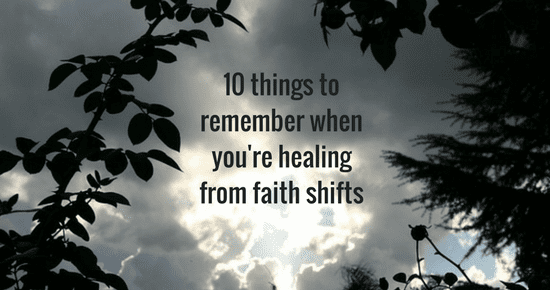
Healing from a radical shift in faith is a raw and weird process. Everyone navigates it differently, but one thing I’m clear on across our different paths is this: we have to take extra good care of ourselves in the process.
After sometimes learning the hard way what is and isn’t a good idea, here are a few suggestions to consider as we travel this path of losing so much of what we once held dear:
1. Be careful what we read. This fits into the same category as “don’t go online looking for medical advice” because it’s a sure way to multiply anxiety and make ourselves crazy. Choose wisely which blogs and books we read, which audio or videos to listen to. I do not allow myself to go on certain websites or click on certain links, period, because if I do, I can feel the spin.
2. Grief is weird. It comes in waves and can be extremely unpredictable. Allowing ourselves to roll with grief instead of resist feelings helps a lot. It’s important to respect that different interactions will trigger unexpected painful feelings. Still experiencing waves of grief after many months or years are not a sign we are stupid; I can sometimes do just fine and then hear a story about something at a church and grief sweeps in again. It’s a freaky feeling, but I’m learning to roll with it better.
3. It’s okay to “just say no” to certain events. In fact, it’s often a necessity! It’s hard when friends are still part of the systems we left, but that doesn’t mean we have to keep torturing ourselves. I have been invited to parties, weddings, and events where I knew I wouldn’t have enough solid ground underneath me so I didn’t go. It usually was a wise decision. Sure, I have had to push through my discomfort sometimes for really special gatherings; however, on the whole, I still evaluate whether or not it’s a good idea for my soul. Often but not always, it’s not.
4. We don’t have to justify our anger or sadness to anyone. Our feelings are ours, not anyone else’s. Everyone processes pain differently. Many people are afraid of emotions like anger and sadness and will do anything possible to shut them down in themselves and others, too. One of the things that gives us the most trouble in the healing process is feeling guilty about how we are feeling. Part of our survival is learning to let go of trying to explain or justify or defend our feelings. My experience has been the more I express my real feelings in a safe space, the more they heal. The more I try to stuff or manage or minimize them, the more they fester and cause more damage.
5. It’s a long road that can’t be rushed. Oh, how we want to get to a new place as fast as possible! But when we’re talking about the losses in Unraveling or years, decades, and lifetimes of faith-a-certain-way or recovering from Goddamage we have to embrace the longer story of healing. Finding our way forward doesn’t come in weeks or months but years and years.
6. Find ways to laugh, and laugh some more. It really is the best medicine. And often our only hope to keep healing.
7. Some relationships won’t make it through the transition. They just won’t. I was hoping to hold on to a few more of them, but what I realized over time is when we experience a fundamental shift in the lens we view God, church, and the world through, we lose a lot of what we had in common. It’s okay. I am sad about some of the losses but also trying to celebrate what was and accept that certain friendships had their season. I thank God I knew some of these people, but it’s sometimes awkward when we see each other. Accepting this new reality has helped me a lot (although I totally still hate those weird moments).
8. Make time for safe, life-giving relationships. Even if we don’t really have the time, find it. It’s crucial to create space to be with people who understand the same feelings and experiences, kindred spirits online or in real life, and safe spaces to freely share what’s really going on in our heads without having to worry about defending anything. I wouldn’t be here today without my people.
9. The serenity prayer. I am partial to it because of being in recovery and healing groups for a long time, but it is such a wise, simple, and sustaining prayer. To accept the things we can’t change, to gain courage to change the things we can, and honor hardship as a pathway to peace is good advice.
10. Swearing can help. Sometimes, they’re really the right words, specially if you have tried to be “good” for way too long!
There are many more, that’s for sure, but these are some off the top of my head. What else would you add?
Be good to yourself on this bumpy path. My heart is with you from Colorado.
Previous Post

October 9, 2017
Goddamage
Next Post

November 10, 2017 I Used To...But Now I...
Browse Our Archives
Select a Category Church Church Pain Faith and Politics Faith Shifts Grief Rebuilding Unraveling
Select a Month May 2019 September 2018 June 2018 April 2018 February 2018 January 2018 December 2017 November 2017 October 2017 September 2017 August 2017 July 2017 May 2017
Follow Us!
TAKE THE
Religious Wisdom Quiz
In which letter does Paul say "love is patient, love is kind"?
Select your answer to see how you score.
Galatians 1 Corinthians 2 Corinthians Ephesians
Related posts from Faith Shift

Why I Love Celtic Christianity
We "Just Can't Anymore" for a Reason.
TRENDING AT PATHEOS Progressive Christian

What Being a Modern-Day Apostle Means to Me
In my last column, I discussed the ins and outs of modern-day...

Did Ancient China Once Worship the God of...
Across human history, a common thread weaves through the origins of the...

Love Your Neighbor – Including Earth-Kin: Lev. 19,...
God’s command to love your neighbor means acting in an ethical and...

Lead a Church Study of “Jesus and Lao...
Guest writer Jack Thomas (The Irreverent Reverend) reflects on leading his church...

Pastoral Wisdom for Responding to Sermon Pushback
Getting sermon pushback on your social justice sermon? Learn practical, Proverbs-based strategies...

Principles for Understanding the Apostolic Ministry Today
Whenever people discover that my formal ministry title is "apostle," as in...
view all Progressive Christian blogs
Ad-Free & Subscriber Log-In Subscription Support
- About Us
- 2026 Calendar
- Videos
- Podcasts
- Library of World Religions
- Faith In Media Tracker
- Advertise With Us
- Write for Us
- Privacy Policy
- Terms of Service
- Do Not Sell My Data
- Contact Us
- Radiant Digital
- Manage Newsletter Subscriptions
- Unsubscribe From Notifications
- Sitemap
Copyright 2008-2026, Patheos. All rights reserved.
Subscription Support Ad-Free & Subscriber Log-In
Follow Patheos