
BuddhistCatholicContemplativeEvangelicalGeneral ChristianHinduJewishLatter-day SaintMuslimNew VisionsProgressive Christian
Beliefs
- Buddhist
- Catholic
- Contemplative
- Evangelical
- General Christian
- Hindu
- Jewish
- Latter-day Saint
- More Voices
- Muslim
- New Visions
- Pagan
- Progressive Christian
Topics
- Religion News
- Food and Religion
- Sports and Religion
- Religious Art
- Religious Music and Entertainment
- Religious Events
- History and Religion
- Style and Religion
- Politics and Religion
- Women in Religion
- Recreation Outdoors and Religion
- Business Finance and Religion
- Careers Workplace and Religion
- Education and Religion
- Family Parenting and Religion
- Health Fitness and Religion
- Home and Religion
- Relationships and Religion
- Technology and Religion
- Travel and Religion
Columnists
- Buddhist Columnists
- Business Finance and Religion Columnists
- Careers Workplace and Religion Columnists
- Catholic Columnists
- Contemplative Columnists
- Education and Religion Columnists
- Evangelists Columnists
- Family Parenting and Religion Columnists
- General Christian Columnists
- Health Fitness and Religion Columnists
- Hindu Columnists
- History and Religion Columnists
- Home and Religion Columnists
- Jewish Columnists
- More Voices Columnists
- Latter Day Columnists
- Muslim Columnists
- New Visions Columnists
- Nonreligious Columnists
- Pagan Columnists
- Politics and Religion Columnists
- Progressive Columnists
- Recreation Outdoors and Religion Columnists
- Relationships and Religion Columnists
- Religion News Columnists
- Religious Art Columnists
- Religious Events Columnists
- Religious Music and Entertainment Columnists
- Sports and Religion Columnists
- Style and Religion Columnists
- Technology and Religion Columnists
- Travel and Religion Columnists
- Women in Religion Columnists
Resource Library
- 2026 Calendar
- Library of World Religions
- The 100 Most Holy Places on Earth
- Patheos Answers
- Podcasts
- Videos
- Faith Leaders Database
- Anglican Episcopalian
- Bahai
- Baptist
- Buddhism
- Christianity
- Confucianism
- Eastern Orthodoxy
- Hinduism
- Holiness and Pentecostal
- ISKCON
- Islam
- Judaism
- Lutheran
- Methodist
- The Church of Jesus Christ of Latter-day Saints
- New Age
- Paganism
- Presbytarian and Reformed
- Protestantism
- Religion Behind the Scenes
- Roman Catholic
- Scientology
- Shia Islam
- Sikhism
- Sufism
- Sunni Islam
- Taoism
- Zen
- See all religions
Research Tools
 Ad-Free & Subscriber Log-In Subscription Support
Ad-Free & Subscriber Log-In Subscription Support
Follow Patheos 

- Trending:
- Forgiveness
- |
- Marriage
- |
- Consciousness
- |
- Death Penalty
- |
- Election
- |
- Halloween
 Faith Shift
- Home
- Progressive Christian
- Unraveling: It’s a lot to Lose
Unraveling: It’s a lot to Lose
Last updated on: August 11, 2017 at 2:27 pm by Kathy Escobar
Unraveling: It’s a lot to Lose 2017-08-11T14:27:00-06:00 Kathy Escobar
Patheos Explore the world's faith through different perspectives on religion and spirituality! Patheos has the views of the prevalent religions and spiritualities of the world.
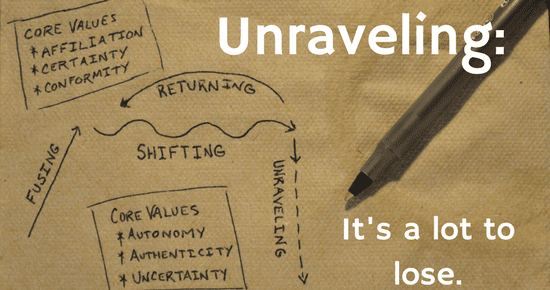
For the past 3 posts, I’ve touched on Fusing, Shifting, and Returning as some of the movements of a lot of our faith experiences. These three are really only groundwork for the places most of us reading here live, and the next three are the ones I’m most passionate about processing.
They are: Unraveling (deconstructing), Severing (for some), and Rebuilding (finding new life on the other side).
While Shifting is the season where things get rumbly, Unraveling is beyond just simple doubts (and beyond our control, really). I didn’t try to unravel and most people I know didn’t, either. This downward descent can make us feel a little crazy (and people around us feel worried).
Our values shift from certainty, conformity and affiliation that are present in Fusing to a deep desire for autonomy, authenticity, and uncertainty.
From Faith Shift: “Here’s how you can know if you’re Unraveling. You may not identify with all of these, but consider the ones you recognize (or others you might add):
- You have more than a few “I don’t knows.” Almost anything related to faith feels up for grabs, and your initial questions and doubts keep leading to many more questions and doubts.
- You long to feel some kind of connection to God again, but no matter what you do or try, nothing comes.
- Often you wish you could shove all the mess back into a box and put the lid on it, but you realize it’s too late for that.
- You feel depressed and lonely. Ironically, however, you also feel freer and lighter.
- When you try to connect with the Bible again, you sometimes see only its inconsistencies and harsh words.
- Not only do you feel heretical, people have called you that (sometimes to your face, sometimes behind your back).
- Sitting in church feels impossible. When you do go, you feel unnerved, edgy, uncomfortable, angry, or sad.
- You may talk trash about your former faith or church community, but you actually miss a lot of things about it too.
- Many who know about your changes have cut off relationship with you. It seems they wanted to be with you only when you were part of the same team, believed the same things, and were tasked with the same cause.
- You stopped caring what people from your former faith system think about you but can’t help wondering what God thinks.
- You feel a lot of anger about the past, wondering how everything could actually end up in ruins after all those years of being dedicated to your faith. You usually direct this anger toward yourself, others, and/or God.
- You are open to exploring other faiths or spiritual practices that you would have once considered “ungodly.”
- Sometimes you don’t have any adequate words to describe what you’re feeling.
- You swing between spurts of peace, where you have a deep sense of knowing you’ll be okay no matter what, and jags of utter confusion and doubt, where you feel completely lost and sure that you’re not just slipping off the slope but headed toward destruction.
- Religious and spiritual songs that used to bring comfort now feel like fingernails on a chalkboard.
- Calling yourself “Christian” feels dishonest. You actually have no idea how to categorize yourself anymore.
- [For those still in a ministry or leadership position] If you’re honest about what you’re experiencing, you will lose your job or role and credibility in a flash” (pp. 66-67).
Not everyone reading here has unraveled, but I can almost guarantee you know someone who has or is.
The entire middle third of Faith Shift is dedicated to Unraveling, including Soul Care exercises, the realities of the losses, and stories from others who know the feeling. If you or someone you know is in the midst of all this, it could be a really helpful tool to gather some hope and feel less crazy, less alone in the midst of all of it.
Really, Unraveling is a big messy grieving process.
It’s so much to lose!
When we lose beliefs, then we lose structures and relationships that were part of those structures.
Once those things go and we find ourselves on the outside of everything that was once familiar, we can often lose our identity, too.
It’s so much to lose.
In many ways, Unraveling is like a game of spiritual Jenga and we wonder, “If I take out this piece, is the whole Christian tower going to fall? Will losing this piece end the game entirely? How far can I go before my whole faith crumbles? ” (p. 68).
The other part about Unraveling I want to mention is how lonely and confusing it is. So many people don’t understand, don’t like the realities, want us to “come back.”
For most of us, there’s no turning back.
Unraveling is past an easy return, and that’s one of the hardest parts.
However, there can be new life, new hope on the other side of a painful unravel.
It just takes a long time (that’s really what I’ll be writing most about here in the months to come).
What have you lost in your Unraveling?
Previous Post
August 9, 2017
Returning: Playing it Safe
Next Post
August 17, 2017 The Church We Long For
Browse Our Archives
Select a Category Church Church Pain Faith and Politics Faith Shifts Grief Rebuilding Unraveling
Select a Month May 2019 September 2018 June 2018 April 2018 February 2018 January 2018 December 2017 November 2017 October 2017 September 2017 August 2017 July 2017 May 2017
Follow Us!
TAKE THE
Religious Wisdom Quiz
To whom does Paul say he has become all things so that by all possible means he might save some?
Select your answer to see how you score.
The Gentiles The Jews The weak Everyone
Related posts from Faith Shift
We "Just Can't Anymore" for a Reason.


Soul Care and Spiritual Practices for Faith Deconstruction
TRENDING AT PATHEOS Progressive Christian

What Being a Modern-Day Apostle Means to Me
In my last column, I discussed the ins and outs of modern-day...

Did Ancient China Once Worship the God of...
Across human history, a common thread weaves through the origins of the...

Love Your Neighbor – Including Earth-Kin: Lev. 19,...
God’s command to love your neighbor means acting in an ethical and...

Lead a Church Study of “Jesus and Lao...
Guest writer Jack Thomas (The Irreverent Reverend) reflects on leading his church...

Pastoral Wisdom for Responding to Sermon Pushback
Getting sermon pushback on your social justice sermon? Learn practical, Proverbs-based strategies...

Principles for Understanding the Apostolic Ministry Today
Whenever people discover that my formal ministry title is "apostle," as in...
view all Progressive Christian blogs
Ad-Free & Subscriber Log-In Subscription Support
- About Us
- 2026 Calendar
- Videos
- Podcasts
- Library of World Religions
- Faith In Media Tracker
- Advertise With Us
- Write for Us
- Privacy Policy
- Terms of Service
- Do Not Sell My Data
- Contact Us
- Radiant Digital
- Manage Newsletter Subscriptions
- Unsubscribe From Notifications
- Sitemap
Copyright 2008-2026, Patheos. All rights reserved.
Subscription Support Ad-Free & Subscriber Log-In
Follow Patheos