
BuddhistCatholicContemplativeEvangelicalGeneral ChristianHinduJewishLatter-day SaintMuslimNew VisionsProgressive Christian
Beliefs
- Buddhist
- Catholic
- Contemplative
- Evangelical
- General Christian
- Hindu
- Jewish
- Latter-day Saint
- More Voices
- Muslim
- New Visions
- Pagan
- Progressive Christian
Topics
- Religion News
- Food and Religion
- Sports and Religion
- Religious Art
- Religious Music and Entertainment
- Religious Events
- History and Religion
- Style and Religion
- Politics and Religion
- Women in Religion
- Recreation Outdoors and Religion
- Business Finance and Religion
- Careers Workplace and Religion
- Education and Religion
- Family Parenting and Religion
- Health Fitness and Religion
- Home and Religion
- Relationships and Religion
- Technology and Religion
- Travel and Religion
Columnists
- Buddhist Columnists
- Business Finance and Religion Columnists
- Careers Workplace and Religion Columnists
- Catholic Columnists
- Contemplative Columnists
- Education and Religion Columnists
- Evangelists Columnists
- Family Parenting and Religion Columnists
- General Christian Columnists
- Health Fitness and Religion Columnists
- Hindu Columnists
- History and Religion Columnists
- Home and Religion Columnists
- Jewish Columnists
- More Voices Columnists
- Latter Day Columnists
- Muslim Columnists
- New Visions Columnists
- Nonreligious Columnists
- Pagan Columnists
- Politics and Religion Columnists
- Progressive Columnists
- Recreation Outdoors and Religion Columnists
- Relationships and Religion Columnists
- Religion News Columnists
- Religious Art Columnists
- Religious Events Columnists
- Religious Music and Entertainment Columnists
- Sports and Religion Columnists
- Style and Religion Columnists
- Technology and Religion Columnists
- Travel and Religion Columnists
- Women in Religion Columnists
Resource Library
- 2026 Calendar
- Library of World Religions
- The 100 Most Holy Places on Earth
- Patheos Answers
- Podcasts
- Videos
- Faith Leaders Database
- Anglican Episcopalian
- Bahai
- Baptist
- Buddhism
- Christianity
- Confucianism
- Eastern Orthodoxy
- Hinduism
- Holiness and Pentecostal
- ISKCON
- Islam
- Judaism
- Lutheran
- Methodist
- The Church of Jesus Christ of Latter-day Saints
- New Age
- Paganism
- Presbytarian and Reformed
- Protestantism
- Religion Behind the Scenes
- Roman Catholic
- Scientology
- Shia Islam
- Sikhism
- Sufism
- Sunni Islam
- Taoism
- Zen
- See all religions
Research Tools
 Ad-Free & Subscriber Log-In Subscription Support
Ad-Free & Subscriber Log-In Subscription Support
Follow Patheos 

- Trending:
- Forgiveness
- |
- Marriage
- |
- Consciousness
- |
- Death Penalty
- |
- Election
- |
- Halloween
 Faith-Promoting Rumor
- Home
- Latter-day Saint
- Sam Gamgee and the Relief Society
Sam Gamgee and the Relief Society
Last updated on: March 17, 2013 at 9:04 pm by Bored in Vernal
Sam Gamgee and the Relief Society 2013-03-17T21:04:51-05:00 Bored in Vernal
Patheos Explore the world's faith through different perspectives on religion and spirituality! Patheos has the views of the prevalent religions and spiritualities of the world.
Sam Gamgee and the Relief Society[1]
 Whenever I watch the film version of the Lord of the Rings, it strikes me that Sam, Frodo’s gardener, is the real hero of the story. Although Frodo is the protagonist, the ring-holder, the champion who saves Middle-Earth, Sam was the one who stood strong when the going was rough, filled in the gaps, supported and carried Frodo when he could no longer go on. This is how I view the history of the Relief Society. Though Joseph Smith, his wife Emma, and Eliza R. Snow are remembered as “Frodos” of the Relief Society, there were also several people who filled the vital role of “Sam.” One of these is Sarah Granger Kimball.
There are many details of Sarah Kimball’s life which are not generally known to the average Latter-day Saint. She and her family arrived in Kirtland, Ohio in 1833, when she was barely fifteen years old. The city was filling with Latter-day Saints and was an exciting place for a girl with an inquisitive young mind. The new doctrines and revelations coming forth from a living Prophet were available in Mormon newspapers, first the Evening and Morning Star and later the Messenger and Advocate. Sarah joined those who studied them seriously. She was one of the twenty-three women known to have attended the School of the Prophets, an irregular gathering of the priesthood-bearing elders to study the gospel and gospel-related topics.[2] In later years she related to her sisters that she had attended the school, perhaps to underscore the importance she placed upon doctrinal study among LDS women.[3]
Sarah remained closely associated with the inner workings of the Church throughout her life. She moved to Nauvoo with her new husband, Hiram Kimball, at the end of 1840. Hiram was a prosperous, non-Mormon merchant, and their home became known for its elegance and suitability as the site of social and religious gatherings.
Hiram’s prosperity pleased his young bride. But when the Church needed assistance to raise the walls of the Nauvoo temple, she realized she owned nothing of her own to contribute. Sarah hesitated to ask her nonmember husband for funds to contribute to the Mormon Church. When she bore their first son, she asked her husband how much he thought the child was worth, suggesting $1,000 as a reasonable estimate. Hiram agreed. She then asked if she owned half of the boy. “Yes, I suppose so.” “Then I have something to help on the Temple,” Sarah declared. When Hiram related this conversation to Joseph Smith, he seemed pleased with the joke, and said, “I accept all such donations, and from this day the boy shall stand recorded, Church property.” Then turning to Willard Richards, his secretary, he said, “Make a record of this, and you are my witness.” Joseph Smith then told Hiram, “You now have the privilege of paying $500 and retaining possession, or receiving $500 and giving possession.” Mr. Kimball paid the church in land, and Mrs. Kimball claimed that the contribution was hers. Hiram was baptized into the Church not long after this incident, on July 20, 1843.
This wasn’t the end of Sarah’s interest in donating to the building of the Temple. In the summer of 1842, she and her seamstress, Margaret Cook were discussing the subject of assisting the Temple hands. Sarah suggested that she could furnish material if Margaret would make some shirts for the workmen. The two women realized that some of their neighbors might wish to combine means and efforts as well. They invited some friends to Sarah’s home to discuss their plan, and asked Eliza R. Snow, the best writer they knew, to draw up a constitution for the Society. After completing the document, Eliza read it to the prophet Joseph Smith, who used this group as a springboard to organize the sisters “under the priesthood after the pattern of the priesthood.”[4] John Taylor later declared that the Prophet organized the women “according to the law of Heaven.” [5]
Eliza R. Snow said: “Although the name [Relief Society] may be of modern date, the institution is of ancient origin. We were told by our martyred prophet that the same organization existed in the church anciently… This is an organization that cannot exist without the Priesthood, from the fact that it derives all its authority and influence from that source. When the Priesthood was taken from the earth, this institution as well as every other appendage to the true order of the church of Jesus Christ on the earth, became extinct, and had never been restored until the time referred to above….”[6] Eliza said that a women’s organization such as the Relief Society “has always existed when the Church of Jesus Church [Christ] has been fully organized. ‘Elect lady,’ as it occurs in the New Testament, has direct reference to the same—alluding to one who presided over this Institution. See 2d Epistle of John, 1st verse.”[7]
At the first official meeting of the Relief Society, on March 17, 171 years ago, Joseph asked the sisters to elect a President for their new society. The sisters chose his wife, Emma Smith as their new leader. Joseph told them that she had been elected in fulfillment of a revelation. He then “read the Revelation to Emma Smith, from the book of Doctrine and Covenants; and stated that she was ordain’d at the time, the Revelation was given, to expound the scriptures to all; and to teach the female part of [the] community; and that not she alone, but others, may attain to the same blessings.[8]
I believe the sisters took this information seriously. Sarah Kimball was one of those “others.” Though the woman’s organization was her idea, she was passed over for President in favor of the Prophet’s wife. The idea that all could be involved in the blessings of the Society might have been comforting. For three years, Sarah and up to thirteen hundred Nauvoo women participated in charitable works, were involved in politics, and were taught the doctrines of the kingdom. In one of his sermons to the women, the Prophet Joseph taught that “the Society should move according to the ancient Priesthood.” This, he declared, required “a select Society separate from all the evils of the world, choice, virtuous and holy.”[9]
The “ancient Priesthood” to which Joseph alluded is the patriarchal order of the Melchizedek Priesthood and its ordinances, with the covenant of marriage and the family unit at its center. President Ezra Taft Benson explained: “The order of the priesthood spoken of in the scriptures is sometimes referred to as the patriarchal order because it came down from father to son. But this order is otherwise described in modern revelation as an order of family government where a man and a woman enter into a covenant with God—just as did Adam and Eve—to be sealed for eternity, to have posterity, and to do the will and work of God through their mortality.”[10] The ancient priesthood was governed by keys representing God’s authority, which “open God’s greatest blessings, including the ‘privilege of receiving the mysteries of the kingdom of heaven, . . . [and] the communion and presence of God the Father, and Jesus’” (D&C 107:19). Thus, when the Prophet declared that Relief Society sisters “should move according to the ancient Priesthood,” he invited them to prepare for the sacred ordinances to be administered in the temple and to eventually enter into the presence of God.[11]
In 1844, the Prophet Joseph Smith was martyred, and the Latter-day Saints began to make preparations to cross the plains to their new home in the West. Some histories of the Relief Society perpetuate the idea that there was no formal Relief Society organization from 1844 to 1866, leaving a twenty-three-year gap. But Eliza R. Snow and the other sisters transported the Relief Society with them across the plains. For further information on how the Relief Society that Joseph Smith had restored by revelation was kept alive during these years see Revolutionary Sisterhood: The Struggle to Sustain a Prophetic Vision. Eliza R. Snow maintained that the Relief Society effort, which eventually became Church-wide under her leadership, continued to function during this time, though much curtailed.[12] When I think about this time in Relief Society history, I picture Frodo, battling the giant spider, Shelob. He was stung and paralyzed; and Sam took the ring for a while to continue the Quest while Frodo was incapacitated. During this difficult time in Utah, a few Relief Society organizations continued to “carry the ring.”
Sarah Kimball was just one example of a continuing Relief Society effort from Nauvoo onward. She was sustained in 1857 as the President of the Salt Lake City Fifteenth Ward Relief Society and retained that position until her death in 1898.[13] (41 years!) As the Fifteenth Ward Relief Society President, Sarah founded a treasury fund which purchased a small plot of ground.[14] On November 13th, 1868, she had the honor of laying the corner stone of the first Relief Society building erected in this dispensation.[15]
Sarah was by her own definition a “woman’s rights woman”. After the death of the Prophet Joseph in Nauvoo, her husband Hiram suffered a reversal of fortune. While he worked to rebuild his career, Sarah came across the plains and supported her family and her widowed mother by teaching school. In later years, Hiram was killed in a tragic steamboat accident on his way to a mission in Hawaii.[16] Many women in Sarah’s position would have felt the need to remarry, or perhaps become a plural wife. But she did neither of these things.
Sarah was constantly striving to help her sisters exercise their minds. The society gathered to sew carpet rags and quilts while members took turns reading from the scriptures, Parley P. Pratt’s Key to Theology, and some contemporary books and periodicals.[17] Mrs. Kimball attempted to vary the curriculum, placing heavy stress on the study of physiology in 1872-73. She told her sisters that “human bodies were not forlorn, disagreeable objects, and should not be subjected to the causes that would make them such.” Accordingly, she preached dress reform, declaring that “tight lacing was a sin against humanity.”[18]
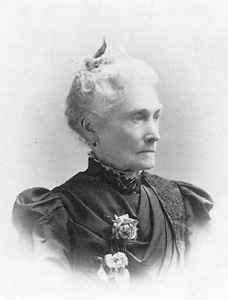 In 1882, Sarah became an active participant in the Utah Constitutional Convention and less than a decade later (1891) she was named the leader of the Utah Women’s Suffrage Association, traveling to Washington, D.C., as Utah’s delegate to the NWSA. This position as president enabled her to petition the Congress of the United States to stop the atrocities inflicted by federal deputies on Latter-day Saint women. As soon as she was elected president, she suggested each woman read over the United States Constitution at least six times and start studying municipal governments as it “would lead to [their] advancement and the enlargement of [their] capacities”. Under her leadership, fifteen hundred members would participate in mock legislation assemblies to help women understand the process of a bill to law.[19] Described by one of her associates as possessing “the courage to say what she thought,” Sarah Kimball labored for the advancement of women, arguing that “education and agitation are our best weapons of warfare”[20]
Just six months before her death in 1898, as Sarah addressed her sisters in the Fifteenth Ward Relief Society, she surveyed the property buying and building, silk manufacture, grain storage, cooperative mercantiles, publications, medical study, and political activity in which Mormon women had become involved, as well as the gains of American women generally and “spoke of the breadth of meaning contained in the statement made by the Prophet Joseph Smith ‘I now turn the key for women.’”[21] For over fifty years that statement colored Sarah Kimball’s perception of woman’s changing sphere. Sarah traced the suffrage movement itself to this “turning of the key,” asserting that “the sure foundations of the suffrage cause were deeply and permanently laid on the 17th of March, 1842.”[22] In her own lifetime she had seen women given significant educational, economic, political, and religious opportunities and responsibilities.
But Joseph’s restoration went further than this. “I now turn the key to you in the name of God,” Joseph had declared, “and this Society shall rejoice and knowledge and intelligence shall flow down from this time.” With those words Joseph metaphorically opened the door to spiritual knowledge and blessings for women. The unfolding “mysteries of God” and “knowledge and intelligence” flowing down from heaven would teach the repentant and faithful how to attain eternal life, life in the presence of God. “If you live up to your privileges,” Joseph promised the women that day, “the angels cannot be restrain’d from being your associates—females, if they are pure and innocent can come into the presence of God.”[23]
The effect of Joseph’s words upon the women was stunning. Nancy Alexander Tracy testified that when Joseph spoke “he was so full of the spirit of the Holy Ghost that his frame shook and his face shone and looked almost transparent.”[24] Eliza R. Snow wrote in the minutes: “The spirit of the Lord was pour’d out in a very powerful manner, never to be forgotten by those present on that interesting occasion.”[25]
I testify that we can all be Sam Gamgees—we can all be Relief Society Sarahs. From what might seem like little beginnings, we can do great things. We can reach out to others in charity, and each one of us, through daily small efforts, can become like God. “The Society is not only to relieve the poor but to save souls,” Joseph told the sisters when he addressed them on June 9, 1842.[26] The Relief Society shows sisters how to do this, and is an example to everyone in this congregation of how to lift ourselves and others. We are all engaged in this great work.
[1] Remarks given in a Sacrament Meeting 3/17/2013 upon the occasion of the 171st anniversary of the founding of the Relief Society.
[2] Mary Stovall Richards, “Sarah Granger Kimball,” Encyclopedia of Mormonism, 784.
[3] Jill Mulvay Derr, Sarah M. Kimball (Salt Lake City: Signature Books, ), . From Fifteenth Ward, Riverside Stake, Relief Society minutes, 1874-94, vol. 5, April 11, 1894, manuscript, LDS Archives.
In an address given in 1895 in Washington, D.C., at the Triennial Council of Women, “Our Sixth Sense, or the Sense of Spiritual Understanding,” Sarah described women “received into communion with the Infinite Father and Mother and permitted to enter hallowed mansions to attend the school of the Prophets, and, by advancing steps to reach the school of the Gods, where they learn the processes by which worlds are organized … the uses for which worlds are called into existence; the manner in which they are controlled, and the laws of progression by which all beings and animate things are perfected, and glorified in their respective spheres.” (Sarah M. Kimball, “Our Sixth Sense, or the Sense of Spiritual Understanding,” Woman’s Exponent, April 15, 1895.)
[4] Augusta Joyce Crocheron, “Sarah M. Kimball, Secretary of the LDS Women’s Organizations,” Representative Women of Deseret: A Book of Biographical Sketches to Accompany the Picture Bearing the Same Title (Salt Lake City: J.C. Graham and Co., 1884), 27.
[5] Sheri Dew and Virginia H. Pearce, The Beginning of Better Days: Divine Instruction to Women from the Prophet Joseph Smith (Salt Lake City: Deseret Book, 2012), 38.
[6] Eliza R. Snow, “Female Relief Society,” Deseret News, Apr. 22, 1868, 1
[7] Eliza R. Snow. “The Female Relief Society.” The Woman’s Exponent 1 [June 1 1872]: 2
[8] Nauvoo Relief Society Minutes, March 17, 1842, 8.
[9] Nauvoo Relief Society Minutes, March 30, 1842, 22.
[10] Ezra Taft Benson, “What I Hope You Will Teach Your Children about the Temple,” Ensign, August 1985, 9.
[11] These ideas on the Priesthood come from Jill Mulvay Derr and Carol Cornwall Madsen, “‘Something Better’ for the Sisters: Joseph Smith and the Female Relief Society of Nauvoo” in Joseph Smith and the Doctrinal Restoration (Provo: Brigham Young University, Religious Studies Center, 2005), 123–43.
[12] Eliza R. Snow: An Immortal, pp. 38-49; [Eliza R. Snow], Brief Sketch of the Organizations conducted by the Latter-day Saint Women of Utah, Salt Lake City, 1880, holograph, Bancroft Library, University of California, Berkeley, California: microfilm, LDS Church Archives.
[13] Sarah boasted that she had been Fifteenth Ward Relief Society President for twenty-five years, “longer than any president living.”
[14] Jill Mulvay Derr, “Sarah M. Kimball” Signature Books Library, http://signaturebookslibrary.org/?p=8385
[15] Augusta Joyce Crocheron, “Sarah M. Kimball, Secretary of the LDS Women’s Organizations,” Representative Women of Deseret: A Book of Biographical Sketches to Accompany the Picture Bearing the Same Title (Salt Lake City: JC Graham and Co., 1884), 27. Mary Walker Morris remembers the occasion as follows: “I remember when the [Fifteenth Ward] Relief Society built their new hall how proud I felt to give a bonnet of my own making as my donation. It was of rice straw and trimmed with blue, if I remember rightly, but I know it was sold and the money applied as I had intended. I saw our beloved President, Sister Sarah M. [Melissa Granger] Kimball lay the South-east stone of the edifice, with a silver trowel.” Milewski, Melissa Lambert, “Before the Manifesto: The Life Writings of Mary Lois Walker Morris,” USU Press Publications, Book 38 (2007);
[16] Hiram died April 27, 1863. See http://www.nytimes.com/1863/05/03/news/san-francisco-terrible-steamboat-disaster-forty-persons-killed-twenty-wounded.html
[17] Jill Mulvay Derr, “Sarah M. Kimball” Signature Books Library http://signaturebookslibrary.org/?p=8385
[18] Jill Mulvay Derr, “Sarah M. Kimball” Signature Books Library http://signaturebookslibrary.org/?p=8385
[19] Jill Mulvay Derr, “Sarah M. Kimball” Signature Books Library http://signaturebookslibrary.org/?p=8385
[20] The Woman’s Exponent 20 [1 May 1892]:159 and 18 [15 Feb. 1890]:139, respectively.
[21] Relief Society Minutes, 1874-94, vol. 5, June 9, 1898. On another occasion, Sarah Kimball recalled the words differently, indicating that Joseph said, “I have desired to organize the Sisters in the order of the Priesthood. I now have the key by which I can do it. The organization of the Church of Christ was never perfect until the women were organized.” Recorded by Sarah M. Kimball in 1882 in her capacity as general secretary of the Relief Society, “Relief Society Record, 1880–1892,” 29, 30, Church History Library, Historical Department of The Church of Jesus Christ of Latter-day Saints.
[22] Woman Suffrage Leaflet (Salt Lake City, January 1892), p. 3.
[23] Nauvoo Relief Society Minutes, April 28, 1842, 38
[24] “Incidents, Travel, and Life of Nancy Naomi Alexander Tracy,” 24–25, Church Archives.
[25] Nauvoo Relief Society Minutes, April 28, 1842, 41.
[26] Nauvoo Relief Society Minutes, June 9, 1842, 63.
Previous Post

March 11, 2013
What's Wrong with the Topical Guide?
Next Post
March 19, 2013 An (Updated) Bible Dictionary?
Browse Our Archives
Select a Category 2013 Scriptures Administrative Apologetics Atonement Bible Book of Mormon Book Review BYU Doctrine Extra-Biblical Literature Family Feminism Guests History LDS Church History Leadership Marginalia Metaphysics Mormon Culture Mormon Studies Personal Issues Political Philosophy Politics Scripture Sexuality Speculation Spotlights Studying Religion Ten Tidbits The Tenure Track Theology Tips on Applying Series Tips on Being an Independent Scholar Uncategorized
Select a Month June 2017 April 2017 March 2017 February 2017 December 2016 November 2016 October 2016 September 2016 August 2016 July 2016 May 2016 April 2016 March 2016 February 2016 January 2016 December 2015 November 2015 October 2015 September 2015 July 2015 April 2015 March 2015 February 2015 January 2015 December 2014 November 2014 October 2014 September 2014 August 2014 July 2014 June 2014 May 2014 April 2014 March 2014 February 2014 January 2014 December 2013 October 2013 September 2013 August 2013 July 2013 June 2013 May 2013 April 2013 March 2013 February 2013 January 2013 December 2012 November 2012 October 2012 September 2012 August 2012 July 2012 June 2012 May 2012 April 2012 March 2012 February 2012 January 2012 December 2011 November 2011 October 2011 September 2011 August 2011 July 2011 June 2011 May 2011 April 2011 March 2011 February 2011 January 2011 December 2010 November 2010 October 2010 September 2010 August 2010 July 2010 June 2010 May 2010 April 2010 March 2010 February 2010 January 2010 December 2009 November 2009 October 2009 September 2009 August 2009 July 2009 June 2009 May 2009 April 2009 March 2009 February 2009 January 2009 December 2008 November 2008 October 2008 September 2008 August 2008 July 2008 June 2008 May 2008 April 2008 March 2008 February 2008 January 2008 December 2007 November 2007 October 2007 September 2007 August 2007 July 2007 June 2007 May 2007 April 2007 March 2007 February 2007 January 2007 December 2006 November 2006 October 2006 September 2006 August 2006 July 2006 June 2006 May 2006 April 2006 March 2006 February 2006 January 2006 December 2005 November 2005 October 2005 September 2005 August 2005 July 2005 June 2005 May 2005
Follow Us!
TAKE THE
Religious Wisdom Quiz
Which book of the Bible has the longest chapter?
Select your answer to see how you score.
Isaiah Genesis Psalms Jeremiah
Related posts from Faith-Promoting Rumor

Canonical Criticism of the Book of Mormon?
Women, Blacks, and the Priesthood in Recent LDS...

Some non-arguments against ordaining women to the LDS...

The Problem of Gendered Voice in the Church...
TRENDING AT PATHEOS Latter-day Saint

Did Prayer Cure His Cancer? Or Was It...
At 4 AM one morning, Joshua W. Brown’s wife awoke to a...

8 Ways a Near-Death Experience Rewires the Soul
Does Consciousness Survive Physical Death? After 50 Years of Research, Dr. Raymond...

Holy Longing: What Our Restlessness Is Telling Us
“One can find so many pains when the rain is falling.” -John...

What this is NOT about. This blog is definitely not about...

Who said the Israelites were God’s chosen? That’s right, they did. Who...

The Spirit World Is the Real World: God...
A Monk’s Wisdom on Body and Spirit I sit with Brother Martin...
view all Latter-day Saint blogs
Ad-Free & Subscriber Log-In Subscription Support
- About Us
- 2026 Calendar
- Videos
- Podcasts
- Library of World Religions
- Faith In Media Tracker
- Advertise With Us
- Write for Us
- Privacy Policy
- Terms of Service
- Do Not Sell My Data
- Contact Us
- Radiant Digital
- Manage Newsletter Subscriptions
- Unsubscribe From Notifications
- Sitemap
Copyright 2008-2026, Patheos. All rights reserved.
Subscription Support Ad-Free & Subscriber Log-In
Follow Patheos