
BuddhistCatholicContemplativeEvangelicalGeneral ChristianHinduJewishLatter-day SaintMuslimNew VisionsProgressive Christian
Beliefs
- Buddhist
- Catholic
- Contemplative
- Evangelical
- General Christian
- Hindu
- Jewish
- Latter-day Saint
- More Voices
- Muslim
- New Visions
- Pagan
- Progressive Christian
Topics
- Religion News
- Food and Religion
- Sports and Religion
- Religious Art
- Religious Music and Entertainment
- Religious Events
- History and Religion
- Style and Religion
- Politics and Religion
- Women in Religion
- Recreation Outdoors and Religion
- Business Finance and Religion
- Careers Workplace and Religion
- Education and Religion
- Family Parenting and Religion
- Health Fitness and Religion
- Home and Religion
- Relationships and Religion
- Technology and Religion
- Travel and Religion
Columnists
- Buddhist Columnists
- Business Finance and Religion Columnists
- Careers Workplace and Religion Columnists
- Catholic Columnists
- Contemplative Columnists
- Education and Religion Columnists
- Evangelists Columnists
- Family Parenting and Religion Columnists
- General Christian Columnists
- Health Fitness and Religion Columnists
- Hindu Columnists
- History and Religion Columnists
- Home and Religion Columnists
- Jewish Columnists
- More Voices Columnists
- Latter Day Columnists
- Muslim Columnists
- New Visions Columnists
- Nonreligious Columnists
- Pagan Columnists
- Politics and Religion Columnists
- Progressive Columnists
- Recreation Outdoors and Religion Columnists
- Relationships and Religion Columnists
- Religion News Columnists
- Religious Art Columnists
- Religious Events Columnists
- Religious Music and Entertainment Columnists
- Sports and Religion Columnists
- Style and Religion Columnists
- Technology and Religion Columnists
- Travel and Religion Columnists
- Women in Religion Columnists
Resource Library
- 2026 Calendar
- Library of World Religions
- The 100 Most Holy Places on Earth
- Patheos Answers
- Podcasts
- Videos
- Faith Leaders Database
- Anglican Episcopalian
- Bahai
- Baptist
- Buddhism
- Christianity
- Confucianism
- Eastern Orthodoxy
- Hinduism
- Holiness and Pentecostal
- ISKCON
- Islam
- Judaism
- Lutheran
- Methodist
- The Church of Jesus Christ of Latter-day Saints
- New Age
- Paganism
- Presbytarian and Reformed
- Protestantism
- Religion Behind the Scenes
- Roman Catholic
- Scientology
- Shia Islam
- Sikhism
- Sufism
- Sunni Islam
- Taoism
- Zen
- See all religions
Research Tools
 Ad-Free & Subscriber Log-In Subscription Support
Ad-Free & Subscriber Log-In Subscription Support
Follow Patheos 

- Trending:
- Forgiveness
- |
- Marriage
- |
- Consciousness
- |
- Death Penalty
- |
- Election
- |
- Halloween
 Faith-Promoting Rumor
- Home
- Latter-day Saint
- Wait, that’s (not) in the Bible?! Creation Ex Nihilo, Israelite Cosmology, and Science
Wait, that’s (not) in the Bible?! Creation Ex Nihilo, Israelite Cosmology, and Science
Last updated on: May 3, 2009 at 5:08 pm by theyellowdart
Wait, that’s (not) in the Bible?! Creation Ex Nihilo, Israelite Cosmology, and Science 2009-05-03T17:08:58-05:00 theyellowdart
Patheos Explore the world's faith through different perspectives on religion and spirituality! Patheos has the views of the prevalent religions and spiritualities of the world.
As I have discussed in a series of posts on creation in Genesis 1-3 (see: here, here, here, here, here, here, here, and here), the vast majority of biblical scholars now recognize that the ancient Israelites viewed the cosmos as being formed from a primeval chaotic state, and not ex nihilo. This may be best understood, perhaps, by taking a closer look at their worldview of the order and structure of the cosmos. Biblical scholar Bernhard Anderson briefly summarizes their cosmological world-view as follows:
The Bible takes for granted a three-storied structure of the universe: heaven, earth, and underworld (Ex. 20:4). According to this Weltbild, the earth is a flat surface, corrugated by mountains and divided by rivers and lakes. Above the earth, like a huge dome, is spread the firmament that holds back the heavenly ocean and supports the dwelling place of the gods (Genesis 1:8; Ps. 148:4). The earth itself is founded on pillars that are sunk into the subterranean waters (Ps. 24:2; 104:5), in the depths of which is located Sheol, the realm of death. In this view, the habitable world is surrounded by the waters of chaos, which unless held back, would engulf the world, a threat graphically portrayed in the flood story (Genesis 7:11; c.f. 1:6) and in various poems in the Old Testament (e.g., Ps. 46:1-4; 104:5-9). [1]
(For a picture of this worldview, see HERE.)
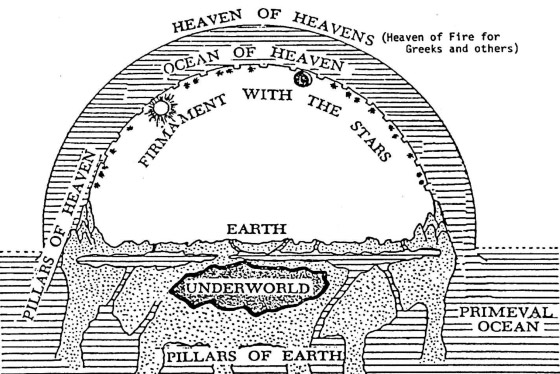
This explanation of the ancient Israelite cosmological worldview makes excellent sense of the P account of creation (Gen. 1.1-2.4a), which views creation as one of providing order through separation and the maintaining of boundaries. For instance, Genesis 1.6-8 (NRSV) reads:
And God said, ‘Let there be a dome [raqi’a] in the midst of the waters, and let it separate [b-d-l] the waters from the waters.’ So God made the dome [raqi’a] and separated [b-d-l] the waters that were under the dome [raqi’a] from the waters that were above the dome [raqi’a]. And it was so. God called the dome [raqi’a] Sky [shamayim]. And there was evening and there was morning, the second day.
For P, the purpose of the raqi’a, which is literally an extended solid surface that encircled the earth (translated as “firmament” in the KJV, “expanse” in the NIV, and “dome” in the NRSV), is to separate the heavenly waters above the earth from the subterranean waters below, so as to provide a space in which God can fashion the remainder of his earthly creation, and in order to hold back these waters from destroying the earth thereafter. Within this “bubble” the earth/land (Hebrew ‘erets) sits upon the subterranean waters with pillars supporting it. Within the raqi’a are holes or “windows” (e.g., Mal. 3.10) which God may at times (from above) open and pour down rain from heaven, and through which (from below) the water for rivers and springs flow upwards. Additionally, as noted just above, the waters above and below the earth, if not restrained by God, may surge forth upon creation rendering it as chaotic as it was before God had formed the cosmos by establishing order through separation and forming boundaries. This is dramatically portrayed in P’s corresponding account of the flood in Genesis 7.11-12. It probably is thus more appropriate then to render raqi’a as “dome,” or something similar, such as the NRSV and several other modern scholarly translations have done, rather than as the (rather ambiguous) translation “firmament” as is found in the KJV.
Furthermore, Israel’s cosmological worldview (as outlined above) coincides with the cosmological worldviews of its ancient Near Eastern neighbors. As mentioned, ancient Israelites did not exist in an ideological and social vacuum, and in this case it seems virtually certain that they shared the dominant cosmological worldview of their day. In fact, as most recent scholarly treatments of the origins of the doctrine of creatio ex nihilo have concluded, no ancient Near Eastern societies held such a view until sometime in the late second century. The fact that no other ancient Near Eastern societies contemporaneous with ancient Israel held this view, combined with the fact that there are no clear or unambiguous references to the notion of creatio ex nihilo until post-biblical times, cuts decidedly against its historical plausibility. In any event, that this ancient Israelite cosmological worldview described above can be so easily superimposed on so many different biblical texts, in conjunction with its terrific overall explanatory power of P’s literary depiction of how God created the earth, in addition to the fact that it also aligns so well within its ancient Near Eastern context, strongly encourages us to take Genesis 1.1-2 as describing a primeval chaotic state from which God formed the cosmos ex materia.
Reflections
This ancient Israelite cosmological worldview assumes a pre-scientific view of the cosmos that was ubiquitous in the ancient Near East among Israel’s neighbors. This worldview helps make sense of why creation is seen in terms of separation and differentiation in the P account, and this cosmological worldview helps make sense of the numerous literary parallels held in common between P and other ancient Near Eastern texts (see here). What value, then, is to be found in such accounts for modern religious traditions that accept the Bible as an authoritative text in some sense, but which are also informed by modern science?
As just one suggestion, I believe value may be found in the fact that this cosmological worldview makes meaningful sense of Israelite understanding(s) of the purpose of the nation of Israel and the organization of its society in relationship to God. Ancient Israelites believed that the creation of the cosmos by means of God’s establishing order and boundaries on the primeval chaos mirrored God’s creation of Israel, which was separated from all other nations by God’s holy covenant, and which was ordered by this covenants’ attending laws. So too God may separate each of us from the darkness of a sinful, alienated life and give meaningful shape and purpose to each of our chaotic lives by creating us anew through his Holy Spirit as we strive after sanctification.
Notes
[1] See Bernhard W. Anderson’s From Creation to New Creation, OTB (Minneapolis, MN: Fortress Press, 1994), 20.
Previous Post

April 30, 2009
Where Todd Wood and Jettboy can have it Out
Next Post
May 4, 2009 The Cultural Critic as Apologist
Browse Our Archives
Select a Category 2013 Scriptures Administrative Apologetics Atonement Bible Book of Mormon Book Review BYU Doctrine Extra-Biblical Literature Family Feminism Guests History LDS Church History Leadership Marginalia Metaphysics Mormon Culture Mormon Studies Personal Issues Political Philosophy Politics Scripture Sexuality Speculation Spotlights Studying Religion Ten Tidbits The Tenure Track Theology Tips on Applying Series Tips on Being an Independent Scholar Uncategorized
Select a Month June 2017 April 2017 March 2017 February 2017 December 2016 November 2016 October 2016 September 2016 August 2016 July 2016 May 2016 April 2016 March 2016 February 2016 January 2016 December 2015 November 2015 October 2015 September 2015 July 2015 April 2015 March 2015 February 2015 January 2015 December 2014 November 2014 October 2014 September 2014 August 2014 July 2014 June 2014 May 2014 April 2014 March 2014 February 2014 January 2014 December 2013 October 2013 September 2013 August 2013 July 2013 June 2013 May 2013 April 2013 March 2013 February 2013 January 2013 December 2012 November 2012 October 2012 September 2012 August 2012 July 2012 June 2012 May 2012 April 2012 March 2012 February 2012 January 2012 December 2011 November 2011 October 2011 September 2011 August 2011 July 2011 June 2011 May 2011 April 2011 March 2011 February 2011 January 2011 December 2010 November 2010 October 2010 September 2010 August 2010 July 2010 June 2010 May 2010 April 2010 March 2010 February 2010 January 2010 December 2009 November 2009 October 2009 September 2009 August 2009 July 2009 June 2009 May 2009 April 2009 March 2009 February 2009 January 2009 December 2008 November 2008 October 2008 September 2008 August 2008 July 2008 June 2008 May 2008 April 2008 March 2008 February 2008 January 2008 December 2007 November 2007 October 2007 September 2007 August 2007 July 2007 June 2007 May 2007 April 2007 March 2007 February 2007 January 2007 December 2006 November 2006 October 2006 September 2006 August 2006 July 2006 June 2006 May 2006 April 2006 March 2006 February 2006 January 2006 December 2005 November 2005 October 2005 September 2005 August 2005 July 2005 June 2005 May 2005
Follow Us!
TAKE THE
Religious Wisdom Quiz
What year was the Bible first translated into English?
Select your answer to see how you score.
1100 1382 1517 1604
Related posts from Faith-Promoting Rumor

Some Sources for More Serious Study

Some More on the BYUNTC and Snuffer’s Version...


Review of Jeremy D. Smoak, The Priestly Blessing...
TRENDING AT PATHEOS Latter-day Saint

Did Prayer Cure His Cancer? Or Was It...
At 4 AM one morning, Joshua W. Brown’s wife awoke to a...

8 Ways a Near-Death Experience Rewires the Soul
Does Consciousness Survive Physical Death? After 50 Years of Research, Dr. Raymond...

Holy Longing: What Our Restlessness Is Telling Us
“One can find so many pains when the rain is falling.” -John...

What this is NOT about. This blog is definitely not about...

Who said the Israelites were God’s chosen? That’s right, they did. Who...

The Spirit World Is the Real World: God...
A Monk’s Wisdom on Body and Spirit I sit with Brother Martin...
view all Latter-day Saint blogs
Ad-Free & Subscriber Log-In Subscription Support
- About Us
- 2026 Calendar
- Videos
- Podcasts
- Library of World Religions
- Faith In Media Tracker
- Advertise With Us
- Write for Us
- Privacy Policy
- Terms of Service
- Do Not Sell My Data
- Contact Us
- Radiant Digital
- Manage Newsletter Subscriptions
- Unsubscribe From Notifications
- Sitemap
Copyright 2008-2026, Patheos. All rights reserved.
Subscription Support Ad-Free & Subscriber Log-In
Follow Patheos