
BuddhistCatholicContemplativeEvangelicalGeneral ChristianHinduJewishLatter-day SaintMuslimNew VisionsProgressive Christian
Beliefs
- Buddhist
- Catholic
- Contemplative
- Evangelical
- General Christian
- Hindu
- Jewish
- Latter-day Saint
- More Voices
- Muslim
- New Visions
- Pagan
- Progressive Christian
Topics
- Religion News
- Food and Religion
- Sports and Religion
- Religious Art
- Religious Music and Entertainment
- Religious Events
- History and Religion
- Style and Religion
- Politics and Religion
- Women in Religion
- Recreation Outdoors and Religion
- Business Finance and Religion
- Careers Workplace and Religion
- Education and Religion
- Family Parenting and Religion
- Health Fitness and Religion
- Home and Religion
- Relationships and Religion
- Technology and Religion
- Travel and Religion
Columnists
- Buddhist Columnists
- Business Finance and Religion Columnists
- Careers Workplace and Religion Columnists
- Catholic Columnists
- Contemplative Columnists
- Education and Religion Columnists
- Evangelists Columnists
- Family Parenting and Religion Columnists
- General Christian Columnists
- Health Fitness and Religion Columnists
- Hindu Columnists
- History and Religion Columnists
- Home and Religion Columnists
- Jewish Columnists
- More Voices Columnists
- Latter Day Columnists
- Muslim Columnists
- New Visions Columnists
- Nonreligious Columnists
- Pagan Columnists
- Politics and Religion Columnists
- Progressive Columnists
- Recreation Outdoors and Religion Columnists
- Relationships and Religion Columnists
- Religion News Columnists
- Religious Art Columnists
- Religious Events Columnists
- Religious Music and Entertainment Columnists
- Sports and Religion Columnists
- Style and Religion Columnists
- Technology and Religion Columnists
- Travel and Religion Columnists
- Women in Religion Columnists
Resource Library
- 2026 Calendar
- Library of World Religions
- The 100 Most Holy Places on Earth
- Patheos Answers
- Podcasts
- Videos
- Faith Leaders Database
- Anglican Episcopalian
- Bahai
- Baptist
- Buddhism
- Christianity
- Confucianism
- Eastern Orthodoxy
- Hinduism
- Holiness and Pentecostal
- ISKCON
- Islam
- Judaism
- Lutheran
- Methodist
- The Church of Jesus Christ of Latter-day Saints
- New Age
- Paganism
- Presbytarian and Reformed
- Protestantism
- Religion Behind the Scenes
- Roman Catholic
- Scientology
- Shia Islam
- Sikhism
- Sufism
- Sunni Islam
- Taoism
- Zen
- See all religions
Research Tools
 Ad-Free & Subscriber Log-In Subscription Support
Ad-Free & Subscriber Log-In Subscription Support
Follow Patheos 

- Trending:
- Forgiveness
- |
- Marriage
- |
- Consciousness
- |
- Death Penalty
- |
- Election
- |
- Halloween
 Faith on the Couch
- Home
- Catholic
- Pope Francis and Spanking: 4 Things to Consider
Pope Francis and Spanking: 4 Things to Consider
Last updated on: February 7, 2015 at 1:48 pm by Rachael Popcak and Dr. Gregory Popcak
Pope Francis and Spanking: 4 Things to Consider 2015-02-07T13:48:03-06:00 Rachael Popcak and Dr. Gregory Popcak
Patheos Explore the world's faith through different perspectives on religion and spirituality! Patheos has the views of the prevalent religions and spiritualities of the world.
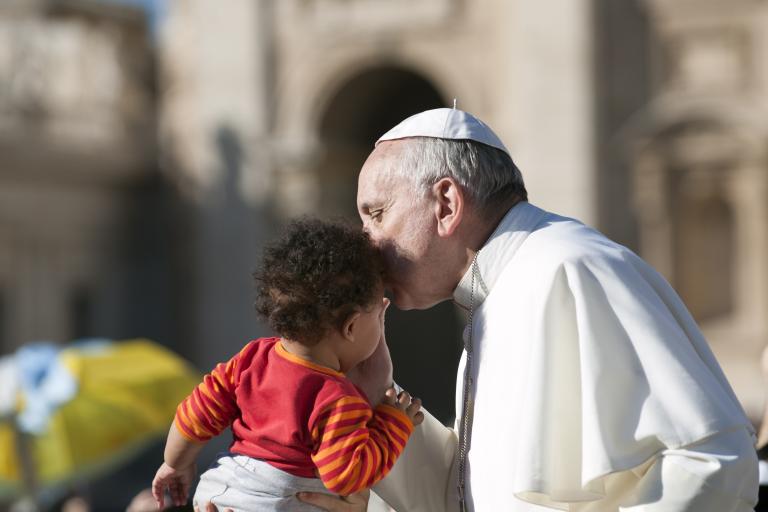
Image via Shutterstock. Used with permission
People know that, as a Catholic Parenting author and family therapist, I encourage parents to eschew corporal punishment in favor of more effective methods discipline that are more respectful of the dignity of the parent and the child. As a result, I’ve been getting emails all week from people about Pope Francis’ recent comments which are being touted in the press as a ringing endorsement of spanking. Before we all get our wimples in a knot, here are a few things to keep in mind.
1. What did Pope Francis really say?
As usual, when the press reports that Pope Francis said something, we have to look at the context of what he actually said. With Pope Francis, context is everything. He tends to not make global pronouncement like St John Paul the Great or Pope Benedict XVI. He is very much a man who is in the here and now, addressing things in a very off the cuff manner. He expects his audience make the effort to “get” the context of his comments. Personally, I think that’s optimistic, but that’s his style and you can’t understand what he means unless you take his style into account.
If you read the actual address–and I encourage you to do so rather than taking the press’ word for it as it’s short enough–the entire talk is about the importance of present, merciful, loving fathers, who aren’t afraid to involve themselves intimately in their wife and children’s lives, lead their families, and discipline their children with love and firmness in a manner that is respectful of their dignity as persons. Here are the paragraphs leading up to the bit that’s getting all the press.
The first need, then, is precisely this: that a father be present in the family. That he be close to his wife, to share everything, joy and sorrow, hope and hardship. And that he be close to his children as they grow: when they play and when they strive, when they are carefree and when they are distressed, when they are talkative and when they are silent, when they are daring and when they are afraid, when they take a wrong step and when they find their path again; a father who is always present. To say “present” is not to say “controlling”! Fathers who are too controlling cancel out their children, they don’t let them develop.
The Gospel speaks to us about the exemplarity of the Father who is in Heaven — who alone, Jesus says, can be truly called the “good Father” (cf. Mk 10:18). Everyone knows that extraordinary parable of the “prodigal son”, or better yet of the “merciful father”, which we find in the Gospel of Luke in chapter 15 (cf. 15:11-32). What dignity and what tenderness there is in the expectation of that father, who stands at the door of the house waiting for his son to return! Fathers must be patient. Often there is nothing else to do but wait; pray and wait with patience, gentleness, magnanimity and mercy.
A good father knows how to wait and knows how to forgive from the depths of his heart. Certainly, he also knows how to correct with firmness: he is not a weak father, submissive and sentimental. The father who knows how to correct without humiliating is the one who knows how to protect without sparing himself.
And then he gives his example. Personally, I don’t think it’s a great example of what he led up to say, but it’s an example and because I’m one of those people who will make the effort to get the context of his remarks, I take his meaning. After all, as a public speaker, I too, have offered examples that fell flat or detracted from my actual point. That said, I don’t think it is too much of a stretch to say that Pope Francis wasn’t really giving a speech about the awesome-y awesomeness of smacking your kids as long as you don’t leave visible marks–that’s COMPLETELY out of character for Pope Francis’ general positions on family life and completely inconsistent with both science and Catholic tradition on this matter (more on this below). Rather, it is clear from the context of his remarks that he was speaking of the importance of dads not being afraid to step up and be dads; involved, loving, generous, engaged leaders of their families and formators of their children’s character and moral life.
2. How Was He Speaking?
The second thing to keep in mind is how he was speaking–that is, in what capacity. When he gave the example of the dad who sometimes has to “strike a child lightly” was he speaking as a theologian? Well, it would not seem so, because he didn’t cite any scriptures, quotes from Vatican documents, or writings of the saints. A theologian always builds from tradition. Pope Francis didn’t do that. He simply offered an example that he thought people could relate to illustrating the point he was trying to make in the three entire paragraphs before the example–three paragraphs, I might add, no one is talking about because his unfortunate example took center stage. It happens, but when an example falls flat, which counts more? The example? Or the 3 paragraphs before it that carefully lays out everything you really meant? Call me crazy, but I would go with what’s behind door #2, that is, the latter of the two options.
Well, if he wasn’t speaking as a theologian, was he speaking as a social scientist? Again, the answer appears to be “no.” A social scientist also speaks from precedence–he cites research, he uses data. Pope Francis did none of this. So, clearly, he wasn’t intending to put forth some final, Catholic judgment on the raging debate in parenting circles and family psychology on the appropriateness and efficacy of corporal punishment.
So if, in giving this example, he was not speaking as a theologian or a social scientist, then what was he speaking as? I would suggest that he was speaking as he often does, as a pastor, who was simply trying to illustrate his larger, main point in a way that his audience might relate to. Again, I personally, think his example failed miserably, but it is a miscalculation that speakers often make. The paragraphs before the example are really quite beautiful and lay out a powerful vision of fatherhood that does, incidentally, track with both Catholic theological tradition and social science.
3. Discipline is a Matter of Prudential Judgment.
The third thing to keep in mind is that, for Catholics, parenting and discipline is a matter of prudential judgment. Pope Francis wouldn’t tell people how to raise their kids because the Church doesn’t do that. it violates subsidiarity. It’s up to parenting experts to state our case for the positions we take and for parents to listen, pray, and decide what makes the most sense to them. I, and the overwhelming majority of my colleagues in family psychology, make the case that there are much more effective and dignified ways than corporal punishment to correct a child; methods that are also completely consistent with Pope Francis’ message of engaged, effective fatherhood. That said, the vast majority of parents ignore that advice and still spank in spite of it. Pope Francis knows this, and so he used an example of someone he felt spanked more mercifully than many other parents to underscore his point and give his message the broadest possible appeal. Again, I think his example failed to serve his intentions, but that doesn’t change the point of his message; namely, dads should discipline, but only by using means that keep the dignity of the child in mind. That point is quite clear and literally obvious from everything he says around the example he gave.
4. What is the Larger Context of This Discussion?
Finally, we need to keep the larger context of this debate in mind. Catholic theologians always respect the scientific findings that impact a particular subject when attempting to speak to that subject. The Vatican regularly asks scientists of every discipline to consult on various issues it has an interest in. If Pope Francis were going to make anything more than a colloquial, folksy, comment on corporal punishment, he would need to consult both tradition and social science, both of which weigh very heavily against corporal punishment as an effective, respectful method of discipline. For instance, here is a summary of the American Psychological Association’s finding on the research about corporal punishment.
Additionally, Pope Francis would need to consult the reflections of those holy men and women who have pronounced on this topic before him. A while ago I posted an article on what the saints had to say about corporal punishment. Here are some quotes pulled from that post.
~If thou shouldst see (your son) transgressing this law, punish him, now with a stern look, now with incisive, now with reproachful, words; at other times win him with gentleness and promises. Have not recourse to blows and accustom him not to be trained by the rod; for if he feel it…, he will learn to despise it. And when he has learnt to despise it, he has reduced thy system to nought. (St. John Chrysostum)
~The birch is used only out of bad temper and weakness for the birch is a servile punishment which degrades the soul even when it corrects, if it indeed corrects, for its usual effect is to burden (St Jean Baptiste de la Salle, c.f., On the Conduct of Christian Schools)
~Force, indeed, punishes guilt but does not heal the guilty….In the case of some boys, a reproachful look is more effective than a slap in the face would be. Praise of work well done and blame in the case of carelessness are already a great reward or punishment. A reproachful or severe look often serves as an excellent means of moral restraint over the young. By it the guilty person is moved to consider his own fault, to feel ashamed, and finally to repent and turn over a new leaf. Never, except in very extreme cases, expose the culprit publicly to shame. Except in very rare cases, corrections and punishments should be given privately and in the absence of companions; and the greatest prudence and patience should be used to bring the pupil to see his fault, with the aid of reason and religion. To strike a child in any way…must be absolutely avoided…[these punishments] greatly irritate the child and degrade the [parent]. (St. John Bosco)
CONCLUSION
So, yes. Pope Francis did, indeed, offer an example of parenting that, taken out of the larger context, appears to suggest that corporal punishment is just grand. Putting it in context, however, it becomes quite clear that his example was just that, an attempt to illustrate a larger point, that unfortunately because of the press’ penchant for sound bites and the volatility of the debate among parents on this topic ended up obliterating the exact point about merciful, loving, engaged fatherhood he was trying to make.
For a thorough perspective on Catholic parenting that takes into account both social science and the fullness of our Catholic tradition, I invite you to pick up a copy of Parenting With Grace: The Catholic Parents’ Guide to Raising (almost) Perfect Kids and Then Comes Baby: The Catholic Guide to Surviving and Thriving in the First Three Years of Parenthood.
Previous Post

February 5, 2015
Fight the Power of 50 Shades: Here's What YOU Can Do!

Browse Our Archives
Select a Category Anxiety atheism Attachment Church Conflict Resolution Counseling Depression faith Family forgiveness Gender Happiness Health Humor Marriage Mental Health Mental Illness Mindfulness morality More2Life Radio Parenting Personal Wellness Personality Disorder Popcak Psychology News reconciliation Relationship religion self-help Sexuality Spirituality stress theology of the body Uncategorized
Select a Month June 2020 May 2020 April 2020 March 2020 February 2020 January 2020 December 2019 November 2019 October 2019 September 2019 August 2019 July 2019 June 2019 May 2019 April 2019 March 2019 February 2019 January 2019 November 2018 October 2018 September 2018 August 2018 July 2018 June 2018 May 2018 April 2018 March 2018 February 2018 January 2018 November 2017 October 2017 September 2017 August 2017 June 2017 May 2017 April 2017 March 2017 February 2017 January 2017 December 2016 November 2016 October 2016 September 2016 August 2016 July 2016 June 2016 May 2016 April 2016 March 2016 February 2016 January 2016 December 2015 November 2015 October 2015 September 2015 August 2015 July 2015 June 2015 May 2015 April 2015 March 2015 February 2015 January 2015 December 2014 November 2014 October 2014 September 2014 August 2014 July 2014 June 2014 May 2014 April 2014 March 2014 February 2014 January 2014 December 2013 November 2013 October 2013 September 2013 August 2013 July 2013 June 2013 May 2013 April 2013 March 2013 February 2013
Follow Us!
TAKE THE
Religious Wisdom Quiz
What did the people do when Ezra read from the Book of the Law?
Select your answer to see how you score.
Ran away Destroyed idols Wept and repented Laughed
Related posts from Faith on the Couch
Attachment and Eternity: The Liturgy of Domestic Church...
You are a Parent Forever In the Line...

Kids Aren't Projects: The Myth of Parenting "Techniques"...

"Imperfect People Need Not Apply" Does the Domestic...
TRENDING AT PATHEOS Catholic

Creation, Preservation, and Teleology in Catholic Theology
As I write this, it is very early Monday morning. Like millions...

The Parable Of The Sower And The Word...
One of Christ’s most famous parables is that of the sower who...

Rejecting Doom: Christian Hope And Human Action
Christianity is a religion of hope. We are to have hope and...

Why I Choose the Eucharist Over the Sermon
Choose the Eucharist, Not the Sermon What are we supposed to get...

5 Design Elements Found in Spiritually Rooted Homes
Putting Spirituality Into Home Decor Our homes are more than our living...

Credo: A Story of God Told with the...
About 10 years ago, I began to imagine a personal "Credo" that...
view all Catholic blogs
Ad-Free & Subscriber Log-In Subscription Support
- About Us
- 2026 Calendar
- Videos
- Podcasts
- Library of World Religions
- Faith In Media Tracker
- Advertise With Us
- Write for Us
- Privacy Policy
- Terms of Service
- Do Not Sell My Data
- Contact Us
- Radiant Digital
- Manage Newsletter Subscriptions
- Unsubscribe From Notifications
- Sitemap
Copyright 2008-2026, Patheos. All rights reserved.
Subscription Support Ad-Free & Subscriber Log-In
Follow Patheos