
BuddhistCatholicContemplativeEvangelicalGeneral ChristianHinduJewishLatter-day SaintMuslimNew VisionsProgressive Christian
Beliefs
- Buddhist
- Catholic
- Contemplative
- Evangelical
- General Christian
- Hindu
- Jewish
- Latter-day Saint
- More Voices
- Muslim
- New Visions
- Pagan
- Progressive Christian
Topics
- Religion News
- Food and Religion
- Sports and Religion
- Religious Art
- Religious Music and Entertainment
- Religious Events
- History and Religion
- Style and Religion
- Politics and Religion
- Women in Religion
- Recreation Outdoors and Religion
- Business Finance and Religion
- Careers Workplace and Religion
- Education and Religion
- Family Parenting and Religion
- Health Fitness and Religion
- Home and Religion
- Relationships and Religion
- Technology and Religion
- Travel and Religion
Columnists
- Buddhist Columnists
- Business Finance and Religion Columnists
- Careers Workplace and Religion Columnists
- Catholic Columnists
- Contemplative Columnists
- Education and Religion Columnists
- Evangelists Columnists
- Family Parenting and Religion Columnists
- General Christian Columnists
- Health Fitness and Religion Columnists
- Hindu Columnists
- History and Religion Columnists
- Home and Religion Columnists
- Jewish Columnists
- More Voices Columnists
- Latter Day Columnists
- Muslim Columnists
- New Visions Columnists
- Nonreligious Columnists
- Pagan Columnists
- Politics and Religion Columnists
- Progressive Columnists
- Recreation Outdoors and Religion Columnists
- Relationships and Religion Columnists
- Religion News Columnists
- Religious Art Columnists
- Religious Events Columnists
- Religious Music and Entertainment Columnists
- Sports and Religion Columnists
- Style and Religion Columnists
- Technology and Religion Columnists
- Travel and Religion Columnists
- Women in Religion Columnists
Resource Library
- 2026 Calendar
- Library of World Religions
- The 100 Most Holy Places on Earth
- Patheos Answers
- Podcasts
- Videos
- Faith Leaders Database
- Anglican Episcopalian
- Bahai
- Baptist
- Buddhism
- Christianity
- Confucianism
- Eastern Orthodoxy
- Hinduism
- Holiness and Pentecostal
- ISKCON
- Islam
- Judaism
- Lutheran
- Methodist
- The Church of Jesus Christ of Latter-day Saints
- New Age
- Paganism
- Presbytarian and Reformed
- Protestantism
- Religion Behind the Scenes
- Roman Catholic
- Scientology
- Shia Islam
- Sikhism
- Sufism
- Sunni Islam
- Taoism
- Zen
- See all religions
Research Tools
 Ad-Free & Subscriber Log-In Subscription Support
Ad-Free & Subscriber Log-In Subscription Support
Follow Patheos 

- Trending:
- Forgiveness
- |
- Marriage
- |
- Consciousness
- |
- Death Penalty
- |
- Election
- |
- Halloween

- Home
- Evangelical
- Politics and Religion
- John Winthrop on Inequality and Social Harmony
John Winthrop on Inequality and Social Harmony
Last updated on: June 22, 2025 at 10:31 pm by John San Nicolas
John Winthrop on Inequality and Social Harmony 2025-06-22T22:31:24-06:00 John San Nicolas
Patheos Explore the world's faith through different perspectives on religion and spirituality! Patheos has the views of the prevalent religions and spiritualities of the world.
In this brief article, we will explore the political thought of John Winthrop (1588-1649). Winthrop served as governor of the Massachusetts Bay colony. In his “Christian Charitie: A Modell Hereof,” Winthrop coined the famous line that his Puritan society would be a “Citty upon a Hill,” in reference to Matthew 5:14. While the extent of Puritan influence on later American political thought is heavily disputed, this metaphor continues to shape America’s national self-understanding.
However, in this article, we will focus on a different component of Winthrop’s thought as it appears to us in “Christian Charitie.” It is a component which the modern liberal order takes for granted: equality as an absolute ideal to be realized in any society worthy of the liberal name.
The pre-liberal Winthrop did not share this dogma of liberalism. Rather, he believed that inequality was key to establishing a harmonious society.
God and Inequality
For Winthrop, a society’s stratification, or its levels of inequality, are ordained and decreed by God. As he writes in his sermon, God has “so disposed of the condition of mankind, as in all times some must be rich some poor, some high and eminent in power and dignity; others mean and in subjection.”
As Michael J. Rosano writes on Winthrop’s thought, “God ordains that [social and economic] diversity in order to make the many parts of creation and conditions of human beings cohere into an organic whole that is greater than the sum of its parts. Human beings must find their place and play their part in that whole in order to become fulfilled as individuals.” [1]
The present social hierarchy is not to be questioned. Nor is it to be overthrown. One’s station in life and socio-economic status are gifts from God. And as we will see shortly, Winthrop believes that this inequality serves a beneficial role to all within society. Inequality is aimed towards the common good.
It is apparent that modern readers living in the liberal milieu of the day will look upon Winthrop’s ideas with disdain, if not condescending curiosity. But one must remember that the vastness of inequality that we see around us today would have been completely inconceivable in Winthrop’s day. One wonders whether Winthrop would see how America’s 0.01% receive over 6% of the entire national income. [2]
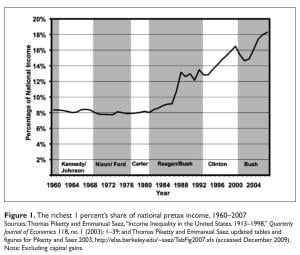
Graph shows America’s richest 1%’s share of national pretax income, 1960–2007
Inequality and Social Harmony
Returning to the subject at hand, how did Winthrop believe that inequality could lead to social harmony? It is important here to note that Winthrop saw stratification as a prerequisite or necessary condition of a harmonious social order. But he by no means thought it alone was sufficient.
Only in a society of believers could stratification lead to social harmony. Against the Lockean assertion of self-interest, and even against the Tocquevillean value of self-interest properly understood, Winthrop had an all too negative view of human nature. Humanity was far too sinful for the pursuit of self-interest itself to produce a flourishing society or flourishing individuals.
Thus, for Winthrop, what was first required was that a society be made of Christians. These Christians were to then order their common life on two precepts: justice and mercy. Justice concerns the creation and following of right laws.
But mercy is a more personal virtue in need of cultivation. Mercy is not rational like justice, but is contextual and much like how we talk of discernment today. [3]
Remember how Winthrop insists that one’s station is a gift from God? If this is so, then the wealth of the rich is really not their own. It belongs to God and its purpose is to glorify Him and edify the community. Therefore, the wealthy are always tasked with “giving, lending, and forgiving,” and doing so cheerfully. [4] In times of grave danger or disaster, the rich must do these things, even beyond their means, to help the community.
The Perfect Bond
In his work on Winthrop, Rosano brings a verse to our minds. It comes from Paul’s letter to the Colossians: love “is the bond of perfection” (Col. 3:14, NKJV). As the team at the Bible Project have done so well in reminding us, “perfection” in its New Testament usage has a meaning quite distinct from how we use the word today.
The Koine Greek teleios is often translated as “perfect.” But in the original language, this perfection is not understood in terms of complete moral rightness. Rather, perfection is fulfillment of something’s purpose or function. God Himself is the purpose of all things, and therefore love, which is the bond of perfection in that Citty on a Hill that Winthrop envisioned, is a striving towards the fulfilled community in God Himself.
Inequality was crucial role for what Winthrop envisioned. In working through inequality, the rich would be tested for their mercy, and the poor for their virtue. All had what they had (or lacked) because it was a gift from God. And because all was from God, all was ultimately to be given back to God. When there arose need within the community, one gave back to God or fulfilled one’s possessions by giving it into the community.
Conclusion
Winthrop’s communal vision would be impracticable today. The sheer amount of inequality, despite centuries of decreasing poverty rates, demands a response. But there is still value in Winthrop’s political vision.
Today we should remember that what we have now is truly from God. Even if we put in the effort, ultimately God is the source and purpose of all things.
Winthrop had a moral vision for the economy of the community. It was supposed to be an exclusively Christian community, no doubt. But perhaps we might adopt a moral vision of the economies of our communities today. We can give unto Caesar through paying our taxes, as Christ said (Matthew 22:21). But Winthrop shows us what it means to give unto God. When our neighbor is in distress, and even in the ordinary course of events, giving unto God means building up the community.
Notes
1. Michael J. Rosano, “John Winthrop, John Cotton, and Nathaniel Niles: The Basic Principles of Puritan Political Thought,”History of American Political Thought, 2nd ed., edited by Bryan-Paul Frost and Jeffrey Sikenga (Lexington Books, 2019), 25.
2. Jacob S. Hacker and Paul Pierson, “Winner-Take-All Politics: Public Policy, Political Organization, and the Precipitous Rise of Top Incomes in the United States,” Politics & Society 38(2): 155.
3. Rosano, “John Winthrop, John Cotton, and Nathaniel Niles,” 28-29.
4. Rosano, “John Winthrop, John Cotton, and Nathaniel Niles,” 29.
Previous Post

June 16, 2025
There is No Muslim Invasion of Europe
Next Post

July 1, 2025 Christianity's Contemporary Challenges: A Gen Z Perspective
Recent Comments
Browse Our Archives
Select a Category Bible Current Events History Press Releases Theory Tradition Uncategorized
Select a Month December 2025 September 2025 August 2025 July 2025 June 2025 May 2025 April 2025 March 2025 February 2025 January 2025 December 2024 November 2024 October 2024 September 2024 August 2024 July 2024 June 2024 May 2024 April 2024 March 2024
Follow Us!
TAKE THE
Religious Wisdom Quiz
What Christian holiday celebrates Jesus' resurrection?
Select your answer to see how you score.
Easter Christmas Good Friday Pentecost
Related posts from Faithful Politics
Religious Liberty and Race in America

Is the Pro-Life Movement Losing Its Party Platform...

Christians and Political Authority in a Democratic Society
Was Dr. Martin Luther King, Jr. a Heretic?
TRENDING AT PATHEOS Evangelical

Reading America at 250: A Nation Wrestles With...
As part of my own reflection on the 250th anniversary of the...

Whenever I am reading a book or listening to an argument, I...

President Trump Ban Animal Torture Videos on Facebook
Call for Stricter Regulations of Animal Abuse Content on Facebook Although President...

Draft Amendments to Address Ritual Abuse in New...
The proposed changes would make it illegal for individuals in domestic partnerships...

How Bans on LGBTQ+ Student Clubs Threaten Religious...
On June 20, 2025, the State of Texas passed Senate Bill 12....

The Truth About the Gen Z Revival
This past year, there has been a lot of media buzz surrounding...
view all Evangelical blogs
What Are Your Thoughts?leave a comment
Ad-Free & Subscriber Log-In Subscription Support
- About Us
- 2026 Calendar
- Videos
- Podcasts
- Library of World Religions
- Faith In Media Tracker
- Advertise With Us
- Write for Us
- Privacy Policy
- Terms of Service
- Do Not Sell My Data
- Contact Us
- Radiant Digital
- Manage Newsletter Subscriptions
- Unsubscribe From Notifications
- Sitemap
Copyright 2008-2026, Patheos. All rights reserved.
Subscription Support Ad-Free & Subscriber Log-In
Follow Patheos