
BuddhistCatholicContemplativeEvangelicalGeneral ChristianHinduJewishLatter-day SaintMuslimNew VisionsProgressive Christian
Beliefs
- Buddhist
- Catholic
- Contemplative
- Evangelical
- General Christian
- Hindu
- Jewish
- Latter-day Saint
- More Voices
- Muslim
- New Visions
- Pagan
- Progressive Christian
Topics
- Religion News
- Food and Religion
- Sports and Religion
- Religious Art
- Religious Music and Entertainment
- Religious Events
- History and Religion
- Style and Religion
- Politics and Religion
- Women in Religion
- Recreation Outdoors and Religion
- Business Finance and Religion
- Careers Workplace and Religion
- Education and Religion
- Family Parenting and Religion
- Health Fitness and Religion
- Home and Religion
- Relationships and Religion
- Technology and Religion
- Travel and Religion
Columnists
- Buddhist Columnists
- Business Finance and Religion Columnists
- Careers Workplace and Religion Columnists
- Catholic Columnists
- Contemplative Columnists
- Education and Religion Columnists
- Evangelists Columnists
- Family Parenting and Religion Columnists
- General Christian Columnists
- Health Fitness and Religion Columnists
- Hindu Columnists
- History and Religion Columnists
- Home and Religion Columnists
- Jewish Columnists
- More Voices Columnists
- Latter Day Columnists
- Muslim Columnists
- New Visions Columnists
- Nonreligious Columnists
- Pagan Columnists
- Politics and Religion Columnists
- Progressive Columnists
- Recreation Outdoors and Religion Columnists
- Relationships and Religion Columnists
- Religion News Columnists
- Religious Art Columnists
- Religious Events Columnists
- Religious Music and Entertainment Columnists
- Sports and Religion Columnists
- Style and Religion Columnists
- Technology and Religion Columnists
- Travel and Religion Columnists
- Women in Religion Columnists
Resource Library
- 2026 Calendar
- Library of World Religions
- The 100 Most Holy Places on Earth
- Patheos Answers
- Podcasts
- Videos
- Faith Leaders Database
- Anglican Episcopalian
- Bahai
- Baptist
- Buddhism
- Christianity
- Confucianism
- Eastern Orthodoxy
- Hinduism
- Holiness and Pentecostal
- ISKCON
- Islam
- Judaism
- Lutheran
- Methodist
- The Church of Jesus Christ of Latter-day Saints
- New Age
- Paganism
- Presbytarian and Reformed
- Protestantism
- Religion Behind the Scenes
- Roman Catholic
- Scientology
- Shia Islam
- Sikhism
- Sufism
- Sunni Islam
- Taoism
- Zen
- See all religions
Research Tools
 Ad-Free & Subscriber Log-In Subscription Support
Ad-Free & Subscriber Log-In Subscription Support
Follow Patheos 

- Trending:
- Forgiveness
- |
- Marriage
- |
- Consciousness
- |
- Death Penalty
- |
- Election
- |
- Halloween

- Home
- Evangelical
- Politics and Religion
- Practicing Faithful Politics
Practicing Faithful Politics
Last updated on: April 16, 2024 at 11:01 am by John San Nicolas
Practicing Faithful Politics 2024-04-16T11:01:47-06:00 John San Nicolas
Patheos Explore the world's faith through different perspectives on religion and spirituality! Patheos has the views of the prevalent religions and spiritualities of the world.
Ah, religion and politics. The two things you don’t want to bring up at the family dinner table.
In the popular imagination, we live in a politically fragmented world. Politics is a site of conflict. It divides us.
We see this in political polarization. The main idea behind polarization is that America’s two party system is becoming more and more divided, and more and more extreme, in both directions. The Right is moving further Right even as the Left goes further Left. Division ends up feeding into itself as groups in both parties become increasingly radicalized and extreme. Polarized politics becomes fertile ground for political extremism and echo chambers. (For more on polarization and extremism, see this Georgia University article.)
Disengaging from Politics
So, where does that leave the rest of us? There was a book written by researchers from the University of Michigan called The Other Divide: Polarization and Disengagement in American Politics. The authors write that although there is a stark division between the vocal Left and vocal Right, there is another divide. The most radicalized voices do not represent the whole American people. There are also Americans who are silent on politics, or simply not as loud as those who are most vocal and most divisive. In the face of political division, these people have become disengaged from politics.
There are plenty of explanations for political disengagement. Perhaps people disengage from politics because they do not like conflict. Maybe they disengage because they have grown tired of politics. Or because they have found that neither party represents their interests. They would rather vote third party, or worse, not at all.
This is the context in which many of us find ourselves. We shy away from politics. We excuse ourselves from political conversations for fear of losing friends or for lack of knowledge. Politics is immense, difficult to grasp, and intimidating.
A Way Forward
In this article, I invite us to think about what it means to practice politics faithfully, especially for Christians. How do we participate in politics without compromising who we are? How can we build a life with our neighbors that is just and good, and at the same time respects the freedom of our neighbors to accept or reject our faith and values? Pursuing honest answers to these questions is what I call faithful politics.
There are the stories of Christian nationalism in Brazil and in the US, where movements of Christians are trying to restore America to its supposed Christian roots. Around the world, Jewish nationalism is wreaking havoc on Gaza, Hindu nationalism threatens the contested territory of Kashmir, and Islamic nationalism takes the lives of Muslims who convert to Christianity.
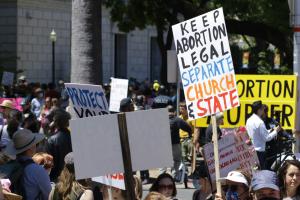
Aiden Frazier / Unsplash
Yet at the same time, Jews, Christians, and Muslims peacefully live alongside each other in various countries throughout Western Asia. Slavery in America was abolished because of the faith and resistance of Black Christians, and with the help of White abolitionists. The Farmworker’s Movement was empowered by Catholicism. Spiritualist women were able to push for more than suffrage at a time when women’s rights were rendered unimportant. Native Americans resisted assimilation and ethnic eradication in part by retaining their spiritualities. Jewish people have been able to hold on to their identity and communities even after millennia of persecution and, under the Nazis, one of the deadliest genocides in history. These stories, although they are not yet over, show how religion can embolden struggles for freedom and survival. Religion and politics can be either a recipe for disaster or a seed that grows towards a better world.
Rethinking “Politics”
But for now, the journey of a thousand miles begins with a single step. The first step towards faithful politics, I believe, is to rethink and reimagine politics. Must politics be divisive? Need it be intimidating? Does political life always have to be a win-or-lose game?
We should question these attitudes and thoughts. To do that, we should probably start by defining politics. Politics stems from the Greek word for “city” (polis). For the ancient Greeks, politics was the art of ordering and governing a city’s life. Consider the philosopher Plato. Plato’s famous Republic was an exploration of the perfect city. It was an ancient piece of political philosophy. Plato asked, “How should we choose who rules the city? What does just rule look like? How should citizens contribute to the life of the city?” And so on.
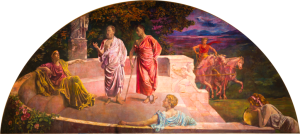
The Relation of the Individual to the State by John La Farge / Public Domain
Politics was seen as a craft and an art by Plato and his fellow Grecians. It was something that someone practiced, just as a person might practice photography or playing an instrument. It was something that could be perfected. And it was a craft that aimed to benefit all in a city. As such, politics was viewed by these ancient thinkers as actively and practically seeking the common good of the city.
The Common Good
Now, the common good is not the same as the greater good. The greater good of society is pursued at the expense of those who are not included in the greater good. If the greater good is defined by the majority of a city, then the goods of the minority are sacrificed. If the greater good is defined by the minority of a nation, such as a group of elites or a dictator, then the “greater good” is pursued at the expense of the majority.
The common good is a high ideal. The common good is what is good for everyone in the city or nation. Everyone wins when the common good is sought. It does not mean that everyone wins equally. Nor does pursuing the common good mean that utopia has been realized. But seeking the common good, in other words, doing politics, means seeking the welfare of everyone. She who seeks the common good is not content with policies and laws that benefit some but bring harm and damage to others.
We have begun to reimagine politics. Instead of winning at the expense of one’s political enemies, politics is an art form. It is a craft that we can practice and make better. It is the pursuit of the good of one’s neighbors, no matter who they are. Every group in a society can seek the common good. But what is beautiful about politics is that each group can pursue the common good in their own unique way.
For Christians, faithful politics means pursuing the common good in deeply Christian ways.
Seeking the Good of the City
There is an often quoted verse in the book of Jeremiah. It exhorts its listeners to seek the welfare of the city in which they live. At the time, the people of Israel were living in exile. They were removed and dispossessed and had to live in a foreign land.
One would think that the Israelites wanted to start a revolution to overthrow Babylon to return to Canaan (this would be the case later on in Jesus’s time). Or perhaps they would have given up and become inactive and disengaged from social life. Maybe they would have given up hope that things could become better. Or maybe they had hope, and that hope prevented them from acting to make life better. But the prophet Jeremiah as a mouthpiece for God presented an alternative path. We would do well to read the full verse.
But seek the welfare of the city where I have sent you into exile, and pray to the Lord on its behalf, for in its welfare you will find your welfare (Jer. 29:7, ESV).
In its welfare we shall find our welfare. When we seek the good of the city, we pursue its health and prosperity. We pursue its justice and its peace. We’re not trying to get our slice of the pie and then give up on the city. We shouldn’t stop at giving it our thoughts and prayers. No. We are to seek its welfare. Because its welfare is ours. This is not politics as divisive and power-hungry. This is a politics that is incredibly faithful. Faithful to one’s commitments, but at the same time faithful to one’s city.
This path entails many questions. Which city do I live in? Which nation do I reside in? What does it mean to be an exile here on earth? And how do I figure out what is good for the place in which I live?
Conclusion: The Focus of Faithful Politics
These questions and more are the focus of Faithful Politics. These questions are immensely important, and they affect our political and social engagement in this world. What matters is not whether we practice the craft and art of politics. We are always already doing that. What matters is how we do politics.
Will we be Christians who bend and break according to the whims and winds of the world? Will we be Christians who are co-opted by ideologies and agendas to serve the mighty and the wicked? Maybe we will be Christians who are tested by fire and succumb to the flames? Or will we be Christians who practice politics faithfully? Will we seek the good of our city?
Politics does not need to be inherently divisive. Christianity does not need to be apolitical, nor is it inherently politically harmful. There are ways for us to build a common life with our neighbors where we can all flourish. But before we put our hands to the plow, we must contemplate. We must pray. And then, we must discern the times together.
Thank you so very much for reading. Let’s get started.

About John San Nicolas
John San Nicolas is an undergraduate student at the University of New Mexico. A double major in Religious Studies and Philosophy, John conducts independent research on religion and politics. John examines how evangelical Christians engage in politics and society in the US and around the world. Drawing from World Christianity, affect theory, and political theology, John hopes to develop and share ideas that can help guide the Church in trying times. You can read more about the author here.
Previous Post

December 22, 2025
How Bans on LGBTQ+ Student Clubs Threaten Religious Liberty
Next Post
March 24, 2024 Lessons from Elevation Church's Easter Invites
Recent Comments
Browse Our Archives
Select a Category Bible Current Events History Press Releases Theory Tradition Uncategorized
Select a Month December 2025 September 2025 August 2025 July 2025 June 2025 May 2025 April 2025 March 2025 February 2025 January 2025 December 2024 November 2024 October 2024 September 2024 August 2024 July 2024 June 2024 May 2024 April 2024 March 2024
Follow Us!
TAKE THE
Religious Wisdom Quiz
According to Hebrews, Jesus is the same yesterday, today, and when?
Select your answer to see how you score.
Forever Throughout all generations Until the end of the age In all eternity past
Related posts from Faithful Politics

Christianity's Contemporary Challenges: A Gen Z Perspective

Christians and Political Authority in a Democratic Society

Poverty is Not Just Economic, It’s Spiritual

Sex, Politics, and Religion: An Introduction
TRENDING AT PATHEOS Evangelical

Reading America at 250: A Nation Wrestles With...
As part of my own reflection on the 250th anniversary of the...

Whenever I am reading a book or listening to an argument, I...

President Trump Ban Animal Torture Videos on Facebook
Call for Stricter Regulations of Animal Abuse Content on Facebook Although President...

Draft Amendments to Address Ritual Abuse in New...
The proposed changes would make it illegal for individuals in domestic partnerships...
How Bans on LGBTQ+ Student Clubs Threaten Religious...
On June 20, 2025, the State of Texas passed Senate Bill 12....

The Truth About the Gen Z Revival
This past year, there has been a lot of media buzz surrounding...
view all Evangelical blogs
What Are Your Thoughts?leave a comment
Ad-Free & Subscriber Log-In Subscription Support
- About Us
- 2026 Calendar
- Videos
- Podcasts
- Library of World Religions
- Faith In Media Tracker
- Advertise With Us
- Write for Us
- Privacy Policy
- Terms of Service
- Do Not Sell My Data
- Contact Us
- Radiant Digital
- Manage Newsletter Subscriptions
- Unsubscribe From Notifications
- Sitemap
Copyright 2008-2026, Patheos. All rights reserved.
Subscription Support Ad-Free & Subscriber Log-In
Follow Patheos