
BuddhistCatholicContemplativeEvangelicalGeneral ChristianHinduJewishLatter-day SaintMuslimNew VisionsProgressive Christian
Beliefs
- Buddhist
- Catholic
- Contemplative
- Evangelical
- General Christian
- Hindu
- Jewish
- Latter-day Saint
- More Voices
- Muslim
- New Visions
- Pagan
- Progressive Christian
Topics
- Religion News
- Food and Religion
- Sports and Religion
- Religious Art
- Religious Music and Entertainment
- Religious Events
- History and Religion
- Style and Religion
- Politics and Religion
- Women in Religion
- Recreation Outdoors and Religion
- Business Finance and Religion
- Careers Workplace and Religion
- Education and Religion
- Family Parenting and Religion
- Health Fitness and Religion
- Home and Religion
- Relationships and Religion
- Technology and Religion
- Travel and Religion
Columnists
- Buddhist Columnists
- Business Finance and Religion Columnists
- Careers Workplace and Religion Columnists
- Catholic Columnists
- Contemplative Columnists
- Education and Religion Columnists
- Evangelists Columnists
- Family Parenting and Religion Columnists
- General Christian Columnists
- Health Fitness and Religion Columnists
- Hindu Columnists
- History and Religion Columnists
- Home and Religion Columnists
- Jewish Columnists
- More Voices Columnists
- Latter Day Columnists
- Muslim Columnists
- New Visions Columnists
- Nonreligious Columnists
- Pagan Columnists
- Politics and Religion Columnists
- Progressive Columnists
- Recreation Outdoors and Religion Columnists
- Relationships and Religion Columnists
- Religion News Columnists
- Religious Art Columnists
- Religious Events Columnists
- Religious Music and Entertainment Columnists
- Sports and Religion Columnists
- Style and Religion Columnists
- Technology and Religion Columnists
- Travel and Religion Columnists
- Women in Religion Columnists
Resource Library
- 2026 Calendar
- Library of World Religions
- The 100 Most Holy Places on Earth
- Patheos Answers
- Podcasts
- Videos
- Faith Leaders Database
- Anglican Episcopalian
- Bahai
- Baptist
- Buddhism
- Christianity
- Confucianism
- Eastern Orthodoxy
- Hinduism
- Holiness and Pentecostal
- ISKCON
- Islam
- Judaism
- Lutheran
- Methodist
- The Church of Jesus Christ of Latter-day Saints
- New Age
- Paganism
- Presbytarian and Reformed
- Protestantism
- Religion Behind the Scenes
- Roman Catholic
- Scientology
- Shia Islam
- Sikhism
- Sufism
- Sunni Islam
- Taoism
- Zen
- See all religions
Research Tools
 Ad-Free & Subscriber Log-In Subscription Support
Ad-Free & Subscriber Log-In Subscription Support
Follow Patheos 

- Trending:
- Forgiveness
- |
- Marriage
- |
- Consciousness
- |
- Death Penalty
- |
- Election
- |
- Halloween
 Faithful Peacemaking
- Home
- Progressive Christian
- Subversive Blessings: The Beatitudes As Guidance For Unconditional Love
Subversive Blessings: The Beatitudes As Guidance For Unconditional Love
Last updated on: February 2, 2023 at 11:43 am by Lindsey Paris-Lopez
Subversive Blessings: The Beatitudes As Guidance For Unconditional Love 2023-02-02T11:43:47-05:00 Lindsey Paris-Lopez
Patheos Explore the world's faith through different perspectives on religion and spirituality! Patheos has the views of the prevalent religions and spiritualities of the world.
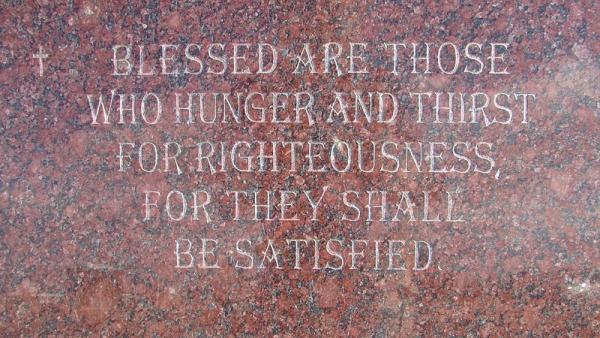
One of the Beatitudes, or Subversive Blessings, of the Sermon on the Mount.
Subversive Blessings
The Sermon on the Mount, as I wrote in my last post, is the blueprint for building Beloved Community here on earth.
It begins with the Beatitudes, subversive blessings on those thought to be cursed. Love’s Dominion is founded upon those thought to be unloved to show that Love is all-encompassing. In a world of measuring our worth over and against each other, the Beatitudes affirm God’s solidarity with the last and least.
As we continue to explore the Beatitudes, the main point I want to emphasize is that we should not dismiss them as otherworldly, impractical platitudes. Rather, the call to see God in the most vulnerable, broken, and despised is actionable guidance to bring us into our fullness as living images of Love.
These subversive blessings comfort us in our times of despair and move us to action to heal a despairing world.
Blessed Are Those Who Hunger And Thirst For Righteousness, For They Shall Be Filled
What does it mean to hunger and thirst for righteousness?
The concept of righteousness has wrought much wrong: (un)holy wars, conquests, genocides. The pseudo-righteousness of condemning others — “righteousness” like that of the Doctrine of Discovery, which commands the subjugation of non-Christians, for example — is a Satanic lie.
Righteousness doesn’t mean right belief or rigid behavior. Righteousness means justice. And justice means ensuring, or restoring, the conditions in which our interconnected world may thrive.
Again, Luke’s rendering is unmistakable. “Blessed are you who are hungry now.” We can readily understand the gnawing pain of an aching stomach. A true hunger for righteousness is intimately intertwined with physical hunger, for it is an earnest desire for every stomach to be filled.
To hunger and thirst for righteousness is to long for a world in which recognition of the infinite dignity of every person leads to communities of compassion for all.
In the Hebrew Bible, God instructs the people to build communities that welcome sojourners, treat foreigners as kindred, and care for the vulnerable. Instructions are given to nurture the land that all may partake of its bounty. God makes provisions for relief from debt and labor. Compassion and co-nurturing for all are God’s conditions for justice*.*
Today we live in a world of rapidly-increasing food insecurity, leaving billions malnourished. Greed and powerlust are creating sacrifice zones around the world, from urban and rural communities in the United States to the battlefields of Ukraine to war-torn, robbed Afghanistan. Injustice festers as people die from falling bombs, empty bellies, or the despair of broken dreams.
To hunger and thirst for righteousness is to work for restorative justice that reclaims the humanity of those dehumanized in pursuit of profit and power. It is to beat swords into plowshares to feed a justice-and-mercy-starved world.
Blessed Are The Merciful, For They Shall Receive Mercy
Of all the Beatitudes, this is the most intuitive.
Of course the merciful shall receive mercy.
Except when they don’t.
The heartbreaking truth is that we don’t always return or even recognize mercy when we receive it. Sometimes ego, frustration, rivalry, or misunderstanding make people see each other through distorted lenses.
Sometimes, people forgive only to receive scorn, injury, or worse in return. In the heat of conflict, offering mercy is an act of vulnerability that can seem almost impossible, especially when trust is lacking.
This is a subversive blessing because the merciful open themselves to vulnerability and potential pain. Mercy is a risk.
But it is a risk worth taking. Because a world without mercy is toxic and deadly.
It can be hard to be merciful in the throes of desperation. But living in mercy day to day creates an infrastructure of mercy that calms, heals, and restores a desperate world.
Moments of crisis are not the only opportunities we have for mercy. Love calls us to build an infrastructure of mercy by living in humility and working for a culture of second chances, abundant generosity, and sincere compassion. We are all interconnected, even in conflict. Only by loving, helping, and forgiving each other can we create a world in which others are there to love, help, and forgive us.
Mercy is risky. But when it catches, it is contagious and transformative.
Jesus promises mercy to those who take the risk of showing mercy. As the Body of Christ, we are called to dare to show kindness in an otherwise merciless world.
We may not always receive mercy in return for mercy. But we can build a world in which mercy comes more naturally.
If we dare to trust in mercy, the world won’t be merciless forever.
Blessed Are The Pure In Heart, For They Shall See God
“Purity,” like “righteousness,” is frequently misunderstood.
Too often, churches have reduced the concept of purity to sexual purity… or at the very least over-emphasized it. Dangerously. It would take a longer article to dissect all of the harm that has come from churches that impose shame on those who do not strictly follow their out-of-context scriptural interpretations. Simply put, misogyny, queerphobia, and shame intertwined in purity culture are impure in themselves, and their fruits are toxic.
Purity means integrity. Love calls us to integrity in all of our relationships, intimate, platonic, familial, and communal. Demonization and dehumanization, denying the value of others, diminishes our integrity and clouds our vision. The “pure in heart” see clearly to recognize God in every human being, and God’s handiwork in all creation.
To be “pure in heart” is to focus on universal, unconditional Love as the guiding principle of life. That’s the kind of purity that greed and selfishness, lust for power and prestige, cannot corrupt. That’s the kind of purity that keeps us from oppressing, exploiting, or neglecting others. It’s the kind of purity that helps us see the needs of others so that we may act on them.
Purity has the unfortunate connotation of being fragile, lost forever if any mistake is made. But Love can purify us whenever we stumble and give into selfishness or fear. We make amends as best as we can as we let Love clear the logs from our eyes.
The pure in heart see God — in friend and stranger, neighbor and enemy. In all colors, genders, sexualities, abilities, classes, and ideologies. May Love purify our vision so that we can see and serve God in one another too.
Blessed Are The Patient, For There Are Still A Few More To Go.
The most subversive blessings, the blessings of the persecuted, slandered, and despised, are yet to come.
Image: Photograph of engraved Beatitude by Chris Light. Available on Wikimedia Commons via Creative Commons Attribution-Share Alike 4.0 International License.

Previous Post

January 31, 2023
The Subversive Sermon on the Mount: A Blueprint for Beloved Community
Next Post

June 27, 2023 Following the Call of the Spirit: Resurrecting Faith In Ourselves
Recent Comments
Browse Our Archives
Select a Category Biblical Interpretation Church Holiday Lectionary Peacemaking Pride Uncategorized
Select a Month July 2023 June 2023 February 2023 January 2023 December 2022 November 2022 October 2022 September 2022 July 2022 June 2022
TAKE THE
Religious Wisdom Quiz
Who was Ahab's wicked wife, notorious for her cruelty?
Select your answer to see how you score.
Athaliah Michal Jezebel Abigail
Related posts from Faithful Peacemaking

Heaven Is Within Us: Wrestling With Doubt on...

Dear Churches, Please Keep Your Rainbow Flags Flying

The Subversive Sermon on the Mount: A Blueprint...

Saying Yes to the Spirit: A Meditation on...
TRENDING AT PATHEOS Progressive Christian

Why Christians Have a Sacred Duty to Vote:...
The Bible offers strong support for the sacred duty to vote. Here...

What Being a Modern-Day Apostle Means to Me
In my last column, I discussed the ins and outs of modern-day...

Did Ancient China Once Worship the God of...
Across human history, a common thread weaves through the origins of the...

Love Your Neighbor – Including Earth-Kin: Lev. 19,...
God’s command to love your neighbor means acting in an ethical and...

Lead a Church Study of “Jesus and Lao...
Guest writer Jack Thomas (The Irreverent Reverend) reflects on leading his church...

Principles for Understanding the Apostolic Ministry Today
Whenever people discover that my formal ministry title is "apostle," as in...
view all Progressive Christian blogs
Ad-Free & Subscriber Log-In Subscription Support
- About Us
- 2026 Calendar
- Videos
- Podcasts
- Library of World Religions
- Faith In Media Tracker
- Advertise With Us
- Write for Us
- Privacy Policy
- Terms of Service
- Do Not Sell My Data
- Contact Us
- Radiant Digital
- Manage Newsletter Subscriptions
- Unsubscribe From Notifications
- Sitemap
Copyright 2008-2026, Patheos. All rights reserved.
Subscription Support Ad-Free & Subscriber Log-In
Follow Patheos