
BuddhistCatholicContemplativeEvangelicalGeneral ChristianHinduJewishLatter-day SaintMuslimNew VisionsProgressive Christian
Beliefs
- Buddhist
- Catholic
- Contemplative
- Evangelical
- General Christian
- Hindu
- Jewish
- Latter-day Saint
- More Voices
- Muslim
- New Visions
- Pagan
- Progressive Christian
Topics
- Religion News
- Food and Religion
- Sports and Religion
- Religious Art
- Religious Music and Entertainment
- Religious Events
- History and Religion
- Style and Religion
- Politics and Religion
- Women in Religion
- Recreation Outdoors and Religion
- Business Finance and Religion
- Careers Workplace and Religion
- Education and Religion
- Family Parenting and Religion
- Health Fitness and Religion
- Home and Religion
- Relationships and Religion
- Technology and Religion
- Travel and Religion
Columnists
- Buddhist Columnists
- Business Finance and Religion Columnists
- Careers Workplace and Religion Columnists
- Catholic Columnists
- Contemplative Columnists
- Education and Religion Columnists
- Evangelists Columnists
- Family Parenting and Religion Columnists
- General Christian Columnists
- Health Fitness and Religion Columnists
- Hindu Columnists
- History and Religion Columnists
- Home and Religion Columnists
- Jewish Columnists
- More Voices Columnists
- Latter Day Columnists
- Muslim Columnists
- New Visions Columnists
- Nonreligious Columnists
- Pagan Columnists
- Politics and Religion Columnists
- Progressive Columnists
- Recreation Outdoors and Religion Columnists
- Relationships and Religion Columnists
- Religion News Columnists
- Religious Art Columnists
- Religious Events Columnists
- Religious Music and Entertainment Columnists
- Sports and Religion Columnists
- Style and Religion Columnists
- Technology and Religion Columnists
- Travel and Religion Columnists
- Women in Religion Columnists
Resource Library
- 2026 Calendar
- Library of World Religions
- The 100 Most Holy Places on Earth
- Patheos Answers
- Podcasts
- Videos
- Faith Leaders Database
- Anglican Episcopalian
- Bahai
- Baptist
- Buddhism
- Christianity
- Confucianism
- Eastern Orthodoxy
- Hinduism
- Holiness and Pentecostal
- ISKCON
- Islam
- Judaism
- Lutheran
- Methodist
- The Church of Jesus Christ of Latter-day Saints
- New Age
- Paganism
- Presbytarian and Reformed
- Protestantism
- Religion Behind the Scenes
- Roman Catholic
- Scientology
- Shia Islam
- Sikhism
- Sufism
- Sunni Islam
- Taoism
- Zen
- See all religions
Research Tools
 Ad-Free & Subscriber Log-In Subscription Support
Ad-Free & Subscriber Log-In Subscription Support
Follow Patheos 

- Trending:
- Forgiveness
- |
- Marriage
- |
- Consciousness
- |
- Death Penalty
- |
- Election
- |
- Halloween

- Home
- Progressive Christian
- No Ideas But In Things: A Baptist Recovers Ritual
No Ideas But In Things: A Baptist Recovers Ritual
Last updated on: January 25, 2017 at 7:42 pm by Guest Contributor
No Ideas But In Things: A Baptist Recovers Ritual 2017-01-25T19:42:29+00:00 Guest Contributor
Patheos Explore the world's faith through different perspectives on religion and spirituality! Patheos has the views of the prevalent religions and spiritualities of the world.

Over the course of 12 months, the Forum for Theological Exploration (FTE) is spotlighting 12 leaders, their stories, and how their passion and call to shape a more hopeful future through Christian ministry guides the impact they are making in their communities, institutions and universities. You can find the full series, here.
By Aaron Coyle-Carr
When I was a teenager, and still proudly an evangelical, I went on a mission trip to South Africa. As it happened, our flight was routed through Paris, and the layover was long enough to provide us the opportunity to do some sight-seeing. We didn’t have time to see the Louvre, but we did have time to visit Notre-Dame de Paris, the medieval gothic cathedral at the heart of the city.
I never did figure out who thought it would be a good idea to send four dozen evangelical teenagers to tour a cathedral, but while some of my peers muttered about “papists” and others treated the nave more like an art gallery, I was utterly enthralled. For the first time in my life I was experiencing a form of Christianity that cared about things like matter and aesthetics. The cathedral was built not just to function as a meeting place, but to be beautiful and to convey meaning in tangible ways – through stone and glass and wood. Even when it was crammed full of tourists, the cathedral remained something sacred, and something in me stirred in response.
Years later, my wife would finally name that feeling for me when she said, “Sometimes I have to hold a truth in my hands before I can know it in my head.” Notre-Dame taught me – and still teaches me – that the physical, tangible things of this good earth have the power to mediate something transcendent. More importantly, it taught me that sometimes we have to experience the power of that transcendence in matter before we can ever talk about the transcendent in abstract ideas or principles. The poet William Carlos Williams says it another, simpler way: “No ideas but in things.”
This was a hard lesson for me as a young Baptist to learn. In my experience, Baptists are famously opposed to the power of things to mediate the transcendent. What most of our brothers and sisters call sacraments we call ordinances, and that language is telling. We do not typically practice communion or baptism because they are beautiful and meaningful and transformative. We do these things because we believe Jesus has commanded us to do them. And because we are all still vaguely aware of the concerns of the Reformers we exercise constant vigilance in ensuring that following Jesus’ orders doesn’t look like what we would perceive as “too Catholic.” We guard carefully against “rituals” because we believe they are lifeless and performed by rote. A traditional Baptist might edit Williams’ words to read, “Ideas are not in things.”
And I might have agreed with that edit if it weren’t for seminary. My first year was a rough time for me, both personally and academically. But every Wednesday night I would share communion with members of the small Episcopal church where I interned. And every Thursday we would gather as a school to celebrate the holy meal. And every Friday a few faithful students would offer a quiet and contemplative Eucharist to close out another long week. It didn’t matter what was going on in my life, the meal was there. On good days, it was celebration. On hard days, it was sustenance. And on days where I felt I could not hold on to anything, it was the thing which I could physically hold in my hand. Bread and wine became things by which I came to know even more deeply the presence of God. As one of my professors told me, “When the world is completely upside down, the Eucharist is always the same. That’s the power of ritual.”
What began in Paris and matured in Atlanta continues even now as I pastor a small Baptist congregation on the edge of Greensboro, North Carolina. They try to be faithful to the traditional Baptist party line, but even they have experienced the power of ideas in things. The communion table, for example, is not to be messed with. Hundreds of lovingly made Chrismons adorn the tree and tell the story during Advent. And people reflexively reach for ancient and powerful rituals even when they cannot articulate why. Breaking down stigma and stereotypes about rituals helps us all to see them more clearly. They are not magical, but they are powerful. They represent, at their heart, the power of ideas communicated through things. A ritual is a truth you can touch, a thought you can hold, an idea in which you can swim for a while.
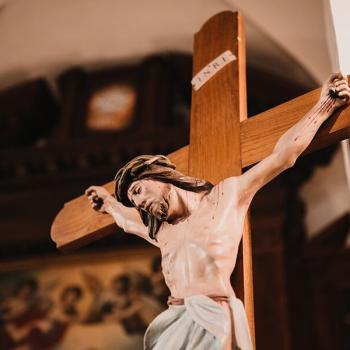
Which should not, fundamentally, surprise us. Even Baptists typically believe that God was revealed to us in the tangible flesh and matter of Jesus Christ. Williams’ insight is perhaps crudely applied to Jesus, but it is still true. The incarnation is an idea contained in a thing. And if God communicated that way once, I believe God continues to communicate that way. No ideas but in things. No grace but in things, either.
 Rev. Aaron Coyle-Carr is an FTE alum, a recent graduate of Candler School of Theology, and the pastor of New Bessemer Baptist Church in Greensboro, North Carolina. He loves absorbing good stories (especially in the form of comic books) and equipping God’s people for the work of laboring in the kingdom of Heaven.
Previous Post

August 30, 2016
Is God Guilty?
Next Post
August 30, 2016 Real Youth Ministry: More Than Kumbaya Around the Campfire
Browse Our Archives
Select a Category Advent Author Interviews Battle Over the Body and Blood of Christ Bearing Beauty Book Reviews Christian Education christian spirituallity christianity Christmas Church Church Leadership Contemplation Creation Care Death and Dying Death Penalty Disruptive Change Disruptors Series Easter Education Evolution and Faith Future of Progressive Christianity Gun Violence Health & Wellness Holy Week Interfaith Israel-Palestine Leading Differently Lent LGBTQ Living with Cancer Meditations on the Cross Mental Illness millennials Mimetic Mondays Monday Meditations Movie Reviews New Monasticism Pando Populus Parenting Patheos 10+1 Q&A Series PC(USA) Politics Pop Culture Practical Theology Series Prayer progressive christian Race Relations Reformation religion Religion and Politics Religion in America Rethink Church Social Justice Spirituality Spirituality of the Body Stump a Scholar Technology and Faith Thanksgiving Theodicy Trust Me Church Uncategorized Why I'm Still Christian Youth Ministry
Select a Month December 2025 April 2025 January 2025 September 2023 September 2022 May 2022 February 2022 January 2022 November 2021 October 2021 May 2021 February 2021 November 2020 October 2020 September 2020 June 2020 May 2020 March 2020 June 2019 March 2019 January 2019 June 2018 May 2018 April 2018 February 2018 January 2018 December 2017 November 2017 October 2017 September 2017 August 2017 July 2017 June 2017 May 2017 April 2017 March 2017 February 2017 January 2017 December 2016 November 2016 October 2016 September 2016 August 2016 July 2016 June 2016 May 2016 April 2016 March 2016 February 2016 January 2016 December 2015 November 2015 October 2015 September 2015 August 2015 July 2015 June 2015 May 2015 April 2015 March 2015 February 2015 January 2015 December 2014 November 2014 October 2014 September 2014 August 2014 July 2014 June 2014 May 2014 April 2014 March 2014 February 2014 January 2014 December 2013 November 2013 October 2013 September 2013 August 2013 July 2013 June 2013 May 2013 April 2013 March 2013 February 2013 January 2013 December 2012 November 2012 October 2012 September 2012 August 2012 July 2012 June 2012 May 2012 April 2012 March 2012 February 2012 January 2012 December 2011 November 2011 October 2011 September 2011 August 2011 July 2011 June 2011 May 2011 April 2011 March 2011 February 2011 January 2011 December 2010 November 2010 October 2010 September 2010 August 2010 July 2010 June 2010 May 2010 April 2010 March 2010
Follow Us!
TAKE THE
Religious Wisdom Quiz
True or False: Paul wrote to Titus about overseers needing to be hospitable and able to teach.
Select your answer to see how you score.
FALSE TRUE
Related posts from Faith Forward

Why People Are Leaving Their Childhood Religion
How to Be Mentally Healthy (Like Jesus)

Good Democrat or Bad Republican?

TRENDING AT PATHEOS Progressive Christian

Why Christians Have a Sacred Duty to Vote:...
The Bible offers strong support for the sacred duty to vote. Here...

What Being a Modern-Day Apostle Means to Me
In my last column, I discussed the ins and outs of modern-day...

Did Ancient China Once Worship the God of...
Across human history, a common thread weaves through the origins of the...

Love Your Neighbor – Including Earth-Kin: Lev. 19,...
God’s command to love your neighbor means acting in an ethical and...

Lead a Church Study of “Jesus and Lao...
Guest writer Jack Thomas (The Irreverent Reverend) reflects on leading his church...

Principles for Understanding the Apostolic Ministry Today
Whenever people discover that my formal ministry title is "apostle," as in...
view all Progressive Christian blogs
Ad-Free & Subscriber Log-In Subscription Support
- About Us
- 2026 Calendar
- Videos
- Podcasts
- Library of World Religions
- Faith In Media Tracker
- Advertise With Us
- Write for Us
- Privacy Policy
- Terms of Service
- Do Not Sell My Data
- Contact Us
- Radiant Digital
- Manage Newsletter Subscriptions
- Unsubscribe From Notifications
- Sitemap
Copyright 2008-2026, Patheos. All rights reserved.
Subscription Support Ad-Free & Subscriber Log-In
Follow Patheos