
BuddhistCatholicContemplativeEvangelicalGeneral ChristianHinduJewishLatter-day SaintMuslimNew VisionsProgressive Christian
Beliefs
- Buddhist
- Catholic
- Contemplative
- Evangelical
- General Christian
- Hindu
- Jewish
- Latter-day Saint
- More Voices
- Muslim
- New Visions
- Pagan
- Progressive Christian
Topics
- Religion News
- Food and Religion
- Sports and Religion
- Religious Art
- Religious Music and Entertainment
- Religious Events
- History and Religion
- Style and Religion
- Politics and Religion
- Women in Religion
- Recreation Outdoors and Religion
- Business Finance and Religion
- Careers Workplace and Religion
- Education and Religion
- Family Parenting and Religion
- Health Fitness and Religion
- Home and Religion
- Relationships and Religion
- Technology and Religion
- Travel and Religion
Columnists
- Buddhist Columnists
- Business Finance and Religion Columnists
- Careers Workplace and Religion Columnists
- Catholic Columnists
- Contemplative Columnists
- Education and Religion Columnists
- Evangelists Columnists
- Family Parenting and Religion Columnists
- General Christian Columnists
- Health Fitness and Religion Columnists
- Hindu Columnists
- History and Religion Columnists
- Home and Religion Columnists
- Jewish Columnists
- More Voices Columnists
- Latter Day Columnists
- Muslim Columnists
- New Visions Columnists
- Nonreligious Columnists
- Pagan Columnists
- Politics and Religion Columnists
- Progressive Columnists
- Recreation Outdoors and Religion Columnists
- Relationships and Religion Columnists
- Religion News Columnists
- Religious Art Columnists
- Religious Events Columnists
- Religious Music and Entertainment Columnists
- Sports and Religion Columnists
- Style and Religion Columnists
- Technology and Religion Columnists
- Travel and Religion Columnists
- Women in Religion Columnists
Resource Library
- 2026 Calendar
- Library of World Religions
- The 100 Most Holy Places on Earth
- Patheos Answers
- Podcasts
- Videos
- Faith Leaders Database
- Anglican Episcopalian
- Bahai
- Baptist
- Buddhism
- Christianity
- Confucianism
- Eastern Orthodoxy
- Hinduism
- Holiness and Pentecostal
- ISKCON
- Islam
- Judaism
- Lutheran
- Methodist
- The Church of Jesus Christ of Latter-day Saints
- New Age
- Paganism
- Presbytarian and Reformed
- Protestantism
- Religion Behind the Scenes
- Roman Catholic
- Scientology
- Shia Islam
- Sikhism
- Sufism
- Sunni Islam
- Taoism
- Zen
- See all religions
Research Tools
 Ad-Free & Subscriber Log-In Subscription Support
Ad-Free & Subscriber Log-In Subscription Support
Follow Patheos 

- Trending:
- Forgiveness
- |
- Marriage
- |
- Consciousness
- |
- Death Penalty
- |
- Election
- |
- Halloween

- Home
- Progressive Christian
- The South IS Rising Again: A Southern Boy on Taking Down the Confederate Flag
The South IS Rising Again: A Southern Boy on Taking Down the Confederate Flag
Last updated on: July 10, 2015 at 3:51 pm by David Lamotte
The South IS Rising Again: A Southern Boy on Taking Down the Confederate Flag 2015-07-10T15:51:39+00:00 David Lamotte
Patheos Explore the world's faith through different perspectives on religion and spirituality! Patheos has the views of the prevalent religions and spiritualities of the world.
This morning the rebel flag was removed from the Capitol grounds of South Carolina. The South Carolina House and Senate, by overwhelming majorities in both houses, voted to take it down this week, and Governor Haley signed the bill yesterday.
I’m a Southerner. My father’s father’s father’s father was one Thomas Jefferson Talley LaMotte, who walked home to Columbia, South Carolina after fighting for the Confederacy in Virginia and North Carolina. Except for time overseas, I’ve lived in the South my whole life, and both sides of my family are from the South. The first LaMotte in the colonies immigrated to Charleston, South Carolina. I watched too much TV as a kid to have much of a Southern accent, but I say ‘y’all’ without irony. And this fully credentialed Southern White Guy is celebrating this day.
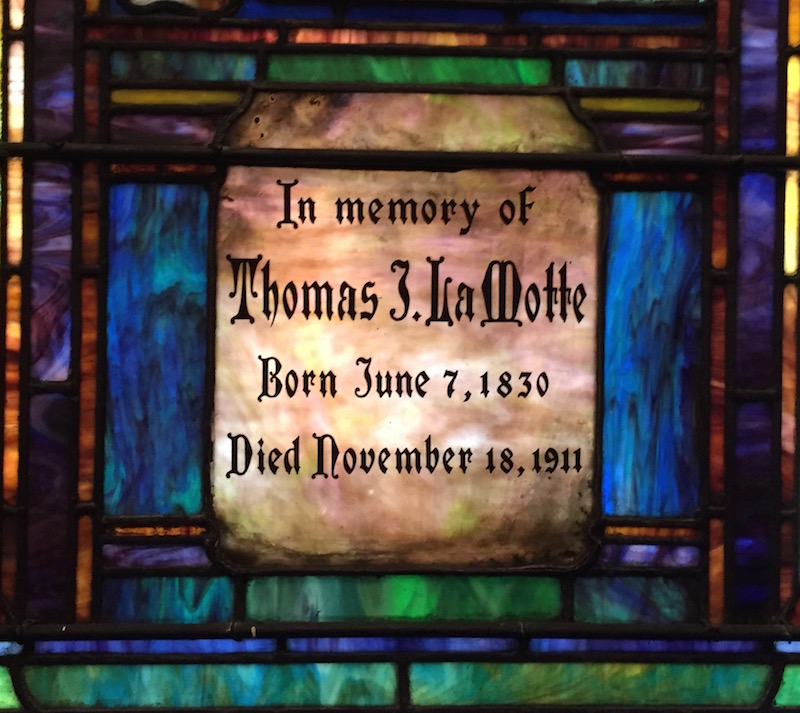
A memorial church window to my great, great grandfather in Columbia, SC
I have been watching and listening to conversations about this issue, and it has taken me a while to organize my thoughts, but I think it’s time I weighed in, as a Southern White male. So here are a few thoughts:
To those who point out that this was never officially the flag of the Confederacy, and rather was the battle flag of Robert E. Lee’s Army of Northern Virginia, I say that this is a specious detail. There is no symbol more widely associated with the Confederacy than the rebel flag, and that is why South Carolina chose to fly it fifty years ago.
To those who say that taking down the flag is a denial and burying of history, I see it as just the opposite. The flag is being moved to historical archives, where we can learn about, reflect on, celebrate and critique our history. The South Carolina legislature has chosen to no longer hold this symbol in a place of honor. Taking it down is a matter of honestly facing history, not denying it.
To those who say that ‘we might as well blow up the Washington monument, then. He owned 300 slaves,’ it is a different thing to honor a man who made many good contributions and also participated in some terrible things (which could possibly be said of anyone), than to hold up a symbol of a large movement whose primary cause we find abhorrent.
To those who say, ‘what about other injustices? you’re a hypocrite!’, I say, yes, I’m a hypocrite. But I’m trying to be a hypocrite who is moving slowly toward justice rather than a hypocrite who is resisting it. If our standard for taking any action is that it addresses all injustices at once, we will never take positive action.
To those who say ‘heritage, not hate,’ I say that heritage does not mean living in the past, frozen in our understanding and beliefs. It is up to us what we make of our lives from the raw material of our history and inheritance. Heritage is the starting point for our lives, not the end point.
It is also worth noting that the flag has not flown there for 150 years, but for 50. It was added in commemoration of the Civil War, and remained as a repudiation of the civil rights movement. Do we want to celebrate the heritage of resisting civil rights?
And ‘not hate?’
Well, actually, I agree with you there.
It’s worse than that.
The Confederacy and the system of slavery that it fought for was not about hatred of Black people; it wasn’t that passionate. The people, including my own ancestors, who held other people in bondage didn’t do so because they hated them; they did it because it was economically advantageous. It was a cold-hearted denial of others’ humanity, and a defense of greed that required the violent enslavement of other human beings. It was also, for some, a desperate clinging to self-worth by poor white people who had come to believe what they have been told: that they are pretty worthless, but at least they are better than those other folks. That’s what a lot of racism still is, and both halves of it are a lie; They are not better, and they are not worthless.
It is so easy to feel superior and condemn oppressors from a safe distance. As I write these words, though, I am painfully aware that the pants I’m wearing and the computer I’m typing on were both made by people working under slave-like conditions (just enough food and living space to survive, abuse, unsafe work spaces, unconscionably long hours, child labor, etc.). This system benefits me, and I support it financially, allowing me relatively cheap merchandise at the cost of others’ well being. In that knowledge, I have to bring some humility to this conversation. I think we all do. We are participating in the oppression of others, even now, through systems that seem too large for us to affect (though they are not). Perhaps that’s how Thomas LaMotte felt as he marched off to war. Or maybe not. I wish I could talk with him about it.
The idea that the Civil War was over ‘states’ rights’ is revisionist history, unless we finish the phrase with ‘states’ rights to buy and sell other people, beat and murder them with impunity, take their children, etc.’ In fact, all of the Declarations of Secession from the various states mention challenges to the institution of slavery as a primary reason for leaving the United States, and the text of the Declaration of Secession of the Confederate States of America actually argues against states’ rights, listing among its primary grievances the northern states’ refusal to return stolen slaves. It argues that they should have been forced to.
Having said that, many Southerners have our identities tied up in symbols like that flag. It feels to many like a symbol of where we’re from, of places and people we love, not what we’ve done. So, as illogical as it may be, marginalizing that symbol, to some people, feels like an attack on one’s very self. It isn’t that, of course. It is a call to be better, to write a new story, to acknowledge the ways we have blown it in the past, and to nourish ‘the better angels of our nature’, as Lincoln said.
 Still, what is intended is not always what is understood (yes, that argument works both ways, and it doesn’t absolve us of responsibility for the damage we inflict in either direction). Let’s not live into the misunderstanding. I’ve seen lots of South-bashing lately, and though I understand something of where that’s coming from, I think it’s a mistake. Let’s not put down Southern White people, South Carolinians, or any other group of people as ‘less than,’ in the very moment that we remove this powerful symbol of denigration and subjugation. The foolish notion that some groups of people are fundamentally better or worse than others is precisely what we are standing against.
A White man whom I love recently said to me, after reading something I had written about race, “Sometimes I wonder whose side you’re on.” Let me clarify that: I’m on the side that doesn’t believe there are sides. We can’t hate people in the name of love, or put people down in the name of tolerance and inclusion, whether we’re winning or losing. We have to reach a little higher than that.
Some say that the flag issue is a distraction. They worry that we will win this struggle, call it done, and then go back to business as usual. Doubtless, some of us will. Others will be awakened to the fact that things that seemed impossible to change are not, if we work to change them, and will be energized to work for the next goal. There is no shortage of important work to do in the world. What is yours to do?
History moves incrementally, and lasting, real change is slow. This day has been a long time in the making. Those words are not a call to patience, however. We should be impatient with issues of justice. It’s a call to hope, and a rebuke to despair. This is only one step in a long journey, but things do change for the better if we work to change them.
As it turns out, the Rebels had it right in at least one regard. The South is rising again. This is what real rising looks like.
Watch and see. The flag is coming down.
 David LaMotte is an award-winning songwriter, speaker and writer. He has performed over 2500 concerts and released eleven full-length CDs of primarily original music, touring in forty-eight of the fifty states, as well as extensively in Europe, Australia and New Zealand.
Previous Post

July 9, 2015
Coming Out as Bi (polar)
Recent Comments
Browse Our Archives
Select a Category Advent Author Interviews Battle Over the Body and Blood of Christ Bearing Beauty Book Reviews Christian Education christian spirituallity christianity Christmas Church Church Leadership Contemplation Creation Care Death and Dying Death Penalty Disruptive Change Disruptors Series Easter Education Evolution and Faith Future of Progressive Christianity Gun Violence Health & Wellness Holy Week Interfaith Israel-Palestine Leading Differently Lent LGBTQ Living with Cancer Meditations on the Cross Mental Illness millennials Mimetic Mondays Monday Meditations Movie Reviews New Monasticism Pando Populus Parenting Patheos 10+1 Q&A Series PC(USA) Politics Pop Culture Practical Theology Series Prayer progressive christian Race Relations Reformation religion Religion and Politics Religion in America Rethink Church Social Justice Spirituality Spirituality of the Body Stump a Scholar Technology and Faith Thanksgiving Theodicy Trust Me Church Uncategorized Why I'm Still Christian Youth Ministry
Select a Month December 2025 April 2025 January 2025 September 2023 September 2022 May 2022 February 2022 January 2022 November 2021 October 2021 May 2021 February 2021 November 2020 October 2020 September 2020 June 2020 May 2020 March 2020 June 2019 March 2019 January 2019 June 2018 May 2018 April 2018 February 2018 January 2018 December 2017 November 2017 October 2017 September 2017 August 2017 July 2017 June 2017 May 2017 April 2017 March 2017 February 2017 January 2017 December 2016 November 2016 October 2016 September 2016 August 2016 July 2016 June 2016 May 2016 April 2016 March 2016 February 2016 January 2016 December 2015 November 2015 October 2015 September 2015 August 2015 July 2015 June 2015 May 2015 April 2015 March 2015 February 2015 January 2015 December 2014 November 2014 October 2014 September 2014 August 2014 July 2014 June 2014 May 2014 April 2014 March 2014 February 2014 January 2014 December 2013 November 2013 October 2013 September 2013 August 2013 July 2013 June 2013 May 2013 April 2013 March 2013 February 2013 January 2013 December 2012 November 2012 October 2012 September 2012 August 2012 July 2012 June 2012 May 2012 April 2012 March 2012 February 2012 January 2012 December 2011 November 2011 October 2011 September 2011 August 2011 July 2011 June 2011 May 2011 April 2011 March 2011 February 2011 January 2011 December 2010 November 2010 October 2010 September 2010 August 2010 July 2010 June 2010 May 2010 April 2010 March 2010
Follow Us!
TAKE THE
Religious Wisdom Quiz
Who prepared spices for Jesus' burial?
Select your answer to see how you score.
Mary Magdalene Salome Mary Martha
Related posts from Faith Forward

A Christian Defense of Critical Theory

Christianity and Environmentalism

How Religious Freedom Benefits the Black Church

What Does the Bible Teach Us About Slavery?
TRENDING AT PATHEOS Progressive Christian

What Being a Modern-Day Apostle Means to Me
In my last column, I discussed the ins and outs of modern-day...

Did Ancient China Once Worship the God of...
Across human history, a common thread weaves through the origins of the...

Love Your Neighbor – Including Earth-Kin: Lev. 19,...
God’s command to love your neighbor means acting in an ethical and...

Lead a Church Study of “Jesus and Lao...
Guest writer Jack Thomas (The Irreverent Reverend) reflects on leading his church...

Pastoral Wisdom for Responding to Sermon Pushback
Getting sermon pushback on your social justice sermon? Learn practical, Proverbs-based strategies...

Principles for Understanding the Apostolic Ministry Today
Whenever people discover that my formal ministry title is "apostle," as in...
view all Progressive Christian blogs
Ad-Free & Subscriber Log-In Subscription Support
- About Us
- 2026 Calendar
- Videos
- Podcasts
- Library of World Religions
- Faith In Media Tracker
- Advertise With Us
- Write for Us
- Privacy Policy
- Terms of Service
- Do Not Sell My Data
- Contact Us
- Radiant Digital
- Manage Newsletter Subscriptions
- Unsubscribe From Notifications
- Sitemap
Copyright 2008-2026, Patheos. All rights reserved.
Subscription Support Ad-Free & Subscriber Log-In
Follow Patheos