
BuddhistCatholicContemplativeEvangelicalGeneral ChristianHinduJewishLatter-day SaintMuslimNew VisionsProgressive Christian
Beliefs
- Buddhist
- Catholic
- Contemplative
- Evangelical
- General Christian
- Hindu
- Jewish
- Latter-day Saint
- More Voices
- Muslim
- New Visions
- Pagan
- Progressive Christian
Topics
- Religion News
- Food and Religion
- Sports and Religion
- Religious Art
- Religious Music and Entertainment
- Religious Events
- History and Religion
- Style and Religion
- Politics and Religion
- Women in Religion
- Recreation Outdoors and Religion
- Business Finance and Religion
- Careers Workplace and Religion
- Education and Religion
- Family Parenting and Religion
- Health Fitness and Religion
- Home and Religion
- Relationships and Religion
- Technology and Religion
- Travel and Religion
Columnists
- Buddhist Columnists
- Business Finance and Religion Columnists
- Careers Workplace and Religion Columnists
- Catholic Columnists
- Contemplative Columnists
- Education and Religion Columnists
- Evangelists Columnists
- Family Parenting and Religion Columnists
- General Christian Columnists
- Health Fitness and Religion Columnists
- Hindu Columnists
- History and Religion Columnists
- Home and Religion Columnists
- Jewish Columnists
- More Voices Columnists
- Latter Day Columnists
- Muslim Columnists
- New Visions Columnists
- Nonreligious Columnists
- Pagan Columnists
- Politics and Religion Columnists
- Progressive Columnists
- Recreation Outdoors and Religion Columnists
- Relationships and Religion Columnists
- Religion News Columnists
- Religious Art Columnists
- Religious Events Columnists
- Religious Music and Entertainment Columnists
- Sports and Religion Columnists
- Style and Religion Columnists
- Technology and Religion Columnists
- Travel and Religion Columnists
- Women in Religion Columnists
Resource Library
- 2026 Calendar
- Library of World Religions
- The 100 Most Holy Places on Earth
- Patheos Answers
- Podcasts
- Videos
- Faith Leaders Database
- Anglican Episcopalian
- Bahai
- Baptist
- Buddhism
- Christianity
- Confucianism
- Eastern Orthodoxy
- Hinduism
- Holiness and Pentecostal
- ISKCON
- Islam
- Judaism
- Lutheran
- Methodist
- The Church of Jesus Christ of Latter-day Saints
- New Age
- Paganism
- Presbytarian and Reformed
- Protestantism
- Religion Behind the Scenes
- Roman Catholic
- Scientology
- Shia Islam
- Sikhism
- Sufism
- Sunni Islam
- Taoism
- Zen
- See all religions
Research Tools
 Ad-Free & Subscriber Log-In Subscription Support
Ad-Free & Subscriber Log-In Subscription Support
Follow Patheos 

- Trending:
- Forgiveness
- |
- Marriage
- |
- Consciousness
- |
- Death Penalty
- |
- Election
- |
- Halloween

- Home
- Progressive Christian
- The Battle Over the Body and Blood of Christ: Altar or Table?
The Battle Over the Body and Blood of Christ: Altar or Table?
Last updated on: February 25, 2015 at 5:40 pm by Kelly Pigott
The Battle Over the Body and Blood of Christ: Altar or Table? 2015-02-25T17:40:37+00:00 Kelly Pigott
Patheos Explore the world's faith through different perspectives on religion and spirituality! Patheos has the views of the prevalent religions and spiritualities of the world.
 Editor’s Note: This is the first in a weekly Lenten series on the body and blood of Christ by Church History Professor Kelly Pigott.
Unless one is referring to the Old Testament sacrificial system, or a place where wedding vows are made, it seems the word “altar” has fallen out of favor with many Protestants. Perhaps the reason dates back to the Reformation when a huge dispute arose over the doctrine known as the “Sacrifice of the Mass.” Essentially, in this, the Eucharist (or the bread of the Lord’s Supper) is understood to be an additional sacrifice so that it has the power to atone for sins. In other words, every time a mass is said, Jesus is sacrificed all over again (though technically, Aquinas argued that the mass was an image of the real sacrifice of Christ).
Either way, Protestants rejected this idea, claiming that Jesus’ sacrifice on the cross was a “once-for-all” sacrifice that covered every sin. Ever. Period. And no additional sacrifices were needed. The idea that Jesus was sacrificed again at each mass in the Eucharist actually offended them. And the Protestants became quite grumpy about it. The Catholics responded to Protestant grumpiness by calling the Council of Trent. In 1562 it published no less than nine canons affirming the Sacrifice of the Mass, declaring that it not only atoned for the sins of the living, but the dead as well (at least those in Purgatory, another doctrine Protestants tended to get grumpy about). Suffice it to say, that it was a long time before Protestants and Catholics were able to speak civilly about this matter to one another.
Since the priest consecrated the Eucharist while holding the host over the altar, Protestants connected the two ideas together and assumed that the reason it was called an altar was because of the doctrine of the Sacrifice of the Mass. So ever since then, most have preferred to refer to it as a “table.” But long before the doctrine of the Sacrifice of the Mass originated, early Christians referred to the table as an altar. One of the earliest references comes from a letter written by Ignatius, a first century bishop of Antioch. Other Church Fathers also regularly referred to it as such, and they even spoke of the Eucharist as a “sacrifice.” Now, they don’t really go into detail about this, for they were satisfied in understanding the Eucharist or the Sacrifice as a great mystery, designed to illicit awe and gratitude in the worshiper over the willingness of Jesus to die for them. But suffice it to say that words such as “sacrifice” and “altar” were important in their understanding of what happened during communion from the very beginning.
“Table” is a good word, too. And in fact, both “altar” and “table” were used interchangeably. All of this is to say that there were many layers of meaning to this most ancient place where Jesus originally met with his disciples for a meal, and then declared that the bread was his body, and the wine was his blood, commanding his followers to consume them in remembrance of him. As an altar, the elements become the body and blood of Christ, and the worshiper is vividly reminded of the ultimate sacrifice Jesus made out of his deep love for us. As a table, the elements are bread and wine offering the worshiper spiritual food, to be consumed in community with his or her brothers and sisters in Christ. It is in this context that the word “Eucharist” or literally “to give thanks” makes the most sense, because it is at this table that God is providing for our deepest needs physically, spiritually, and emotionally, for which we are giving thanks.
Ironically, however, the story of the table or altar has a lot of drama and tragedy, even though today, many have forgotten these family feuds as the table has become more of an enigma. As postmodern Christians ponder the table, they view it more like an odd antique one would find in a grandparent’s house. It looks pretty, but it doesn’t seem to have any practical purpose anymore. Even in traditions where communion is still the apex of worship, not many members are aware of the place of prominence the altar has traditionally held.
Not only has the table been the center of attention in worship, but it has also been at the center of some of the Church’s fiercest fights. Roman Emperors were cowed here. The Latin and Eastern churches got a divorce here. The Protestant church became Protestant churches here. Catholics and Protestant slaughtered each other here. And one famous founder of a major denomination dissed his ex-girlfriend here. Perhaps all this drama is one reason why many contemporary churches have decided to tuck this odd piece of furniture in the attic.
It’s hard to blame them. And yet, maybe we are missing something vital and ancient to our faith by doing so. For as the early Christians gathered at the altar to break bread, they deemed it so important that they were willing to risk their lives and the lives of their families in order to take, eat, and drink.
Leading up to Easter, I’d like to tell you the story of the table, from its humble beginning with Jesus and the disciples, to the battlefield it became as powerful figures fought over the body and blood of Christ. I hope you’ll join me.
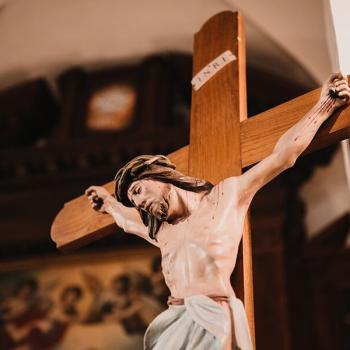
Photo credit: wideonet/Shutterstock.som
 Kelly Pigott is a church history professor who teaches at Hardin-Simmons University in Abilene, Texas. You can find more musings on history, culture, contemplative spirituality and theology, along with interviews with authors at kellypigott.com. Follow him on twitter @kellypigott
Battle Over the Body and Blood of Christ
Previous Post

February 25, 2015
The (N. T.) Wright-way or the Highway
Next Post
February 26, 2015 I Might Be The World's Worst Evangelist
Recent Comments
Browse Our Archives
Select a Category Advent Author Interviews Battle Over the Body and Blood of Christ Bearing Beauty Book Reviews Christian Education christian spirituallity christianity Christmas Church Church Leadership Contemplation Creation Care Death and Dying Death Penalty Disruptive Change Disruptors Series Easter Education Evolution and Faith Future of Progressive Christianity Gun Violence Health & Wellness Holy Week Interfaith Israel-Palestine Leading Differently Lent LGBTQ Living with Cancer Meditations on the Cross Mental Illness millennials Mimetic Mondays Monday Meditations Movie Reviews New Monasticism Pando Populus Parenting Patheos 10+1 Q&A Series PC(USA) Politics Pop Culture Practical Theology Series Prayer progressive christian Race Relations Reformation religion Religion and Politics Religion in America Rethink Church Social Justice Spirituality Spirituality of the Body Stump a Scholar Technology and Faith Thanksgiving Theodicy Trust Me Church Uncategorized Why I'm Still Christian Youth Ministry
Select a Month December 2025 April 2025 January 2025 September 2023 September 2022 May 2022 February 2022 January 2022 November 2021 October 2021 May 2021 February 2021 November 2020 October 2020 September 2020 June 2020 May 2020 March 2020 June 2019 March 2019 January 2019 June 2018 May 2018 April 2018 February 2018 January 2018 December 2017 November 2017 October 2017 September 2017 August 2017 July 2017 June 2017 May 2017 April 2017 March 2017 February 2017 January 2017 December 2016 November 2016 October 2016 September 2016 August 2016 July 2016 June 2016 May 2016 April 2016 March 2016 February 2016 January 2016 December 2015 November 2015 October 2015 September 2015 August 2015 July 2015 June 2015 May 2015 April 2015 March 2015 February 2015 January 2015 December 2014 November 2014 October 2014 September 2014 August 2014 July 2014 June 2014 May 2014 April 2014 March 2014 February 2014 January 2014 December 2013 November 2013 October 2013 September 2013 August 2013 July 2013 June 2013 May 2013 April 2013 March 2013 February 2013 January 2013 December 2012 November 2012 October 2012 September 2012 August 2012 July 2012 June 2012 May 2012 April 2012 March 2012 February 2012 January 2012 December 2011 November 2011 October 2011 September 2011 August 2011 July 2011 June 2011 May 2011 April 2011 March 2011 February 2011 January 2011 December 2010 November 2010 October 2010 September 2010 August 2010 July 2010 June 2010 May 2010 April 2010 March 2010
Follow Us!
TAKE THE
Religious Wisdom Quiz
I am a goat released into the wilderness, carrying away the sins of the people. What am I?
Select your answer to see how you score.
The scapegoat A sacrifice A sin offering An atonement goat
Related posts from Faith Forward
Is Christ a Sacrifice or a Survivor? How...

A Christian Defense of Critical Theory

Christianity and Environmentalism

What Difference Can Another Lent Make?
TRENDING AT PATHEOS Progressive Christian

Why Christians Have a Sacred Duty to Vote:...
The Bible offers strong support for the sacred duty to vote. Here...

What Being a Modern-Day Apostle Means to Me
In my last column, I discussed the ins and outs of modern-day...

Did Ancient China Once Worship the God of...
Across human history, a common thread weaves through the origins of the...

Love Your Neighbor – Including Earth-Kin: Lev. 19,...
God’s command to love your neighbor means acting in an ethical and...

Lead a Church Study of “Jesus and Lao...
Guest writer Jack Thomas (The Irreverent Reverend) reflects on leading his church...

Principles for Understanding the Apostolic Ministry Today
Whenever people discover that my formal ministry title is "apostle," as in...
view all Progressive Christian blogs
Ad-Free & Subscriber Log-In Subscription Support
- About Us
- 2026 Calendar
- Videos
- Podcasts
- Library of World Religions
- Faith In Media Tracker
- Advertise With Us
- Write for Us
- Privacy Policy
- Terms of Service
- Do Not Sell My Data
- Contact Us
- Radiant Digital
- Manage Newsletter Subscriptions
- Unsubscribe From Notifications
- Sitemap
Copyright 2008-2026, Patheos. All rights reserved.
Subscription Support Ad-Free & Subscriber Log-In
Follow Patheos