
BuddhistCatholicContemplativeEvangelicalGeneral ChristianHinduJewishLatter-day SaintMuslimNew VisionsProgressive Christian
Beliefs
- Buddhist
- Catholic
- Contemplative
- Evangelical
- General Christian
- Hindu
- Jewish
- Latter-day Saint
- More Voices
- Muslim
- New Visions
- Pagan
- Progressive Christian
Topics
- Religion News
- Food and Religion
- Sports and Religion
- Religious Art
- Religious Music and Entertainment
- Religious Events
- History and Religion
- Style and Religion
- Politics and Religion
- Women in Religion
- Recreation Outdoors and Religion
- Business Finance and Religion
- Careers Workplace and Religion
- Education and Religion
- Family Parenting and Religion
- Health Fitness and Religion
- Home and Religion
- Relationships and Religion
- Technology and Religion
- Travel and Religion
Columnists
- Buddhist Columnists
- Business Finance and Religion Columnists
- Careers Workplace and Religion Columnists
- Catholic Columnists
- Contemplative Columnists
- Education and Religion Columnists
- Evangelists Columnists
- Family Parenting and Religion Columnists
- General Christian Columnists
- Health Fitness and Religion Columnists
- Hindu Columnists
- History and Religion Columnists
- Home and Religion Columnists
- Jewish Columnists
- More Voices Columnists
- Latter Day Columnists
- Muslim Columnists
- New Visions Columnists
- Nonreligious Columnists
- Pagan Columnists
- Politics and Religion Columnists
- Progressive Columnists
- Recreation Outdoors and Religion Columnists
- Relationships and Religion Columnists
- Religion News Columnists
- Religious Art Columnists
- Religious Events Columnists
- Religious Music and Entertainment Columnists
- Sports and Religion Columnists
- Style and Religion Columnists
- Technology and Religion Columnists
- Travel and Religion Columnists
- Women in Religion Columnists
Resource Library
- 2026 Calendar
- Library of World Religions
- The 100 Most Holy Places on Earth
- Patheos Answers
- Podcasts
- Videos
- Faith Leaders Database
- Anglican Episcopalian
- Bahai
- Baptist
- Buddhism
- Christianity
- Confucianism
- Eastern Orthodoxy
- Hinduism
- Holiness and Pentecostal
- ISKCON
- Islam
- Judaism
- Lutheran
- Methodist
- The Church of Jesus Christ of Latter-day Saints
- New Age
- Paganism
- Presbytarian and Reformed
- Protestantism
- Religion Behind the Scenes
- Roman Catholic
- Scientology
- Shia Islam
- Sikhism
- Sufism
- Sunni Islam
- Taoism
- Zen
- See all religions
Research Tools
 Ad-Free & Subscriber Log-In Subscription Support
Ad-Free & Subscriber Log-In Subscription Support
Follow Patheos 

- Trending:
- Forgiveness
- |
- Marriage
- |
- Consciousness
- |
- Death Penalty
- |
- Election
- |
- Halloween

- Home
- Progressive Christian
- The Cross, Part 5: What is it Good For?
The Cross, Part 5: What is it Good For?
Last updated on: April 4, 2014 at 8:45 pm by Kelly Pigott
The Cross, Part 5: What is it Good For? 2014-04-04T20:45:47+00:00 Kelly Pigott
Patheos Explore the world's faith through different perspectives on religion and spirituality! Patheos has the views of the prevalent religions and spiritualities of the world.
 Imagine a courtroom where the worst kind of criminal has just been convicted of a heinous crime. Everyone wants to see this guy sentenced to the full extent of the law. Everyone, that is, except his widowed mother. Before the judge is able to make public how justice is about to be served, the tearful woman stands up in the back of the room and waves at the judge. The judge acknowledges the woman and invites her to approach the desk (indulge me a little).
“Judge,” she says, wiping her face. “I know what you are about to say. What my boy did was wrong. And I know the law demands that he should be punished. But I love him very dearly. And so, I’m begging you to punish me instead. I’ve never committed a crime in my entire life. I’ve paid my taxes. I volunteered at the PTA. I’ve been a model citizen. Please, judge. Let my boy go. I know he is sorry. And I love him so much.” She grabs the judge’s hand. “Please. Execute me instead so that justice is served and my boy can go free.”
Now, what’s the judge going to do?
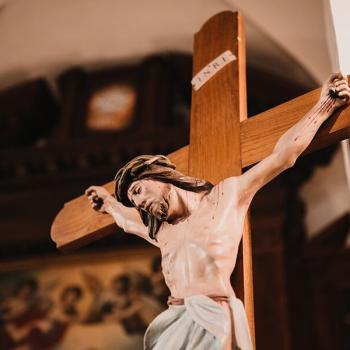
Many of us have heard that Jesus died for us. And that somehow his crucifixion wiped away all our sins. Various faith traditions offer different ways of appropriating that grace. Confessional theology teaches that we must confess our faith. Sacramental theology teaches we must participate in the sacraments of the church. Covenantal theology teaches that God predestined us to a covenant of grace. And there are others, but those are the biggies.
What they all have in common is this idea that the sacrifice of Jesus is the source of that grace, so that the crucifixion “washed away our sins,” “paid our debts,” “made us whole,” and similar phrases found in Christian hymns.
But as I illustrated with my parable, there is a problem. How is this justice?
A popular answer comes from an 11th century theologian named Anselm who managed to tick off enough people (especially the King of England) that he spent a good chunk of his life exiled. He had a lot of time on his hands and not much to do, so he sat and thought a lot.
He was a part of a group of theologians known as the Scholastics, which meant that they desired to arrive at the great doctrines of the church, and even God Himself, through reason rather than the Bible or the writings of the early Fathers.
One day while Anselm sat thinking he came up with one of his seminal ideas. God is infinite. Or as he put it, “That-than-which-no-greater-can-be-thought.” Now you might be thinking, “duh.” But what intrigued Anselm was how finite beings could come up with this idea.
Applying his epiphany to the cross, he surmised that humanity faced an almost insurmountable problem. Since God is infinite, he is of infinite value. And since humanity is finite, we have finite value. According to medieval law, a crime committed against a king was far worse than a crime committed against a serf, even though it’s the same crime.
For example, if you stole a nickel from a fellow serf, you might just get your hands cut off. But if you stole a nickel from your King, it was off with your head. The role of class and honor in a society obviously shaped medieval law. To dishonor a king was worse than dishonoring a commoner.
Anselm understood sin as a crime committed against a being of infinite value. This means that even if a person was executed for his/her sins, it was insufficient to satisfy the scales of cosmic justice. Anselm deduced that Jesus was executed because as God, he had infinite value, and as a human, he could die on behalf of humanity; thus, “satisfying” God’s demand for justice.
But remember my opening illustration? How is this justice? And besides, it makes God seem like Marlon Brando in the Godfather rather than the one who commanded us to forgive our enemies.
Protestants in the Reformation, who typically enjoyed protesting all things Catholic, slightly changed Anselm’s view into something called “penal substitution.” It’s very close to Anselm’s satisfaction theory, but simplified: Jesus took OUR place on the cross because the law demands that SOMEONE gets a spanking. God could have done something else, but He chose this plan. Since justice is defined by God, He can do whatever he wants and it’s just.
Speaking of spanking, believe it or not, there was a common practice that when a crown prince acted naughty he was brought into a room and forced to watch his good friend get punished, even though the friend had done nothing wrong. This gave rise to the phrase “whipping boy.” And the reason for this practice was that spanking the future king was considered dishonorable; and besides, it could eventually have dire consequences for the spanker. So the “whipping boy” got punished, instead.
Critics of “penal substitution” charged that the Reformers (mainly the Calvinists) made Jesus out to be just that.
An Arminian scholar trained in law named Grotius wondered the same thing. So he argued that we must keep in mind the purpose of laws, which is not to appease the wrath of the king but to maintain order. A good king loves his subjects and wants them to thrive. In order for this to happen he must maintain order, which is why we have laws.
When a person commits a crime, a king has some leeway about what to do about it. If it’s a first offense, he can let the man go with a warning. If he is a repeat offender, he may punish him in varying degrees.
Punishment satisfies the scales of justice AND acts as a deterrent. It sends the message to other would-be criminals that this is what will happen to you if you mess with the king, allowing him to maintain peace throughout the land
Applied to the cross, Grotius argued that Jesus became our substitute, and as such was punished to the full extent of the law. As a result, it sent the message to the rest of the kingdom that this is what happens to sinners. With the deterrent in place, God can then dispense grace to whom he pleases and still keep the peace.
Now imagine a small country with a ruler who loves his people and who wants to provide an orderly society for them to thrive. His son says to him, “Father, let’s send a message to all the kingdom that you are a loving and just king. I will put a sign around my neck that says, “criminal,” even though the townspeople will know otherwise. Then, execute me in the town square on behalf of all criminals so that everyone will see that you take the law seriously in your kingdom. Then you can be lenient to your subjects and grant them the grace you so desire.
Do you see the problem?
For many, these theories became so important that in the early 20th century a book entitled The Fundamentals was published declaring that, among other things, believing in “substitutionary atonement” was a fundamental necessity of the Christian faith.
Many, many Christian pastors and theologians today would argue the same thing, even though one may make the case that this idea didn’t exist in its current form for the first 1,000 years of Christianity.
But as we ponder the cross this lent, let us be a little daring and ask, “Is the language of law really the best way to approach this subject?”
Read Part I, II, III and IV of Kelly Pigott’s Lenten series on The Cross at Patheos.
 Kelly Pigott is a church history professor who teaches at Hardin-Simmons University in Abilene, Texas. You can find more musings on history, culture, contemplative spirituality and theology, along with interviews with authors at kellypigott.com. Follow him on twitter @kellypigott
Previous Post

April 3, 2014
If Jesus Gave a TED Talk (#5): When the Capitol is Surrounded by Armies
Next Post

April 7, 2014 Mimetic Mondays: Does God Create Evil? Mimetic Theory and Isaiah 45:7
Recent Comments
Browse Our Archives
Select a Category Advent Author Interviews Battle Over the Body and Blood of Christ Bearing Beauty Book Reviews Christian Education christian spirituallity christianity Christmas Church Church Leadership Contemplation Creation Care Death and Dying Death Penalty Disruptive Change Disruptors Series Easter Education Evolution and Faith Future of Progressive Christianity Gun Violence Health & Wellness Holy Week Interfaith Israel-Palestine Leading Differently Lent LGBTQ Living with Cancer Meditations on the Cross Mental Illness millennials Mimetic Mondays Monday Meditations Movie Reviews New Monasticism Pando Populus Parenting Patheos 10+1 Q&A Series PC(USA) Politics Pop Culture Practical Theology Series Prayer progressive christian Race Relations Reformation religion Religion and Politics Religion in America Rethink Church Social Justice Spirituality Spirituality of the Body Stump a Scholar Technology and Faith Thanksgiving Theodicy Trust Me Church Uncategorized Why I'm Still Christian Youth Ministry
Select a Month December 2025 April 2025 January 2025 September 2023 September 2022 May 2022 February 2022 January 2022 November 2021 October 2021 May 2021 February 2021 November 2020 October 2020 September 2020 June 2020 May 2020 March 2020 June 2019 March 2019 January 2019 June 2018 May 2018 April 2018 February 2018 January 2018 December 2017 November 2017 October 2017 September 2017 August 2017 July 2017 June 2017 May 2017 April 2017 March 2017 February 2017 January 2017 December 2016 November 2016 October 2016 September 2016 August 2016 July 2016 June 2016 May 2016 April 2016 March 2016 February 2016 January 2016 December 2015 November 2015 October 2015 September 2015 August 2015 July 2015 June 2015 May 2015 April 2015 March 2015 February 2015 January 2015 December 2014 November 2014 October 2014 September 2014 August 2014 July 2014 June 2014 May 2014 April 2014 March 2014 February 2014 January 2014 December 2013 November 2013 October 2013 September 2013 August 2013 July 2013 June 2013 May 2013 April 2013 March 2013 February 2013 January 2013 December 2012 November 2012 October 2012 September 2012 August 2012 July 2012 June 2012 May 2012 April 2012 March 2012 February 2012 January 2012 December 2011 November 2011 October 2011 September 2011 August 2011 July 2011 June 2011 May 2011 April 2011 March 2011 February 2011 January 2011 December 2010 November 2010 October 2010 September 2010 August 2010 July 2010 June 2010 May 2010 April 2010 March 2010
Follow Us!
TAKE THE
Religious Wisdom Quiz
Where did the Pentecostal movement begin in the early 1900s?
Select your answer to see how you score.
Berlin London Azusa Street, Los Angeles Rome
Related posts from Faith Forward
Is Christ a Sacrifice or a Survivor? How...

A Christian Defense of Critical Theory

Christianity and Environmentalism

What Difference Can Another Lent Make?
TRENDING AT PATHEOS Progressive Christian

What Being a Modern-Day Apostle Means to Me
In my last column, I discussed the ins and outs of modern-day...

Did Ancient China Once Worship the God of...
Across human history, a common thread weaves through the origins of the...

Love Your Neighbor – Including Earth-Kin: Lev. 19,...
God’s command to love your neighbor means acting in an ethical and...

Lead a Church Study of “Jesus and Lao...
Guest writer Jack Thomas (The Irreverent Reverend) reflects on leading his church...

Pastoral Wisdom for Responding to Sermon Pushback
Getting sermon pushback on your social justice sermon? Learn practical, Proverbs-based strategies...

Principles for Understanding the Apostolic Ministry Today
Whenever people discover that my formal ministry title is "apostle," as in...
view all Progressive Christian blogs
Ad-Free & Subscriber Log-In Subscription Support
- About Us
- 2026 Calendar
- Videos
- Podcasts
- Library of World Religions
- Faith In Media Tracker
- Advertise With Us
- Write for Us
- Privacy Policy
- Terms of Service
- Do Not Sell My Data
- Contact Us
- Radiant Digital
- Manage Newsletter Subscriptions
- Unsubscribe From Notifications
- Sitemap
Copyright 2008-2026, Patheos. All rights reserved.
Subscription Support Ad-Free & Subscriber Log-In
Follow Patheos