
BuddhistCatholicContemplativeEvangelicalGeneral ChristianHinduJewishLatter-day SaintMuslimNew VisionsProgressive Christian
Beliefs
- Buddhist
- Catholic
- Contemplative
- Evangelical
- General Christian
- Hindu
- Jewish
- Latter-day Saint
- More Voices
- Muslim
- New Visions
- Pagan
- Progressive Christian
Topics
- Religion News
- Food and Religion
- Sports and Religion
- Religious Art
- Religious Music and Entertainment
- Religious Events
- History and Religion
- Style and Religion
- Politics and Religion
- Women in Religion
- Recreation Outdoors and Religion
- Business Finance and Religion
- Careers Workplace and Religion
- Education and Religion
- Family Parenting and Religion
- Health Fitness and Religion
- Home and Religion
- Relationships and Religion
- Technology and Religion
- Travel and Religion
Columnists
- Buddhist Columnists
- Business Finance and Religion Columnists
- Careers Workplace and Religion Columnists
- Catholic Columnists
- Contemplative Columnists
- Education and Religion Columnists
- Evangelists Columnists
- Family Parenting and Religion Columnists
- General Christian Columnists
- Health Fitness and Religion Columnists
- Hindu Columnists
- History and Religion Columnists
- Home and Religion Columnists
- Jewish Columnists
- More Voices Columnists
- Latter Day Columnists
- Muslim Columnists
- New Visions Columnists
- Nonreligious Columnists
- Pagan Columnists
- Politics and Religion Columnists
- Progressive Columnists
- Recreation Outdoors and Religion Columnists
- Relationships and Religion Columnists
- Religion News Columnists
- Religious Art Columnists
- Religious Events Columnists
- Religious Music and Entertainment Columnists
- Sports and Religion Columnists
- Style and Religion Columnists
- Technology and Religion Columnists
- Travel and Religion Columnists
- Women in Religion Columnists
Resource Library
- 2026 Calendar
- Library of World Religions
- The 100 Most Holy Places on Earth
- Patheos Answers
- Podcasts
- Videos
- Faith Leaders Database
- Anglican Episcopalian
- Bahai
- Baptist
- Buddhism
- Christianity
- Confucianism
- Eastern Orthodoxy
- Hinduism
- Holiness and Pentecostal
- ISKCON
- Islam
- Judaism
- Lutheran
- Methodist
- The Church of Jesus Christ of Latter-day Saints
- New Age
- Paganism
- Presbytarian and Reformed
- Protestantism
- Religion Behind the Scenes
- Roman Catholic
- Scientology
- Shia Islam
- Sikhism
- Sufism
- Sunni Islam
- Taoism
- Zen
- See all religions
Research Tools
 Ad-Free & Subscriber Log-In Subscription Support
Ad-Free & Subscriber Log-In Subscription Support
Follow Patheos 

- Trending:
- Forgiveness
- |
- Marriage
- |
- Consciousness
- |
- Death Penalty
- |
- Election
- |
- Halloween

- Home
- Progressive Christian
- The Cross, Part 6: They Should Have Sent a Poet
The Cross, Part 6: They Should Have Sent a Poet
Last updated on: April 11, 2014 at 4:16 pm by Kelly Pigott
The Cross, Part 6: They Should Have Sent a Poet 2014-04-11T16:16:53+00:00 Kelly Pigott
Patheos Explore the world's faith through different perspectives on religion and spirituality! Patheos has the views of the prevalent religions and spiritualities of the world.
 Like most six-year-olds on their first day of school, I remember sitting excited and terrified. My desk was made of grey metal and blonde wood, with a square laminate tabletop angled in such a way that your pencil rattled down if it wasn’t placed in the dark groove. In the right corner was my name, hand-written in black ink on a narrow, white piece of paper scotch-taped to the desk.
As a class, we sat with our backs rigid in anxious silence, the girls in white blouses and plaid skirts, with knee-high socks and black, mary jane shoes; the boys in white dress shirts with navy pants, neatly pressed and creased. I can still recall the smell of chalk dust and bleach.
The teacher sat at her desk scribbling in a notebook, waiting for the bell to ring. She was a nun in full habit, pale hands and a stern face the only flesh showing. In my little six-grade mind she looked ancient, silver eyebrows, deep crow’s feet around her eyes and lined wrinkles on her forehead.
The bell clanged, jarring us, but not our teacher. She gracefully put her pen down and rose, then glided to the front of the classroom. She spoke slowly, enunciating each word in a thin voice, reciting a speech she obviously had given a thousand times before about the rules.
I don’t remember the list, but I do remember her closing remarks. She pointed to a picture of Jesus that hung above the center of the blackboard. It showed only his face, in agony, with sweat and blood streaming down his cheeks. He wore a large crown of thorns on his head.
“If you break any of these rules,” the nun said. “Or, if you are naughty in any way,” she gazed at the portrait. “Then another thorn gets pushed into the head of our Savior.”
That’s penal substitution.
Well, sort of, because we still got paddled. Which made me more afraid of the nun than hurting Jesus.
The crucifixion has multiple facets of truth. And in my last two posts I’ve summarized the major views on atonement, and hopefully I’ve provoked some thought by demonstrating that there are some real weaknesses.
And I wonder if a part of our problem in comprehending this event stems from the fact that in our day, the vocabulary most used to describe what happened at the crucifixion comes from the legal world.
For to me, describing the cross in strictly punitive terms is a lot like letting lawyers define marriage. Are they really the best people for the job? Granted, at one level marriage is a legal contract between two parties. But whenever a judge is called into the conversation it’s usually because things have broken down so badly that the law must intervene. It’s sad. But you can’t understand marriage by only studying what happens when you have to call 9-1-1.
When we want to learn about marriage, most of us turn to our parents, or a counselor, or Shakespeare, or Shrek 3, or that couple in your church who has been married for fifty years and who still stroll down the street at sunset holding hands.
My guess is that very few of us, if any, turn to a dusty law book.
Before there was Neil deGrasse Tyson showing us the universe, there was Carl Sagan. As a teenager, I watched the original Cosmos series on PBS, and I still remember the wonder that Sagan conjured. It motivated me to read his books, including a science fiction novel he wrote entitled, Contact.
You may have seen the movie, starring Jodie Foster as a radio astronomer name Ellie. The story begins with her praising the scientific method to a group of children. And as the narrative progresses, Ellie defiantly defends science as the only legitimate way to understand truth. And yet, her credentials as a scientist were questioned by her more serious counterparts because Ellie had devoted her career to listening for aliens. So the bad guys shut her down.
In true Hollywood fashion, Ellie is saved by an eccentric and insanely wealthy patron who gives her a second chance. And she is soon vindicated as the aliens give us a call. They send a message that describes how to build an enigmatic machine with a capsule seating one person.
[A bit of a spoiler alert here] Ellie fights for the job, and in the end, she gets her chance. Turns out, the machine whisks the individual off through a wormhole. As the capsule containing Ellie drops into the monstrous contraption, she is yanked on a journey through the cosmos. The capsule dips and turns as if on your worst nightmare of a roller coaster ride, stopping from time to time to give Ellie an awe-inspiring view. In short, she is shown what awaits the future of humanity. She narrates her experience into a video recorder, hoping that at least her journal survives, even if she does not.
At the climax of her journey, Ellie sees an especially inexplicable scene. And it’s at this point that she’s confronted with the fact that all of her training as a scientist was failing her in this moment, perhaps the most important one of all of human history. With tears forming in her eyes and in a rare moment of humility she whispers,
“They should have sent a poet.”
Maybe one of the reasons why atonement has been so problematic to understand is because before the inexplicable image of the cross, the language of law just breaks down.
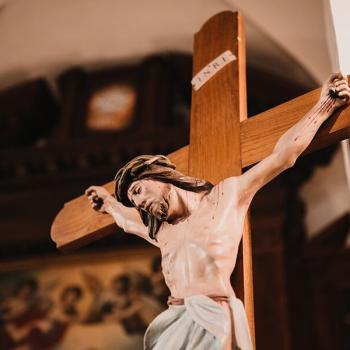
Maybe the language of literature is better suited to allow for all the nuances and complexities. Because the cross is not found in a courtroom presided over by a judge. It’s on a hill, surrounded by humanity, with God in the center, and it’s the most important moment in all of human history. Like all good dramas, evil and good are on full display, and the fate of the world is at hand.
And YOU, my dear reader, are there with your recorder.
The question is: What are you going to say?
Read Part I, II, III, IV and V of Kelly Pigott’s Lenten series on The Cross at Patheos.
 Kelly Pigott is a church history professor who teaches at Hardin-Simmons University in Abilene, Texas. You can find more musings on history, culture, contemplative spirituality and theology, along with interviews with authors at kellypigott.com. Follow him on twitter @kellypigott
Previous Post

April 9, 2014
A Gentle Fraying: Observing a Homespun Lent, Week 6
Next Post

April 14, 2014 Resurrection: Calculating the Probabilities
Recent Comments
Browse Our Archives
Select a Category Advent Author Interviews Battle Over the Body and Blood of Christ Bearing Beauty Book Reviews Christian Education christian spirituallity christianity Christmas Church Church Leadership Contemplation Creation Care Death and Dying Death Penalty Disruptive Change Disruptors Series Easter Education Evolution and Faith Future of Progressive Christianity Gun Violence Health & Wellness Holy Week Interfaith Israel-Palestine Leading Differently Lent LGBTQ Living with Cancer Meditations on the Cross Mental Illness millennials Mimetic Mondays Monday Meditations Movie Reviews New Monasticism Pando Populus Parenting Patheos 10+1 Q&A Series PC(USA) Politics Pop Culture Practical Theology Series Prayer progressive christian Race Relations Reformation religion Religion and Politics Religion in America Rethink Church Social Justice Spirituality Spirituality of the Body Stump a Scholar Technology and Faith Thanksgiving Theodicy Trust Me Church Uncategorized Why I'm Still Christian Youth Ministry
Select a Month December 2025 April 2025 January 2025 September 2023 September 2022 May 2022 February 2022 January 2022 November 2021 October 2021 May 2021 February 2021 November 2020 October 2020 September 2020 June 2020 May 2020 March 2020 June 2019 March 2019 January 2019 June 2018 May 2018 April 2018 February 2018 January 2018 December 2017 November 2017 October 2017 September 2017 August 2017 July 2017 June 2017 May 2017 April 2017 March 2017 February 2017 January 2017 December 2016 November 2016 October 2016 September 2016 August 2016 July 2016 June 2016 May 2016 April 2016 March 2016 February 2016 January 2016 December 2015 November 2015 October 2015 September 2015 August 2015 July 2015 June 2015 May 2015 April 2015 March 2015 February 2015 January 2015 December 2014 November 2014 October 2014 September 2014 August 2014 July 2014 June 2014 May 2014 April 2014 March 2014 February 2014 January 2014 December 2013 November 2013 October 2013 September 2013 August 2013 July 2013 June 2013 May 2013 April 2013 March 2013 February 2013 January 2013 December 2012 November 2012 October 2012 September 2012 August 2012 July 2012 June 2012 May 2012 April 2012 March 2012 February 2012 January 2012 December 2011 November 2011 October 2011 September 2011 August 2011 July 2011 June 2011 May 2011 April 2011 March 2011 February 2011 January 2011 December 2010 November 2010 October 2010 September 2010 August 2010 July 2010 June 2010 May 2010 April 2010 March 2010
Follow Us!
TAKE THE
Religious Wisdom Quiz
Which prophet confronted David about his sin with Bathsheba?
Select your answer to see how you score.
Gad Nathan Samuel Abiathar
Related posts from Faith Forward
Is Christ a Sacrifice or a Survivor? How...

A Christian Defense of Critical Theory

Christianity and Environmentalism

6 Reasons Why Love Made Me A Progressive...
TRENDING AT PATHEOS Progressive Christian

Why Christians Have a Sacred Duty to Vote:...
The Bible offers strong support for the sacred duty to vote. Here...

What Being a Modern-Day Apostle Means to Me
In my last column, I discussed the ins and outs of modern-day...

Did Ancient China Once Worship the God of...
Across human history, a common thread weaves through the origins of the...

Love Your Neighbor – Including Earth-Kin: Lev. 19,...
God’s command to love your neighbor means acting in an ethical and...

Lead a Church Study of “Jesus and Lao...
Guest writer Jack Thomas (The Irreverent Reverend) reflects on leading his church...

Principles for Understanding the Apostolic Ministry Today
Whenever people discover that my formal ministry title is "apostle," as in...
view all Progressive Christian blogs
Ad-Free & Subscriber Log-In Subscription Support
- About Us
- 2026 Calendar
- Videos
- Podcasts
- Library of World Religions
- Faith In Media Tracker
- Advertise With Us
- Write for Us
- Privacy Policy
- Terms of Service
- Do Not Sell My Data
- Contact Us
- Radiant Digital
- Manage Newsletter Subscriptions
- Unsubscribe From Notifications
- Sitemap
Copyright 2008-2026, Patheos. All rights reserved.
Subscription Support Ad-Free & Subscriber Log-In
Follow Patheos