
BuddhistCatholicContemplativeEvangelicalGeneral ChristianHinduJewishLatter-day SaintMuslimNew VisionsProgressive Christian
Beliefs
- Buddhist
- Catholic
- Contemplative
- Evangelical
- General Christian
- Hindu
- Jewish
- Latter-day Saint
- More Voices
- Muslim
- New Visions
- Pagan
- Progressive Christian
Topics
- Religion News
- Food and Religion
- Sports and Religion
- Religious Art
- Religious Music and Entertainment
- Religious Events
- History and Religion
- Style and Religion
- Politics and Religion
- Women in Religion
- Recreation Outdoors and Religion
- Business Finance and Religion
- Careers Workplace and Religion
- Education and Religion
- Family Parenting and Religion
- Health Fitness and Religion
- Home and Religion
- Relationships and Religion
- Technology and Religion
- Travel and Religion
Columnists
- Buddhist Columnists
- Business Finance and Religion Columnists
- Careers Workplace and Religion Columnists
- Catholic Columnists
- Contemplative Columnists
- Education and Religion Columnists
- Evangelists Columnists
- Family Parenting and Religion Columnists
- General Christian Columnists
- Health Fitness and Religion Columnists
- Hindu Columnists
- History and Religion Columnists
- Home and Religion Columnists
- Jewish Columnists
- More Voices Columnists
- Latter Day Columnists
- Muslim Columnists
- New Visions Columnists
- Nonreligious Columnists
- Pagan Columnists
- Politics and Religion Columnists
- Progressive Columnists
- Recreation Outdoors and Religion Columnists
- Relationships and Religion Columnists
- Religion News Columnists
- Religious Art Columnists
- Religious Events Columnists
- Religious Music and Entertainment Columnists
- Sports and Religion Columnists
- Style and Religion Columnists
- Technology and Religion Columnists
- Travel and Religion Columnists
- Women in Religion Columnists
Resource Library
- 2026 Calendar
- Library of World Religions
- The 100 Most Holy Places on Earth
- Patheos Answers
- Podcasts
- Videos
- Faith Leaders Database
- Anglican Episcopalian
- Bahai
- Baptist
- Buddhism
- Christianity
- Confucianism
- Eastern Orthodoxy
- Hinduism
- Holiness and Pentecostal
- ISKCON
- Islam
- Judaism
- Lutheran
- Methodist
- The Church of Jesus Christ of Latter-day Saints
- New Age
- Paganism
- Presbytarian and Reformed
- Protestantism
- Religion Behind the Scenes
- Roman Catholic
- Scientology
- Shia Islam
- Sikhism
- Sufism
- Sunni Islam
- Taoism
- Zen
- See all religions
Research Tools
 Ad-Free & Subscriber Log-In Subscription Support
Ad-Free & Subscriber Log-In Subscription Support
Follow Patheos 

- Trending:
- Forgiveness
- |
- Marriage
- |
- Consciousness
- |
- Death Penalty
- |
- Election
- |
- Halloween

- Home
- Progressive Christian
- The Cross: My Answer to My Daughter’s Question, “Why Did God Make Sickness?”
The Cross: My Answer to My Daughter’s Question, “Why Did God Make Sickness?”
Last updated on: April 18, 2014 at 6:00 am by Kelly Pigott
The Cross: My Answer to My Daughter’s Question, “Why Did God Make Sickness?” 2014-04-17T18:51:36+00:00 Kelly Pigott
Patheos Explore the world's faith through different perspectives on religion and spirituality! Patheos has the views of the prevalent religions and spiritualities of the world.
 In the beginning, Cain murdered Abel—a horrific act of violence between two men closely related to one another, no less. It’s the first time the Bible actually uses the word “sin.” And as Cain goes off to other people groups, violence followed him. Unjustified violence is at the heart of humanity’s first sin. And it escalates throughout the story as one reads the Old Testament. Violence becomes our universal language. It is what we resort to when all else fails. All communication. All love. All civility. All law. All order. All humanity. Remove all of these things, and one is left with violence.
Put two people in a room who speak completely different languages, and I promise you if one of them hits the other, both will understand exactly what’s going on.
Violence reached a fevered pitch in the Roman world when Jesus arrived. To illustrate how bad things got, Herod had toddlers put to death in Bethlehem and no supervisor called him into the office to explain. This is not to say that Herod’s actions failed to incite anger. Actually, at the moment that Jesus began his ministry, Jews were hopping mad. Many were looking for just the right moment, and just the right military ruler, to lead Israel into war against the Romans, putting “tactical genius” at the top of the qualifications for the long-expected messiah. They were looking for a Patton.
Jesus proved to be not even close. Instead of filling his sermons with images of the wicked getting punished, Jesus preached about grace and reconciliation. Literally, if the Romans slap you on one side of the face, offer them the other. If they take your coat, offer them your shirt. What kind of language is that! To make matters worse, he commanded his followers to “Forgive one another.” And to add force to it, he said, “If you don’t forgive others, God won’t forgive you” (Matthew 6:15).
What?! Is he wanting us to be cowards? We want plagues and fire and brimstone and angels smiting the gentiles!
After a while, the crowds had had enough. They threatened, persecuted, tortured, and ultimately abandoned Jesus, leaving him with nothing more to say. He had explained his revolutionary ideas about the Kingdom in every way possible, even using spectacular miracles as object lessons, and his audience still didn’t get it. There was only one thing left to do.
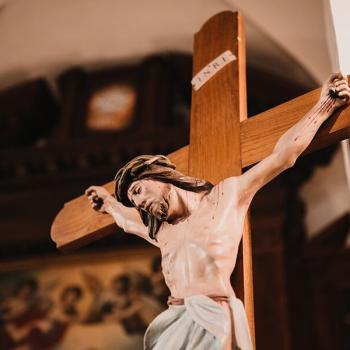
Crucifixion on a cross.
The cross was necessary because humanity had chosen violence as its universal language, making execution and torture the only way for God to communicate His incomprehensible love. In other words, at Golgotha, humanity spoke violence and God spoke love, and the cross became the Rosetta stone.
The cross becomes the one place where all peoples–Greeks, Jews, Romans, Ethiopians, Egyptians, etc., can understand what God has been trying to say to us all along. Since we all speak the language of violence displayed on the cross, then at a very primitive level, when we see a man beaten and bloodied and suffering while surrounded by an angry mob, no words are necessary.
But then, God does something truly profound and beautiful. Right in the middle of the violence and evil, the Son of God spoke, “Father, forgive them.” And he taught us our first words.
But now the world has two languages: violence and love. And the latter is far more difficult than the former.
Odds are, we will never face evil and suffering at the level Jesus faced. And yet, he was still able to say, “Father, forgive them.” How does one pronounce THOSE words in THAT context? Yet, if Jesus can forgive his enemies while nailed to a cross, then any excuse we might offer as to why we can’t do the same looks anemic. Ridiculous, even.
Forgiveness is as the heart of Jesus’ teaching. It is an integral part of the strategy with which the Kingdom of God will prevail over the gates of Hell. Jesus wasn’t kidding when he said, “Love your enemies.” And the first century Christians understood this. It became a litmus test for inclusion in the community of faith. But ever since Cain murdered Abel, humanity has become quite fluent in the language of violence. Just scan the top stories of any news app, and you’ll see.
And that’s the problem. The angry mob is still here.
But imagine a world in which the Church was able to convince every single person to forgive. To respond to all evil and suffering inflicted on us by others with grace. Say we could even pick a day, like next Friday, where we all agree to wake up that morning and offer love to our enemies—where we literally turn the other cheek. What would our world look like?
The wolf will live with the lamb,
the leopard will lie down with the goat,
the calf and the lion and the yearling together;
and a little child will lead them. (Isaiah 11:6, NIV)
Idealistic? I know. Impractical? Yep. And see, already the excuses have started….
Perhaps the most powerful lesson of the cross is found not so much in answering questions about atonement or theodicy, but about showing us how to respond to the very real suffering and evil that is in the world—and in us—and in doing so, we learn how to speak love.
My guess is that if God were to administer a doctrinal test at the gates of heaven, not many would get a passing grade. I get excited if my students just know what the words atonement and theodicy mean. Rather, I think God will be looking at how our theology shapes who we are.
How did we respond to the person on the other side of the political or theological fence? To the unfaithful spouse? To the unethical pastor? To the school bully? To the lazy coworker? Even after they deeply hurt us. Did we respond by frightening and intimidating them or by listening and trying to redeem the situation? Did we lash out or love? Did we advance the Kingdom? Or the boundaries of Hell?
As you may recall, this meditation on the cross began with a story about my seven-year-old daughter going through a crisis of faith in the throes of nausea. Though she had never heard of atonement or theodicy, at a very basic level she was grappling with these ideas. And as a result, she was forced to redraw her connect-the-dot picture of God as she faced a page with words like “sin” and “love” and “grace” and “justice” with no numbers to guide her.
She asked for my help.
And after a decade of schooling to get a Ph.D. and more decades of teaching historical theology to students while pastoring a small congregation, I was stumped.
“Why did God make sickness?” she said tearfully.
In that moment, I really wished I had had an answer: but if the Father refused to give Job and Jesus an answer as they faced suffering, then what could I possibly say?
So I had to just hug her tightly and confess, “I don’t know.”
And as I did, I wondered how her picture of God looked now that she was forced to draw it herself. I decided a long time ago that I can’t speak for God about why He created sickness. I have no idea what He’d say. It’s one of those questions so complex that only Sophomore Bible majors know the answer.
But I can respond to her trauma with the language of love. I can snuggle her and share her frustration. I can speak to God on her behalf. I can clean out the throw-up bowl, place a cold washcloth on her forehead, and sit with her through the night. I can tenderly hold her hair back as she throws up again and again, in the hopes that as she connects the dots picturing God, she remembers that God didn’t just make sickness.
He made daddies, too.
Read Kelly Pigott’s complete Lenten series on the Cross here.
 Kelly Pigott is a church history professor who teaches at Hardin-Simmons University in Abilene, Texas. You can find more musings on history, culture, contemplative spirituality and theology, along with interviews with authors atkellypigott.com. Follow him on twitter @kellypigott
Previous Post

April 16, 2014
A Gentle Fraying: Observing a Homespun Lent, Week 7
Next Post

April 21, 2014 Faith Forward: The Future of Christian Education
Recent Comments
Browse Our Archives
Select a Category Advent Author Interviews Battle Over the Body and Blood of Christ Bearing Beauty Book Reviews Christian Education christian spirituallity christianity Christmas Church Church Leadership Contemplation Creation Care Death and Dying Death Penalty Disruptive Change Disruptors Series Easter Education Evolution and Faith Future of Progressive Christianity Gun Violence Health & Wellness Holy Week Interfaith Israel-Palestine Leading Differently Lent LGBTQ Living with Cancer Meditations on the Cross Mental Illness millennials Mimetic Mondays Monday Meditations Movie Reviews New Monasticism Pando Populus Parenting Patheos 10+1 Q&A Series PC(USA) Politics Pop Culture Practical Theology Series Prayer progressive christian Race Relations Reformation religion Religion and Politics Religion in America Rethink Church Social Justice Spirituality Spirituality of the Body Stump a Scholar Technology and Faith Thanksgiving Theodicy Trust Me Church Uncategorized Why I'm Still Christian Youth Ministry
Select a Month December 2025 April 2025 January 2025 September 2023 September 2022 May 2022 February 2022 January 2022 November 2021 October 2021 May 2021 February 2021 November 2020 October 2020 September 2020 June 2020 May 2020 March 2020 June 2019 March 2019 January 2019 June 2018 May 2018 April 2018 February 2018 January 2018 December 2017 November 2017 October 2017 September 2017 August 2017 July 2017 June 2017 May 2017 April 2017 March 2017 February 2017 January 2017 December 2016 November 2016 October 2016 September 2016 August 2016 July 2016 June 2016 May 2016 April 2016 March 2016 February 2016 January 2016 December 2015 November 2015 October 2015 September 2015 August 2015 July 2015 June 2015 May 2015 April 2015 March 2015 February 2015 January 2015 December 2014 November 2014 October 2014 September 2014 August 2014 July 2014 June 2014 May 2014 April 2014 March 2014 February 2014 January 2014 December 2013 November 2013 October 2013 September 2013 August 2013 July 2013 June 2013 May 2013 April 2013 March 2013 February 2013 January 2013 December 2012 November 2012 October 2012 September 2012 August 2012 July 2012 June 2012 May 2012 April 2012 March 2012 February 2012 January 2012 December 2011 November 2011 October 2011 September 2011 August 2011 July 2011 June 2011 May 2011 April 2011 March 2011 February 2011 January 2011 December 2010 November 2010 October 2010 September 2010 August 2010 July 2010 June 2010 May 2010 April 2010 March 2010
Follow Us!
TAKE THE
Religious Wisdom Quiz
Who said, "Who am I, that I should go to Pharaoh?"
Select your answer to see how you score.
Moses Aaron Joshua Elijah
Related posts from Faith Forward

Should Christians Attend Same-Sex Weddings?

Gender Dysphoria: Real or Imagined?
Is Christ a Sacrifice or a Survivor? How...

A Christian Defense of Critical Theory
TRENDING AT PATHEOS Progressive Christian

What Being a Modern-Day Apostle Means to Me
In my last column, I discussed the ins and outs of modern-day...

Did Ancient China Once Worship the God of...
Across human history, a common thread weaves through the origins of the...

Love Your Neighbor – Including Earth-Kin: Lev. 19,...
God’s command to love your neighbor means acting in an ethical and...

Lead a Church Study of “Jesus and Lao...
Guest writer Jack Thomas (The Irreverent Reverend) reflects on leading his church...

Pastoral Wisdom for Responding to Sermon Pushback
Getting sermon pushback on your social justice sermon? Learn practical, Proverbs-based strategies...

Principles for Understanding the Apostolic Ministry Today
Whenever people discover that my formal ministry title is "apostle," as in...
view all Progressive Christian blogs
Ad-Free & Subscriber Log-In Subscription Support
- About Us
- 2026 Calendar
- Videos
- Podcasts
- Library of World Religions
- Faith In Media Tracker
- Advertise With Us
- Write for Us
- Privacy Policy
- Terms of Service
- Do Not Sell My Data
- Contact Us
- Radiant Digital
- Manage Newsletter Subscriptions
- Unsubscribe From Notifications
- Sitemap
Copyright 2008-2026, Patheos. All rights reserved.
Subscription Support Ad-Free & Subscriber Log-In
Follow Patheos