
BuddhistCatholicContemplativeEvangelicalGeneral ChristianHinduJewishLatter-day SaintMuslimNew VisionsProgressive Christian
Beliefs
- Buddhist
- Catholic
- Contemplative
- Evangelical
- General Christian
- Hindu
- Jewish
- Latter-day Saint
- More Voices
- Muslim
- New Visions
- Pagan
- Progressive Christian
Topics
- Religion News
- Food and Religion
- Sports and Religion
- Religious Art
- Religious Music and Entertainment
- Religious Events
- History and Religion
- Style and Religion
- Politics and Religion
- Women in Religion
- Recreation Outdoors and Religion
- Business Finance and Religion
- Careers Workplace and Religion
- Education and Religion
- Family Parenting and Religion
- Health Fitness and Religion
- Home and Religion
- Relationships and Religion
- Technology and Religion
- Travel and Religion
Columnists
- Buddhist Columnists
- Business Finance and Religion Columnists
- Careers Workplace and Religion Columnists
- Catholic Columnists
- Contemplative Columnists
- Education and Religion Columnists
- Evangelists Columnists
- Family Parenting and Religion Columnists
- General Christian Columnists
- Health Fitness and Religion Columnists
- Hindu Columnists
- History and Religion Columnists
- Home and Religion Columnists
- Jewish Columnists
- More Voices Columnists
- Latter Day Columnists
- Muslim Columnists
- New Visions Columnists
- Nonreligious Columnists
- Pagan Columnists
- Politics and Religion Columnists
- Progressive Columnists
- Recreation Outdoors and Religion Columnists
- Relationships and Religion Columnists
- Religion News Columnists
- Religious Art Columnists
- Religious Events Columnists
- Religious Music and Entertainment Columnists
- Sports and Religion Columnists
- Style and Religion Columnists
- Technology and Religion Columnists
- Travel and Religion Columnists
- Women in Religion Columnists
Resource Library
- 2026 Calendar
- Library of World Religions
- The 100 Most Holy Places on Earth
- Patheos Answers
- Podcasts
- Videos
- Faith Leaders Database
- Anglican Episcopalian
- Bahai
- Baptist
- Buddhism
- Christianity
- Confucianism
- Eastern Orthodoxy
- Hinduism
- Holiness and Pentecostal
- ISKCON
- Islam
- Judaism
- Lutheran
- Methodist
- The Church of Jesus Christ of Latter-day Saints
- New Age
- Paganism
- Presbytarian and Reformed
- Protestantism
- Religion Behind the Scenes
- Roman Catholic
- Scientology
- Shia Islam
- Sikhism
- Sufism
- Sunni Islam
- Taoism
- Zen
- See all religions
Research Tools
 Ad-Free & Subscriber Log-In Subscription Support
Ad-Free & Subscriber Log-In Subscription Support
Follow Patheos 

- Trending:
- Forgiveness
- |
- Marriage
- |
- Consciousness
- |
- Death Penalty
- |
- Election
- |
- Halloween

- Home
- Progressive Christian
- The Cross: The Problem of Evil
The Cross: The Problem of Evil
Last updated on: March 7, 2014 at 7:03 pm by Kelly Pigott
The Cross: The Problem of Evil 2014-03-07T19:03:44+00:00 Kelly Pigott
Patheos Explore the world's faith through different perspectives on religion and spirituality! Patheos has the views of the prevalent religions and spiritualities of the world.
 Editor’s Note: This is the first in a weekly series of meditations on the cross during Lent by Church History Professor Kelly Pigott.
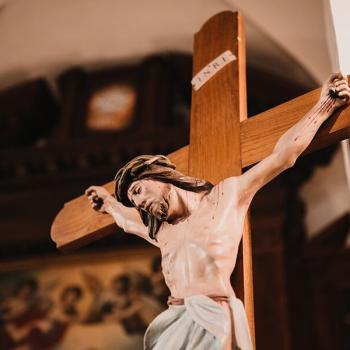
At the end of the crucifixion event described in the books of Mark and Matthew, Jesus uttered one of the most profound and baffling questions ever to face those of us who believe in a loving God. On the last day of his life, Jesus was beaten several times. He was whipped with a cat o’ nine tails, an especially gruesome torture device consisting of leather straps and sharp fragments of bone and pottery used to inflict the maximum amount of pain on the victim. He then had to carry a heavy cross to Golgotha, all the while jeered and spat upon by the crowd, and probably pelted with object. And all of this before he was then nailed to two pieces of wood to face one of the most horrific ways to die: crucifixion. I won’t even go into detail about all the agony inflicted on the body as a result of this form of torture.
But then, at that moment, the Son of Man looked to heaven and asked, “My God, my God, why have you forsaken me?” If this doesn’t move you, consider also the fact that after he yelled his brutally raw interrogative/accusation, he was answered with silence.
My seven-year-old daughter entered the bedroom in the middle of the night in tears. “Daddy, my tummy hurts.”
I sat up, rubbing my eyes. “Do you feel like you’re going to throw up?” Always my first question when it comes to tummy troubles.
She nods her head.
Ugh, I think. There are few things worse than this. I know this is going to sound really selfish, but as I search for the throw-up-bowl and a towel, my mind reflects over the day to review how much contact I had with her in order to calculate the odds of catching the stomach virus myself. I eventually wind up in her bedroom and sit next to her as she moans and cries. I know she’s miserable and I feel helpless because there’s absolutely nothing I can do. This is just going to be a long, horrible, sleepless night.
“Daddy?” She sounds so pitiful.
“Yeah, baby.”
“Can you pray and ask God to take my sickness away?” My heart sinks–because now, on top of feeling helpless, I feel like a hypocrite. Understand that I believe in the power of prayer. I believe that God sometimes heals people. But after a couple of decades of pastoral ministry, I also know sometimes people get sick and they don’t get better, despite our
most fervent petitions. My anxiety increased because I feared that my daughter was about to learn this lesson the hard way, because I’m going to lead her in a prayer that I didn’t expect God to answer, and this was going to break her heart.
We prayed. I mustered all the sincerity I could. But her tummy just got worse and worse. She cried harder and moaned deeper. I tried patting her, wiping her brow with a wet cloth, letting her chew mint gum. Nothing
worked. Finally, in a heart-wrenching voice, she stared at me with narrow, red eyes and asked in dismay, “Why did God make sickness!?”
Then she threw up.
Her question fits under a general category called theodicy, whereby theologians and seven-year-old girls ponder why a good and loving God allows evil and suffering to exist. Put plainly: why does God allow people like Hitler to slaughter the innocent; why doesn’t God just take grandma when she’s in such pain; why does God send tornadoes to wipe out
entire towns.
The dirty little secret of theology is that no one has been able to come up with a satisfying answer. A lot of smart people have tried. And many have come up with something that satisfies them. But ultimately one is left with one of two untenable positions: either God is not all-loving, or He is not all-powerful. In a grossly simplistic way, this is the problem of theodicy.
The Bible gives us little hints and clues to help us understand the dilemma, but it doesn’t provide a smoking-gun answer. Instead, what we get is like a connect-the-dot drawing without numbers to guide us. Essentially, we gaze at a page full of dots with labels like “sin,” “broken,” “love,” “sovereign,” “Satan,” “free will,” “grace,” “guilt,” and “evil” just to name a few.
And God gives each person a crayon with which to connect the dots. Some draw a King who commands everything to happen. He sends the earthquakes, tsunamis, dictators and diseases, and if people get in the way and die, they
deserve it for being a bunch of dirty rotten sinners. It’s a disturbing picture, but one that attempts to satisfy the problem of theodicy by emphasizing God’s power and justice. In the process, though, God comes across mean and cranky. Did God really send the pedophile into the five-year-olds room because she deserved it?
Others connect the dots and create a picture of a loving father who grieves when tragedy strikes. They blame our broken work on humanity’s propensity to choose sin. In other words, evil exists because of the evil choices people make. Some believe that even God suffers because of this. Sometimes He intervenes to relieve the pain. His overall presence keeps things from getting really bad. But sometimes He doesn’t do anything and allows evil to reign.
It’s this last part that’s problematic. Imagine a person who passes a house on fire and sees a child banging on the window for help. And even though no risk exists in the rescue attempt, that person ignores the pleas and walks on. What would you think of that callous individual? He’s not very loving, is he? Which leads to the other side of the equation, he must want to do something about it, but he can’t.
A myriad of other ways to connect the dots have been attempted, but there’s always a part of the picture that just doesn’t make sense. It’s out of proportion with the rest of the figure, or unfinished sections remain. Therefore, we must approach the subject with a great deal of humility, realizing that our picture may help us, but not necessarily
someone else.
Because when people suffer, they tend to become very emotionally invested in their picture. Or else they become traumatized over the fact that their picture just isn’t working, and so they have to redraw it. The problem of theodicy is one of the reasons why faith is faith. It’s an area where understanding the question may be far more important than coming up with an answer.
Put another way, perhaps understanding the question better IS the answer. For the great picture of theodicy is Jesus hanging on the cross after hours and hours of excruciating pain, rejection, and injustice, at which point he gazes to heaven with a tear-and-blood-streaked face and asks, “Why?”
Real damage occurs when well-meaning friends feel compelled to provide the answers that they’ve come up with, convinced their wisdom will resolve the tension and make the victim feel better. They say things like: “God always has a reason.” “Something good will come of this.” “God won’t test you beyond your ability.” “If you just have faith, things will get better.” “Maybe there’s unconfessed sin in your life.” There may be some truth in a few of these statements, but the vast majority of the time these words come across callous and trite.
When people suffer, the last thing they want you to do is to connect the dots for them.
Over the course of Lent, I will be reflecting on the Cross and how different people have understood it throughout church history, especially as it relates to evil and suffering in the world. The final meditation will be on Good Friday.
 Kelly Pigott is a church history professor who teaches at Hardin-Simmons University in Abilene, Texas. You can find more musings on history, culture, contemplative spirituality and theology, along with interviews with authors at kellypigott.com. Follow him on twitter @kellypigott
Previous Post

March 6, 2014
If Jesus Gave a TED Talk (#1)
Next Post

March 10, 2014 Attn SBNR: Biblical Violence Matters to Peace
Recent Comments
129 Comments | Leave a Comment
Browse Our Archives
Select a Category Advent Author Interviews Battle Over the Body and Blood of Christ Bearing Beauty Book Reviews Christian Education christian spirituallity christianity Christmas Church Church Leadership Contemplation Creation Care Death and Dying Death Penalty Disruptive Change Disruptors Series Easter Education Evolution and Faith Future of Progressive Christianity Gun Violence Health & Wellness Holy Week Interfaith Israel-Palestine Leading Differently Lent LGBTQ Living with Cancer Meditations on the Cross Mental Illness millennials Mimetic Mondays Monday Meditations Movie Reviews New Monasticism Pando Populus Parenting Patheos 10+1 Q&A Series PC(USA) Politics Pop Culture Practical Theology Series Prayer progressive christian Race Relations Reformation religion Religion and Politics Religion in America Rethink Church Social Justice Spirituality Spirituality of the Body Stump a Scholar Technology and Faith Thanksgiving Theodicy Trust Me Church Uncategorized Why I'm Still Christian Youth Ministry
Select a Month December 2025 April 2025 January 2025 September 2023 September 2022 May 2022 February 2022 January 2022 November 2021 October 2021 May 2021 February 2021 November 2020 October 2020 September 2020 June 2020 May 2020 March 2020 June 2019 March 2019 January 2019 June 2018 May 2018 April 2018 February 2018 January 2018 December 2017 November 2017 October 2017 September 2017 August 2017 July 2017 June 2017 May 2017 April 2017 March 2017 February 2017 January 2017 December 2016 November 2016 October 2016 September 2016 August 2016 July 2016 June 2016 May 2016 April 2016 March 2016 February 2016 January 2016 December 2015 November 2015 October 2015 September 2015 August 2015 July 2015 June 2015 May 2015 April 2015 March 2015 February 2015 January 2015 December 2014 November 2014 October 2014 September 2014 August 2014 July 2014 June 2014 May 2014 April 2014 March 2014 February 2014 January 2014 December 2013 November 2013 October 2013 September 2013 August 2013 July 2013 June 2013 May 2013 April 2013 March 2013 February 2013 January 2013 December 2012 November 2012 October 2012 September 2012 August 2012 July 2012 June 2012 May 2012 April 2012 March 2012 February 2012 January 2012 December 2011 November 2011 October 2011 September 2011 August 2011 July 2011 June 2011 May 2011 April 2011 March 2011 February 2011 January 2011 December 2010 November 2010 October 2010 September 2010 August 2010 July 2010 June 2010 May 2010 April 2010 March 2010
Follow Us!
TAKE THE
Religious Wisdom Quiz
Which prophet's father was a priest named Buzi?
Select your answer to see how you score.
Ezekiel Joel Daniel Hosea
Related posts from Faith Forward
Is Christ a Sacrifice or a Survivor? How...

A Christian Defense of Critical Theory

Christianity and Environmentalism

What Difference Can Another Lent Make?
TRENDING AT PATHEOS Progressive Christian

What Being a Modern-Day Apostle Means to Me
In my last column, I discussed the ins and outs of modern-day...

Did Ancient China Once Worship the God of...
Across human history, a common thread weaves through the origins of the...

Love Your Neighbor – Including Earth-Kin: Lev. 19,...
God’s command to love your neighbor means acting in an ethical and...

Lead a Church Study of “Jesus and Lao...
Guest writer Jack Thomas (The Irreverent Reverend) reflects on leading his church...

Pastoral Wisdom for Responding to Sermon Pushback
Getting sermon pushback on your social justice sermon? Learn practical, Proverbs-based strategies...

Principles for Understanding the Apostolic Ministry Today
Whenever people discover that my formal ministry title is "apostle," as in...
view all Progressive Christian blogs
Ad-Free & Subscriber Log-In Subscription Support
- About Us
- 2026 Calendar
- Videos
- Podcasts
- Library of World Religions
- Faith In Media Tracker
- Advertise With Us
- Write for Us
- Privacy Policy
- Terms of Service
- Do Not Sell My Data
- Contact Us
- Radiant Digital
- Manage Newsletter Subscriptions
- Unsubscribe From Notifications
- Sitemap
Copyright 2008-2026, Patheos. All rights reserved.
Subscription Support Ad-Free & Subscriber Log-In
Follow Patheos