
BuddhistCatholicContemplativeEvangelicalGeneral ChristianHinduJewishLatter-day SaintMuslimNew VisionsProgressive Christian
Beliefs
- Buddhist
- Catholic
- Contemplative
- Evangelical
- General Christian
- Hindu
- Jewish
- Latter-day Saint
- More Voices
- Muslim
- New Visions
- Pagan
- Progressive Christian
Topics
- Religion News
- Food and Religion
- Sports and Religion
- Religious Art
- Religious Music and Entertainment
- Religious Events
- History and Religion
- Style and Religion
- Politics and Religion
- Women in Religion
- Recreation Outdoors and Religion
- Business Finance and Religion
- Careers Workplace and Religion
- Education and Religion
- Family Parenting and Religion
- Health Fitness and Religion
- Home and Religion
- Relationships and Religion
- Technology and Religion
- Travel and Religion
Columnists
- Buddhist Columnists
- Business Finance and Religion Columnists
- Careers Workplace and Religion Columnists
- Catholic Columnists
- Contemplative Columnists
- Education and Religion Columnists
- Evangelists Columnists
- Family Parenting and Religion Columnists
- General Christian Columnists
- Health Fitness and Religion Columnists
- Hindu Columnists
- History and Religion Columnists
- Home and Religion Columnists
- Jewish Columnists
- More Voices Columnists
- Latter Day Columnists
- Muslim Columnists
- New Visions Columnists
- Nonreligious Columnists
- Pagan Columnists
- Politics and Religion Columnists
- Progressive Columnists
- Recreation Outdoors and Religion Columnists
- Relationships and Religion Columnists
- Religion News Columnists
- Religious Art Columnists
- Religious Events Columnists
- Religious Music and Entertainment Columnists
- Sports and Religion Columnists
- Style and Religion Columnists
- Technology and Religion Columnists
- Travel and Religion Columnists
- Women in Religion Columnists
Resource Library
- 2026 Calendar
- Library of World Religions
- The 100 Most Holy Places on Earth
- Patheos Answers
- Podcasts
- Videos
- Faith Leaders Database
- Anglican Episcopalian
- Bahai
- Baptist
- Buddhism
- Christianity
- Confucianism
- Eastern Orthodoxy
- Hinduism
- Holiness and Pentecostal
- ISKCON
- Islam
- Judaism
- Lutheran
- Methodist
- The Church of Jesus Christ of Latter-day Saints
- New Age
- Paganism
- Presbytarian and Reformed
- Protestantism
- Religion Behind the Scenes
- Roman Catholic
- Scientology
- Shia Islam
- Sikhism
- Sufism
- Sunni Islam
- Taoism
- Zen
- See all religions
Research Tools
 Ad-Free & Subscriber Log-In Subscription Support
Ad-Free & Subscriber Log-In Subscription Support
Follow Patheos 

- Trending:
- Forgiveness
- |
- Marriage
- |
- Consciousness
- |
- Death Penalty
- |
- Election
- |
- Halloween

- Home
- Progressive Christian
- The Cross, Part 4: The Views of Calvin, Arminius, and Aslan Described Somewhat Snarkily
The Cross, Part 4: The Views of Calvin, Arminius, and Aslan Described Somewhat Snarkily
Last updated on: April 3, 2014 at 5:24 pm by Kelly Pigott
The Cross, Part 4: The Views of Calvin, Arminius, and Aslan Described Somewhat Snarkily 2014-04-03T17:24:29+00:00 Kelly Pigott
Patheos Explore the world's faith through different perspectives on religion and spirituality! Patheos has the views of the prevalent religions and spiritualities of the world.
 One of the issues facing our understanding of the crucifixion event centers on who to blame for the wickedness on display. One popular view is presented by people called “Calvinists” who tend to emphasize the sovereignty or power of God, and the depravity or wickedness of humanity. Calvinists are followers of a famous 16th century reformer in Geneva named John Calvin, who wrote one of the most eloquent summaries of Reformation theology entitled, The Institutes of the Christian Religion. In it, Calvin comes to the conclusion that God the Father is behind the crucifixion of His Son. It is the logical conclusion stemming from the fact that if God is sovereign, then nothing can happen without Him behind it somehow, otherwise He wouldn’t be sovereign. And God’s justice demands that Jesus face the full wrath of the Father in order to atone for the utter depravity of humanity. In fact, utter depravity is something Calvinists love to apply to everything about themselves, except, of course, to their theology.
Another popular view is maintained by Arminians, named after Jacobus Arminius, who was a Calvinist. I know, this gets really confusing. But stay with me. Arminius was concerned with the possibility that Calvinism might devolve into a type of unattractive fatalism. If God causes everything to happen, then there’s nothing I can do about anything, so why bother? C’est la vie. Or more accurately (if Google translate is to be trusted), Tel est Dieu.
To keep this from happening, Arminius attempted to retain the sovereignty of God while at the same time elevating free will in humanity. And the crux of the problem, he correctly surmised, was in how Calvinists understood “predestination.” But perhaps, Arminius mused, predestination doesn’t necessarily mean that God causes everything to happen, but that God knows ahead of time what’s going to happen. In other words, predestination is really foreknowledge. And so, when you fall down the stairs, it isn’t because God pushed you, it’s because he knows you’re a klutz. This gave Arminius the freedom to proclaim that you and I actually have some power to make choices in life, because God gives us just enough grace to decide between good and evil. When applied to the cross, Arminians tend not to see God causing the suffering, but humanity. For Arminians tend to blame all that’s wrong with the world on the bad choices that people make, especially the choice that many make to become Calvinists.
Now, there is a third major culprit in this arena. And for the first thousand years of Christianity, this character was the most popular villain among those who pondered the “passion,” or suffering, surrounding the cross. It’s an idea at the heart of C.S. Lewis’s book, The Lion, the Witch, and the Wardrobe, and as I explain it you will quickly recognize how Aslan took on the role of Jesus, Edmund took on the role of humanity, and the White Witch took on the role of this third culprit, Satan.
So picture a chessboard with God the Father (he’s the favorite) on one side, and Satan, the prince of darkness (the underdog) on the other. The board doesn’t look good for Satan. He is down to a few pieces, but that’s it. And God hasn’t lost a piece, yet. God’s a really good chess player. But then, a plot twist occurs. God’s pawns (humanity) all of a sudden switch sides, because in this narrative, sin is viewed as an act of treason. Once humanity erred, we essentially became pawns of Satan. And he can do with us whatever he wants. However, God loves us deeply, even though we’re just pawns. And he doesn’t want to see us spend an eternity with the pointy-tailed one. And so, he offers Satan a deal. God will give him the most powerful piece on the board, Jesus. Or in chess-speak, the queen. Though Jesus isn’t the queen because he’s a boy. Well, actually he’s God, who is playing the game and not really on the board. But, um,…OK, the analogy is breaking down.
So let’s just stick with the plot. God gives Jesus to Satan in exchange for humanity. In this way, Jesus becomes our ransom (Matt. 20:28, Hebrews 9:15) that allows God to buy back humanity. We are no longer under the dominion of Satan, but Jesus is, which is why the crucifixion takes place. Satan believes he is removing Jesus from the board for good because he uses all of his evil powers to kill Jesus. So that the crucifixion event is ultimately Satan mustering all his forces to torture and execute the Son of Man. And for a couple of days after Jesus gave up his spirit, Satan thinks he has won. But what he doesn’t know about is the power of the resurrection. It’s like moving a pawn down to the last row and getting your most powerful piece back. So in the end, the Father not only gets humanity, but Jesus as well. And Satan winds up the big loser. And he’s a really sore loser, which is why he keeps pestering Christians. But it’s only a matter of time before he will be thrown in the Lake of Fire, and he knows it.
Now, I don’t want to make light of a very serious question. Because the truth is, behind my overly simplistic and somewhat snarky attempt at explaining these three grand ideas is a sober desire for you to understand the problem of evil and suffering as it was displayed at the cross. For one may argue that there is no greater picture of evil than the senseless torture and execution of the innocent.
But who is to blame?
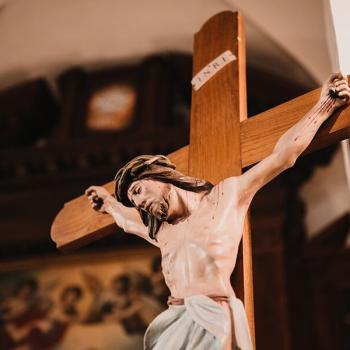
Did violence happen at the cross because God made the people torture and crucify His Son (Calvin), or because the people made evil choices (Arminius), or that Satan manipulates people to commit treason (Aslan).
An even stickier question is how did the crucifixion of Jesus act as a remedy for the rampant evil on display at the cross? The word for this is “atonement,” and whether you know it or not, there is somewhat of a war going on right now among a certain segment of Protestants over this issue. But we will have to wait until next week to delve into that one.
Read Part I, II and III of Kelly Pigott’s The Cross Lenten series at Patheos.
 Kelly Pigott is a church history professor who teaches at Hardin-Simmons University in Abilene, Texas. You can find more musings on history, culture, contemplative spirituality and theology, along with interviews with authors at kellypigott.com. Follow him on twitter @kellypigott
Previous Post

March 27, 2014
If Jesus Gave a TED Talk (#4): Be Like Unto Katie
Next Post

March 31, 2014 Stronger Together: Observing an Interfaith Lent
Recent Comments
139 Comments | Leave a Comment
Browse Our Archives
Select a Category Advent Author Interviews Battle Over the Body and Blood of Christ Bearing Beauty Book Reviews Christian Education christian spirituallity christianity Christmas Church Church Leadership Contemplation Creation Care Death and Dying Death Penalty Disruptive Change Disruptors Series Easter Education Evolution and Faith Future of Progressive Christianity Gun Violence Health & Wellness Holy Week Interfaith Israel-Palestine Leading Differently Lent LGBTQ Living with Cancer Meditations on the Cross Mental Illness millennials Mimetic Mondays Monday Meditations Movie Reviews New Monasticism Pando Populus Parenting Patheos 10+1 Q&A Series PC(USA) Politics Pop Culture Practical Theology Series Prayer progressive christian Race Relations Reformation religion Religion and Politics Religion in America Rethink Church Social Justice Spirituality Spirituality of the Body Stump a Scholar Technology and Faith Thanksgiving Theodicy Trust Me Church Uncategorized Why I'm Still Christian Youth Ministry
Select a Month December 2025 April 2025 January 2025 September 2023 September 2022 May 2022 February 2022 January 2022 November 2021 October 2021 May 2021 February 2021 November 2020 October 2020 September 2020 June 2020 May 2020 March 2020 June 2019 March 2019 January 2019 June 2018 May 2018 April 2018 February 2018 January 2018 December 2017 November 2017 October 2017 September 2017 August 2017 July 2017 June 2017 May 2017 April 2017 March 2017 February 2017 January 2017 December 2016 November 2016 October 2016 September 2016 August 2016 July 2016 June 2016 May 2016 April 2016 March 2016 February 2016 January 2016 December 2015 November 2015 October 2015 September 2015 August 2015 July 2015 June 2015 May 2015 April 2015 March 2015 February 2015 January 2015 December 2014 November 2014 October 2014 September 2014 August 2014 July 2014 June 2014 May 2014 April 2014 March 2014 February 2014 January 2014 December 2013 November 2013 October 2013 September 2013 August 2013 July 2013 June 2013 May 2013 April 2013 March 2013 February 2013 January 2013 December 2012 November 2012 October 2012 September 2012 August 2012 July 2012 June 2012 May 2012 April 2012 March 2012 February 2012 January 2012 December 2011 November 2011 October 2011 September 2011 August 2011 July 2011 June 2011 May 2011 April 2011 March 2011 February 2011 January 2011 December 2010 November 2010 October 2010 September 2010 August 2010 July 2010 June 2010 May 2010 April 2010 March 2010
Follow Us!
TAKE THE
Religious Wisdom Quiz
The queen of Ethiopia in the time of the early church was …
Select your answer to see how you score.
Candace Bernice Hatshepsut Esther
Related posts from Faith Forward

Should Christians Attend Same-Sex Weddings?

Gender Dysphoria: Real or Imagined?
Is Christ a Sacrifice or a Survivor? How...

A Christian Defense of Critical Theory
TRENDING AT PATHEOS Progressive Christian

Why Christians Have a Sacred Duty to Vote:...
The Bible offers strong support for the sacred duty to vote. Here...

What Being a Modern-Day Apostle Means to Me
In my last column, I discussed the ins and outs of modern-day...

Did Ancient China Once Worship the God of...
Across human history, a common thread weaves through the origins of the...

Love Your Neighbor – Including Earth-Kin: Lev. 19,...
God’s command to love your neighbor means acting in an ethical and...

Lead a Church Study of “Jesus and Lao...
Guest writer Jack Thomas (The Irreverent Reverend) reflects on leading his church...

Principles for Understanding the Apostolic Ministry Today
Whenever people discover that my formal ministry title is "apostle," as in...
view all Progressive Christian blogs
Ad-Free & Subscriber Log-In Subscription Support
- About Us
- 2026 Calendar
- Videos
- Podcasts
- Library of World Religions
- Faith In Media Tracker
- Advertise With Us
- Write for Us
- Privacy Policy
- Terms of Service
- Do Not Sell My Data
- Contact Us
- Radiant Digital
- Manage Newsletter Subscriptions
- Unsubscribe From Notifications
- Sitemap
Copyright 2008-2026, Patheos. All rights reserved.
Subscription Support Ad-Free & Subscriber Log-In
Follow Patheos