
BuddhistCatholicContemplativeEvangelicalGeneral ChristianHinduJewishLatter-day SaintMuslimNew VisionsProgressive Christian
Beliefs
- Buddhist
- Catholic
- Contemplative
- Evangelical
- General Christian
- Hindu
- Jewish
- Latter-day Saint
- More Voices
- Muslim
- New Visions
- Pagan
- Progressive Christian
Topics
- Religion News
- Food and Religion
- Sports and Religion
- Religious Art
- Religious Music and Entertainment
- Religious Events
- History and Religion
- Style and Religion
- Politics and Religion
- Women in Religion
- Recreation Outdoors and Religion
- Business Finance and Religion
- Careers Workplace and Religion
- Education and Religion
- Family Parenting and Religion
- Health Fitness and Religion
- Home and Religion
- Relationships and Religion
- Technology and Religion
- Travel and Religion
Columnists
- Buddhist Columnists
- Business Finance and Religion Columnists
- Careers Workplace and Religion Columnists
- Catholic Columnists
- Contemplative Columnists
- Education and Religion Columnists
- Evangelists Columnists
- Family Parenting and Religion Columnists
- General Christian Columnists
- Health Fitness and Religion Columnists
- Hindu Columnists
- History and Religion Columnists
- Home and Religion Columnists
- Jewish Columnists
- More Voices Columnists
- Latter Day Columnists
- Muslim Columnists
- New Visions Columnists
- Nonreligious Columnists
- Pagan Columnists
- Politics and Religion Columnists
- Progressive Columnists
- Recreation Outdoors and Religion Columnists
- Relationships and Religion Columnists
- Religion News Columnists
- Religious Art Columnists
- Religious Events Columnists
- Religious Music and Entertainment Columnists
- Sports and Religion Columnists
- Style and Religion Columnists
- Technology and Religion Columnists
- Travel and Religion Columnists
- Women in Religion Columnists
Resource Library
- 2026 Calendar
- Library of World Religions
- The 100 Most Holy Places on Earth
- Patheos Answers
- Podcasts
- Videos
- Faith Leaders Database
- Anglican Episcopalian
- Bahai
- Baptist
- Buddhism
- Christianity
- Confucianism
- Eastern Orthodoxy
- Hinduism
- Holiness and Pentecostal
- ISKCON
- Islam
- Judaism
- Lutheran
- Methodist
- The Church of Jesus Christ of Latter-day Saints
- New Age
- Paganism
- Presbytarian and Reformed
- Protestantism
- Religion Behind the Scenes
- Roman Catholic
- Scientology
- Shia Islam
- Sikhism
- Sufism
- Sunni Islam
- Taoism
- Zen
- See all religions
Research Tools
 Ad-Free & Subscriber Log-In Subscription Support
Ad-Free & Subscriber Log-In Subscription Support
Follow Patheos 

- Trending:
- Forgiveness
- |
- Marriage
- |
- Consciousness
- |
- Death Penalty
- |
- Election
- |
- Halloween

- Home
- Progressive Christian
- Living in a Post-Theological World: Beyond Theories of God
Living in a Post-Theological World: Beyond Theories of God
Last updated on: November 12, 2010 at 1:04 pm by George Elerick
Living in a Post-Theological World: Beyond Theories of God 2010-11-12T13:04:49+00:00 George Elerick
Patheos Explore the world's faith through different perspectives on religion and spirituality! Patheos has the views of the prevalent religions and spiritualities of the world.
In philosophy, theory (from ancient Greek theoria, θεωρία, meaning “a looking at, viewing, beholding”) refers to contemplation or speculation, as opposed to action.[1] Theory is especially often contrasted to “practice” (Greek praxis, πρᾶξις) a concept that in its original Aristotelian context referred to actions done for their own sake, but can also refer to “technical” actions instrumental to some other aim, such as the making of tools or houses. “Theoria” is also a word still used in theological contexts.
“Hollie Baylor: I was still waiting for everything to start, and now it’s over” (Elizabethtown, Movie)
In terms of developing theories, why do we do it? Most likely because we want to know. In a very simple form, this is a type of gnosis. We look to information to inform us of something that lies outside of ideology. I think it also comes down to how we view God. Sometimes it does seem we use theology to prove to God who she should be. In this light, theology as a theory then becomes a tool of coercion and/or measurement. And not only towards the divine, but towards one another.
In this moment, our theories on the Divine are to prohibit people from believing or living certain ways. Yet, the hope of any religion is to make humanity better, right? Some might agree that to be better at being human is to be better at being free. So if religion has come to a place where it denies the very element it inherently claims it holds, then it has become something other than religion.
We’ve entered into an interesting era in history where people are beginning to ask if history is all we get. Not just in Christianity, but within the framework of the world. We are beginning to see things differently, and I think this is a great time for transformation. I think a good place to start is to realize that now doesn’t have the last word for what is to come.
There is more to God, more to Jesus, more to Christianity than what has previously been offered. But, I have to be honest, I don’t think this exciting new change includes theology. Let me explain. When I used the word theology I am speaking of the theory of theology. Theology as Ideology. Theology as a static entity that exists before the liminal threshold of ideological transformation.
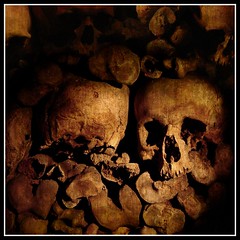
The nation of Israel in Ezekiel 37 are represented as a metaphorical pile of bones. These bones are awaiting resurrection. Awaiting new life. These bones are lying in a deep valley. Darkness surrounds this nation of people. It is a dark time. They have systematically lived their lives to the letter of the law, and God enters the scene and promises to give them a new heart. This is the thing that sustains life, the heart. Israel has lost her heart.
To the point of no longer being human.
She is the object that still persists beyond existence. Although there is no flesh in sight, God responds to Israel as if she is embodied. In this moment, there is a realization that occurs, that God’s Gaze* is actually Israel’s Gaze*. The only way God can respond to Israel as if she is embodied in this metaphor is because God is full embodiment of the disembodied divine. God’s ability to interact creates the illusion of embodiment. The reality in the parable is that Israel is de-fleshed.
Theology has become the pile of bones. It has become embodied by history, assumptions, subjective truths and alienated concepts that have been kept in tow by those before us.
If we simply believe something that has either been socially or historically accepted as truth without ever questioning the intentions of the writer or the point that is being made, than we are not believing, we are simply believing under the guise of belief. In this sense the system itself is mediating our belief. Theology has become the mediator of our belief.
It believes for us.
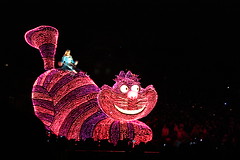
In a post-theological world God exists not because theology says so, but because God is pure in the Hegelian sense. He exists as Being, but also exists as non-being. This much like the character of the Cheshire Cat who’s mouth exists without his body. It is the disembodied reality that is also the embodiment of reality. Rather than one being different from the other, they are one in the same. Or like how the Matrix is something that is always spoken of but never fully realized. In a post-theological world, there is no system in place to describe God because every system does not have ability to account for a God is consistently becoming.
This is why Heresy as the New Theology must be taken seriously and not simply because it is inflammatory. When I speak of heresy, I do not just mean what is deemed as theoretically unsound by the mass majority, but as a positive deconstruction that grows through the systems we create round the Divine. It is positive in that it opens up endles possibilities for discovery. It leaves holy space for unholy moments. It invites us to see that this Being beyond being lies outside of our system of thought. This is why the mystics are so important to the general religious landscape, they remind us the inherent inadequacy of our words. We must exchange awe for literal expression.
It’s that moment where we experience the Divine to the point where we just can’t seem to fit God in our rhetoric. This is a post-theological moment. This is a moment of heresy. Heresy leads those with theories to action. God illicits darkness because that is where she belongs. God had to create light, because she exists there. This isn’t the darkness that is easily compared to evil acts, but rather the darkness that brings distinction, paradox, inconsistency.
We need this stark inconsistency to understand that we don’t understand God and that is a good thing. So what do we do with God being near, and the God who is far? They are one in the same. His immanence is her transcendance. In a Post-Theological world God resides in inconsistency because that’s where the Divine makes sense.
So, what does this world look like without ‘Theology’? What it means is that competition and apologetics are near non-existent in their current forms. That we don’t have to be right. That beyond our theories lies humanity at its best. This may sound like one idea replacing another, but it is more than that, it is the ability to see that multi-culturalism doesn’t just lie in the culture itself but is understood as something comprised of many things. So, a heretical multiculturalism seeks to open space where there was no space to be open prior to the post-theological world.
This heretical multi-culturalism asserts that truth much like Hegel’s pur God is just as becoming as the Divine itself. What does this mean then for all of us? It means we have to lace up our boots, pull out our camping gear, bring some rations because we have no idea where this might end, but we know we are moving forward…
* Lacan’s Gaze is simply defined as : “The ‘Gaze’ is a psychoanalytical term brought into popular usage by Jacques Lacan to describe a condition where the mature autonomous subject observes “the observation of himself” in a mirror.
Previous Post

November 11, 2010
Justice for Veterans and the Vulnerable
Next Post
November 15, 2010 Monday Meditation: Christ is Coming
Recent Comments
624 Comments | Leave a Comment
Browse Our Archives
Select a Category Advent Author Interviews Battle Over the Body and Blood of Christ Bearing Beauty Book Reviews Christian Education christian spirituallity christianity Christmas Church Church Leadership Contemplation Creation Care Death and Dying Death Penalty Disruptive Change Disruptors Series Easter Education Evolution and Faith Future of Progressive Christianity Gun Violence Health & Wellness Holy Week Interfaith Israel-Palestine Leading Differently Lent LGBTQ Living with Cancer Meditations on the Cross Mental Illness millennials Mimetic Mondays Monday Meditations Movie Reviews New Monasticism Pando Populus Parenting Patheos 10+1 Q&A Series PC(USA) Politics Pop Culture Practical Theology Series Prayer progressive christian Race Relations Reformation religion Religion and Politics Religion in America Rethink Church Social Justice Spirituality Spirituality of the Body Stump a Scholar Technology and Faith Thanksgiving Theodicy Trust Me Church Uncategorized Why I'm Still Christian Youth Ministry
Select a Month December 2025 April 2025 January 2025 September 2023 September 2022 May 2022 February 2022 January 2022 November 2021 October 2021 May 2021 February 2021 November 2020 October 2020 September 2020 June 2020 May 2020 March 2020 June 2019 March 2019 January 2019 June 2018 May 2018 April 2018 February 2018 January 2018 December 2017 November 2017 October 2017 September 2017 August 2017 July 2017 June 2017 May 2017 April 2017 March 2017 February 2017 January 2017 December 2016 November 2016 October 2016 September 2016 August 2016 July 2016 June 2016 May 2016 April 2016 March 2016 February 2016 January 2016 December 2015 November 2015 October 2015 September 2015 August 2015 July 2015 June 2015 May 2015 April 2015 March 2015 February 2015 January 2015 December 2014 November 2014 October 2014 September 2014 August 2014 July 2014 June 2014 May 2014 April 2014 March 2014 February 2014 January 2014 December 2013 November 2013 October 2013 September 2013 August 2013 July 2013 June 2013 May 2013 April 2013 March 2013 February 2013 January 2013 December 2012 November 2012 October 2012 September 2012 August 2012 July 2012 June 2012 May 2012 April 2012 March 2012 February 2012 January 2012 December 2011 November 2011 October 2011 September 2011 August 2011 July 2011 June 2011 May 2011 April 2011 March 2011 February 2011 January 2011 December 2010 November 2010 October 2010 September 2010 August 2010 July 2010 June 2010 May 2010 April 2010 March 2010
Follow Us!
TAKE THE
Religious Wisdom Quiz
Who was turned into a pillar of salt?
Select your answer to see how you score.
Lot's wife Lot Naomi Ruth
Related posts from Faith Forward

Should Christians Attend Same-Sex Weddings?

Gender Dysphoria: Real or Imagined?

God, Racism, and our World: A Multi-Layered Diagnostic...

TRENDING AT PATHEOS Progressive Christian

Why Christians Have a Sacred Duty to Vote:...
The Bible offers strong support for the sacred duty to vote. Here...

What Being a Modern-Day Apostle Means to Me
In my last column, I discussed the ins and outs of modern-day...

Did Ancient China Once Worship the God of...
Across human history, a common thread weaves through the origins of the...

Love Your Neighbor – Including Earth-Kin: Lev. 19,...
God’s command to love your neighbor means acting in an ethical and...

Lead a Church Study of “Jesus and Lao...
Guest writer Jack Thomas (The Irreverent Reverend) reflects on leading his church...

Principles for Understanding the Apostolic Ministry Today
Whenever people discover that my formal ministry title is "apostle," as in...
view all Progressive Christian blogs
Ad-Free & Subscriber Log-In Subscription Support
- About Us
- 2026 Calendar
- Videos
- Podcasts
- Library of World Religions
- Faith In Media Tracker
- Advertise With Us
- Write for Us
- Privacy Policy
- Terms of Service
- Do Not Sell My Data
- Contact Us
- Radiant Digital
- Manage Newsletter Subscriptions
- Unsubscribe From Notifications
- Sitemap
Copyright 2008-2026, Patheos. All rights reserved.
Subscription Support Ad-Free & Subscriber Log-In
Follow Patheos