
BuddhistCatholicContemplativeEvangelicalGeneral ChristianHinduJewishLatter-day SaintMuslimNew VisionsProgressive Christian
Beliefs
- Buddhist
- Catholic
- Contemplative
- Evangelical
- General Christian
- Hindu
- Jewish
- Latter-day Saint
- More Voices
- Muslim
- New Visions
- Pagan
- Progressive Christian
Topics
- Religion News
- Food and Religion
- Sports and Religion
- Religious Art
- Religious Music and Entertainment
- Religious Events
- History and Religion
- Style and Religion
- Politics and Religion
- Women in Religion
- Recreation Outdoors and Religion
- Business Finance and Religion
- Careers Workplace and Religion
- Education and Religion
- Family Parenting and Religion
- Health Fitness and Religion
- Home and Religion
- Relationships and Religion
- Technology and Religion
- Travel and Religion
Columnists
- Buddhist Columnists
- Business Finance and Religion Columnists
- Careers Workplace and Religion Columnists
- Catholic Columnists
- Contemplative Columnists
- Education and Religion Columnists
- Evangelists Columnists
- Family Parenting and Religion Columnists
- General Christian Columnists
- Health Fitness and Religion Columnists
- Hindu Columnists
- History and Religion Columnists
- Home and Religion Columnists
- Jewish Columnists
- More Voices Columnists
- Latter Day Columnists
- Muslim Columnists
- New Visions Columnists
- Nonreligious Columnists
- Pagan Columnists
- Politics and Religion Columnists
- Progressive Columnists
- Recreation Outdoors and Religion Columnists
- Relationships and Religion Columnists
- Religion News Columnists
- Religious Art Columnists
- Religious Events Columnists
- Religious Music and Entertainment Columnists
- Sports and Religion Columnists
- Style and Religion Columnists
- Technology and Religion Columnists
- Travel and Religion Columnists
- Women in Religion Columnists
Resource Library
- 2026 Calendar
- Library of World Religions
- The 100 Most Holy Places on Earth
- Patheos Answers
- Podcasts
- Videos
- Faith Leaders Database
- Anglican Episcopalian
- Bahai
- Baptist
- Buddhism
- Christianity
- Confucianism
- Eastern Orthodoxy
- Hinduism
- Holiness and Pentecostal
- ISKCON
- Islam
- Judaism
- Lutheran
- Methodist
- The Church of Jesus Christ of Latter-day Saints
- New Age
- Paganism
- Presbytarian and Reformed
- Protestantism
- Religion Behind the Scenes
- Roman Catholic
- Scientology
- Shia Islam
- Sikhism
- Sufism
- Sunni Islam
- Taoism
- Zen
- See all religions
Research Tools
 Ad-Free & Subscriber Log-In Subscription Support
Follow Patheos 

- Trending:
- Advent
- |
- Forgiveness
- |
- Thanksgiving
- |
- Election
- |
- Seasonal Holidays
- |
- Marriage
 Faith and Chelsen
- Home
- Evangelical
- It is Well With My Soul: The Witness of the Church of Nigeria
It is Well With My Soul: The Witness of the Church of Nigeria
Last updated on: July 11, 2018 at 3:07 pm by Faith J. H. McDonnell
It is Well With My Soul: The Witness of the Church of Nigeria 2018-07-11T15:07:15-05:00 Faith J. H. McDonnell
Patheos Explore the world's faith through different perspectives on religion and spirituality! Patheos has the views of the prevalent religions and spiritualities of the world.
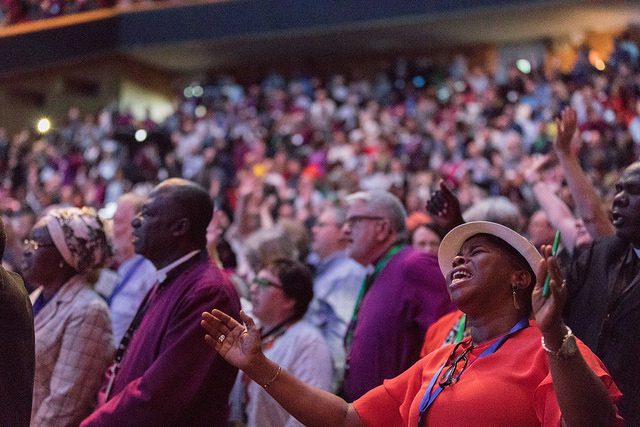
“It is Well with My Soul” on the final day GAFCON 2018. (Photo credit: Jesse Parks, GAFCON media)
For a week in June we met as 2000 Anglican Christians from around the world at GAFCON 2018 in Jerusalem, the Global Anglican Future Conference. We worshipped, prayed, and discussed the way forward. We came as fellow believers who acknowledge the Lordship of Christ and honor the authority of Holy Scripture.
Our delegation from the United States and Canada was not too shabby in size! And Australia, New Zealand, South America — even Europe — were surprisingly well represented. But by far, the most delegates were from Africa. It seems certain that the future of Biblical Anglicanism depends upon provinces such as the Anglican Church of Nigeria. If the Anglican Church in Nigeria survives the war against its nation’s Christians, that is.
Christian Genocide in Nigeria?
At present, the future for all Christians in Nigeria looks grim:
- Nine of the country’s thirty-six states impose full-blown Sharia. This forces Christians in those states to navigate a minefield. In this minefield, Islamic rage could be detonated by anything as seemingly innocuous as a gesture, a word, or even an act of God. In one such incident, Muslims blamed Christians for a lunar eclipse and went on a killing spree.
- Then there is the murderous violence of Boko Haram. For years the U.S. State Department seemed determined to see Boko Haram as “disenfranchised, impoverished youth.” (Forget the fact that they were driving around the northern and middle belt states in fully-loaded SUVs, accompanied by their own chef.) Elites complained that they were just “in need of job counseling and midnight basketball.” But determined activists, of which I was one, finally broke through the false narrative. State designated Boko Haram a Foreign Terrorist Organization in November 2013.
- In more recent years, nomadic Fulani “herdsmen” have evolved into Fulani Jihadists. They target Christians, wiping out entire villages and grabbing the land. If Christians attempt to defend themselves, they are accused of “retaliating.” As one Nigerian Christian told a member of Congress, “We are told to ‘turn the other cheek,’ but we have no more cheeks left to turn.” The Fulani are now ranked above Boko Haram as deadliest terrorists. They murdered more people than Boko Haram in 2015, 2016, and 2017. And they are already on their way to beating their own record in 2018.
Faith and Peace
Still, at GAFCON it was obvious to me that the Nigerian archbishops, bishops, clergy, and lay delegates were full of the joy of the Lord. A 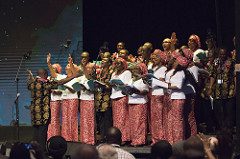 talented and powerful worship team from Nigeria had led our music all week long. I was happy to see Nigerian church leaders that I already knew. Among those were the Archbishop and Primate, the Most Reverend Nicholas Okoh. And there was Bishop Nathan Inyom, whose Diocese of Makurdi is a refuge for those fleeing from Fulani.
I also made a lot of new Nigerian friends. My daily morning small group included the Rt. Reverend Evans Ibeagha, the Bishop of the Diocese of Nike, and his sweet wife, Peace. (There was a lot of laughter by Mama Peace and me over the coincidence of Faith and Peace sitting side by side in the huge auditorium.)
Early in the week, Archbishop Okoh had addressed our gathering. Okoh, who is the current chairman of GAFCON, declared, “The authentic Gospel means we are no longer in charge because we have been bought with the blood of Jesus Christ.” And on this last day of the conference, GAFCON announced new leaders. My own Archbishop, the Most Reverend Foley Beach, would follow Archbishop Okoh as chairman. The Most Reverend Ben Kwashi, the Archbishop of Jos, would be the new Secretary General. Jos, in Plateau State, is at the center of much of the violence against Christians by Fulani.
Threats from Without
GAFCON that day also announced the final version of the conference statement, a “Letter to the Churches.” The letter explains the mission and ministry of GAFCON going forward after its first ten years. The letter concludes:
To proclaim the gospel, we must first defend the gospel against threats from without and within. We testify to the extraordinary blessings on this Conference, which leads us to call upon God even more, that the Anglican Communion may become a mighty instrument in the hand of God for the salvation of the world. We invite all faithful Anglicans to join us in this great enterprise of proclaiming Christ faithfully to the nations.
We all burst into applause at the end of the letter. And then we burst into song, joyfully, but reverently singing “It is Well With My Soul.” The Nigerians, spread throughout the vast crowd, were among the first to their feet, hands raised upwards, as we sang:
When peace like a river attendeth my way,
When sorrows like sea billows roll,
Whatever my lot, Thou hast taught me to say,
“It is well, it is well with my soul.”
Sorrows like sea billows are rolling over the Christians of Nigeria. It is in large part on behalf of Nigeria, but also relevant to numerous other provinces, that the Letter to the Churches included the admission, “Militant forms of religion and secularism are hostile to the preaching of Christ and persecute his people.” That is putting it mildly! But some Christians — usually the ones not experiencing the persecution — still believe that reticence about the source of the persecution is best.
Strength to the Persecuted
The letter promises, “We commit to encouraging each other to give strength to the persecuted, a voice to the voiceless, advocacy for the oppressed, protection of the vulnerable. . .” Sadly, there will be plenty of opportunities to give strength to the persecuted.
It was shocking, but not surprising, to hear that Fulani had killed as many as 200 men, women, and children in Archbishop Kwashi’s province of Jos, even as we were meeting. The slaughter that spread throughout dozens of villages had started on Thursday, June 22, and continued unabated until Sunday night, the 24th:
Though Satan should buffet, though trials should come,
Let this blest assurance control,
That Christ hath regarded my helpless estate,
And hath shed His own blood for my soul.
Since that horrific attack there have been more attacks on Christians almost every day. In some cases, the Nigerian police and/or military collaborate with attackers, or at least delay coming to the scene until the attack has been completed. And the Fulani are acting with impunity. Rather than holding them unconditionally accountable, Nigerian President Buhari and others have framed their attacks on defenseless communities as “clashes” between farmers and “herdsmen.”
The Future of Nigerian Christians?
Now the residents of Plateau State, including the Christians, are demanding that President Buhari cease equivocating and act to protect the Christians. Recently the Christian Association of Nigeria (CAN) released a statement noting that with the most recent slaughter, the death toll for 2018 alone is up to 6000 people. The statement warned, “There is no doubt that the sole purpose of these attacks is aimed at ethnic cleansing, land grabbing and forceful ejection of the Christian natives from their ancestral land and heritage.”
What should Western Christians be doing? All Western Christians are accountable for their response to this slaughter of their brothers and sisters in Nigeria, but particularly American Anglicans — who found theological and spiritual shelter in the Church of Nigeria. Pray. Counter the lie of moral equivalence that “both sides” are to blame. Urge your members of Congress and the State Department to put pressure on the Nigerian government to protect the Christians, to find out who is funding the transformation of the Fulani into full-fledged jihadis, and to place the blame where it belongs and not succumb to political correctness.
In spite of great sorrow and persecution, the Nigerian Christians are a witness to the world of their faith in the goodness of God and the resurrection power of Jesus Christ. They can sing “it is well with my soul.” If Western Christians stand idly by or equivocate about blame while their fellow believers are being slaughtered, this is a song they cannot sing.
Global Anglican Future Conference

Browse Our Archives
Select a Category Beauty Christmas Cultural Marxism Feminism Freedom Global Christian Persecution Israel Jesus Justice and Human Rights Marriage Peace and Reconciliation Rebecca Gonzales Sanctity of Life Self-Worth Social Witness Sudan and South Sudan Uncategorized Women
Select a Month December 2022 May 2022 March 2022 December 2021 April 2021 December 2020 August 2020 February 2020 December 2019 May 2019 April 2019 February 2019 September 2018 July 2018 March 2018 February 2018 January 2018 December 2017 November 2017 September 2017 August 2017 July 2017 June 2017 May 2017 March 2017 February 2017 January 2017 December 2016 November 2016 October 2016 September 2016 August 2016 July 2016 June 2016 May 2016 April 2016 March 2016 February 2016
Follow Us!
TAKE THE
Religious Wisdom Quiz
Which tribe first accepted David as king after Saul's death?
Select your answer to see how you score.
Benjamin Judah Ephraim Dan
Books by This Author Books by Faith McDonnell
Related posts from Faith and Chelsen
What I Remember About Noah Feldman
Found in the Files: An Excursion through 25...
Rejecting the Nuclear Option: President Trump Promises Support...
TRENDING AT PATHEOS Evangelical

When you hear the word riches, what comes to mind? For most...

Don’t Miss the Parents: A Creative Christmas Meditation
As we enter the Advent Season, I see many people trying to...

Making Stones Into Bread: Choosing the “Right” Work
I was on my online arts ministry Zoom meeting with the International...

Ukraine’s exhausted Christians face fifth winter of war
By Julian Lukins The full-scale war in Ukraine is taking “a serious...

Russell Brand's Conviction is not anti-Christian Persecution
How do we shed the reputation that the Church is OK with...

Have you ever caught yourself saying, “I’ll do it tomorrow,” or “Now...
view all Evangelical blogs
Ad-Free & Subscriber Log-In Subscription Support
- About Us
- 2026 Calendar
- Videos
- Podcasts
- Library of World Religions
- Faith In Media Tracker
- Advertise With Us
- Write for Us
- Privacy Policy
- Terms of Service
- Do Not Sell My Data
- Contact Us
- Radiant Digital
- Manage Newsletter Subscriptions
- Unsubscribe From Notifications
- Sitemap
Copyright 2008-2026, Patheos, part of the Radiant Digital network of media brands. All rights reserved.
Subscription Support Ad-Free & Subscriber Log-In
Follow Patheos