
BuddhistCatholicContemplativeEvangelicalGeneral ChristianHinduJewishLatter-day SaintMuslimNew VisionsProgressive Christian
Beliefs
- Buddhist
- Catholic
- Contemplative
- Evangelical
- General Christian
- Hindu
- Jewish
- Latter-day Saint
- More Voices
- Muslim
- New Visions
- Pagan
- Progressive Christian
Topics
- Religion News
- Food and Religion
- Sports and Religion
- Religious Art
- Religious Music and Entertainment
- Religious Events
- History and Religion
- Style and Religion
- Politics and Religion
- Women in Religion
- Recreation Outdoors and Religion
- Business Finance and Religion
- Careers Workplace and Religion
- Education and Religion
- Family Parenting and Religion
- Health Fitness and Religion
- Home and Religion
- Relationships and Religion
- Technology and Religion
- Travel and Religion
Columnists
- Buddhist Columnists
- Business Finance and Religion Columnists
- Careers Workplace and Religion Columnists
- Catholic Columnists
- Contemplative Columnists
- Education and Religion Columnists
- Evangelists Columnists
- Family Parenting and Religion Columnists
- General Christian Columnists
- Health Fitness and Religion Columnists
- Hindu Columnists
- History and Religion Columnists
- Home and Religion Columnists
- Jewish Columnists
- More Voices Columnists
- Latter Day Columnists
- Muslim Columnists
- New Visions Columnists
- Nonreligious Columnists
- Pagan Columnists
- Politics and Religion Columnists
- Progressive Columnists
- Recreation Outdoors and Religion Columnists
- Relationships and Religion Columnists
- Religion News Columnists
- Religious Art Columnists
- Religious Events Columnists
- Religious Music and Entertainment Columnists
- Sports and Religion Columnists
- Style and Religion Columnists
- Technology and Religion Columnists
- Travel and Religion Columnists
- Women in Religion Columnists
Resource Library
- 2026 Calendar
- Library of World Religions
- The 100 Most Holy Places on Earth
- Patheos Answers
- Podcasts
- Videos
- Faith Leaders Database
- Anglican Episcopalian
- Bahai
- Baptist
- Buddhism
- Christianity
- Confucianism
- Eastern Orthodoxy
- Hinduism
- Holiness and Pentecostal
- ISKCON
- Islam
- Judaism
- Lutheran
- Methodist
- The Church of Jesus Christ of Latter-day Saints
- New Age
- Paganism
- Presbytarian and Reformed
- Protestantism
- Religion Behind the Scenes
- Roman Catholic
- Scientology
- Shia Islam
- Sikhism
- Sufism
- Sunni Islam
- Taoism
- Zen
- See all religions
Research Tools
 Ad-Free & Subscriber Log-In Subscription Support
Ad-Free & Subscriber Log-In Subscription Support
Follow Patheos 

- Trending:
- Forgiveness
- |
- Marriage
- |
- Consciousness
- |
- Death Penalty
- |
- Election
- |
- Halloween
 Faith and Chelsen
- Home
- Evangelical
- A Saint Bridging Ireland’s Great Divide
A Saint Bridging Ireland’s Great Divide
Last updated on: March 17, 2016 at 6:00 am by Faith J. H. McDonnell
A Saint Bridging Ireland’s Great Divide 2016-03-17T00:09:09-05:00 Faith J. H. McDonnell
Patheos Explore the world's faith through different perspectives on religion and spirituality! Patheos has the views of the prevalent religions and spiritualities of the world.

Statue of St. Patrick at Saul, County Down, his burial place.
(Copyright Albert Bridge, licensed for reuse under Creative Commons Licence)
Being half Irish, I’ve always had great fondness for St. Patrick. That fondness grew when I was on my first short-term mission trip to Northern Ireland in the 1980’s.
I discovered on that trip that in spite of the Roman Catholic/Protestant division in that time of ‘the Troubles,’ both Catholics and Protestants claimed a connection to Patrick. Who was this saintly man who could be owned by both sides of that great chasm?
Going into town from our mission base at Darkley House in South Armagh, I learned that the City of Armagh was home to two St. Patrick’s Cathedrals. First we explored St. Patrick’s Cathedral of the Church of Ireland, on Sally Hill or Druim Saileach. According to history and legend, it was there that Patrick launched his mission to share the Gospel, praying for the conversion of all of Ireland to Christianity. He chose this hilltop to build his first stone church in 455 A.D.
St. Patrick’s on Sally Hill was rebuilt 17 times over the centuries. It was transferred to the Protestant custody during the Irish Reformation of Henry VIII, and since then has been the seat of the Archbishop of Armagh in the Church of Ireland.
We also visited the Roman Catholic St. Patrick’s Cathedral. For centuries, there was no need for a Catholic Cathedral as the Irish Penal Laws kept Catholic faith suppressed and Irish Catholics oppressed. But soon after the Catholic Emancipation, 1929, the Catholic Church of Ireland began to build.
This St. Patrick’s Cathedral is less than a mile from its Protestant sister. The site chosen for building this cathedral is both symbolic and links inextricably the two cathedrals, Protestant and Catholic. The connection is explained in “Armagh: City of Two Cathedrals,” part of The Armagh Project, that explains that even while Patrick was planning the building of his first church on Sally Hill, he was led to his second:
Patrick chose a hilltop in Armagh to build the first church. In trying to take possession of the hill, though, he startled a doe and its fawn. When they ran away, Patrick followed them, and in doing so caught the fawn and gently lifted it and carried it down the hill while the doe followed behind. Patrick crossed a small glen, then placed the frightened animal on the slope of the neighboring hill called “Telach na Licci” (Sandy Hill). This legend would serve as the inspiration for building the second (Roman Catholic) cathedral on Sandy Hill.
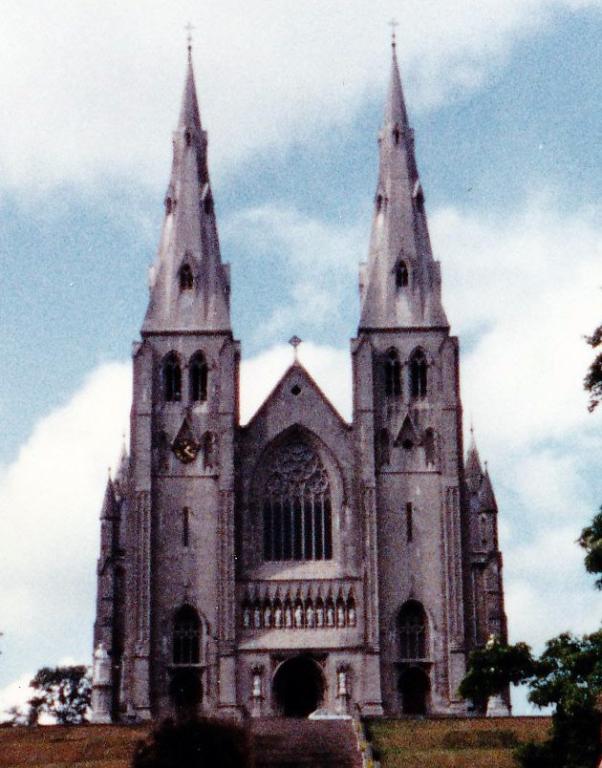
St. Patrick’s Roman Catholic Cathedral on Sandy Hill (Photo credit: Faith McDonnell)
I was impressed by both beautiful cathedrals and their sharing space in Armagh City, but I was even more impressed by Patrick, born in Britain — probably Scotland — around 385 A.D., who went from being the teenage son of Roman British parents (some like to say “Italian”), to being kidnapped by wild Irish ruffians and brought to (Northern) Ireland as a slave.
In captivity for six years, he worked as a shepherd, and according to his own words in his confession (Confessio), this is where his conversion and relationship with Christ began:
And there the Lord opened my mind to an awareness of my unbelief, in order that, even so late, I might remember my transgressions and turn with all my heart to the Lord my God, who had regard for my insignificance and pitied my youth and ignorance. And he watched over me before I knew him, and before I learned sense or even distinguished between good and evil, and he protected me, and consoled me as a father would his son.
God showed Patrick how to escape and return home in a vision, but in another vision, He asked the young man to return to the place of his captivity! In his Confession, Patrick relates that in the vision was a man “whose name was Victoricus” who came from Ireland with letters for Patrick. He then heard the voice of the Irish saying, ” ‘We beg you, holy youth, that you shall come and shall walk again among us.”
After studying in Auxerre, Patrick was ordained. In 432 A.D. he was made a missionary bishop to take the Gospel to the Irish as God had commanded him. In Ireland Patrick faced off against druids and other pagans, High Kings and brutal warlords, and a culture that was careless of human life in general and women in particular. As Mike Pettingill writes for The Gospel Coalition, “Patrick entered an Ireland full of paganism and idol worship. But just a few short decades after Patrick arrived, a healthy, Christ-honoring church was thriving.”
Some sneer, like an article in the Huffington Post, that the claim that Patrick drove the snakes out of Ireland is a lie — that there is no evidence that there ever were snakes there because Ireland is too cold for snakes. But the truth is that Patrick brought the light of Christ to Ireland, and drove the demonic forces of Satan out, building churches on top of ancient pagan sites, mobilizing an entire country to become missionaries, and claiming the land for the Triune God he served.
It has broken my heart, and I know it would have broken Patrick’s, that the land of saints and scholars, mystics and missionaries, would become so wracked and divided. And that hatred, bigotry, lust for power, and political ambition would murder not just in the form of guns and bombs, but with callous indifference to potato famine starvation and through wounded spirits anesthetized by drink and drugs.
But the same Holy Spirit that inspired Patrick and set a nation ablaze for the one True God, has brought the spirit of revival and forgiveness and reconciliation to the north of Ireland in recent years in ways that have permeated the political situation and the culture beyond the walls of the churches and cathedrals. And God will complete in all of Ireland the work that He began through Patrick so many centuries ago.
Previous Post

March 16, 2016
China’s One-Child Policy is Over, But Not Its Culture of Death
Next Post
March 18, 2016 Now is Not the Time to Abandon “Evangelical”
Browse Our Archives
Select a Category Beauty Christmas Cultural Marxism Feminism Freedom Global Christian Persecution Israel Jesus Justice and Human Rights Marriage Peace and Reconciliation Rebecca Gonzales Sanctity of Life Self-Worth Social Witness Sudan and South Sudan Uncategorized Women
Select a Month December 2022 May 2022 March 2022 December 2021 April 2021 December 2020 August 2020 February 2020 December 2019 May 2019 April 2019 February 2019 September 2018 July 2018 March 2018 February 2018 January 2018 December 2017 November 2017 September 2017 August 2017 July 2017 June 2017 May 2017 March 2017 February 2017 January 2017 December 2016 November 2016 October 2016 September 2016 August 2016 July 2016 June 2016 May 2016 April 2016 March 2016 February 2016
Follow Us!
TAKE THE
Religious Wisdom Quiz
Which major prophet book is directly after Isaiah?
Select your answer to see how you score.
Lamentations Ezekiel Daniel Jeremiah
Books by This Author Books by Faith McDonnell
Related posts from Faith and Chelsen


My Christmas Favorites You Should Not Miss
Mark Pearson Explores Why the Ascension is Neglected

Americans Don't Let America's Sovereignty Get Sold to...
TRENDING AT PATHEOS Evangelical

The REST of Your Life: A Creative Wrestles...
This week I had a conversation with a good friend from church....

How the author of the world's best hymn...
I've been working with John Newton for a while now. This makes...

Long before this Lectio Divina, Psalm 130 - the song - started...

What About the Trees? Another Living Parable
After I finished writing the last article about falling leaves as a...

Why Classical Education Is a Conversation, Not a...
Come and Read: Joy in Classical Education When I was a little...

Cornell University has received a great deal of negative publicity and intense...
view all Evangelical blogs
Ad-Free & Subscriber Log-In Subscription Support
- About Us
- 2026 Calendar
- Videos
- Podcasts
- Library of World Religions
- Faith In Media Tracker
- Advertise With Us
- Write for Us
- Privacy Policy
- Terms of Service
- Do Not Sell My Data
- Contact Us
- Radiant Digital
- Manage Newsletter Subscriptions
- Unsubscribe From Notifications
- Sitemap
Copyright 2008-2026, Patheos. All rights reserved.
Subscription Support Ad-Free & Subscriber Log-In
Follow Patheos