
BuddhistCatholicContemplativeEvangelicalGeneral ChristianHinduJewishLatter-day SaintMuslimNew VisionsProgressive Christian
Beliefs
- Buddhist
- Catholic
- Contemplative
- Evangelical
- General Christian
- Hindu
- Jewish
- Latter-day Saint
- More Voices
- Muslim
- New Visions
- Pagan
- Progressive Christian
Topics
- Religion News
- Food and Religion
- Sports and Religion
- Religious Art
- Religious Music and Entertainment
- Religious Events
- History and Religion
- Style and Religion
- Politics and Religion
- Women in Religion
- Recreation Outdoors and Religion
- Business Finance and Religion
- Careers Workplace and Religion
- Education and Religion
- Family Parenting and Religion
- Health Fitness and Religion
- Home and Religion
- Relationships and Religion
- Technology and Religion
- Travel and Religion
Columnists
- Buddhist Columnists
- Business Finance and Religion Columnists
- Careers Workplace and Religion Columnists
- Catholic Columnists
- Contemplative Columnists
- Education and Religion Columnists
- Evangelists Columnists
- Family Parenting and Religion Columnists
- General Christian Columnists
- Health Fitness and Religion Columnists
- Hindu Columnists
- History and Religion Columnists
- Home and Religion Columnists
- Jewish Columnists
- More Voices Columnists
- Latter Day Columnists
- Muslim Columnists
- New Visions Columnists
- Nonreligious Columnists
- Pagan Columnists
- Politics and Religion Columnists
- Progressive Columnists
- Recreation Outdoors and Religion Columnists
- Relationships and Religion Columnists
- Religion News Columnists
- Religious Art Columnists
- Religious Events Columnists
- Religious Music and Entertainment Columnists
- Sports and Religion Columnists
- Style and Religion Columnists
- Technology and Religion Columnists
- Travel and Religion Columnists
- Women in Religion Columnists
Resource Library
- 2026 Calendar
- Library of World Religions
- The 100 Most Holy Places on Earth
- Patheos Answers
- Podcasts
- Videos
- Faith Leaders Database
- Anglican Episcopalian
- Bahai
- Baptist
- Buddhism
- Christianity
- Confucianism
- Eastern Orthodoxy
- Hinduism
- Holiness and Pentecostal
- ISKCON
- Islam
- Judaism
- Lutheran
- Methodist
- The Church of Jesus Christ of Latter-day Saints
- New Age
- Paganism
- Presbytarian and Reformed
- Protestantism
- Religion Behind the Scenes
- Roman Catholic
- Scientology
- Shia Islam
- Sikhism
- Sufism
- Sunni Islam
- Taoism
- Zen
- See all religions
Research Tools
 Ad-Free & Subscriber Log-In Subscription Support
Ad-Free & Subscriber Log-In Subscription Support
Follow Patheos 

- Trending:
- Forgiveness
- |
- Marriage
- |
- Consciousness
- |
- Death Penalty
- |
- Election
- |
- Halloween
 Faith and Reason
- Home
- Catholic
- Politics and Religion
- How the Synod on Synodality Report Models Real Inclusivity
How the Synod on Synodality Report Models Real Inclusivity
Last updated on: November 4, 2023 at 8:10 am by Elizabeth Grace Matthew
How the Synod on Synodality Report Models Real Inclusivity 2023-11-04T08:10:14-04:00 Elizabeth Grace Matthew
Patheos Explore the world's faith through different perspectives on religion and spirituality! Patheos has the views of the prevalent religions and spiritualities of the world.
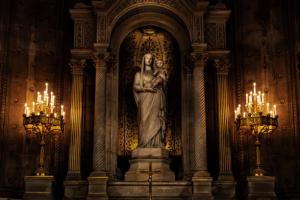
The Blessed Virgin Mary in Catholic Church
The recently concluded synod on synodality could have gone in a lot of different directions—a nothingburger, a schism, or anything in between. To this Catholic at least, the possibility that the synodal process would end in a substantive report that is not symbolically beholden to the politics of the moment—liberal or conservative—seemed like too much to hope for.
Political Ideology
The modern Church in the West, like Western society more generally, seems ever more polarized along lines that have less to do with religious belief than with political identity. Indeed, Pope Francis is often perceived (mostly unfairly) by both the liberal media and its conservative antagonists within and outside the Church as a progressive first and a pope second. Meanwhile, the Catholic Church writ large is often perceived by mainstream secularists as regressive and backwards, mostly due to its doctrinal positions on matters of sexual morality.
But the Church, properly understood, has no ideology. Any positions it appears to take on political matters are in fact best interpreted as understandings of spiritual matters that have been politicized.
For example, to advocate against abortion, as the Church does, is not “conservative.” It is to stand for the sanctity of human life, which sits on a higher plane than politics. Meanwhile, to work toward the alleviation of poverty, as the Church also does, is not “progressive.” It is to stand for the dignity of human life, which also transcends political considerations. To any Catholic with even a passing acquaintance with the faith, neither of these statements is controversial.
Where Catholics often seem to get almost unavoidably bogged down in politics is on issues related to sexual orientation and so-called gender identity. Some of the faithful see the welcome and inclusion of people with varying sexual orientations and gender identities as inextricable from the love of Christ. Others see the unequivocal recognition of male and female, and the sacramental union of the two, as inextricable from God’s truth, without which there can be no real love.
That these two perspectives (and many in between, like mine) would come together at the synod on synodality and emerge with a document that manages to give adequate voice to both “unconditional acceptance” and “magisterium on marriage and sexual ethics” appeared unlikely. But much to many self-identified progressive Catholics’ disappointment—and even more to the credit of Pope Francis and the progressive Catholics who attended the synod—that is exactly what they did.
Progressive Catholics’ Finest Hour
In the West, there is a growing interpretation of the Church’s sexual ethics as outdated, regressive, and exclusive. The working document for the synod reflected this concern, expressly noting the needs of “LGBTQ” Catholics.
The final report of the synod, however, refers only to “matters of identity and sexuality,” which is a step “backwards” from the point of view of those aligned with Jesuit priest and LGBTQ Catholic advocate Father James Martin, who attended the synod. When the final report was made public, Martin expressed disappointment “not only that the LGBTQ were excised but also that the discussions we had, which were passionate on both sides, were not reflected in the final document.”
Given Martin’s correct belief that the Catholic faith demands equal dignity for all and his defensible perspective that the Church does not currently treat those identifying as LGBTQ with sufficient dignity, his disappointment—and that of others who share his view—is understandable.
But, in fact, this very document in which progressive Catholics profess disappointment is a profound tribute to their own good faith in practicing the inclusivity that they preach.
Although well-known American conservatives, like Cardinal Timothy Dolan, certainly aided in the effort to excise the inherently political, sub-religious language of identity (like “LGBTQ”) from the synod’s final report, the primary opposition to categorizing people in accordance with progressive political monikers came from priests, bishops, and lay Catholics in the global South.
In Africa, where the Church is growing rapidly (unlike in the West, where it is losing adherents), support for the Church’s teachings on sexual morality—that is, that homosexuality is “intrinsically disordered” and that all sexual activity outside of a sacramental marriage, which necessarily includes all homosexual activity, is a sin—is near-ubiquitous. Not only for doctrinal reasons, but also for exactly the kinds of cultural considerations to which progressives favor being sensitive. As Martin himself explains, for some Catholics in the global South, the very term “LGBTQ” is received as an unwelcome, neo-colonial imposition.
That the LGBTQ Catholic cause held so dear by many Western progressive Catholics was ultimately subordinated to the process of the synod—in which everyone’s opinions were heard, and every part of the final report required two-thirds approval from the participants—merits great hope because it reflects good faith on the part of Pope Francis and his mostly progressive acolytes.
At the synod, true inclusivity took precedence over the faux-inclusivity that we so often see in progressive circles, in which the ostensibly marginalized are sycophantically tokenized when they tow the party line—and excluded when they don’t.
This may not have been the synod report that progressive Catholics wanted, but it is to their credit one upon which the global Church can move forward none the worse–and perhaps even somewhat the better–for this synodal process.
Like many Catholics, I have often been embarrassed and angered by the overt sexism (benevolent and otherwise) that women experience within the Church due in large measure to its clericalism. So, to see unexpectedly insightful lines like this out of the synod report is cause for renewed faith in those entrusted with the future of the faith itself:
- “Pastoral accompaniment and vigorous advocacy for women should go hand in hand.”
- Women are not “an issue or a problem.”
- Women and men should be “in dialogue together…as protagonists, without subordination, exclusion, and competition.”
- We must excise “clericalism, a chauvinist mentality, and inappropriate expressions of authority” vis-à-vis women.
Pope Francis entrusted the process of the synod to the Holy Spirit. Apparently, this last month in Rome, He was working overtime on multiple fronts.
Religious Events
Next Post

March 25, 2024 "Good Will Hunting" is About Fatherhood, Not Therapy
Recent Comments
Browse Our Archives
Select a Category Uncategorized
Select a Month September 2024 July 2024 May 2024 March 2024 November 2023 September 2023 April 2023 February 2023 January 2023 December 2022 November 2022 October 2022 September 2022
Follow Us!
TAKE THE
Religious Wisdom Quiz
Who was the first woman?
Select your answer to see how you score.
Sarah Deborah Mary Eve
Related posts from Faith and Reason

Yours, Mine and Ours: Pro-Natalist Hyperbole to Make...
Baby Formula Feminism: On Beauvoir and “Breast is...

Maybe Lena Dunham’s Girls Wasn’t So Bad After...
TRENDING AT PATHEOS Catholic

Creation, Preservation, and Teleology in Catholic Theology
As I write this, it is very early Monday morning. Like millions...

The Parable Of The Sower And The Word...
One of Christ’s most famous parables is that of the sower who...

Rejecting Doom: Christian Hope And Human Action
Christianity is a religion of hope. We are to have hope and...

Why I Choose the Eucharist Over the Sermon
Choose the Eucharist, Not the Sermon What are we supposed to get...

5 Design Elements Found in Spiritually Rooted Homes
Putting Spirituality Into Home Decor Our homes are more than our living...

Credo: A Story of God Told with the...
About 10 years ago, I began to imagine a personal "Credo" that...
view all Catholic blogs
Ad-Free & Subscriber Log-In Subscription Support
- About Us
- 2026 Calendar
- Videos
- Podcasts
- Library of World Religions
- Faith In Media Tracker
- Advertise With Us
- Write for Us
- Privacy Policy
- Terms of Service
- Do Not Sell My Data
- Contact Us
- Radiant Digital
- Manage Newsletter Subscriptions
- Unsubscribe From Notifications
- Sitemap
Copyright 2008-2026, Patheos. All rights reserved.
Subscription Support Ad-Free & Subscriber Log-In
Follow Patheos