
BuddhistCatholicContemplativeEvangelicalGeneral ChristianHinduJewishLatter-day SaintMuslimNew VisionsProgressive Christian
Beliefs
- Buddhist
- Catholic
- Contemplative
- Evangelical
- General Christian
- Hindu
- Jewish
- Latter-day Saint
- More Voices
- Muslim
- New Visions
- Pagan
- Progressive Christian
Topics
- Religion News
- Food and Religion
- Sports and Religion
- Religious Art
- Religious Music and Entertainment
- Religious Events
- History and Religion
- Style and Religion
- Politics and Religion
- Women in Religion
- Recreation Outdoors and Religion
- Business Finance and Religion
- Careers Workplace and Religion
- Education and Religion
- Family Parenting and Religion
- Health Fitness and Religion
- Home and Religion
- Relationships and Religion
- Technology and Religion
- Travel and Religion
Columnists
- Buddhist Columnists
- Business Finance and Religion Columnists
- Careers Workplace and Religion Columnists
- Catholic Columnists
- Contemplative Columnists
- Education and Religion Columnists
- Evangelists Columnists
- Family Parenting and Religion Columnists
- General Christian Columnists
- Health Fitness and Religion Columnists
- Hindu Columnists
- History and Religion Columnists
- Home and Religion Columnists
- Jewish Columnists
- More Voices Columnists
- Latter Day Columnists
- Muslim Columnists
- New Visions Columnists
- Nonreligious Columnists
- Pagan Columnists
- Politics and Religion Columnists
- Progressive Columnists
- Recreation Outdoors and Religion Columnists
- Relationships and Religion Columnists
- Religion News Columnists
- Religious Art Columnists
- Religious Events Columnists
- Religious Music and Entertainment Columnists
- Sports and Religion Columnists
- Style and Religion Columnists
- Technology and Religion Columnists
- Travel and Religion Columnists
- Women in Religion Columnists
Resource Library
- 2026 Calendar
- Library of World Religions
- The 100 Most Holy Places on Earth
- Patheos Answers
- Podcasts
- Videos
- Faith Leaders Database
- Anglican Episcopalian
- Bahai
- Baptist
- Buddhism
- Christianity
- Confucianism
- Eastern Orthodoxy
- Hinduism
- Holiness and Pentecostal
- ISKCON
- Islam
- Judaism
- Lutheran
- Methodist
- The Church of Jesus Christ of Latter-day Saints
- New Age
- Paganism
- Presbytarian and Reformed
- Protestantism
- Religion Behind the Scenes
- Roman Catholic
- Scientology
- Shia Islam
- Sikhism
- Sufism
- Sunni Islam
- Taoism
- Zen
- See all religions
Research Tools
 Ad-Free & Subscriber Log-In Subscription Support
Ad-Free & Subscriber Log-In Subscription Support
Follow Patheos 

- Trending:
- Forgiveness
- |
- Marriage
- |
- Consciousness
- |
- Death Penalty
- |
- Election
- |
- Halloween
 Faith and Reason
- Home
- Catholic
- Politics and Religion
- The Problem with “Girl Power” (Part I)
The Problem with “Girl Power” (Part I)
Last updated on: January 5, 2023 at 9:24 pm by Elizabeth Grace Matthew
The Problem with “Girl Power” (Part I) 2023-01-05T21:24:34-05:00 Elizabeth Grace Matthew
Patheos Explore the world's faith through different perspectives on religion and spirituality! Patheos has the views of the prevalent religions and spiritualities of the world.
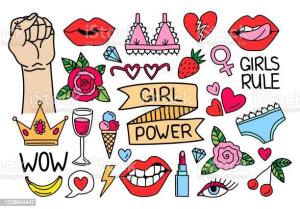
Feminism and girl power positivity collection vector illustration. Set of colourful stickers flat style design. Motivation poster. Isolated on white background
When I was in fourth or fifth grade, I had an issue of the magazine “Girls Life” that featured those original “girl power” icons, the Spice Girls. One of the pop stars (I can’t recall which) was quoted in the story saying, “Feminism has become a dirty word. Girl power is a nineties way of saying it.”
Why, in the 1990’s, had feminism become a “dirty word?” Because of sustained and ultimately successful push back against the “burn your bra” stereotype of a 1970’s feminism that supposedly hated men, eschewed motherhood, and railed against make up.
From Feminism to Girl Power
For a crash course in how “feminism” became “girl power,” consult the 2000 film “Miss Congeniality.” When the movie begins, Sandra Bullock’s “Grace Hart” is a 1970’s feminist throwback: a tough FBI agent that doesn’t own a hairbrush and chafes at authority. By the time the movie ends, she is an epitome of 1990’s girl power: a traditionally feminine beauty queen with a gun strapped under her sequined evening gown. As went the movie in two hours, so went the exigencies of the culture in 20 years.
That’s because most people never really got on board with the aesthetics and aims of 1970’s feminism in the first place. A lot of women, given the option to wear pants over unshaven legs, still chose to wear skirts over shaven ones. Moreover, a majority of women, given the option to spend more time with their children or more time at work, chose to spend more time with their children. And a super-majority of women, given the option to choose careers that focused on technical things (like information technology and engineering) or on people (like nursing and teaching), chose people-centered professions. In short, most (but by no means all!) women are inclined to be, more or less, traditionally “feminine.”
Meanwhile, nearly all women expect to be considered men’s equals, regardless of how “feminine” or “unfeminine” we are. And rightly so.
What is a Woman?
Scientifically and rationally speaking, of course, the word “woman” means no more and no less than the word “hen.” It is merely a scientific word for female humans, just as “hen” is a word for female chickens. Nothing that a hen does or thinks or feels can make her biologically or biochemically a rooster; and nothing that a woman does or thinks or feels can make her biologically or biochemically a man.
“Girl power,” which celebrated women’s access to the kind of public power that had once been solely the purview of men (but without expecting that they adopt traditionally masculine attire or mores, as 1970’s feminism had) was a way of bridging the divide between feminists’ aims and most women’s preferences. And for a lot of girls and women (myself mostly included — more on this in Part II) it worked just fine.
But “girl power” also re-feminized the prototype of empowered womanhood in a way that re-constricted the range of normative self-presentation options for women. This resulted in a re-entrenchment of the idea that “femininity” and “womanhood” are synonymous, when in fact they are correlated.
The persistence of a greater rather than a lesser degree of correlation between “femininity” and “womanhood” caused the 1970’s feminists to all but lose their minds. They wanted the relationship between biological womanhood and traditional femininity to be proven nonexistent. In their view, everything (child care hours, CEO slots, engineering professorships, high heel wearing, etc) would be split 50/50 between women and men, if the culture were truly interested in women’s equality.
The fact that ordinary women in the 1970’s and 1980’s were free to render the correlation between “womanhood” and “femininity” obsolete but did not do so spelled the end of the 1970’s women’s movement. The free choices of individual women (i.e., the ostensible reason d’être of feminism) did not mirror feminist aspirations. Hence, the 1970’s women’s movement’s once influential combatants retreated to the universities’ newly created women’s studies departments. (That these are now being renamed “gender studies” departments means that 1970’s feminism is not only culturally dead—as it has been since before I was born in 1987—but also semantically buried).
Meanwhile, the only people more upset about the persistent reality of correlation between “femininity” and “womanhood” than the old-school feminists were their conservative antagonists. They wanted biological womanhood and traditional femininity to be proven synonymous. Multiple kinds of (male and female) conservatives—from the “chastity ring” types on the religious right to the “boys will be boys and girls will be strippers” types on the non-religious right—were (and, in some cases, remain) invested in the idea that to be a woman of good standing in our culture should be synonymous with being traditionally feminine. By “traditionally feminine,” some of them mean cleavage-baring tops and stiletto heels; others mean homemade cookies and mom jeans; still others mean the preferences for people over things and family over career evinced by many women; and many mean all three.
The Problem with Girl Power
“Girl power” ultimately represented the triumph of the conservatives, who succeeded in re-institutionalizing traditional femininity while stamping it with an “empowered” label, thereby dovetailing with a 1990’s women’s culture that was inextricable from 1970’s feminist language but worlds away from 1970’s feminist aesthetics.
By 2013, when Sheryl Sandberg published “Lean In,” which assumed a duly coifed and perfumed future “girl boss” for a reader, “feminism” and “girl power” were synonymous. That’s why feminism is no longer “a dirty word.”
One problem with this “girl power” version of feminism, though, is that it leaves a lot of women out. After all, while the relationship between womanhood and traditional femininity is not nonexistent (as the 1970’s feminist establishment insisted), it also is not conclusive or unanimous, as conservatives contended (and, in some cases, still contend).
So, what happens to the girl that does not identify with the “girlie” part of “girl power,” or what is now the “feminine” presumption of feminism? The girl that wants to wear androgynous outfits and army boots, and crop her hair short? Are we going to predispose her for alienation from her own biological and biochemical existence (which, again, she cannot ultimately change, given that every cell in the body is coded female or male) because we believe that womanhood is synonymous with femininity after all?
Are we really handing conservatives the final victory and accepting that the embodiment of womanhood should look the same for every woman? Even unto literally cutting off the female appendages of those that do not conform to our notions of how a woman should appear and behave, and thereby turning them into so many twenty-first century witches?
Must all women that are inclined toward traditionally masculine self-presentation, personality traits, and/or pursuits follow the evolution of Grace Hart in “Miss Congeniality,” and become embodiments of today’s highly curated, indelibly feminine “girl power as feminism?” Otherwise, they aren’t women at all—they might be men, or they might not have any biological sex (or, God help us, “pronouns”) that anyone can reliably determine without consulting them directly?
The (allegedly) feminist establishment now answers “yes”—de facto, if not de jure—to all of the above, for two reasons. First, because they long ago capitulated to the conservative inertia of the wider society on the idea that “womanhood” is a weighty cultural reality rather than a merely biological and biochemical one. Second, because they remain perpetually unwilling to acknowledge that the correlation between biological womanhood and traditional femininity on average means that joining the in-crowd among women will always involve conforming, more or less, to traditionally feminine norms. That is, that even if feminists (as they should) advocate uncompromisingly against all conservative repression affecting the many partial and total exceptions to the traditionally feminine norm, that norm (and a majority that embodies it, more or less) will still exist.
According to the feminist establishment, it’s apparently preferable to “identify as” the prototype of one of 97 non-existent sexes (with so many, everyone can be a prototype) than to simply be (like almost every woman and man in history) a non-prototype of one’s own actual sex.
This is a travesty. For girls, for feminism, and for all of us. But, as in all things, the truth will set us free no matter how strenuously we try to deny it.
More—on womanhood, femininity, and how we negotiate space between the two as individuals and as a society—to come in Part II.
Women in Religion
Family, Parenting and Religion
Previous Post

October 5, 2022
Midnight in Paris: On the Human Condition and its Discontents
Next Post
October 21, 2022 The Problem with “Girl Power” (Part II)
Browse Our Archives
Select a Category Uncategorized
Select a Month September 2024 July 2024 May 2024 March 2024 November 2023 September 2023 April 2023 February 2023 January 2023 December 2022 November 2022 October 2022 September 2022
Follow Us!
TAKE THE
Religious Wisdom Quiz
Which Psalm is a prayer of repentance after David's sin with Bathsheba?
Select your answer to see how you score.
Psalm 23 Psalm 7 Psalm 51 Psalm 24
Related posts from Faith and Reason

Yours, Mine and Ours: Pro-Natalist Hyperbole to Make...

Baby Formula Feminism: On Beauvoir and “Breast is...

Maybe Lena Dunham’s Girls Wasn’t So Bad After...
TRENDING AT PATHEOS Catholic

Creation, Preservation, and Teleology in Catholic Theology
As I write this, it is very early Monday morning. Like millions...

The Parable Of The Sower And The Word...
One of Christ’s most famous parables is that of the sower who...

Rejecting Doom: Christian Hope And Human Action
Christianity is a religion of hope. We are to have hope and...

Why I Choose the Eucharist Over the Sermon
Choose the Eucharist, Not the Sermon What are we supposed to get...

5 Design Elements Found in Spiritually Rooted Homes
Putting Spirituality Into Home Decor Our homes are more than our living...

Credo: A Story of God Told with the...
About 10 years ago, I began to imagine a personal "Credo" that...
view all Catholic blogs
Ad-Free & Subscriber Log-In Subscription Support
- About Us
- 2026 Calendar
- Videos
- Podcasts
- Library of World Religions
- Faith In Media Tracker
- Advertise With Us
- Write for Us
- Privacy Policy
- Terms of Service
- Do Not Sell My Data
- Contact Us
- Radiant Digital
- Manage Newsletter Subscriptions
- Unsubscribe From Notifications
- Sitemap
Copyright 2008-2026, Patheos. All rights reserved.
Subscription Support Ad-Free & Subscriber Log-In
Follow Patheos