
BuddhistCatholicContemplativeEvangelicalGeneral ChristianHinduJewishLatter-day SaintMuslimNew VisionsProgressive Christian
Beliefs
- Buddhist
- Catholic
- Contemplative
- Evangelical
- General Christian
- Hindu
- Jewish
- Latter-day Saint
- More Voices
- Muslim
- New Visions
- Pagan
- Progressive Christian
Topics
- Religion News
- Food and Religion
- Sports and Religion
- Religious Art
- Religious Music and Entertainment
- Religious Events
- History and Religion
- Style and Religion
- Politics and Religion
- Women in Religion
- Recreation Outdoors and Religion
- Business Finance and Religion
- Careers Workplace and Religion
- Education and Religion
- Family Parenting and Religion
- Health Fitness and Religion
- Home and Religion
- Relationships and Religion
- Technology and Religion
- Travel and Religion
Columnists
- Buddhist Columnists
- Business Finance and Religion Columnists
- Careers Workplace and Religion Columnists
- Catholic Columnists
- Contemplative Columnists
- Education and Religion Columnists
- Evangelists Columnists
- Family Parenting and Religion Columnists
- General Christian Columnists
- Health Fitness and Religion Columnists
- Hindu Columnists
- History and Religion Columnists
- Home and Religion Columnists
- Jewish Columnists
- More Voices Columnists
- Latter Day Columnists
- Muslim Columnists
- New Visions Columnists
- Nonreligious Columnists
- Pagan Columnists
- Politics and Religion Columnists
- Progressive Columnists
- Recreation Outdoors and Religion Columnists
- Relationships and Religion Columnists
- Religion News Columnists
- Religious Art Columnists
- Religious Events Columnists
- Religious Music and Entertainment Columnists
- Sports and Religion Columnists
- Style and Religion Columnists
- Technology and Religion Columnists
- Travel and Religion Columnists
- Women in Religion Columnists
Resource Library
- 2026 Calendar
- Library of World Religions
- The 100 Most Holy Places on Earth
- Patheos Answers
- Podcasts
- Videos
- Faith Leaders Database
- Anglican Episcopalian
- Bahai
- Baptist
- Buddhism
- Christianity
- Confucianism
- Eastern Orthodoxy
- Hinduism
- Holiness and Pentecostal
- ISKCON
- Islam
- Judaism
- Lutheran
- Methodist
- The Church of Jesus Christ of Latter-day Saints
- New Age
- Paganism
- Presbytarian and Reformed
- Protestantism
- Religion Behind the Scenes
- Roman Catholic
- Scientology
- Shia Islam
- Sikhism
- Sufism
- Sunni Islam
- Taoism
- Zen
- See all religions
Research Tools
 Ad-Free & Subscriber Log-In Subscription Support
Ad-Free & Subscriber Log-In Subscription Support
Follow Patheos 

- Trending:
- Forgiveness
- |
- Marriage
- |
- Consciousness
- |
- Death Penalty
- |
- Election
- |
- Halloween

- Home
- Progressive Christian
- Health, Fitness and Religion
- Why the Baby in the Manger Isn’t the Whole Christmas Story
Why the Baby in the Manger Isn’t the Whole Christmas Story
Last updated on: December 15, 2025 at 10:46 am by Olapeju Simoyan, MD, MPH
Why the Baby in the Manger Isn’t the Whole Christmas Story 2025-12-15T10:46:34-05:00 Olapeju Simoyan, MD, MPH
Patheos Explore the world's faith through different perspectives on religion and spirituality! Patheos has the views of the prevalent religions and spiritualities of the world.
Chains Shall He Break – The Subversive Message of Christmas
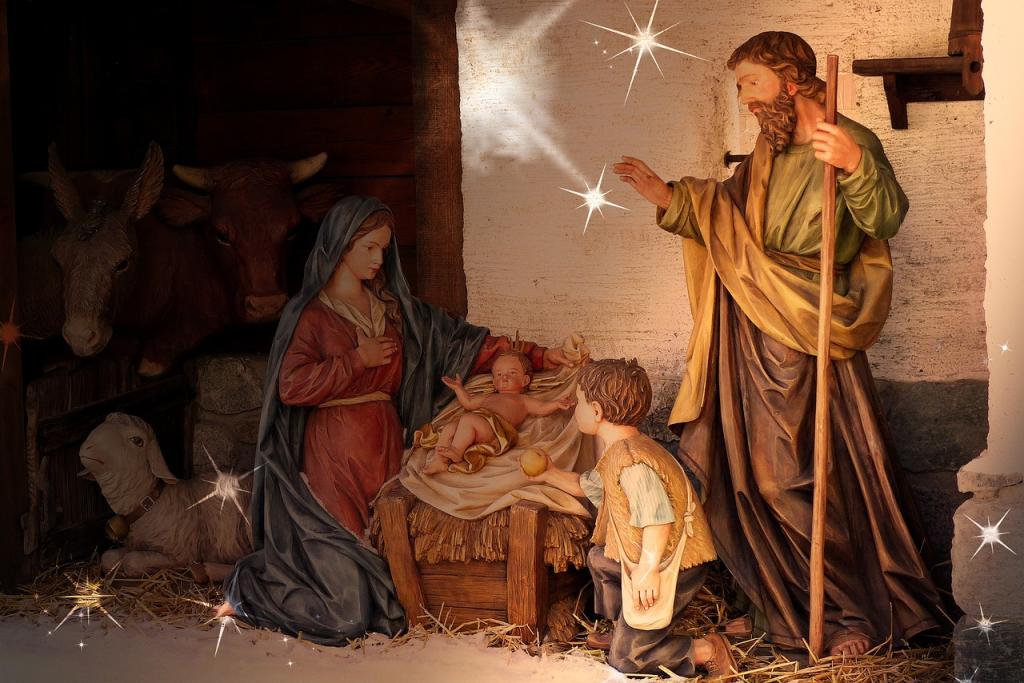
Mary may not have known ahead of time about the events mentioned in “Mary, Did You Know?”, it certainly seems like she knew a lot more than she is given credit for. | Image by Petra from Pixabay.
“The little Lord Jesus, no crying he makes.”
These sweet, albeit unrealistic words from the traditional Christmas carol, “Away in a Manger,” demonstrate an aspect of the narratives around the Christmas story that is worth exploring. The idea of Baby Jesus lying in the manger without crying isn’t realistic. Babies cry. Perhaps the bigger question, is why do we see a need to “put him back in the manger” each Christmas? Typically when birthdays are celebrated, we don’t keep focusing on what happened on the first day of life. Imagine this conversation:
Happy birthday! I remember when you were born. Your mother was in labor for five hours. She pushed and pushed, but you wouldn’t come out! The doctor finally decided to perform a C- section and I wasn’t allowed to go into the operating room. I waited with the rest of the family in the waiting room, and we were so happy when the doctor came and told us that our baby girl had arrived safely, and she was breathing on her own. Her fingers and toes were all intact…. Her heartbeat was regular, lungs clear and everything was just fine!
If this (or any other) birth story was repeated every single year, wouldn’t you get tired of hearing it?
I am by no means suggesting that we stop singing traditional Christmas carols, but I do think we can perhaps shift our focus to the message of Jesus, rather than fixating on the circumstances of his birth. What often gets lost in the telling of the Christmas message is the subversive nature of the Christmas story. Jesus identified with the poor and marginalized, rather than establishing an empire or granting his followers political power.
A closer look at some popular Christmas carols shows that the lyricists understood this.
O Holy Night
The Christmas carol, “O Holy Night,” was translated from French by an American Unitarian minister, John Sullivan Dwight. An abolitionist, he modified the lyrics to include a reference to breaking the chains of slavery:
Chains shall he break, for the slave is our brother,
And in his name all oppression shall cease,
The preceding words in this verse emphasize what Jesus taught:
Truly He taught us to love one another;
His law is Love and His gospel is Peace;
It is sobering to think of all the oppression that has occurred and, in some cases, is still happening, in the name of Christianity. This is the antithesis of what Christ taught.
What did Mary know?
The song, “Mary Did You Know,” is beautiful, but portrays an image of a rather clueless young lady. Similarly, most nativity scenes portray Mary in a way that makes her seem docile and insecure. In the Magnificat (Mary’s Song), we get a picture of a much more knowledgeable Mary, who made declarations that were later considered so radical that they were banned by governments.
Mary’s Song
Luke 1:51-53 (NIV)
51
He has performed mighty deeds with his arm;
he has scattered those who are proud in their inmost thoughts.
52
He has brought down rulers from their thrones
but has lifted up the humble.
53
He has filled the hungry with good things
but has sent the rich away empty.
Mary declared that God would bring rulers down while lifting up the humble. No wonder her words were considered radical – they were!
So, while Mary may not have known ahead of time about the events mentioned in “Mary, Did You Know?”, it certainly seems like she knew a lot more than she is given credit for.
From Sacred to Secular – A Christmas Carol
Charles Dickens’1843 classic, A Christmas Carol, is a powerful critique of inequality in Victorian England. In this book, Dickens drew attention to the plight of the poor and challenged the wealthy to recognize their responsibilities to the larger society. It was a radical wake-up call, and as a result, philanthropy became mainstream. An American businessman is said to have been so moved by the story in this book that he closed his factory on Christmas Day and sent his each of his workers a turkey. The editor of the Edinburgh Review, Lord Jeffrey, wrote to Dickens:
“You have done more good by this little publication, fostered more kindly feelings and prompted more positive acts of beneficence, than can be traced to all the pulpits and confessionals in Christendom.”
In advocating for the poor through storytelling, Dickens made a lasting impact on his society that benefited the poor and marginalized. Isn’t that what Christmas is all about?
I Still Love Christmas Music!
When we sing about the first Christmas and the baby in a manger, let’s remember that the baby didn’t stay in a manger. He grew up, shattered societal norms, advocated for the poor and vulnerable and set an example for us to follow.
What are you doing this Christmas to make an impact?
2025 update:
To learn more about the stories behind Christmas carols, you can check out my book, “I Played My Best for Him! The Inspiring Stories Behind the Little Drummer Boy and Other Christmas Favorites”
and the companion devotional, Heartfelt Offerings.
You can listen to the songs on Spotify, or your favorite listening platform.
Merry Christmas! Happy Holidays! Best wishes for a prosperous New Year!
General Christian
Religious Music and Entertainment

About Olapeju Simoyan, MD, MPH
Dr. Olapeju Simoyan is a physician, board certified in family medicine and addiction medicine, with a special interest in the connections between faith and health. She strongly believes that faith and critical thinking are not mutually exclusive. As a female physician, Dr. Simoyan is also interested in women's issues and writes about religious abuse and trauma, with a focus on how misinterpretations of biblical texts have led to the perpetration of abuse within church settings. She has combined her writing and photography in several books, including Living Foolproof, a devotional based on reflections from the book of Proverbs. You can check out her author page on Amazon: https://www.amazon.com/stores/Olapeju-Simoyan/author/B0BP7RSYBL You can read more about the author here.
Previous Post

December 20, 2024
Can sad music be uplifting? "Smile" and "Rejoice"
Next Post

February 7, 2025 "Purity Culture" Is Not So Pure - A Book Review
Recent Comments
"The sources are mentioned in the text and there are also hyperlinks. Hyperlinks are standard ..."
Why Are Christians Celebrating Robert Mueller’s ..."
"Obviously you're a deluded psychopath, denying medical science for the sake of immorality."
Why Are Christians Celebrating Robert Mueller’s ..."
"This article should not be even allowed by Patheos. It fails the first test of ..."
Why Are Christians Celebrating Robert Mueller’s ..."
"Why would I or anyone else grieve for insentient fetal tissue? That's freaky and insensitive ..."
Why Are Christians Celebrating Robert Mueller’s ..."
Browse Our Archives
Select a Category Uncategorized
Select a Month October 2026 July 2026 June 2026 May 2026 March 2026 February 2026 January 2026 November 2025 October 2025 September 2025 June 2025 May 2025 March 2025 February 2025 December 2024 October 2024 July 2024 May 2024 April 2024 March 2024 February 2024 January 2024 December 2023 November 2023 October 2023 September 2023 August 2023 July 2023 June 2023 May 2023
TAKE THE
Religious Wisdom Quiz
My reign brought prosperity until pride led me to burn incense in the temple, resulting in leprosy. Who am I?
Select your answer to see how you score.
Josiah Hezekiah Asa Uzziah
Related posts from Where Faith and Critical Thinking Meet

What Makes a Place Home? Lessons From Hershey...
Where Faith and Critical Thinking Meet
America at 250: Independence Was Actually July 2
Where Faith and Critical Thinking Meet

Why do we celebrate Flag Day on June...
Where Faith and Critical Thinking Meet
Lincoln, Wilson, Nixon: Presidents and Mental Health
Where Faith and Critical Thinking Meet
TRENDING AT PATHEOS Progressive Christian

How to Make a Decision When You Can't...
Main point: It’s much more valuable to stay close to God so...

Archdiocese Hosts Military Marriage Retreat in Germany
RASTATT, Germany — The transient military lifestyle, with its frequent deployments and...

Nearly every morning, I make the drive to Detroit with my high-school-age...

The Real AI Story Is Adoption Without Trust
Artificial intelligence has crossed a political threshold. It is no longer a...

A new article, written by Jeff Lindsay and Gale L. Pooley,...

Swimfan: Forgotten Aughts Pleasures
This is a recovery effort. In 2002, My Big Fat Greek Wedding...
view all Progressive Christian blogs
What Are Your Thoughts?leave a comment
Ad-Free & Subscriber Log-In Subscription Support
- About Us
- 2026 Calendar
- Videos
- Podcasts
- Library of World Religions
- Faith In Media Tracker
- Advertise With Us
- Write for Us
- Privacy Policy
- Terms of Service
- Do Not Sell My Data
- Contact Us
- Radiant Digital
- Manage Newsletter Subscriptions
- Unsubscribe From Notifications
- Sitemap
Copyright 2008-2026, Patheos. All rights reserved.
Subscription Support Ad-Free & Subscriber Log-In
Follow Patheos