
BuddhistCatholicContemplativeEvangelicalGeneral ChristianHinduJewishLatter-day SaintMuslimNew VisionsProgressive Christian
Beliefs
- Buddhist
- Catholic
- Contemplative
- Evangelical
- General Christian
- Hindu
- Jewish
- Latter-day Saint
- More Voices
- Muslim
- New Visions
- Pagan
- Progressive Christian
Topics
- Religion News
- Food and Religion
- Sports and Religion
- Religious Art
- Religious Music and Entertainment
- Religious Events
- History and Religion
- Style and Religion
- Politics and Religion
- Women in Religion
- Recreation Outdoors and Religion
- Business Finance and Religion
- Careers Workplace and Religion
- Education and Religion
- Family Parenting and Religion
- Health Fitness and Religion
- Home and Religion
- Relationships and Religion
- Technology and Religion
- Travel and Religion
Columnists
- Buddhist Columnists
- Business Finance and Religion Columnists
- Careers Workplace and Religion Columnists
- Catholic Columnists
- Contemplative Columnists
- Education and Religion Columnists
- Evangelists Columnists
- Family Parenting and Religion Columnists
- General Christian Columnists
- Health Fitness and Religion Columnists
- Hindu Columnists
- History and Religion Columnists
- Home and Religion Columnists
- Jewish Columnists
- More Voices Columnists
- Latter Day Columnists
- Muslim Columnists
- New Visions Columnists
- Nonreligious Columnists
- Pagan Columnists
- Politics and Religion Columnists
- Progressive Columnists
- Recreation Outdoors and Religion Columnists
- Relationships and Religion Columnists
- Religion News Columnists
- Religious Art Columnists
- Religious Events Columnists
- Religious Music and Entertainment Columnists
- Sports and Religion Columnists
- Style and Religion Columnists
- Technology and Religion Columnists
- Travel and Religion Columnists
- Women in Religion Columnists
Resource Library
- 2026 Calendar
- Library of World Religions
- The 100 Most Holy Places on Earth
- Patheos Answers
- Podcasts
- Videos
- Faith Leaders Database
- Anglican Episcopalian
- Bahai
- Baptist
- Buddhism
- Christianity
- Confucianism
- Eastern Orthodoxy
- Hinduism
- Holiness and Pentecostal
- ISKCON
- Islam
- Judaism
- Lutheran
- Methodist
- The Church of Jesus Christ of Latter-day Saints
- New Age
- Paganism
- Presbytarian and Reformed
- Protestantism
- Religion Behind the Scenes
- Roman Catholic
- Scientology
- Shia Islam
- Sikhism
- Sufism
- Sunni Islam
- Taoism
- Zen
- See all religions
Research Tools
 Ad-Free & Subscriber Log-In Subscription Support
Follow Patheos 

- Trending:
- Advent
- |
- Forgiveness
- |
- Thanksgiving
- |
- Election
- |
- Seasonal Holidays
- |
- Marriage

- Home
- General Christian
- Careers, Workplace and Religion
- How Thoughts Shape Our Lives – Even Lies
How Thoughts Shape Our Lives – Even Lies
Last updated on: November 23, 2026 at 9:06 am by Teresa Devine
How Thoughts Shape Our Lives – Even Lies 2026-11-23T09:06:32-05:00 Teresa Devine
Patheos Explore the world's faith through different perspectives on religion and spirituality! Patheos has the views of the prevalent religions and spiritualities of the world.

Are lies shaping your life? | Image created in ChatGPT by the author
She wakes up with a familiar heaviness. Nothing troubling is happening yet, but before her feet touch the floor, her mind rehearses yesterday’s disappointments.
I should have handled that differently. Why do I always overreact? Nothing seems to change.
Before she pours her first cup of coffee, she’s dreading another hard day.
She loves God. She prays and reads her Bible. Yet somehow, the negative chatter occupies more mental space than the truth she proclaims to believe.
What she doesn’t realize is that she’s been treating every thought as factual for decades. And those thoughts have quietly been shaping the way she experiences life.
Still do.
Perhaps you recognize something familiar in her story.
When Our Thoughts Become Mind Traps
Not every negative thought is a mind trap. Sometimes, our thoughts alert us to genuine problems, necessary changes, or unresolved pain. God has given us the ability to think, reason, remember, and discern.
But what happens when our thinking becomes distorted by fear, rejection, shame, bitterness, or false beliefs?
A passing thought can become a recurring narrative. Over time, that narrative can influence how we see ourselves, interpret other people’s actions, and even how we evaluate God’s character.
In my novel, Facing the MindTrap, a mind trap is described as a negative thought pattern made up of false beliefs trapped in our mind.
Typically, these patterns are not obvious. In fact, some thoughts are so familiar that we don’t ask whether they are true.
Consider a few common examples:
- The trap of rejection: “I’m not wanted.” A disappointing interaction becomes further evidence of a deeply held belief that we are unworthy of love or belonging.
- The trap of shame: “My past defines me.” Regret over previous decisions becomes an identity rather than something we can acknowledge, repent of, and move forward.
- The trap of fear: “Something terrible is going to happen.” Our minds continually anticipate unfavorable outcomes, robbing us of the ability to experience today’s blessings.
- The trap of comparison: “Everyone else is doing better than I am.” We measure our worth against another person’s circumstances, accomplishments, appearance, or spiritual maturity.
- The trap of unforgiveness: “I cannot let go of what happened.” We repeatedly rehearse an offense until resentment occupies far more space in our hearts than we realize.
- The trap of control: “Everything depends on me.” We carry responsibilities and outcomes that were never ours to control, leaving little room for trust and surrender.
These thought patterns may emerge from painful experiences, repeated messages, personal disappointments, or beliefs we’ve never stopped to examine.
The danger is not simply that our thoughts make us feel bad. It’s what we repeatedly believe that influences how we live.
Are You Aligned With God? Take a FREE Quiz
What Does Scripture Say About Our Thinking?
The Bible places extraordinary importance on the mind.
Romans 12:2 calls believers to be transformed by the renewing of their minds. Notice that transformation involves more than changing external behavior. It includes a change in how we think.
In 2 Corinthians 10:5, Paul speaks of taking every thought captive in obedience to Christ. Although the broader passage addresses arguments and knowledge raised against God, the principle challenges us to examine thinking that contradicts His truth.
And Philippians 4:8 encourages believers to dwell on what is true, honorable, right, pure, lovely, and admirable.
Together, these passages invite us to become intentional about what occupies our minds.
But renewing the mind is not simply a matter of replacing negative statements with positive affirmations.
It’s about allowing God’s truth to challenge what we have mistakenly accepted as true.
For example, we don’t dismiss the thought “I am worthless” because it feels unpleasant. We must examine the thought according to what Scripture reveals about our value to God.
Likewise, surrendering control is not pretending our responsibilities don’t matter. It’s recognizing the difference between faithful stewardship and attempting to control outcomes that belong to God.
Biblical renewal is not denial of reality. It is learning to interpret reality through the lens of God’s truth.
We expect financial stewardship. Why not mental stewardship?
From Recognizing the Trap to Renewing the Mind
Recognizing a destructive thought pattern is an important beginning, but awareness alone does not produce transformation.
We can identify our fears, understand where certain beliefs originate, and recognize unhealthy reactions while continuing to think and respond in familiar ways.
This is where intentional spiritual growth becomes critical.
As we spend time with God, examine our beliefs through Scripture, practice surrender, and respond differently to familiar triggers, we start participating in the ongoing work of renewal.
Not every struggle disappears quickly. Some patterns are deeply rooted, and emotional healing may also require wise counsel, supportive relationships, or professional care.
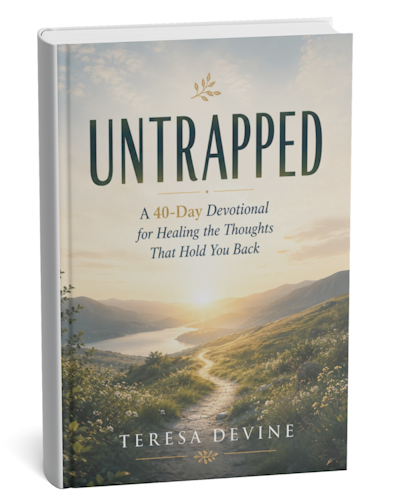
An Invitation to Become UNTRAPPED
Understanding the need for mental stewardship inspired UNTRAPPED, a 40-day emotional healing devotional and companion to my Christian novel, Facing the MindTrap: A Supernatural Journey from Trauma to Triumph.
This is not another formula for instant freedom. The devotional equips readers to invite God into their daily journey to help them identify negative thought patterns, expose the lies, reflect on Scripture, and surrender what they discover to God.
The goal is not to achieve perfect thoughts or eliminate every painful emotion.
Instead, expect to become increasingly grounded in God’s truth, allowing the Holy Spirit to shape your thinking, your responses, and ultimately your life.
Perhaps the most important question isn’t whether a negative thought will enter your mind. It will.
The question is whether you allow that thought to remain unexamined, shaping what you believe and how you respond to daily life.
Today, consider asking yourself:
What thought have I believed for so long that I’ve stopped questioning whether it’s true?
Bring that thought before God. Examine it through His Word. Invite Him to reveal what you may not yet recognize.
Because sometimes the first step toward freedom begins with discovering that the thought you’ve been believing was never the truth.
UNTRAPPED is a 40-day emotional healing devotional by Teresa Devine, companion to the Christian novel Facing the MindTrap. Learn more at teresadevine.com.
Previous Post

September 11, 2026
7 Scriptures for Overcoming Workplace Anxiety
Browse Our Archives
Select a Category Uncategorized
Select a Month November 2026 September 2026 August 2026 January 2026 October 2025 October 2024 July 2024 June 2024 May 2024 April 2024 March 2024 February 2024 January 2024 October 2023 September 2023 August 2023
Follow Us!
TAKE THE
Religious Wisdom Quiz
Which couple taught Apollos more accurately about Jesus in Ephesus?
Select your answer to see how you score.
Mary and Joseph Lydia and Titus Priscilla and Aquila Ananias and Sapphira
Related posts from Fabric of Faith

Women's Movement? I Wanted Him to Lead But...

7 Scriptures for Overcoming Workplace Anxiety

7 Ways Dolly Parton Shared Jesus: One Will...

What If You’re Wandering From God and Don’t...
TRENDING AT PATHEOS General Christian

The Thanksgiving Hymn Born in a Plague-Ravaged Town
The Impossible Story of “Now Thank We All Our God" It’s an...
Does Islam Teach the Subjugation of Christians and...
“There is no compulsion in religion.” When discussions about Islam's relationship...

The Church calendar begins Advent this year on Sunday November 29....

Apples of Gold: Words Around the Thanksgiving Table
There is a verse in Proverbs that I think every mother should...

Why Jesus Shone on the Mountain and Moses...
The Divine Glory In all three of the synoptic gospels, Matthew, Mark,...

What the Midterms Say About White Christian Nationalism
Christian Nationalism has been in the news more and more since the...
view all General Christian blogs
Ad-Free & Subscriber Log-In Subscription Support
- About Us
- 2026 Calendar
- Videos
- Podcasts
- Library of World Religions
- Faith In Media Tracker
- Advertise With Us
- Write for Us
- Privacy Policy
- Terms of Service
- Do Not Sell My Data
- Contact Us
- Radiant Digital
- Manage Newsletter Subscriptions
- Unsubscribe From Notifications
- Sitemap
Copyright 2008-2026, Patheos. All rights reserved.
Subscription Support Ad-Free & Subscriber Log-In
Follow Patheos