
BuddhistCatholicContemplativeEvangelicalGeneral ChristianHinduJewishLatter-day SaintMuslimNew VisionsProgressive Christian
Beliefs
- Buddhist
- Catholic
- Contemplative
- Evangelical
- General Christian
- Hindu
- Jewish
- Latter-day Saint
- More Voices
- Muslim
- New Visions
- Pagan
- Progressive Christian
Topics
- Religion News
- Food and Religion
- Sports and Religion
- Religious Art
- Religious Music and Entertainment
- Religious Events
- History and Religion
- Style and Religion
- Politics and Religion
- Women in Religion
- Recreation Outdoors and Religion
- Business Finance and Religion
- Careers Workplace and Religion
- Education and Religion
- Family Parenting and Religion
- Health Fitness and Religion
- Home and Religion
- Relationships and Religion
- Technology and Religion
- Travel and Religion
Columnists
- Buddhist Columnists
- Business Finance and Religion Columnists
- Careers Workplace and Religion Columnists
- Catholic Columnists
- Contemplative Columnists
- Education and Religion Columnists
- Evangelists Columnists
- Family Parenting and Religion Columnists
- General Christian Columnists
- Health Fitness and Religion Columnists
- Hindu Columnists
- History and Religion Columnists
- Home and Religion Columnists
- Jewish Columnists
- More Voices Columnists
- Latter Day Columnists
- Muslim Columnists
- New Visions Columnists
- Nonreligious Columnists
- Pagan Columnists
- Politics and Religion Columnists
- Progressive Columnists
- Recreation Outdoors and Religion Columnists
- Relationships and Religion Columnists
- Religion News Columnists
- Religious Art Columnists
- Religious Events Columnists
- Religious Music and Entertainment Columnists
- Sports and Religion Columnists
- Style and Religion Columnists
- Technology and Religion Columnists
- Travel and Religion Columnists
- Women in Religion Columnists
Resource Library
- 2026 Calendar
- Library of World Religions
- The 100 Most Holy Places on Earth
- Patheos Answers
- Podcasts
- Videos
- Faith Leaders Database
- Anglican Episcopalian
- Bahai
- Baptist
- Buddhism
- Christianity
- Confucianism
- Eastern Orthodoxy
- Hinduism
- Holiness and Pentecostal
- ISKCON
- Islam
- Judaism
- Lutheran
- Methodist
- The Church of Jesus Christ of Latter-day Saints
- New Age
- Paganism
- Presbytarian and Reformed
- Protestantism
- Religion Behind the Scenes
- Roman Catholic
- Scientology
- Shia Islam
- Sikhism
- Sufism
- Sunni Islam
- Taoism
- Zen
- See all religions
Research Tools
 Ad-Free & Subscriber Log-In Subscription Support
Ad-Free & Subscriber Log-In Subscription Support
Follow Patheos 

- Trending:
- Forgiveness
- |
- Marriage
- |
- Consciousness
- |
- Death Penalty
- |
- Election
- |
- Halloween

- Home
- Evangelical
- Travel and Religion
- Dangers of the Social Gospel: Lessons from Chinese Missions
Dangers of the Social Gospel: Lessons from Chinese Missions
Last updated on: October 4, 2024 at 2:58 pm by Guest Contributor
Dangers of the Social Gospel: Lessons from Chinese Missions 2024-10-04T14:58:06-04:00 Guest Contributor
Patheos Explore the world's faith through different perspectives on religion and spirituality! Patheos has the views of the prevalent religions and spiritualities of the world.
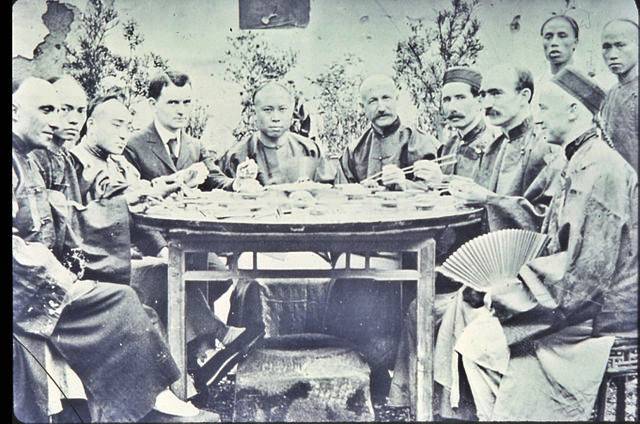
At the turn of the 20th century, China was a land ripe for evangelistic efforts. Group of Chinese and missionary men at a feast, Changde, Hunan, China, ca.1902 Image Courtesy of Wikimedia Commons
By Dr. John Wind
The “social gospel” has been a powerful yet controversial force within Christian history, particularly within American Protestantism. Emerging in the late 19th and early 20th centuries, this movement sought to intertwine social reform with the Christian mission, emphasizing the importance of societal transformation alongside personal conversion. However, the historical impact of the social gospel on American Protestant missions in China reveals significant dangers that remain relevant today, particularly as the church continues to engage with social justice issues.
The social gospel movement began as a response to the rapid social changes brought about by industrialization, urbanization and immigration in the United States. Christian leaders like Washington Gladden and Walter Rauschenbusch believed that the church had a responsibility not only to save souls but also to address social ills such as poverty, inequality and injustice. They argued that Christianity should play a role in reforming society, advocating for labor rights, education and improved living conditions.
However, the movement quickly became a theological battleground. Early proponents of the social gospel often held a high view of Scripture and saw social action as a natural outgrowth of Christian discipleship. Yet, as the movement evolved, it began to adopt more liberal theological positions, influenced by the rise of German Higher Criticism, Darwinian evolution and Freudian psychology. These influences led to a reinterpretation of Christian doctrine that de-emphasized the necessity of personal conversion and the authority of Scripture, focusing instead on social ethics and community transformation.
The Social Gospel’s Impact on Missions in China
This theological shift had profound implications for American Protestant missions abroad, particularly in China. At the turn of the 20th century, China was a land ripe for evangelistic efforts. The fall of the Qing Dynasty and the rise of the Republic of China created a window of opportunity for missionaries to spread the gospel in a nation undergoing significant social and political change.
American missionaries arrived in China with a dual purpose: to preach the gospel and to “civilize” the Chinese people by introducing Western education, technology and democratic values. This blend of spiritual and social missions reflected the broader influence of the social gospel, which viewed societal transformation as integral to the Christian mission.
Initially, this approach seemed successful. Missionaries found a receptive audience among Chinese students and intellectuals, many of whom were eager to embrace Western knowledge and ideas. The early social gospel, with its emphasis on both individual conversion and societal reform, created a sense of unity among missionaries of various denominations and theological backgrounds.
However, this unity was built on a fragile foundation. Beneath the surface, significant theological differences existed between conservative and liberal missionaries. Conservatives emphasized the primacy of evangelism and the necessity of personal conversion, holding to a high view of Scripture and traditional Christian doctrines. Liberals, on the other hand, were more inclined to reinterpret Christian teachings in light of modern science and philosophy, prioritizing social reform over evangelism.
As the social gospel gained traction, particularly after World War I, these theological divisions became increasingly apparent. The war shattered the optimistic belief in the superiority of Western civilization and Christian culture, leading many liberal missionaries to question the exclusivity of the Christian message. Influenced by the growing tide of cultural relativism and religious pluralism, they began to advocate for a more inclusive approach that sought common ground with other religions, particularly Confucianism and Buddhism.
This shift had significant implications for missions in China. The once-strong emphasis on evangelism began to wane as missionaries focused more on social reform and interreligious dialogue. This was particularly evident in organizations like the YMCA, which played a leading role in promoting social service and community development in China. The YMCA’s approach evolved from a balance of evangelism and social service to a focus on social reform and cultural accommodation, reflecting the broader influence of the social gospel.
The impact of the social gospel on American Protestant missions in China was profound, yet ultimately detrimental to the long-term success of these missions. By the 1920s and 1930s, the social gospel had led to a significant shift away from traditional evangelism. The focus on social action and cultural accommodation led many missionaries to downplay the exclusivity of the Christian message, instead presenting Christianity as one among many paths to moral and social improvement.
This approach failed to resonate with the broader Chinese population, who were increasingly drawn to secular ideologies like nationalism and communism. The social gospel’s emphasis on social reform, divorced from the proclamation of the gospel, left a void that these ideologies quickly filled. As Chinese society became more politically and ideologically polarized, the influence of Christianity waned, and many missionaries found themselves marginalized or expelled from the country altogether.
The culmination of this shift was the 1932 “Rethinking Missions” report, produced by an interdenominational committee, which called for a reorientation of missions away from evangelism and toward social service and interreligious dialogue. This report marked the final break between evangelical and liberal missionaries, solidifying the association of the social gospel with theological liberalism and further alienating conservative evangelicals.
Lessons for the Church Today
The history of the social gospel in China offers important lessons for the church today, particularly as it navigates the complexities of engaging with social justice issues. While the church has a clear biblical mandate to care for the poor, fight injustice and promote peace, these efforts must not come at the expense of the core message of the gospel: the salvation of sinners through faith in Jesus Christ.
One of the key dangers of the social gospel, both in the past and today, is its tendency to prioritize social reform over personal conversion. When the church becomes primarily focused on societal change, it risks losing its distinctiveness as the bearer of the gospel message. Social action, while important, must always be secondary to the proclamation of the gospel. The church’s primary mission is to make disciples of all nations, teaching them to obey everything Christ has commanded (Matthew 28:19-20). This mission cannot be fulfilled if the gospel is reduced to a set of moral principles or social programs.
Moreover, the social gospel’s tendency to accommodate the gospel message to the prevailing cultural and ideological trends is another significant danger. In China, this accommodation led to the dilution of Christian doctrine and the eventual rejection of Christianity by many who saw it as just another form of Western imperialism. Today, the church faces similar pressures to conform to cultural norms and political ideologies, whether in the form of secular progressivism or religious pluralism. The church must resist these pressures and maintain its commitment to the authority of Scripture and the exclusivity of the gospel.
The legacy of the social gospel in Chinese missions serves as a stark warning for the church today. While the pursuit of justice is a vital expression of Christian faith, it must never eclipse the church’s primary mission of proclaiming the gospel. The history of American Protestant missions in China demonstrates the dangers of allowing social reform to overshadow evangelism, leading to the erosion of theological clarity and the weakening of the church’s witness.
As the church engages with the world, it must do so with a clear understanding of its mission and message. Social action is an important aspect of Christian discipleship, but it must always be grounded in and directed by the gospel. The church’s ultimate goal is not merely to reform society but to bring people into a saving relationship with Jesus Christ. This is the message that has the power to truly transform lives and societies, both in China and around the world.
General Christian
Travel and Religion
History and Religion

About Dr. John Wind
Dr. John Wind is an Associate Professor of Theology at Colorado Christian University and a fellow at the Centennial Institute. He has been married to his sweet bride, Rachel, since 1996, and the Lord has blessed them with five children. Before coming to CCU, he served with his family in China for eight years. You can read more about the author here.
Previous Post

August 11, 2023
Hope for Iran in the Gospel: The Intimacy of Heart Languages
Next Post

February 14, 2025 Jesus and Time: “I Have Overcome the World"
Browse Our Archives
Select a Category Culture Slideshow Uncategorized
Select a Month April 2026 October 2025 July 2025 April 2025 February 2025 October 2024 August 2023 June 2023 March 2023 February 2023 November 2022 April 2022 January 2022 December 2021 November 2021 October 2021 September 2021 August 2021 March 2021 February 2021 January 2021 December 2020 September 2020 August 2020 July 2020 May 2020 April 2020 March 2020 January 2020 December 2019 October 2019 September 2019 August 2019 July 2019 May 2019 April 2019 March 2019 January 2019 October 2018 August 2018 June 2018 May 2018 March 2018 February 2018 January 2018 December 2017 November 2017 October 2017 September 2017 August 2017 July 2017 May 2017 April 2017 March 2017 February 2017 January 2017 December 2016 November 2016 October 2016 September 2016 August 2016 July 2016 June 2016 May 2016 April 2016 March 2016 February 2016 January 2016 December 2015 November 2015 October 2015 September 2015 August 2015 July 2015 June 2015 May 2015 April 2015 March 2015 February 2015 January 2015 December 2014 November 2014 October 2014 September 2014
TAKE THE
Religious Wisdom Quiz
How did God speak to Moses at the burning bush?
Select your answer to see how you score.
Through wind By name Symbols from the fire Through lightning
Related posts from The Evangelical Pulpit

How Faith Leaders Helped Pass the First Step...

Middle East Digital Extremism Is Rising - Can...

Can Your Prayers of Intercession Help Save the...

USSR Couldn't Snuff Out Easter—Now Russians Reap Hope
TRENDING AT PATHEOS Evangelical

How the author of the world's best hymn...
I've been working with John Newton for a while now. This makes...

Long before this Lectio Divina, Psalm 130 - the song - started...

What About the Trees? Another Living Parable
After I finished writing the last article about falling leaves as a...

Why Classical Education Is a Conversation, Not a...
Come and Read: Joy in Classical Education When I was a little...

Falling Leaves: A Living Parable on Letting Go
I’ve spent the vast majority of my life in the southeast corner...

Cornell University has received a great deal of negative publicity and intense...
view all Evangelical blogs
Ad-Free & Subscriber Log-In Subscription Support
- About Us
- 2026 Calendar
- Videos
- Podcasts
- Library of World Religions
- Faith In Media Tracker
- Advertise With Us
- Write for Us
- Privacy Policy
- Terms of Service
- Do Not Sell My Data
- Contact Us
- Radiant Digital
- Manage Newsletter Subscriptions
- Unsubscribe From Notifications
- Sitemap
Copyright 2008-2026, Patheos. All rights reserved.
Subscription Support Ad-Free & Subscriber Log-In
Follow Patheos