
BuddhistCatholicContemplativeEvangelicalGeneral ChristianHinduJewishLatter-day SaintMuslimNew VisionsProgressive Christian
Beliefs
- Buddhist
- Catholic
- Contemplative
- Evangelical
- General Christian
- Hindu
- Jewish
- Latter-day Saint
- More Voices
- Muslim
- New Visions
- Pagan
- Progressive Christian
Topics
- Religion News
- Food and Religion
- Sports and Religion
- Religious Art
- Religious Music and Entertainment
- Religious Events
- History and Religion
- Style and Religion
- Politics and Religion
- Women in Religion
- Recreation Outdoors and Religion
- Business Finance and Religion
- Careers Workplace and Religion
- Education and Religion
- Family Parenting and Religion
- Health Fitness and Religion
- Home and Religion
- Relationships and Religion
- Technology and Religion
- Travel and Religion
Columnists
- Buddhist Columnists
- Business Finance and Religion Columnists
- Careers Workplace and Religion Columnists
- Catholic Columnists
- Contemplative Columnists
- Education and Religion Columnists
- Evangelists Columnists
- Family Parenting and Religion Columnists
- General Christian Columnists
- Health Fitness and Religion Columnists
- Hindu Columnists
- History and Religion Columnists
- Home and Religion Columnists
- Jewish Columnists
- More Voices Columnists
- Latter Day Columnists
- Muslim Columnists
- New Visions Columnists
- Nonreligious Columnists
- Pagan Columnists
- Politics and Religion Columnists
- Progressive Columnists
- Recreation Outdoors and Religion Columnists
- Relationships and Religion Columnists
- Religion News Columnists
- Religious Art Columnists
- Religious Events Columnists
- Religious Music and Entertainment Columnists
- Sports and Religion Columnists
- Style and Religion Columnists
- Technology and Religion Columnists
- Travel and Religion Columnists
- Women in Religion Columnists
Resource Library
- 2026 Calendar
- Library of World Religions
- The 100 Most Holy Places on Earth
- Patheos Answers
- Podcasts
- Videos
- Faith Leaders Database
- Anglican Episcopalian
- Bahai
- Baptist
- Buddhism
- Christianity
- Confucianism
- Eastern Orthodoxy
- Hinduism
- Holiness and Pentecostal
- ISKCON
- Islam
- Judaism
- Lutheran
- Methodist
- The Church of Jesus Christ of Latter-day Saints
- New Age
- Paganism
- Presbytarian and Reformed
- Protestantism
- Religion Behind the Scenes
- Roman Catholic
- Scientology
- Shia Islam
- Sikhism
- Sufism
- Sunni Islam
- Taoism
- Zen
- See all religions
Research Tools
 Ad-Free & Subscriber Log-In Subscription Support
Ad-Free & Subscriber Log-In Subscription Support
Follow Patheos 

- Trending:
- Forgiveness
- |
- Marriage
- |
- Consciousness
- |
- Death Penalty
- |
- Election
- |
- Halloween

- Home
- Evangelical
- An Anniversary Worth Remembering
An Anniversary Worth Remembering
Last updated on: October 21, 2019 at 1:17 pm by Guest Contributor
An Anniversary Worth Remembering 2019-10-21T13:17:42-04:00 Guest Contributor
Patheos Explore the world's faith through different perspectives on religion and spirituality! Patheos has the views of the prevalent religions and spiritualities of the world.
 On a driving trip through Scandinavia I got my first view of aurora borealis, the Northern Lights. In Finland, just twenty miles from the Russian border, I stood shivering in the cold and watched as waves of luminous color arced across the sky, covering perhaps one-seventh of the dark dome above. Tendrils of green light pulsed and slid together like the interlocking teeth of a giant comb, blocking the stars above. It seemed at once ominous and magical.
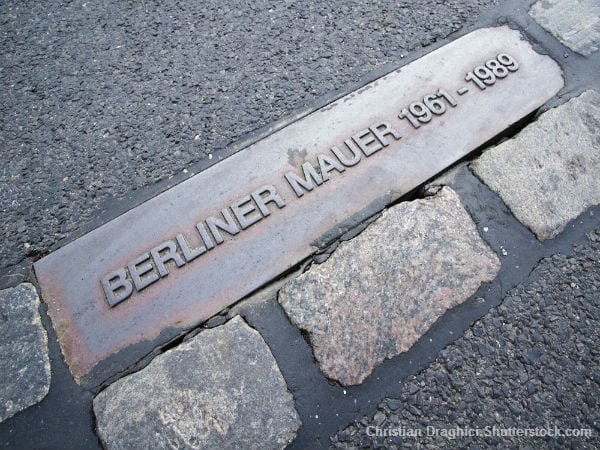
An hour later, after checking into a cheap motel, I turned on the tiny black-and-white television and saw images of what looked like a riot. Crowds of young people in blue jeans were smashing something with sledgehammers, obviously trying to destroy it. Not knowing Finnish, I did not learn until the next day what had happened the night before: on November 9, 1989, the Berlin Wall fell.
For 28 years the wall had snaked across the landscape of a divided Germany. Quite possibly the ugliest construction in history—concrete posts laced with miles of barbed wire, bunkers slotted for machine guns, watchtowers and searchlights mounted on steel scaffolds—this barrier was built to keep people inside, not out. It was communism’s last redoubt.
You would have had to live through the 1960s to realize the enormity of what took place in 1989. Whereas today’s students practice “active shooter” drills, kids in that era practiced “Duck and Cover.” When an alarm sounded, we moved away from windows and climbed under our desks with our arms over our heads. Nikita Khrushchev, the Soviet Premier, had promised, “We will bury you,” and we had no better defense against an imminent nuclear attack.
Communism was ascendant in those days, ruling over a third of humanity. Time magazine regularly printed a map showing its global advance and each time, it seemed, the red stain on the page grew in size. Many universities in the West had taken on a Marxist tilt, and most of Europe was at risk. In 1968, French Communists and Socialists formed an alliance, and workers began a nationwide strike that virtually shut down the country.
Flash forward two decades. In 1989, shockingly, not just the Berlin Wall but the entire system of communism began to collapse. Within months, almost 600 million people would throw off its yoke.
In the thirty years since that momentous day in November, historians have had a field day analyzing what prompted a revolution no one had predicted. Some credit the arms race driven by Ronald Reagan, which helped bankrupt an already shaky Soviet economy. The Collapse: The Accidental Opening of the Berlin Wall details a series of blunders by East German bureaucrats that led to the surprise decision to allow free movement to the West.
Behind the wall, East German churches played a key role. According to Sam Nunn, then Chairman of the Senate Committee on Armed Services, the Cold War ended “not in a nuclear inferno, but in a blaze of candles in the churches of Eastern Europe.” Church was the one place where the communist state allowed freedom of assembly, and throughout 1989 four churches in Leipzig, East Germany, (including Bach’s Thomaskirche) held weekly prayer meetings. The pastors conducted the old Lutheran hymns, addressed their congregations with the Bible in one hand and the daily newspaper in the other, and led rounds of prayer.
At first, a handful of Christians, a few dozen at most, assembled. Gradually, though, the congregations for these prayer meetings began to swell, attracting not just believers but also political dissidents and ordinary citizens. After each meeting the groups would join together and walk through the dark streets of Leipzig, singing hymns and holding candles and banners—a most benign form of political protest. Similar demonstrations spread across the country, most of them beginning in this way, with worship.
News media from the West soon picked up the story. Alarmed, the communist hierarchy debated how to stamp out the peaceful marches. Secret police surrounded the churches, sometimes roughing up the demonstrators as they took to the streets. They arrested 3,500 marchers and injured many others. Yet crowds in Leipzig kept growing: hundreds, thousands, then 50,000 protesters.
On October 9, nearly everyone expected the political pressure to reach a critical mass. East Berlin was celebrating the forty-year anniversary of the communist state, and authorities viewed the marches in Leipzig as a provocation. Police and army units moved into the city, with instructions from East German leader Erich Honecker to fire on the demonstrators. The nation braced for a replay of Tiananmen Square, the tragedy in China only four months before. Leipzig’s Lutheran bishop warned of a massacre, hospitals cleared emergency rooms, and churches and concert halls agreed to open their doors in case people needed a place of refuge.
No one knows for sure why the military held their fire that night. Some theorize that Mikhail Gorbachev himself telephoned a warning to Honecker. Others believe the army was simply cowed by the huge crowds. But everyone credits the prayer vigils in Leipzig for kindling the peaceful revolution. Despite the threat, 70,000 people made an orderly march through downtown Leipzig on October 9. The following Monday, 120,000 showed up. A week later, 500,000 turned out—nearly the entire population of Leipzig.
In early November the largest demonstration of all took place, almost one million people marching peacefully through the capital city of East Berlin. Police and soldiers with all their weapons seemed powerless against such a force. Erich Honecker resigned, humiliated. And at midnight on November 9, something no one had dared pray for happened: a gap opened up in the Berlin Wall. East Germans streamed through the checkpoints, past guards who had always obeyed their orders to “shoot to kill.” On that night the hated Berlin Wall came tumbling down without a shot being fired.
Not a single life was lost as throngs of people holding candles brought down a government in East Germany. Like a windstorm of pure air driving out pollution, the peaceful revolution spread across the globe. In 1989 alone ten nations comprising more than half a billion people—Poland, East Germany, Hungary, Czechoslovakia, Bulgaria, Romania, Albania, Yugoslavia, Mongolia, the Soviet Union—experienced nonviolent revolutions.
As Bud Bultman, a producer and writer for CNN, wrote: “We in the media watched in astonishment as the walls of totalitarianism came crashing down. But in the rush to cover the cataclysmic events, the story behind the story was overlooked. We trained our cameras on hundreds of thousands of people praying for freedom, votive candles in hand, and yet we missed the transcendent dimension, the explicitly spiritual and religious character of the story. We looked right at it and could not see it.”
A huge banner appeared across a Leipzig street: Wir danken Dir, Kirche (We thank you, church).
Historians still have not sorted out all the reasons for communism’s collapse. As one who lived through the 1960s—a decade when barricades went up in the streets of Paris, when leftists were bombing public buildings in the U.S., and when academics were embracing Marxism—I trace the fault line back to a lone Russian, his courage hardened to steel during eight years in the Gulag, who dared proclaim, “It is a lie.” Aleksandr Solzhenitsyn released the first volume of his massive book, The Gulag Archipelago, in 1973. His relentless documentation worked like a sledgehammer to destroy the façade of Soviet communism and expose its lies and oppressive terror.
Russian authorities recognized early the threat posed by Solzhenitsyn’s truth-telling. Hoping to silence him, they expelled him from the Union of Writers and refused to let him accept the Nobel Prize in Literature. The KGB sent him envelopes filled with photographs of car accidents, brain surgery, and other frightening illustrations. In an assassination attempt, they poisoned Solzhenitsyn with ricin, leaving him seriously ill. Finally, when The Gulag Archipelago was smuggled out of Russia and published in the West, they deported him and stripped him of Soviet citizenship. The book went on to sell 30 million copies in 35 languages.
As more truth emerged, one by one the elite of Europe abandoned the illusion of Marxist utopia. A decade after the events of 1989, a thick book with the title The Black Book of Communism was published in France, causing a sensation. In its 858 pages, six European scholars (all former communist sympathizers) detail the global crimes of a system based on repression. The authors calculate that communist regimes are responsible for 85 to 100 million deaths worldwide—compared to 25 million victims of the Nazis.
As history’s most violent century came to a close, truth won out over all the propaganda and false news pumped out by communist governments, a living fulfillment of Jesus’ statement, “…you will know the truth, and the truth will set you free.” As one Romanian told a reporter for Time, “I never thought this could happen, this revolution. We are like children waking from a nightmare in the middle of the night. All we want is reassurance that it won’t happen again.”

About Philip Yancey
Philip Yancey is an award-winning Christian author, whose books include Disappointment with God, Where is God When it Hurts?, The Jesus I Never Knew, What’s So Amazing About Grace?, and Prayer: Does It Make Any Difference? You can read more about the author here.
Previous Post

October 10, 2019
Jesus' Last Words: "Feed" and "Give"
Next Post

December 19, 2019 An Instrument of Righteousness?
Browse Our Archives
Select a Category Culture Slideshow Uncategorized
Select a Month April 2026 October 2025 July 2025 April 2025 February 2025 October 2024 August 2023 June 2023 March 2023 February 2023 November 2022 April 2022 January 2022 December 2021 November 2021 October 2021 September 2021 August 2021 March 2021 February 2021 January 2021 December 2020 September 2020 August 2020 July 2020 May 2020 April 2020 March 2020 January 2020 December 2019 October 2019 September 2019 August 2019 July 2019 May 2019 April 2019 March 2019 January 2019 October 2018 August 2018 June 2018 May 2018 March 2018 February 2018 January 2018 December 2017 November 2017 October 2017 September 2017 August 2017 July 2017 May 2017 April 2017 March 2017 February 2017 January 2017 December 2016 November 2016 October 2016 September 2016 August 2016 July 2016 June 2016 May 2016 April 2016 March 2016 February 2016 January 2016 December 2015 November 2015 October 2015 September 2015 August 2015 July 2015 June 2015 May 2015 April 2015 March 2015 February 2015 January 2015 December 2014 November 2014 October 2014 September 2014
TAKE THE
Religious Wisdom Quiz
Who is traditionally believed to have written the book of Ecclesiastes?
Select your answer to see how you score.
Ezra Solomon David Isaiah
Related posts from The Evangelical Pulpit

How Faith Leaders Helped Pass the First Step...

Middle East Digital Extremism Is Rising - Can...
Can Your Prayers of Intercession Help Save the...
USSR Couldn't Snuff Out Easter—Now Russians Reap Hope
TRENDING AT PATHEOS Evangelical

How the author of the world's best hymn...
I've been working with John Newton for a while now. This makes...

Long before this Lectio Divina, Psalm 130 - the song - started...

What About the Trees? Another Living Parable
After I finished writing the last article about falling leaves as a...

Why Classical Education Is a Conversation, Not a...
Come and Read: Joy in Classical Education When I was a little...

Falling Leaves: A Living Parable on Letting Go
I’ve spent the vast majority of my life in the southeast corner...

Cornell University has received a great deal of negative publicity and intense...
view all Evangelical blogs
Ad-Free & Subscriber Log-In Subscription Support
- About Us
- 2026 Calendar
- Videos
- Podcasts
- Library of World Religions
- Faith In Media Tracker
- Advertise With Us
- Write for Us
- Privacy Policy
- Terms of Service
- Do Not Sell My Data
- Contact Us
- Radiant Digital
- Manage Newsletter Subscriptions
- Unsubscribe From Notifications
- Sitemap
Copyright 2008-2026, Patheos. All rights reserved.
Subscription Support Ad-Free & Subscriber Log-In
Follow Patheos