
BuddhistCatholicContemplativeEvangelicalGeneral ChristianHinduJewishLatter-day SaintMuslimNew VisionsProgressive Christian
Beliefs
- Buddhist
- Catholic
- Contemplative
- Evangelical
- General Christian
- Hindu
- Jewish
- Latter-day Saint
- More Voices
- Muslim
- New Visions
- Pagan
- Progressive Christian
Topics
- Religion News
- Food and Religion
- Sports and Religion
- Religious Art
- Religious Music and Entertainment
- Religious Events
- History and Religion
- Style and Religion
- Politics and Religion
- Women in Religion
- Recreation Outdoors and Religion
- Business Finance and Religion
- Careers Workplace and Religion
- Education and Religion
- Family Parenting and Religion
- Health Fitness and Religion
- Home and Religion
- Relationships and Religion
- Technology and Religion
- Travel and Religion
Columnists
- Buddhist Columnists
- Business Finance and Religion Columnists
- Careers Workplace and Religion Columnists
- Catholic Columnists
- Contemplative Columnists
- Education and Religion Columnists
- Evangelists Columnists
- Family Parenting and Religion Columnists
- General Christian Columnists
- Health Fitness and Religion Columnists
- Hindu Columnists
- History and Religion Columnists
- Home and Religion Columnists
- Jewish Columnists
- More Voices Columnists
- Latter Day Columnists
- Muslim Columnists
- New Visions Columnists
- Nonreligious Columnists
- Pagan Columnists
- Politics and Religion Columnists
- Progressive Columnists
- Recreation Outdoors and Religion Columnists
- Relationships and Religion Columnists
- Religion News Columnists
- Religious Art Columnists
- Religious Events Columnists
- Religious Music and Entertainment Columnists
- Sports and Religion Columnists
- Style and Religion Columnists
- Technology and Religion Columnists
- Travel and Religion Columnists
- Women in Religion Columnists
Resource Library
- 2026 Calendar
- Library of World Religions
- The 100 Most Holy Places on Earth
- Patheos Answers
- Podcasts
- Videos
- Faith Leaders Database
- Anglican Episcopalian
- Bahai
- Baptist
- Buddhism
- Christianity
- Confucianism
- Eastern Orthodoxy
- Hinduism
- Holiness and Pentecostal
- ISKCON
- Islam
- Judaism
- Lutheran
- Methodist
- The Church of Jesus Christ of Latter-day Saints
- New Age
- Paganism
- Presbytarian and Reformed
- Protestantism
- Religion Behind the Scenes
- Roman Catholic
- Scientology
- Shia Islam
- Sikhism
- Sufism
- Sunni Islam
- Taoism
- Zen
- See all religions
Research Tools
 Ad-Free & Subscriber Log-In Subscription Support
Ad-Free & Subscriber Log-In Subscription Support
Follow Patheos 

- Trending:
- Forgiveness
- |
- Marriage
- |
- Consciousness
- |
- Death Penalty
- |
- Election
- |
- Halloween

- Home
- Evangelical
- A Knock on the Door in the Night
A Knock on the Door in the Night
Last updated on: May 15, 2018 at 2:26 pm by Guest Contributor
A Knock on the Door in the Night 2018-05-15T14:26:40-04:00 Guest Contributor
Patheos Explore the world's faith through different perspectives on religion and spirituality! Patheos has the views of the prevalent religions and spiritualities of the world.
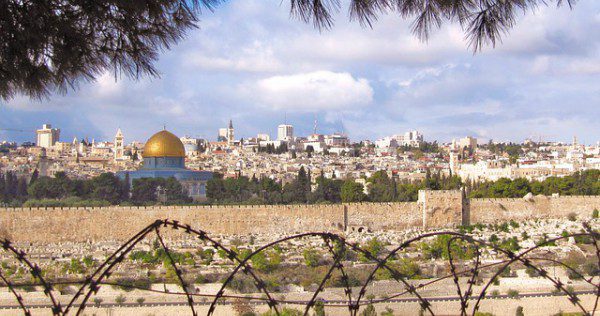
Nighttime was especially dangerous on the West Bank – we always tried to get back home to Bethlehem in our little VW Beetle before dark. As foreigners living among the Arabs, we felt vulnerable, although our neighbors were friendly and supportive. But they could do little to help us if anyone wanted to visit harm upon us.
Even if we had a telephone (which we didn’t) there were no police to call for help. When the first “Intifada” (Arab uprising) erupted, everything changed. The shadowy radicals who controlled things behind the scenes demanded that the police in Beit Jala, where we lived next to Bethlehem abandon their posts. Anyone who had any connection with the hated Israelis was in mortal danger. Almost all the police immediately resigned: one or two who did not were summarily killed. The same happened with anyone who expressed support for the “peace process;” they were branded “collaborators” with Israel. several in our area were dragged from their homes in the night and slaughtered.
The Arabs that we befriended, frequented their shops, and were welcomed into their homes to engage in the time-honored tradition of drinking tea together, were honorable people who wanted only to get on with their lives. But they dared not speak a word against the extremists: to do so was a veritable death sentence. Truth be told, most of us would do the same.
The irony is that many Arabs prospered when the West Bank was under Israeli control. Palestine was a neglected backwater under Jordan, which ruled the West Bank between 1948 and 1967, contributing little to its economy. But under the Israelis the Arabs had plenty of work. Being expert stone masons, and with limestone being the common building material in the area, they built the new Israeli towns and cities, using their earnings to construct their own large, handsome villas throughout the West Bank.
Many of our Arab neighbors had jobs in Israel or worked for Israeli companies. Conversely, Israelis shopped in the Arab markets throughout the West Bank. Virtually all those jobs and commerce disappeared after the Intifada, when having anything to do with Israelis was, again, the equivalent of a death sentence.
All of which gives the lie to the endlessly-repeated fiction that the Palestinians are suffering because of Israeli oppression. Another factor is the inherent corruption and diversion of financial aid and building materials, e.g., for the construction of tunnels used for attacks upon Israel. If they had chosen coexistence instead of perpetual war, there is every reason to believe that the Palestinians would be immeasurably better off today. And once again, this is the unspoken wish of the clear majority of Palestinians, who tragically will not dare to speak a word in defense of peaceful coexistence.
One thing was certain: a knock on the door late at night could not be good news. Thus, when I heard the insistent pounding, I shooed my wife away to the back bedroom where our two young children lay asleep, and approached the door, feeling utterly helpless. Our two kindly old Arab landlords who lived above us could scarcely be of any help, nor could any of our neighbors, however much they would have wanted to be of assistance.
But it was not Muslim radicals massed outside: it was a squad of Israeli soldiers. To my surprise, they politely asked – in excellent English – if they could step inside. Not having much choice, I uneasily opened the door for them.
What transpired was frankly unexpected. The soldiers did not rampage through our flat looking for any terrorists that we might be hiding. They merely asked me if I had seen any of the young extremists who had been causing trouble in the area, smashing rocks and bricks through the windshields of Israeli vehicles driving down the road, causing injury and sometimes death. We lived close to three refugee camps, which were hotbeds of radicalism. I explained to them that our narrow street was populated with Christian Arabs, who were peaceful, and that the young men they sought likely came from one of the nearby camps.
The Israeli soldiers excused themselves, confirming what I by then had observed living under Israeli “occupation.” With few exceptions, Israeli soldiers conducted themselves with considerable restraint and according to a strict protocol, which governed a gradual escalation in response to varying levels of violence.
Normally, the Israeli soldiers would stand down in the face of peaceful protests, focusing on containing the protestors. If and when the protests turned violent (as they often did), the next escalation would be the use of tear gas, which although debilitating, rarely caused serious injury. If the “protests” – which were now destructive riots – were in danger of seriously threatening Israelis or anyone in their path, rubber bullets would be used to drive them back.
It was only as a very last resort, when all other means of containing the situation failed and it was a case of “do or die,” that live ammunition would be used. This is what occurred in Monday’s riots, when tens of thousands of Arabs stormed the border fence. If they would have gotten through, anyone in their path would have been viciously attacked, including women and children.
Tuesday will be worse. It is the “holiest” day for radical Palestinians: “Nakba Day” (Arabic: النكبة, al-Nakbah, literally “catastrophe” which occurred when the Arabs lost the 1948 war against Israel. The Gaza terrorist organization Hamas expects that the border with Israel will be overwhelmed with over 100,000 rioters. A Palestinian video warned Jews to leave Israel by midnight: ““This is the last caution, you have been warned.” The narrator threatened, “Your entity’s army can’t protect you. Your men will be collected by the war crimes court in The Hague. Your women and children will be put in refugee camps under UN control. Your money and property will be confiscated to compensate the refugees and the immigrants.”
On Tuesday many more are likely to suffer and die in the melee. If the rioters manage to break through and surge towards nearby Israeli communities, they must be stopped. And all the while the international community will be calling upon Israel to “show restraint.”
I fear that a fuse has been lit after the United States – honoring a public law enacted by Congress which every administration since 1995 has ignored – declared Jerusalem to be the capital of Israel. Extremist Palestinians will never accept this, and thus a return to the “status quo” is now impossible.
One enigmatic factor will presumably soon be revealed: the long-awaited United States “Peace Plan,” the details of which are a closely-guarded secret. How such a peace treaty could address intractable issues such as the status of Jerusalem – which both sides of the conflict claim as non-negotiable – remains unclear. The Temple Mount, in the heart of the Old City of Jerusalem, is the most sacred land in all of Israel. It also happens to be the site of two of the most holy edifices for Muslims.
Perhaps most troubling of all is the biblical prophecy of a coming peace treaty spoken of in Daniel chapter 9, concerning which one commentator writes: “The signs of the times indicate that we are on the threshold of the Tribulation — a time of unparalleled carnage that will befall the earth. The earth will plunge into a period of time that the Bible describes will be the most horrific in all of human history.” Still, we are commanded to “pray for the peace of Jerusalem.” Let us therefore pray that cooler heads will prevail and that some solution will be found to diffuse the present morass.
Dr. Timothy Dailey
Previous Post

March 23, 2018
Sounds of Silence in Japan
Next Post

May 16, 2018 Christians Must Take a Hard Stand Against Sexual Objectification
Browse Our Archives
Select a Category Culture Slideshow Uncategorized
Select a Month April 2026 October 2025 July 2025 April 2025 February 2025 October 2024 August 2023 June 2023 March 2023 February 2023 November 2022 April 2022 January 2022 December 2021 November 2021 October 2021 September 2021 August 2021 March 2021 February 2021 January 2021 December 2020 September 2020 August 2020 July 2020 May 2020 April 2020 March 2020 January 2020 December 2019 October 2019 September 2019 August 2019 July 2019 May 2019 April 2019 March 2019 January 2019 October 2018 August 2018 June 2018 May 2018 March 2018 February 2018 January 2018 December 2017 November 2017 October 2017 September 2017 August 2017 July 2017 May 2017 April 2017 March 2017 February 2017 January 2017 December 2016 November 2016 October 2016 September 2016 August 2016 July 2016 June 2016 May 2016 April 2016 March 2016 February 2016 January 2016 December 2015 November 2015 October 2015 September 2015 August 2015 July 2015 June 2015 May 2015 April 2015 March 2015 February 2015 January 2015 December 2014 November 2014 October 2014 September 2014
TAKE THE
Religious Wisdom Quiz
Where did God tell Moses to remove his shoes because it was holy ground?
Select your answer to see how you score.
Egyptian palace At the burning bush Red Sea Mount Sinai
Related posts from The Evangelical Pulpit
Building Bridges Between the Black Church and the...

How Faith Leaders Helped Pass the First Step...

Middle East Digital Extremism Is Rising - Can...
Can Your Prayers of Intercession Help Save the...
TRENDING AT PATHEOS Evangelical

How the author of the world's best hymn...
I've been working with John Newton for a while now. This makes...

Long before this Lectio Divina, Psalm 130 - the song - started...

What About the Trees? Another Living Parable
After I finished writing the last article about falling leaves as a...

Why Classical Education Is a Conversation, Not a...
Come and Read: Joy in Classical Education When I was a little...

Falling Leaves: A Living Parable on Letting Go
I’ve spent the vast majority of my life in the southeast corner...

Cornell University has received a great deal of negative publicity and intense...
view all Evangelical blogs
Ad-Free & Subscriber Log-In Subscription Support
- About Us
- 2026 Calendar
- Videos
- Podcasts
- Library of World Religions
- Faith In Media Tracker
- Advertise With Us
- Write for Us
- Privacy Policy
- Terms of Service
- Do Not Sell My Data
- Contact Us
- Radiant Digital
- Manage Newsletter Subscriptions
- Unsubscribe From Notifications
- Sitemap
Copyright 2008-2026, Patheos. All rights reserved.
Subscription Support Ad-Free & Subscriber Log-In
Follow Patheos