
BuddhistCatholicContemplativeEvangelicalGeneral ChristianHinduJewishLatter-day SaintMuslimNew VisionsProgressive Christian
Beliefs
- Buddhist
- Catholic
- Contemplative
- Evangelical
- General Christian
- Hindu
- Jewish
- Latter-day Saint
- More Voices
- Muslim
- New Visions
- Pagan
- Progressive Christian
Topics
- Religion News
- Food and Religion
- Sports and Religion
- Religious Art
- Religious Music and Entertainment
- Religious Events
- History and Religion
- Style and Religion
- Politics and Religion
- Women in Religion
- Recreation Outdoors and Religion
- Business Finance and Religion
- Careers Workplace and Religion
- Education and Religion
- Family Parenting and Religion
- Health Fitness and Religion
- Home and Religion
- Relationships and Religion
- Technology and Religion
- Travel and Religion
Columnists
- Buddhist Columnists
- Business Finance and Religion Columnists
- Careers Workplace and Religion Columnists
- Catholic Columnists
- Contemplative Columnists
- Education and Religion Columnists
- Evangelists Columnists
- Family Parenting and Religion Columnists
- General Christian Columnists
- Health Fitness and Religion Columnists
- Hindu Columnists
- History and Religion Columnists
- Home and Religion Columnists
- Jewish Columnists
- More Voices Columnists
- Latter Day Columnists
- Muslim Columnists
- New Visions Columnists
- Nonreligious Columnists
- Pagan Columnists
- Politics and Religion Columnists
- Progressive Columnists
- Recreation Outdoors and Religion Columnists
- Relationships and Religion Columnists
- Religion News Columnists
- Religious Art Columnists
- Religious Events Columnists
- Religious Music and Entertainment Columnists
- Sports and Religion Columnists
- Style and Religion Columnists
- Technology and Religion Columnists
- Travel and Religion Columnists
- Women in Religion Columnists
Resource Library
- 2026 Calendar
- Library of World Religions
- The 100 Most Holy Places on Earth
- Patheos Answers
- Podcasts
- Videos
- Faith Leaders Database
- Anglican Episcopalian
- Bahai
- Baptist
- Buddhism
- Christianity
- Confucianism
- Eastern Orthodoxy
- Hinduism
- Holiness and Pentecostal
- ISKCON
- Islam
- Judaism
- Lutheran
- Methodist
- The Church of Jesus Christ of Latter-day Saints
- New Age
- Paganism
- Presbytarian and Reformed
- Protestantism
- Religion Behind the Scenes
- Roman Catholic
- Scientology
- Shia Islam
- Sikhism
- Sufism
- Sunni Islam
- Taoism
- Zen
- See all religions
Research Tools
 Ad-Free & Subscriber Log-In Subscription Support
Ad-Free & Subscriber Log-In Subscription Support
Follow Patheos 

- Trending:
- Forgiveness
- |
- Marriage
- |
- Consciousness
- |
- Death Penalty
- |
- Election
- |
- Halloween

- Home
- Evangelical
- Early Jesus-followers as a Hodgepodge of Competing Christianities: Rethinking a Popular Thesis
Early Jesus-followers as a Hodgepodge of Competing Christianities: Rethinking a Popular Thesis
Last updated on: May 24, 2017 at 4:45 pm by Guest Contributor
Early Jesus-followers as a Hodgepodge of Competing Christianities: Rethinking a Popular Thesis 2017-05-24T16:45:03-04:00 Guest Contributor
Patheos Explore the world's faith through different perspectives on religion and spirituality! Patheos has the views of the prevalent religions and spiritualities of the world.
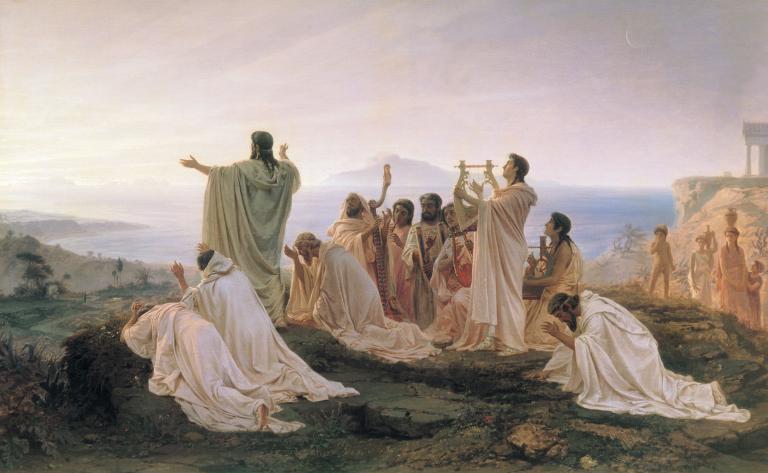
Fyodor Bronnikov / Wikimedia Commons
If you could travel back in time to the year 100 to visit several of the small Christian communities scattered across the Mediterranean world, what would you find?
Separate clusters of squabbling devotees with wildly divergent ideas of what it means to be Christian? A loose network of communities with a lot of love for each other but only fuzzy ideas about Jesus? Or perhaps tight-knit churches with standardized rites and a strong sense of belonging to the Catholic Church?
A perspective common in the public square today is that the on-the-ground reality throughout the Greco-Roman world was constituted by radical diversity and even rabid conflict among many groups, all claiming to be the true Christians. In fact, some say it’s more accurate to picture multiple “Christianities” rather than a single “Christianity.” In this view, Christians in Egypt embraced a very different kind of Jesus than Christians in Judea, or Syria, or Greece, or Rome.
As the story goes, in some places Jesus was a divine being sent from heaven. In other places, he was a merely a human teacher whose radical message got him killed. Among some communities, he was a holy man chosen by God to be a divine agent in judgment. Some thought God raised him from the dead. Others believed he lived on metaphorically through the memory of his teachings.
In this account of history, early Jesus-followers constituted a hodgepodge of competing Christianities with only a vague sense of identity, each vying for converts to their own spin on Jesus. This history usually ends with the Holy Catholic Church emerging from the fog of diversity and conflict, forcing their narrow view of Jesus on everybody else, and enforcing a uniform brand of Christianity.
This quasi-tyrannical Christendom, then, continued to the modern era, when objective critical scholars finally swooped in, cleared the fog, and proved that the earliest decades after Jesus were characterized by many Christs and many Christianities.
At least, this is the version that has become fashionable in some academic circles, many popular publications, and numerous media outlets.
The problem is, even the most nuanced versions of this history are gross exaggerations.
Both the New Testament and the teachings of the early church demonstrate that even the earliest Christians had a pretty solid picture of what it meant to self-identify as “Christian.” Repeatedly, early Jesus-followers told the same basic story of who Jesus was and what he did.
Around the year A.D. 110, the influential Syrian church leader, Ignatius of Antioch, summed up the universal belief about Jesus when he wrote to his fellow Christians in Ephesus of modern-day Turkey: “There is one healer, flesh and spirit, born and unborn, God in man, true life in death, both from Mary and from God, first suffering then without suffering, Jesus Christ our Lord.” (Ignatius, Ephesians 7.2).
Ignatius wasn’t alone. Churches established by the first generation of believers in Jesus shared the same view of their savior. Certainly, diversity of teachers, texts, and traditions prevailed from church to church, but this didn’t diminish the general unity of what Ignatius of Antioch called the “catholic church”—the worldwide church thought of as a whole, centered around the person and work of Jesus Christ. This was the source of their common Christian identity.
So, if you could travel back in time to the year 100 and visit several of the small Christian communities scattered across the Mediterranean world, here’s what you’d actually find: Numerous Christian communities, each with its own corporate personality but all sharing a common sense of belonging to something bigger than themselves. Each church viewed itself as a sort of nuclear family that belonged to an extended family of fellow Christian communities from places as far away as Egypt, Syria, Greece, and Rome.
Despite some real diversity, they held the most important things in common: their self-conscious identity as “Christians” centered on what we might call the “incarnational narrative.” That is, they shared a unique faith in the divine Son of God who came to earth as a real human through a virgin birth, lived a sinless life, died to save sinners, rose again bodily, ascended into heaven, and sent his Spirit to dwell with his followers until he returned to earth as judge and king.
The situation wasn’t all that different from the vastly diverse denominations of Christians around the world today. Despite what’s become popular to parrot in the public square, the earliest Christians, like far-flung Christians today, anchored their common identity on the person and work of the same Jesus. This shared faith was so early, widespread, and foundational to their beliefs and practices that we can reasonably conclude that the worldwide Christian communities received this one Christianity from the previous generation—from the original apostles and prophets themselves.
Michael J. Svigel, PhD, is chair and professor of Theological Studies at Dallas Theological Seminary. He details and defends the unity and diversity of early Christianity in his book, The Center and the Source: Second Century Incarnational Christianity and Early Catholic Christianity (Gorgias Press, 2016).
Previous Post

May 24, 2017
As It Is in Heaven
Next Post

July 13, 2017 False Messiahs: Who Are They, Really?
Browse Our Archives
Select a Category Culture Slideshow Uncategorized
Select a Month April 2026 October 2025 July 2025 April 2025 February 2025 October 2024 August 2023 June 2023 March 2023 February 2023 November 2022 April 2022 January 2022 December 2021 November 2021 October 2021 September 2021 August 2021 March 2021 February 2021 January 2021 December 2020 September 2020 August 2020 July 2020 May 2020 April 2020 March 2020 January 2020 December 2019 October 2019 September 2019 August 2019 July 2019 May 2019 April 2019 March 2019 January 2019 October 2018 August 2018 June 2018 May 2018 March 2018 February 2018 January 2018 December 2017 November 2017 October 2017 September 2017 August 2017 July 2017 May 2017 April 2017 March 2017 February 2017 January 2017 December 2016 November 2016 October 2016 September 2016 August 2016 July 2016 June 2016 May 2016 April 2016 March 2016 February 2016 January 2016 December 2015 November 2015 October 2015 September 2015 August 2015 July 2015 June 2015 May 2015 April 2015 March 2015 February 2015 January 2015 December 2014 November 2014 October 2014 September 2014
TAKE THE
Religious Wisdom Quiz
What does 2 Peter say scoffers will say in the last days?
Select your answer to see how you score.
Where is this 'coming' he promised? Jesus will never return There is no God The world will never end
Related posts from The Evangelical Pulpit

How Faith Leaders Helped Pass the First Step...

Middle East Digital Extremism Is Rising - Can...

Can Your Prayers of Intercession Help Save the...
USSR Couldn't Snuff Out Easter—Now Russians Reap Hope
TRENDING AT PATHEOS Evangelical

The REST of Your Life: A Creative Wrestles...
This week I had a conversation with a good friend from church....

How the author of the world's best hymn...
I've been working with John Newton for a while now. This makes...

Long before this Lectio Divina, Psalm 130 - the song - started...

What About the Trees? Another Living Parable
After I finished writing the last article about falling leaves as a...

Why Classical Education Is a Conversation, Not a...
Come and Read: Joy in Classical Education When I was a little...

Cornell University has received a great deal of negative publicity and intense...
view all Evangelical blogs
Ad-Free & Subscriber Log-In Subscription Support
- About Us
- 2026 Calendar
- Videos
- Podcasts
- Library of World Religions
- Faith In Media Tracker
- Advertise With Us
- Write for Us
- Privacy Policy
- Terms of Service
- Do Not Sell My Data
- Contact Us
- Radiant Digital
- Manage Newsletter Subscriptions
- Unsubscribe From Notifications
- Sitemap
Copyright 2008-2026, Patheos. All rights reserved.
Subscription Support Ad-Free & Subscriber Log-In
Follow Patheos