
BuddhistCatholicContemplativeEvangelicalGeneral ChristianHinduJewishLatter-day SaintMuslimNew VisionsProgressive Christian
Beliefs
- Buddhist
- Catholic
- Contemplative
- Evangelical
- General Christian
- Hindu
- Jewish
- Latter-day Saint
- More Voices
- Muslim
- New Visions
- Pagan
- Progressive Christian
Topics
- Religion News
- Food and Religion
- Sports and Religion
- Religious Art
- Religious Music and Entertainment
- Religious Events
- History and Religion
- Style and Religion
- Politics and Religion
- Women in Religion
- Recreation Outdoors and Religion
- Business Finance and Religion
- Careers Workplace and Religion
- Education and Religion
- Family Parenting and Religion
- Health Fitness and Religion
- Home and Religion
- Relationships and Religion
- Technology and Religion
- Travel and Religion
Columnists
- Buddhist Columnists
- Business Finance and Religion Columnists
- Careers Workplace and Religion Columnists
- Catholic Columnists
- Contemplative Columnists
- Education and Religion Columnists
- Evangelists Columnists
- Family Parenting and Religion Columnists
- General Christian Columnists
- Health Fitness and Religion Columnists
- Hindu Columnists
- History and Religion Columnists
- Home and Religion Columnists
- Jewish Columnists
- More Voices Columnists
- Latter Day Columnists
- Muslim Columnists
- New Visions Columnists
- Nonreligious Columnists
- Pagan Columnists
- Politics and Religion Columnists
- Progressive Columnists
- Recreation Outdoors and Religion Columnists
- Relationships and Religion Columnists
- Religion News Columnists
- Religious Art Columnists
- Religious Events Columnists
- Religious Music and Entertainment Columnists
- Sports and Religion Columnists
- Style and Religion Columnists
- Technology and Religion Columnists
- Travel and Religion Columnists
- Women in Religion Columnists
Resource Library
- 2026 Calendar
- Library of World Religions
- The 100 Most Holy Places on Earth
- Patheos Answers
- Podcasts
- Videos
- Faith Leaders Database
- Anglican Episcopalian
- Bahai
- Baptist
- Buddhism
- Christianity
- Confucianism
- Eastern Orthodoxy
- Hinduism
- Holiness and Pentecostal
- ISKCON
- Islam
- Judaism
- Lutheran
- Methodist
- The Church of Jesus Christ of Latter-day Saints
- New Age
- Paganism
- Presbytarian and Reformed
- Protestantism
- Religion Behind the Scenes
- Roman Catholic
- Scientology
- Shia Islam
- Sikhism
- Sufism
- Sunni Islam
- Taoism
- Zen
- See all religions
Research Tools
 Ad-Free & Subscriber Log-In Subscription Support
Ad-Free & Subscriber Log-In Subscription Support
Follow Patheos 

- Trending:
- Forgiveness
- |
- Marriage
- |
- Consciousness
- |
- Death Penalty
- |
- Election
- |
- Halloween

- Home
- Evangelical
- Little Widgets
Little Widgets
Last updated on: June 3, 2015 at 8:59 am by Guest Contributor
Little Widgets 2015-06-03T08:59:18-04:00 Guest Contributor
Patheos Explore the world's faith through different perspectives on religion and spirituality! Patheos has the views of the prevalent religions and spiritualities of the world.
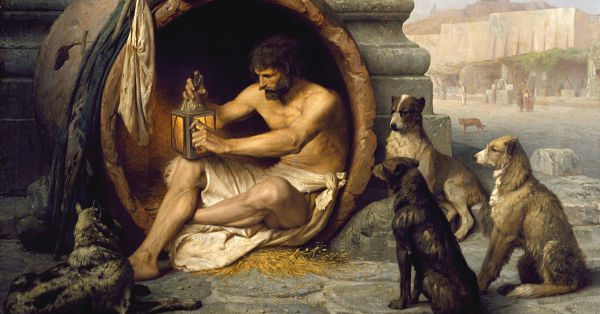
Diogenes sitting in his tub by Jean-Léon Gérôme (Public Domain)
By Ron Benson with Dr. Jeffrey Koperski
My friend has widgets.
He’s like a door-to-door traveling medicine show, offering his wares from a vagabond wagon, showing them off from the inside of his silk-lined overcoat using hushed tones and a wink of his eye.
I am hesitant to admit that I have sneaked a peek at his widgets and find them appealing and provocative.
Why so mysterious? Because his little gadgets claim to answer Big Questions and solve Big Troubles. These are not your normal everyday widgets.
Why so surreptitious? Because around these parts—inside the evangelical strongholds—the kind of gadgets he’s peddling are not always met with resounding “Amens!” These pretty items are a little edgy, and they force people to think beyond easy answers and pat conclusions.
I am a pastor, going on thirty-five years. I get stuck in that rut of easy answers. But if I think hard about some things—some of the puzzles of God and faith and miracles—those answers don’t fit as well as I’d like. Sometimes the answers I give to people are set on a shaky confidence, and I wonder if even I should believe what I’m so cocky about.
My friend is a Philosopher of Science. He tackles questions and wrestles with problems that are way outside my ability to grasp. But that’s why his offerings are tempting. His widgets make sense, and they help clear the fog. They bridge the gap between theology and science, bringing the two to a place where they can get along and see things differently. They help to bring some clarity to divine intervention in miracles and answers to prayer.
That’s where Jeff, my friend, comes in. He’s got the widgets and he knows how to use them. If I spend enough time with him, and open my God-given brain just a little, I can begin to see how his widgets—the tools of the Philosophy of Science—can be applied to faith. When he pulls them out, and explains their functions, they can open up new ways to think about things. Here’s a sample of his wares:
Approximate Truth
This is the idea that truth, in most cases, is understood along a continuum. Approximate truth allows for relative degrees of closeness to reality. We cannot, for instance, say that a thing is completely, 100% true unless we have tested for every possible combination of nuance and circumstance and understanding. And that is not possible.
So in the case of divine intervention, approximate truth gives us wiggle room to explain a miracle while not dismissing the possible conflicts involved. A Pentecostal says that our prayers have moved the hand of God, bringing about a miracle that would not have happened otherwise. His Lutheran friend says it’s the providence of God decided before the beginning of time. From a God’s-eye point of view, it’s not either/or. Both might be approximately true.
Similar conflicts, like whether God can violate his own laws, or whether he changes his mind, are skirmishes that we typically avoid with some glib evangelical-speak like “Well, he’s God; he can do what he wants!” With this widget, we have the ability to say that God was the initiator and source—the causal force—behind the answer to prayers or a miracle, while at the same time acknowledging that any more precise description is at best approximately true, based on our ability to test and analyze and understand.
Models
“A model is a representation of some object, behavior, or system that is usually not considered fully realistic” (Koperski, p.278). A scale model of a VW bus might look just like the real thing in many ways, but we all know it’s not a real automobile. Models are not designed to function as the real thing, but are intended to help test the laws governing the subject. A physical model placed in a wind tunnel, for instance, helps to determine drag and friction.
So-called simplifying models, such as frictionless planes and perfect elasticity, are designed to make the mathematics easier to handle. They are “useful fictions” that help scientists in the testing and application of theories, analysis, and predictions.
What if the concept of models could be a tool applied to theology? In this case, disputes about divine intervention could be understood “as a conflict of models, rather than one of absolute doctrines” (Koperski, p.279).
Both the Pentecostal and the Lutheran in the example above are using models of divine intervention. Both are making assumptions about the mechanics of miracles. While partisans on social media see this as a fundamental conflict of theology, the disagreement lies at a different level. A conflict between models need not involve a conflict between theories (science) or theologies (religion).
Anomalies
Anomalies are phenomena that conflict with our expectations. In science, anomalies are results that aren’t supposed to happen if our theory is right. For example, distant galaxies aren’t moving the way they’re supposed to according to our theory of gravity. The idea of “dark matter” was invented to fix the problem.
Theology and science both have anomalies. That doesn’t mean that a given doctrine is bad or that our theory is false. It does mean that we don’t have all of the information. Adjustments might have to be made, even if we don’t know what they are yet.
But what about anomalies that persist? What about the “hard” issues about which no satisfying resolutions can be made? In this case, the concept of mystery—a precise theological term—can be applied. Not a lazy trump card, mystery refers to the logical boundaries of understanding and knowledge. Our epistemic resources eventually run dry, whether we’re talking about science or theology.
In the case of miracles, after all possible explanations and theories are tested and tried and applied, there may remain that last bit of unexplained truth—a little portion of squirrely, nagging question—that still hangs in the air. “How can a loving God let this bad thing happen?” It’s an anomaly, but that doesn’t mean we give up on God’s love any more than astrophysicists reject gravity.
Each of these sample widgets present challenges for those who prefer to use a more locked-down, tidied-up system of handling Big Questions. But if you see those kinds of answers as being a little too constraining, there might be a widget for you.
Widgets are not the end-all for solving the riddles at the intersection of science and theology. But used properly, they can help us untie some of the philosophical knots.
(Quotations taken from The Physics of Theism by Dr. Jeffrey Koperski. Wiley-Blackwell, 2015).
 Dr. Jeffrey Koperski is a Professor of Philosophy at Saginaw Valley State University in Saginaw, Michigan, with specialties in Philosophy of Science and Philosophy of Religion. His book on the subject, The Physics of Theism was published by Wiley-Blackwell earlier this year. Dr. Koperski has been published in many other articles, journals, and collaborative projects.
 Ron Benson has been a pastor for over thirty years. Ron has written for several publications over the last dozen years including Leadership Journal, the former Discipleship Journal, and many articles for Plain Truth Magazine. He is most proud of his publication in the infamous Wittenberg Door. Ron continues to write articles, devotionals, and curriculum for publication.
Previous Post

May 27, 2015
Christianity’s Revolutionary Recognition of Women as Equals
Next Post

June 5, 2015 Preach as a Dying Man to Dying Men
Browse Our Archives
Select a Category Culture Slideshow Uncategorized
Select a Month April 2026 October 2025 July 2025 April 2025 February 2025 October 2024 August 2023 June 2023 March 2023 February 2023 November 2022 April 2022 January 2022 December 2021 November 2021 October 2021 September 2021 August 2021 March 2021 February 2021 January 2021 December 2020 September 2020 August 2020 July 2020 May 2020 April 2020 March 2020 January 2020 December 2019 October 2019 September 2019 August 2019 July 2019 May 2019 April 2019 March 2019 January 2019 October 2018 August 2018 June 2018 May 2018 March 2018 February 2018 January 2018 December 2017 November 2017 October 2017 September 2017 August 2017 July 2017 May 2017 April 2017 March 2017 February 2017 January 2017 December 2016 November 2016 October 2016 September 2016 August 2016 July 2016 June 2016 May 2016 April 2016 March 2016 February 2016 January 2016 December 2015 November 2015 October 2015 September 2015 August 2015 July 2015 June 2015 May 2015 April 2015 March 2015 February 2015 January 2015 December 2014 November 2014 October 2014 September 2014
TAKE THE
Religious Wisdom Quiz
What was the primary form of transportation in Biblical times?
Select your answer to see how you score.
Camel Chariot Horse Donkey
Related posts from The Evangelical Pulpit

Does God the Father Hate His Beloved Son?

Dear Millennial Christians - An Open Letter


The Real Theological Challenge of Evolution
TRENDING AT PATHEOS Evangelical

How the author of the world's best hymn...
I've been working with John Newton for a while now. This makes...

Long before this Lectio Divina, Psalm 130 - the song - started...

What About the Trees? Another Living Parable
After I finished writing the last article about falling leaves as a...

Why Classical Education Is a Conversation, Not a...
Come and Read: Joy in Classical Education When I was a little...

Falling Leaves: A Living Parable on Letting Go
I’ve spent the vast majority of my life in the southeast corner...

Cornell University has received a great deal of negative publicity and intense...
view all Evangelical blogs
Ad-Free & Subscriber Log-In Subscription Support
- About Us
- 2026 Calendar
- Videos
- Podcasts
- Library of World Religions
- Faith In Media Tracker
- Advertise With Us
- Write for Us
- Privacy Policy
- Terms of Service
- Do Not Sell My Data
- Contact Us
- Radiant Digital
- Manage Newsletter Subscriptions
- Unsubscribe From Notifications
- Sitemap
Copyright 2008-2026, Patheos. All rights reserved.
Subscription Support Ad-Free & Subscriber Log-In
Follow Patheos