
BuddhistCatholicContemplativeEvangelicalGeneral ChristianHinduJewishLatter-day SaintMuslimNew VisionsProgressive Christian
Beliefs
- Buddhist
- Catholic
- Contemplative
- Evangelical
- General Christian
- Hindu
- Jewish
- Latter-day Saint
- More Voices
- Muslim
- New Visions
- Pagan
- Progressive Christian
Topics
- Religion News
- Food and Religion
- Sports and Religion
- Religious Art
- Religious Music and Entertainment
- Religious Events
- History and Religion
- Style and Religion
- Politics and Religion
- Women in Religion
- Recreation Outdoors and Religion
- Business Finance and Religion
- Careers Workplace and Religion
- Education and Religion
- Family Parenting and Religion
- Health Fitness and Religion
- Home and Religion
- Relationships and Religion
- Technology and Religion
- Travel and Religion
Columnists
- Buddhist Columnists
- Business Finance and Religion Columnists
- Careers Workplace and Religion Columnists
- Catholic Columnists
- Contemplative Columnists
- Education and Religion Columnists
- Evangelists Columnists
- Family Parenting and Religion Columnists
- General Christian Columnists
- Health Fitness and Religion Columnists
- Hindu Columnists
- History and Religion Columnists
- Home and Religion Columnists
- Jewish Columnists
- More Voices Columnists
- Latter Day Columnists
- Muslim Columnists
- New Visions Columnists
- Nonreligious Columnists
- Pagan Columnists
- Politics and Religion Columnists
- Progressive Columnists
- Recreation Outdoors and Religion Columnists
- Relationships and Religion Columnists
- Religion News Columnists
- Religious Art Columnists
- Religious Events Columnists
- Religious Music and Entertainment Columnists
- Sports and Religion Columnists
- Style and Religion Columnists
- Technology and Religion Columnists
- Travel and Religion Columnists
- Women in Religion Columnists
Resource Library
- 2026 Calendar
- Library of World Religions
- The 100 Most Holy Places on Earth
- Patheos Answers
- Podcasts
- Videos
- Faith Leaders Database
- Anglican Episcopalian
- Bahai
- Baptist
- Buddhism
- Christianity
- Confucianism
- Eastern Orthodoxy
- Hinduism
- Holiness and Pentecostal
- ISKCON
- Islam
- Judaism
- Lutheran
- Methodist
- The Church of Jesus Christ of Latter-day Saints
- New Age
- Paganism
- Presbytarian and Reformed
- Protestantism
- Religion Behind the Scenes
- Roman Catholic
- Scientology
- Shia Islam
- Sikhism
- Sufism
- Sunni Islam
- Taoism
- Zen
- See all religions
Research Tools
 Ad-Free & Subscriber Log-In Subscription Support
Follow Patheos 

- Trending:
- Advent
- |
- Forgiveness
- |
- Thanksgiving
- |
- Election
- |
- Seasonal Holidays
- |
- Marriage
 Euangelion
- Home
- Evangelical
- David Smith on Teaching Christianly
David Smith on Teaching Christianly
Last updated on: July 29, 2018 at 9:21 pm by Michael F. Bird
David Smith on Teaching Christianly 2018-07-29T21:21:03-04:00 Michael F. Bird
Patheos Explore the world's faith through different perspectives on religion and spirituality! Patheos has the views of the prevalent religions and spiritualities of the world.
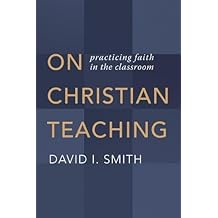 David Smith
On Christian Teaching: practicing faith in the classroom
Grand Rapids: Eerdmans, 2018.
Available at Amazon.com
What does it mean to teach ‘Christianly’ (other than perhaps avoiding the use of words like ‘Christianly’)? In On Christian Teaching David Smith answers this question. His interest is not simply in teaching Christian content, or in teaching within a Christian ethos. Instead, Smith argues for an approach to teaching and learning, the pedagogical process itself, that is explicitly shaped by Christian faith.
Smith’s argument is not a simplistic quest for a uniquely Christian approach to teaching, nor for a biblical imprimatur for classroom practices. This is not a book that tells Science teachers how to craft a lesson on intelligent design, or Maths teachers to design learning activities for students to calculate a tithe on after-tax income. Smith argues for an approach to teaching and learning that “can be meaningfully ‘motivated’ by Christian faith” (p.63). Rather than looking for divine command, Smith outlines a way of thinking about education that looks for “fit”, for pedagogical practices that are “sensible extensions of being Christian” (p.64).
The book comes in two halves. Chapters 1 through 5 make the case that faith can shape pedagogy. Chapters 6 through 10 build on that theoretical (and theological) foundation to detail how classroom teachers can approach the practical task of teaching and learning design.
This is a book squarely aimed at actual classroom teachers. Smith is himself a teacher, formerly as a High School teacher of German, French, and Russian, and currently at Calvin College Michigan, as Director of Graduate Studies in Education, and the Kuyers Institute for Christian Teaching and Learning. The text is littered with examples from actual classroom experience, both as passing references, and in extended analysis. Moreover, the text itself is an example of Smith’s pedagogical practice. Smith quotes an extract on a theology of sin as self-love three times at various points of his argument. In this Smith is not only arguing for the value of reflective reading as a teaching practice, he invites his readers to actually engage in the practice for themselves. Consistent with his emphasis on personal integrity and community formation, each chapter concludes with questions for group discussion, together with reflective activities and journaling prompts.
The case for a faith-formed pedagogy owes much to the Christian Practices paradigm in practical theology, drawing in particular on the work of people like Craig Dykstra, Dorothy Bass, Alasdair Macintyre, and Etienne Wenger. Smith does not suggest that a faith-formed pedagogy will be uniquely Christian (“practices have a way of not staying distinctive if they are helpful”, p.129). Rather than aiming for uniqueness, Smith is arguing for “integrity” where our classroom practices are a faithful embodiment of Christian beliefs. One of the most arresting images in the book is that of pedagogy as “a home in which teachers and students can live together for a while, a place to which students are welcomed as guests and in which they can grow” (p.12).
The practical proposal for teaching and learning design presents the ‘What-If Learning’ approach, developed by an international team of Christian educators (http://www.whatiflearning.com/). After an initial overview (chapter 6), a chapter apiece is given to each facet of the model: seeing anew, choosing engagement, and reshaping practice. Rather than suggesting one prescribed technique, What-if learning offers a “process of faith-informed reflection on how we teach” (p.129).
As I read this book I found myself thinking of all kinds of ways I could reimagine and reshape my own teaching. My summary notes on Smith’s argument are interrupted in various places with ideas to implement in particular classes.
This is a book that will inspire Christian teachers to recognise the theological and faith-forming power their classroom interactions hold. For those who have the privilege of teaching, whether in primary, secondary, or tertiary education, whether in explicitly Christian settings or in secular institutions, On Christian Teaching is a wonderful gift of insight, challenge, and practical help.
Graham Stanton
Ridley Centre for Children’s and Youth Ministry
Previous Post

July 26, 2018
Why Incarnation is Not a Model for Biblical Inspiration
Next Post

August 2, 2018 Must Have DVD: The New Testament You Never Knew
Browse Our Archives
Select a Category Bible Lands Blogosphere Book Review Calvinism Colleges & Universities Ecclesiology Emerging Adulthood Evangelicalism Foreign Affairs Gospel of John Greco-Roman World Humor Just War N. T. Wright Old Testament Resurrection Terrorism Theological Education Travel Uncategorized Writing
Select a Month September 2021 July 2021 June 2021 May 2021 April 2021 March 2021 February 2021 January 2021 December 2020 November 2020 October 2020 September 2020 August 2020 July 2020 June 2020 May 2020 April 2020 March 2020 February 2020 January 2020 December 2019 November 2019 October 2019 September 2019 August 2019 July 2019 June 2019 May 2019 April 2019 March 2019 February 2019 January 2019 December 2018 November 2018 October 2018 September 2018 August 2018 July 2018 June 2018 May 2018 April 2018 March 2018 February 2018 January 2018 December 2017 November 2017 October 2017 September 2017 August 2017 July 2017 June 2017 May 2017 April 2017 March 2017 February 2017 January 2017 December 2016 November 2016 October 2016 September 2016 August 2016 July 2016 June 2016 May 2016 April 2016 March 2016 February 2016 January 2016 December 2015 November 2015 October 2015 September 2015 August 2015 July 2015 June 2015 May 2015 April 2015 March 2015 February 2015 January 2015 December 2014 November 2014 October 2014 September 2014 August 2014 July 2014 June 2014 May 2014 April 2014 March 2014 February 2014 January 2014 December 2013 November 2013 October 2013 September 2013 August 2013 July 2013 June 2013 May 2013 April 2013 March 2013 February 2013 January 2013 December 2012 November 2012 October 2012 September 2012 August 2012 July 2012 June 2012 May 2012 April 2012 March 2012 February 2012 January 2012 December 2011 November 2011 October 2011 September 2011 August 2011 July 2011 June 2011 May 2011 January 2011
TAKE THE
Religious Wisdom Quiz
What was the primary legal document in Biblical times?
Select your answer to see how you score.
Tablet Contract Land deed Scroll
Books by This Author Books by Mike Bird
Related posts from Euangelion

Rom 3:21-26 - Translates, Paraphrase, Notes
Studying the New Testament through Inscriptions


Romans 13:1-7 - Translates, Paraphrase, and Notes
TRENDING AT PATHEOS Evangelical

Don’t Miss the Parents: A Creative Christmas Meditation
As we enter the Advent Season, I see a lot of people...

Making Stones Into Bread: Choosing the “Right” Work
I was on my online arts ministry Zoom meeting with the International...

Ukraine’s exhausted Christians face fifth winter of war
By Julian Lukins The full-scale war in Ukraine is taking “a serious...

Russell Brand's Conviction is not anti-Christian Persecution
How do we shed the reputation that the Church is OK with...

Have you ever caught yourself saying, “I’ll do it tomorrow,” or “Now...

Throughout history, people have pursued pleasure, possessions, relationships, and success in an...
view all Evangelical blogs
Ad-Free & Subscriber Log-In Subscription Support
- About Us
- 2026 Calendar
- Videos
- Podcasts
- Library of World Religions
- Faith In Media Tracker
- Advertise With Us
- Write for Us
- Privacy Policy
- Terms of Service
- Do Not Sell My Data
- Contact Us
- Radiant Digital
- Manage Newsletter Subscriptions
- Unsubscribe From Notifications
- Sitemap
Copyright 2008-2026, Patheos, part of the Radiant Digital network of media brands. All rights reserved.
Subscription Support Ad-Free & Subscriber Log-In
Follow Patheos