
BuddhistCatholicContemplativeEvangelicalGeneral ChristianHinduJewishLatter-day SaintMuslimNew VisionsProgressive Christian
Beliefs
- Buddhist
- Catholic
- Contemplative
- Evangelical
- General Christian
- Hindu
- Jewish
- Latter-day Saint
- More Voices
- Muslim
- New Visions
- Pagan
- Progressive Christian
Topics
- Religion News
- Food and Religion
- Sports and Religion
- Religious Art
- Religious Music and Entertainment
- Religious Events
- History and Religion
- Style and Religion
- Politics and Religion
- Women in Religion
- Recreation Outdoors and Religion
- Business Finance and Religion
- Careers Workplace and Religion
- Education and Religion
- Family Parenting and Religion
- Health Fitness and Religion
- Home and Religion
- Relationships and Religion
- Technology and Religion
- Travel and Religion
Columnists
- Buddhist Columnists
- Business Finance and Religion Columnists
- Careers Workplace and Religion Columnists
- Catholic Columnists
- Contemplative Columnists
- Education and Religion Columnists
- Evangelists Columnists
- Family Parenting and Religion Columnists
- General Christian Columnists
- Health Fitness and Religion Columnists
- Hindu Columnists
- History and Religion Columnists
- Home and Religion Columnists
- Jewish Columnists
- More Voices Columnists
- Latter Day Columnists
- Muslim Columnists
- New Visions Columnists
- Nonreligious Columnists
- Pagan Columnists
- Politics and Religion Columnists
- Progressive Columnists
- Recreation Outdoors and Religion Columnists
- Relationships and Religion Columnists
- Religion News Columnists
- Religious Art Columnists
- Religious Events Columnists
- Religious Music and Entertainment Columnists
- Sports and Religion Columnists
- Style and Religion Columnists
- Technology and Religion Columnists
- Travel and Religion Columnists
- Women in Religion Columnists
Resource Library
- 2026 Calendar
- Library of World Religions
- The 100 Most Holy Places on Earth
- Patheos Answers
- Podcasts
- Videos
- Faith Leaders Database
- Anglican Episcopalian
- Bahai
- Baptist
- Buddhism
- Christianity
- Confucianism
- Eastern Orthodoxy
- Hinduism
- Holiness and Pentecostal
- ISKCON
- Islam
- Judaism
- Lutheran
- Methodist
- The Church of Jesus Christ of Latter-day Saints
- New Age
- Paganism
- Presbytarian and Reformed
- Protestantism
- Religion Behind the Scenes
- Roman Catholic
- Scientology
- Shia Islam
- Sikhism
- Sufism
- Sunni Islam
- Taoism
- Zen
- See all religions
Research Tools
 Ad-Free & Subscriber Log-In Subscription Support
Ad-Free & Subscriber Log-In Subscription Support
Follow Patheos 

- Trending:
- Forgiveness
- |
- Marriage
- |
- Consciousness
- |
- Death Penalty
- |
- Election
- |
- Halloween
 Euangelion
- Home
- Evangelical
- Salvation by Allegiance Alone – Interview with Matt Bates (Part 3)
Salvation by Allegiance Alone – Interview with Matt Bates (Part 3)
Last updated on: May 3, 2017 at 8:59 am by Michael F. Bird
Salvation by Allegiance Alone – Interview with Matt Bates (Part 3) 2017-05-03T08:59:14-04:00 Michael F. Bird
Patheos Explore the world's faith through different perspectives on religion and spirituality! Patheos has the views of the prevalent religions and spiritualities of the world.
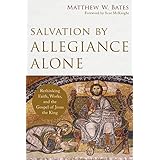 Matthew W. Bates, Salvation by Allegiance Alone: Rethinking Faith, Works, and the Gospel of Jesus the King (Grand Rapids: Baker Academic, 2017)
MIKE BIRD: For obvious reasons, I like how you tie Christ’s resurrection to justification and prefer “incorporated righteousness” to “imputed righteousness.” How do you differ from standard accounts of justification?
MATTHEW BATES: Well, Mike, I’m not sure what you are hinting at here with your “obvious reasons.” But with regard to incorporated righteousness, I do cite an obscure Australian biblical scholar in the footnotes a few times in my chapter 8. Hmmm…
The biblical witness can perhaps best be understood by juxtaposing it alongside classic Protestant and Catholic treatments. In the book, in light of the biblical evidence, I discuss some limitations to imputed righteousness (the dominant Protestant model) while still accepting it if union is explicitly foregrounded. Meanwhile, I reject Catholic imparted righteousness yet accept infused righteousness, if properly qualified. Chapter 8 in the book has the rationale and details. However, in the end I think it best for the church to prioritize new language that better reflects Scripture’s own emphases: in-the-Christ righteousness or incorporated righteousness. I am not sure who has suggested incorporated righteousness, but, wow, it’s brilliant.
I urge that “the righteousness of God” is both the justifying verdict rendered over Jesus that resulted in his resurrection and a gift that we receive in Christ when we come to share in it. Our justification happens when we come to participate in Jesus’s justification through allegiance alone; thus justification entails resurrection-effecting liberation and ontological change. Here I bring together discussions by Joshua Jipp (Christ is King), Douglas Campbell (The Deliverance of God), and Charles Lee Irons (The Righteousness of God), while adding my own insights. I also embrace some traditional Reformed theology (e.g. John Piper and Thomas Schreiner) but disagree with the “covenant faithfulness” interpretation by N. T. Wright.
I also show that “justification” was not considered by Paul to be a “step” in a person’s order of salvation. The Reformed tradition has been deeply invested in trying to systematize the true order by which salvation comes to be applied to an individual—the ordo salutis. A traditional version of the Reformed ordo salutis begins with God’s unsearchable decree to save and to damn specific individuals, and then proceeds to speak about how God comes to apply salvation to those individuals that have been elected through calling, regeneration, repentance/faith, justification, sanctification, and then, finally, glorification. It is important for the Reformed scheme that God is the primary actor in each step of the ordo salutis, otherwise human works contaminate the process. Then humans would have a “boast” before God. The problem is, I contend, that the Bible nowhere articulates an individualized ordo salutis, nor can “justification” be considered a step or stage in the order.
This, I believe, is the reason why Thomas Schreiner (here), Douglas Wilson (here), and some others are upset by my book. It is perceived as a threat to aspects of traditional Reformed theology.
Let the reader understand: faulty sixteenth-century definitions of “faith,” “grace,” “works,” and “boasting” get smuggled into proof-texts such as Ephesians 2:8. We must use first-century meanings here and elsewhere. I have sought to develop and explore such first-century meanings in Salvation by Allegiance Alone.
In the end, the reader will need to decide for his or herself whether “justification” as part of an individualized ordo salutis can safely be maintained. But, speaking as one by and large trained in the Reformed tradition, this and other challenges to the Reformed edifice are mounting. Just one example must suffice.
As I discuss in Chapter 8, Paul does not speak of God’s extension of saving election to individuals before creation, but only to the Christ, the Son, and the church in him. That is, even though God is involved in stimulating personal salvation, foreordained election is not individualized by Paul. Reformed theologians might prefer a both-and approach to individual/corporate election, but numerous studies have shown that such a view is quite unlikely in our New Testament texts (see e.g., A. Chadwick Thornhill, The Chosen People; N. T. Wright, Paul and the Faithfulness of God; Brian J. Abasciano, Paul’s Use of the Old Testament in Romans 9.10-18; “Corporate Election in Romans 9: A Reply to Thomas Schreiner,” JETS 49 (2006), 351-71). In particular, Schreiner’s attempt to defend both individual and corporate election has been refuted by Thornhill’s recent monograph, and there has been no successful rejoinder. If it has not already happened, corporate-but-not-individual election in Paul is rapidly becoming the standard view among biblical scholars. This may not sit well with certain theologians, but any who doubt corporate-but-not-individual election will need to do business with the above mentioned studies.
So, I stress “the righteousness of God” is both the justifying verdict rendered over Jesus that resulted in his resurrection and a gift that we receive in Christ when we come to share in it. “Justification” is not a stage of salvation that the individual must move through, but describes our past, present, and future status only when we remain united to Jesus, the already having-been-justified Messiah.
MIKE BIRD: How does thinking of faith as allegiance lead to a better gospel invitation?
MATTHEW BATES: I have stories and practical suggestions in Chapter 9. So I’ll keep my answer here short and sweet.
Allegiance alone leads to a better gospel invitation because (1) it more accurately represents biblical teaching about the gospel and the necessary human response than the standard “Romans Road” model, and (2) it forces us to realize that discipleship to Jesus is not an optional extra.
We are not first saved when we come to trust that Jesus died for our sins, and then placed into a discipleship program with the hope that we might (optionally) “mature.” This evangelism-then-discipleship model reduces the gospel to a personal forgiveness transaction and fails to take into account the fact that Jesus’s becoming king is part of the gospel. A holistic allegiance-alone model refuses to separate evangelism from discipleship.
We are saved by allegiance alone.
Thanks, Mike, for the terrific questions and the stimulating dialogue.
Previous Post

April 26, 2017
Salvation by Allegiance Alone - Interview with Matt Bates (Part 2)
Next Post
May 1, 2017 E.P. Sanders on Paul's Life, Letters, and Thought
Browse Our Archives
Select a Category Bible Lands Blogosphere Book Review Calvinism Colleges & Universities Ecclesiology Emerging Adulthood Evangelicalism Foreign Affairs Gospel of John Greco-Roman World Humor Just War N. T. Wright Old Testament Resurrection Terrorism Theological Education Travel Uncategorized Writing
Select a Month September 2021 July 2021 June 2021 May 2021 April 2021 March 2021 February 2021 January 2021 December 2020 November 2020 October 2020 September 2020 August 2020 July 2020 June 2020 May 2020 April 2020 March 2020 February 2020 January 2020 December 2019 November 2019 October 2019 September 2019 August 2019 July 2019 June 2019 May 2019 April 2019 March 2019 February 2019 January 2019 December 2018 November 2018 October 2018 September 2018 August 2018 July 2018 June 2018 May 2018 April 2018 March 2018 February 2018 January 2018 December 2017 November 2017 October 2017 September 2017 August 2017 July 2017 June 2017 May 2017 April 2017 March 2017 February 2017 January 2017 December 2016 November 2016 October 2016 September 2016 August 2016 July 2016 June 2016 May 2016 April 2016 March 2016 February 2016 January 2016 December 2015 November 2015 October 2015 September 2015 August 2015 July 2015 June 2015 May 2015 April 2015 March 2015 February 2015 January 2015 December 2014 November 2014 October 2014 September 2014 August 2014 July 2014 June 2014 May 2014 April 2014 March 2014 February 2014 January 2014 December 2013 November 2013 October 2013 September 2013 August 2013 July 2013 June 2013 May 2013 April 2013 March 2013 February 2013 January 2013 December 2012 November 2012 October 2012 September 2012 August 2012 July 2012 June 2012 May 2012 April 2012 March 2012 February 2012 January 2012 December 2011 November 2011 October 2011 September 2011 August 2011 July 2011 June 2011 May 2011 January 2011
TAKE THE
Religious Wisdom Quiz
What book contains the shortest chapter in the Bible?
Select your answer to see how you score.
Proverbs Obadiah Haggai Psalms
Books by This Author Books by Mike Bird
Related posts from Euangelion

Rom 3:21-26 - Translates, Paraphrase, Notes

Studying the New Testament through Inscriptions


Romans 13:1-7 - Translates, Paraphrase, and Notes
TRENDING AT PATHEOS Evangelical

How the author of the world's best hymn...
I've been working with John Newton for a while now. This makes...

Long before this Lectio Divina, Psalm 130 - the song - started...

What About the Trees? Another Living Parable
After I finished writing the last article about falling leaves as a...

Why Classical Education Is a Conversation, Not a...
Come and Read: Joy in Classical Education When I was a little...

Falling Leaves: A Living Parable on Letting Go
I’ve spent the vast majority of my life in the southeast corner...

Cornell University has received a great deal of negative publicity and intense...
view all Evangelical blogs
Ad-Free & Subscriber Log-In Subscription Support
- About Us
- 2026 Calendar
- Videos
- Podcasts
- Library of World Religions
- Faith In Media Tracker
- Advertise With Us
- Write for Us
- Privacy Policy
- Terms of Service
- Do Not Sell My Data
- Contact Us
- Radiant Digital
- Manage Newsletter Subscriptions
- Unsubscribe From Notifications
- Sitemap
Copyright 2008-2026, Patheos. All rights reserved.
Subscription Support Ad-Free & Subscriber Log-In
Follow Patheos