
BuddhistCatholicContemplativeEvangelicalGeneral ChristianHinduJewishLatter-day SaintMuslimNew VisionsProgressive Christian
Beliefs
- Buddhist
- Catholic
- Contemplative
- Evangelical
- General Christian
- Hindu
- Jewish
- Latter-day Saint
- More Voices
- Muslim
- New Visions
- Pagan
- Progressive Christian
Topics
- Religion News
- Food and Religion
- Sports and Religion
- Religious Art
- Religious Music and Entertainment
- Religious Events
- History and Religion
- Style and Religion
- Politics and Religion
- Women in Religion
- Recreation Outdoors and Religion
- Business Finance and Religion
- Careers Workplace and Religion
- Education and Religion
- Family Parenting and Religion
- Health Fitness and Religion
- Home and Religion
- Relationships and Religion
- Technology and Religion
- Travel and Religion
Columnists
- Buddhist Columnists
- Business Finance and Religion Columnists
- Careers Workplace and Religion Columnists
- Catholic Columnists
- Contemplative Columnists
- Education and Religion Columnists
- Evangelists Columnists
- Family Parenting and Religion Columnists
- General Christian Columnists
- Health Fitness and Religion Columnists
- Hindu Columnists
- History and Religion Columnists
- Home and Religion Columnists
- Jewish Columnists
- More Voices Columnists
- Latter Day Columnists
- Muslim Columnists
- New Visions Columnists
- Nonreligious Columnists
- Pagan Columnists
- Politics and Religion Columnists
- Progressive Columnists
- Recreation Outdoors and Religion Columnists
- Relationships and Religion Columnists
- Religion News Columnists
- Religious Art Columnists
- Religious Events Columnists
- Religious Music and Entertainment Columnists
- Sports and Religion Columnists
- Style and Religion Columnists
- Technology and Religion Columnists
- Travel and Religion Columnists
- Women in Religion Columnists
Resource Library
- 2026 Calendar
- Library of World Religions
- The 100 Most Holy Places on Earth
- Patheos Answers
- Podcasts
- Videos
- Faith Leaders Database
- Anglican Episcopalian
- Bahai
- Baptist
- Buddhism
- Christianity
- Confucianism
- Eastern Orthodoxy
- Hinduism
- Holiness and Pentecostal
- ISKCON
- Islam
- Judaism
- Lutheran
- Methodist
- The Church of Jesus Christ of Latter-day Saints
- New Age
- Paganism
- Presbytarian and Reformed
- Protestantism
- Religion Behind the Scenes
- Roman Catholic
- Scientology
- Shia Islam
- Sikhism
- Sufism
- Sunni Islam
- Taoism
- Zen
- See all religions
Research Tools
 Ad-Free & Subscriber Log-In Subscription Support
Ad-Free & Subscriber Log-In Subscription Support
Follow Patheos 

- Trending:
- Forgiveness
- |
- Marriage
- |
- Consciousness
- |
- Death Penalty
- |
- Election
- |
- Halloween
 Euangelion
- Home
- Evangelical
- Engaging Josh Jipp’s Christ is King, Chapter 4: King and Kingdom, Part 2
Engaging Josh Jipp’s Christ is King, Chapter 4: King and Kingdom, Part 2
Last updated on: January 7, 2016 at 7:44 am by Joel Willitts
Engaging Josh Jipp’s Christ is King, Chapter 4: King and Kingdom, Part 2 2016-01-07T07:44:31-04:00 Joel Willitts
Patheos Explore the world's faith through different perspectives on religion and spirituality! Patheos has the views of the prevalent religions and spiritualities of the world.
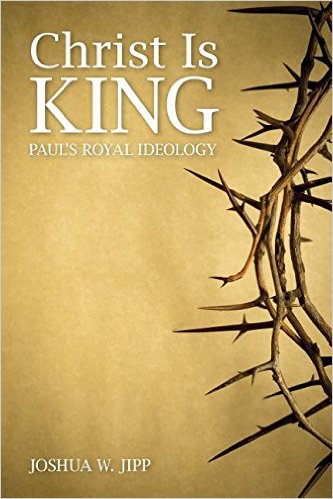 In this post, I continue the discussion I began in the last post on Josh Jipp’s fourth chapter in his book Christ Is King: Paul’s Royal Ideology. In the first post, I summarized the argument.
Now I offer six critical observations and questions.
Psalms of Solomon 17
In previous posts, I’ve raise the relevance of Psalms of Solomon. Josh does interact with this ancient pre-New Testament Davidic messianic text, but not sufficiently enough in my view. Again here in this discussion I am surprised that Josh didn’t make more of the Messianism of Psalms of Solomon 17. Pss. Sol. 17:32 is relevant:
And he will be a righteous king over them, taught by God. There will be no unrighteousness among them in his days, for all shall be holy, and their king shall be the Lord Messiah.
Notice the relationship between the king’s righteousness on account of his being “taught by God” and the people’s. The righteousness of the people is consequent: as goes the king so go the people. This is the exact point Josh is making. Further, the arguments of each Christ the King’s chapters can be demonstrated by this pseudepigraphon. What I’ve learned from Josh’s study however is the way that Psalms of Solomon was but one representation of a much wider ancient Mediterranean kingship ideology. What makes it most important is its Davidic focus.
Why Davidic Messianism?
I have a concern that I’m struggling to put into words. It is related to a criticism I’ve noted in previous posts. Josh’s Paul seems to have a greater independent agency than I think is historically likely. One way of putting it, is that he seems to me above the evidence, not within the evidence. It is as if he knows “the Son” apart from his Davidic character. But he knows the significance of the Son so he uses his tradition to express the “truth” of the Son. The structure of his knowledge of the Son is somehow outside, above, independent. Perhaps an example would help illuminate what I am putting my finger on. Consider this paragraph:
For the early Christians familiar with Israel’s Davidic royal ideology, Rom. 1:3 would almost certainly activate rereadings of the Davidic royal tradition around Messiah Jesus and would suggest that God had fulfilled God’s promises for a messianic-Davidic ruler for Israel. In order to function as Israel’s royal representative as the true seed of David, it is necessary that God’s son share in human, Davidic flesh. Adolf Schlatter states it clearly: “He would not be the promised Son of God if he did not share in the flesh and thus belong to Israel and to the family of David” (171, emphasis added).\
One other interestingly put statement about Jesus’ Davidic identity:
In Rom 1:3-4, and throughout the epistle, Paul characterizes Christ as God’s singular anointed Davidic-like figure who is marked by God’s Spirit and enacts God’s rule through his royal career (166, emphasis added).
On the surface, the statements seems true. But on a deeper level I feel a problem. Perhaps it is because Josh, and it seems others, read Rom 1:3 as asserting the pre-existence of the son who then became Davidic flesh: “[The gospel] about his son who was born from the seed of David according to the flesh” (Josh’s translation from pg. 168). But this reading is not required. I’ve always taken the two adjectival participles following the word “son” to define who the son is, the son is the one who is both a Davidide and the son of God by the Spirit in his resurrection. So rather than assert that Paul had a knowledge of the pre-existent son independent of his Davidic and resurrected identities, Paul knows the Son of God’s the gospel only as both Davidide and the enthroned Son of God.
I want to then ask, does the Davidic identity of Jesus function determinatively in Paul’s argument in Romans? Does it force Paul’s argument in any certain directions? It is commonplace to think that Paul revised, reimagined, reconfigured, innovated his inherited traditions about the Davidic Messiah – and I see every reason to agree, to an extent; but the question I think needs to be asked, additionally: what influence did the tradition itself press on Paul? To ask what Markus Bockmuehl asked Richard Hays (see the introduction to Hays’ Reading Backwards), does the influence go forwards as well as backwards? And if so, what influence did the tradition have on Paul’s gospel? And further would the argument or explanation turn out differently if this aspect was observed? I’m curious as to why Paul struck such a strong Davidic note? And given it’s a Davidic Messiah, what is lost? what is the gained?
The answer that Paul “chose” a Davidic messiah because he needed to in order to express what he somehow previously believed about the Son seems inadequate an answer to me.
KATA SARKA
I was somewhat surprised, and disappointed to be honest, at the direction that Josh went in discussing the Davidic flesh of Jesus (171-74). Rather than pursing more fully its implication – which I think should be done more fully as I indicated in the previous point – Josh emphasized what at best is a minor note in the context of Romans 1:3-4: the Messiah’s humiliation and death. It seems to be approaching the totality transfer fallacy by emphasizing a meaning for the phrase what Paul does not. References to supposed parallel texts where Paul discusses the humanity of Jesus emphasizing his weakness (e.g. Gal 4:4) moves the focus away from Paul’s. Paul uses the term “flesh” in all kinds of ways. And Josh knows Paul is referring to Jesus’ family history, his storied existence you might say; and Josh roundly rejects interpretations that suggest Paul makes use of the term to paint Jesus’ Davidic nature in a negative light, whether that be ethical or cosmological (171). Weakness and humiliation do not seem remotely the point here; instead its royal identity and legitimacy.
David and Adam
Here I simply want to raise a point that Josh has neither developed nor has anyone I’m aware. That is the theory that the Adam story was framed to reflect the David story by the reactors of the Pentateuch. We generally recognize today that the Pentateuch was put into its final form sometime in the 6th century BCE. It was during the time when Israel was in great need of strengthening its identity. The Pentateuch contains earlier material, some perhaps even from Moses, but it was shaped to address the needs of an exilic and post-exilic community in shambles after the lost of the Davidic Kingdom. The royal reflection on Adam and the echoes of Adam in David may then have more to do with the shaping of the Adam story by David’s than we have recognized. I can put the proposal this way: Adam’s story – and this would be true for the whole of the story of Israel as well – was shaped consciously or unconsciously to mirror David’s, rather than the other way around. Jewish Scripture is shaped by David’s story; it are a Davidic story – and the shape of Chronicles corroborates this hypothesis.
Perhaps we can see something of this same kind of thing with Josephus’ presentation of Solomon in Jewish Antiquities. Adam Kolman Marshak in his recent book The Many Faces of Herod the Great observes that Josephus’ characterization of Solomon may reflect Herod’s kingship, although Josephus wrote his history 80 years after Herod. He writes, “As Samuel Rocca has observed, although at first glance Josephus’s Solomon looks similar to his biblical counterpart in 1 Kings, some of the modified passages might reflect a created Solomon whose narrative was inspired by Herod and his kingship . . . Josephus’ narrative . . . could have been influenced by the king’s propaganda without Josephus even being conscious of it” (284).
What then would this kind of influence do to the analysis of Paul’s connection between David and Adam? Not only does it appear that for Paul in Romans 5 Jesus the Messiah determined his use and presentation of Adam – the proverbial “Solution to Problem”, but perhaps also this tendency to read Adam through David was latent in the Jewish Scriptures itself? As far as I know this is a new proposal and something I intend to pursue in a later volume on Davidic Christology. But I’d like to hear Josh’s response to this idea.
Qumran’s Davidic Messianism
This is simply an observation about the nature of Davidic messinaism contemporaneous with the NT. In an article published in JJS on a Qumran cave 4 Pesher on Isaiah (4Q161), I argued that the community of the Scrolls expected to participate in the judging activity of the Messiah when he judged Israel and pagans. Sharing in the Davidic Messiah’s rule was part of the Davidic Messianic expectation at least at Qumran. Another interesting conclusion I drew from that study was for the author of the scroll, the Davidic Messiah was a member of the community and under the authority of the priests. This is quite different from Paul’s understanding of Jesus, where the priestly and royal elements are united and not separated as apparently is the case in the Scrolls – at least in the consensus interpretation.
Gentile Audience
My final question has to do with the audience of Paul’s rhetoric/discourse. This has been a question I’ve had on my mind since the beginning. It seems right to ask it now since Josh strongly argued for Paul’s use of kingship discourse to “socialize his churches into a realm where Christ alone is supremely sovereign and invested with divine lordship over the cosmos” (148) – and I agree fully with this. Does the ethnic composition of his audience matter the interpretation of Paul’s King Jesus in his letters? Does Paul’s audience of Gentile followers of Jesus play a determinative role in making sense of his innovation and use of Davidic ideology? Does this matter? Should it be taken into consideration? Josh either consciously or unconsciously does not. One of the important contributions of the recent movement with Pauline studies – going by the name “Paul within Judaism” – is the practice of taking hermeneutical account of this fact. I think a more ethnically oriented explanation for Paul’s innovation of Davidic traditions is needed than Josh provides. If Paul were writing to ethnically Jewish followers in Jesus, how much different, if at all, would his social formation work through kingship discourse look? It would seem on the surface at least that he would do something different. It seems obvious enough that a Jew who harbored Davidic eschatological expectations, and who also trusted upon Jesus, would need little exhortation to consider Jesus “supremely sovereign and invested with divine lordship over the cosmos”. Isn’t Paul primarily shaping Gentile social identities in his attempt to reconstruct their social imaginary? What is the significance of this? What does the ethnic particularity mean for the argument?
Previous Post

January 5, 2016
New SGBC Volumes on Genesis and Romans
Next Post
January 6, 2016 Do Christians and Muslims Worship the Same God? (Updated)
Browse Our Archives
Select a Category Bible Lands Blogosphere Book Review Calvinism Colleges & Universities Ecclesiology Emerging Adulthood Evangelicalism Foreign Affairs Gospel of John Greco-Roman World Humor Just War N. T. Wright Old Testament Resurrection Terrorism Theological Education Travel Uncategorized Writing
Select a Month September 2021 July 2021 June 2021 May 2021 April 2021 March 2021 February 2021 January 2021 December 2020 November 2020 October 2020 September 2020 August 2020 July 2020 June 2020 May 2020 April 2020 March 2020 February 2020 January 2020 December 2019 November 2019 October 2019 September 2019 August 2019 July 2019 June 2019 May 2019 April 2019 March 2019 February 2019 January 2019 December 2018 November 2018 October 2018 September 2018 August 2018 July 2018 June 2018 May 2018 April 2018 March 2018 February 2018 January 2018 December 2017 November 2017 October 2017 September 2017 August 2017 July 2017 June 2017 May 2017 April 2017 March 2017 February 2017 January 2017 December 2016 November 2016 October 2016 September 2016 August 2016 July 2016 June 2016 May 2016 April 2016 March 2016 February 2016 January 2016 December 2015 November 2015 October 2015 September 2015 August 2015 July 2015 June 2015 May 2015 April 2015 March 2015 February 2015 January 2015 December 2014 November 2014 October 2014 September 2014 August 2014 July 2014 June 2014 May 2014 April 2014 March 2014 February 2014 January 2014 December 2013 November 2013 October 2013 September 2013 August 2013 July 2013 June 2013 May 2013 April 2013 March 2013 February 2013 January 2013 December 2012 November 2012 October 2012 September 2012 August 2012 July 2012 June 2012 May 2012 April 2012 March 2012 February 2012 January 2012 December 2011 November 2011 October 2011 September 2011 August 2011 July 2011 June 2011 May 2011 January 2011
TAKE THE
Religious Wisdom Quiz
What does Jesus say about loving only those who love you?
Select your answer to see how you score.
It's most important Even sinners do that It's hard to do It's required
Books by This Author Books by Mike Bird
Related posts from Euangelion

Rom 3:21-26 - Translates, Paraphrase, Notes

Studying the New Testament through Inscriptions


Romans 13:1-7 - Translates, Paraphrase, and Notes
TRENDING AT PATHEOS Evangelical

How the author of the world's best hymn...
I've been working with John Newton for a while now. This makes...

Long before this Lectio Divina, Psalm 130 - the song - started...

What About the Trees? Another Living Parable
After I finished writing the last article about falling leaves as a...

Why Classical Education Is a Conversation, Not a...
Come and Read: Joy in Classical Education When I was a little...

Falling Leaves: A Living Parable on Letting Go
I’ve spent the vast majority of my life in the southeast corner...

Cornell University has received a great deal of negative publicity and intense...
view all Evangelical blogs
Ad-Free & Subscriber Log-In Subscription Support
- About Us
- 2026 Calendar
- Videos
- Podcasts
- Library of World Religions
- Faith In Media Tracker
- Advertise With Us
- Write for Us
- Privacy Policy
- Terms of Service
- Do Not Sell My Data
- Contact Us
- Radiant Digital
- Manage Newsletter Subscriptions
- Unsubscribe From Notifications
- Sitemap
Copyright 2008-2026, Patheos. All rights reserved.
Subscription Support Ad-Free & Subscriber Log-In
Follow Patheos