
BuddhistCatholicContemplativeEvangelicalGeneral ChristianHinduJewishLatter-day SaintMuslimNew VisionsProgressive Christian
Beliefs
- Buddhist
- Catholic
- Contemplative
- Evangelical
- General Christian
- Hindu
- Jewish
- Latter-day Saint
- More Voices
- Muslim
- New Visions
- Pagan
- Progressive Christian
Topics
- Religion News
- Food and Religion
- Sports and Religion
- Religious Art
- Religious Music and Entertainment
- Religious Events
- History and Religion
- Style and Religion
- Politics and Religion
- Women in Religion
- Recreation Outdoors and Religion
- Business Finance and Religion
- Careers Workplace and Religion
- Education and Religion
- Family Parenting and Religion
- Health Fitness and Religion
- Home and Religion
- Relationships and Religion
- Technology and Religion
- Travel and Religion
Columnists
- Buddhist Columnists
- Business Finance and Religion Columnists
- Careers Workplace and Religion Columnists
- Catholic Columnists
- Contemplative Columnists
- Education and Religion Columnists
- Evangelists Columnists
- Family Parenting and Religion Columnists
- General Christian Columnists
- Health Fitness and Religion Columnists
- Hindu Columnists
- History and Religion Columnists
- Home and Religion Columnists
- Jewish Columnists
- More Voices Columnists
- Latter Day Columnists
- Muslim Columnists
- New Visions Columnists
- Nonreligious Columnists
- Pagan Columnists
- Politics and Religion Columnists
- Progressive Columnists
- Recreation Outdoors and Religion Columnists
- Relationships and Religion Columnists
- Religion News Columnists
- Religious Art Columnists
- Religious Events Columnists
- Religious Music and Entertainment Columnists
- Sports and Religion Columnists
- Style and Religion Columnists
- Technology and Religion Columnists
- Travel and Religion Columnists
- Women in Religion Columnists
Resource Library
- 2026 Calendar
- Library of World Religions
- The 100 Most Holy Places on Earth
- Patheos Answers
- Podcasts
- Videos
- Faith Leaders Database
- Anglican Episcopalian
- Bahai
- Baptist
- Buddhism
- Christianity
- Confucianism
- Eastern Orthodoxy
- Hinduism
- Holiness and Pentecostal
- ISKCON
- Islam
- Judaism
- Lutheran
- Methodist
- The Church of Jesus Christ of Latter-day Saints
- New Age
- Paganism
- Presbytarian and Reformed
- Protestantism
- Religion Behind the Scenes
- Roman Catholic
- Scientology
- Shia Islam
- Sikhism
- Sufism
- Sunni Islam
- Taoism
- Zen
- See all religions
Research Tools
 Ad-Free & Subscriber Log-In Subscription Support
Ad-Free & Subscriber Log-In Subscription Support
Follow Patheos 

- Trending:
- Forgiveness
- |
- Marriage
- |
- Consciousness
- |
- Death Penalty
- |
- Election
- |
- Halloween
 Euangelion
- Home
- Evangelical
- Engaging Josh Jipp’s Christ is King, Chapter 4: King and Kingdom, Part 1
Engaging Josh Jipp’s Christ is King, Chapter 4: King and Kingdom, Part 1
Last updated on: January 3, 2016 at 8:53 am by Joel Willitts
Engaging Josh Jipp’s Christ is King, Chapter 4: King and Kingdom, Part 1 2016-01-03T08:53:45-04:00 Joel Willitts
Patheos Explore the world's faith through different perspectives on religion and spirituality! Patheos has the views of the prevalent religions and spiritualities of the world.
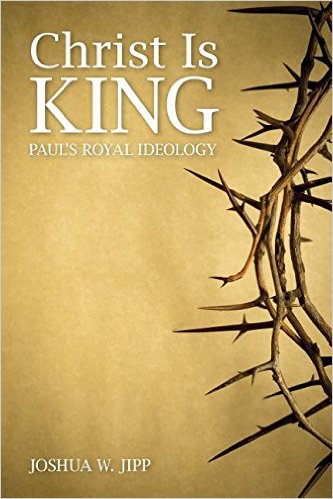 In this fourth installment of the series of posts engaging with Josh Jipp’s recent book Christ Is King: Paul’s Royal Ideology
In writing up this post, it became too long, so I’ve broken it up into two parts. The first is a summation of the argument of the chapter. The second will offer six critical observations and questions for Josh’s response.
Josh heads the chapter with a quotation from 2 Tim. 2:8, 11-12a that seems little noticed by Pauline scholars –this absence is surely because of the tendency to ignore the so-called Pastorals. Still, even if Paul did not pen these words, the Davidic element is at the heart of the gospel his circle preached. The words:
Remember Messiah Jesus, raised from the dead, from the seed for David, according to my gospel . . . The saying is faithful—for if we have died with him, we shall also live with him; if we endure, we shall also rule together with him.
The contents of these verses capture the argument of the chapter: Jesus’ identity as Israel’s Davidic Messiah can explain, to a large extent, the logic of Paul’s participation and incorporation themes.
The chapter is expansive and detailed and I cannot attempt to engage with most of it here. It seems on every one of the 71 pages there is something with which to interact. The chapter has essentially four parts. It begins with a look again at the Christ hymns of Colossians and Philippians—discussed in chapter 3—in order to show that Paul applies the kingship discourse established in these hymns in the rest of the letter. Josh’s argument is two-fold. First, he wishes to show that the panegyrics are resources for Paul to “socialize his churches into a realm where Christ alone is supremely sovereign and invested with divine lordship over the cosmos”. Second, he wants to demonstrate that Paul uses the claims in the hymns through the letters insisting that the churches do not only “benefit from but are even participants in Christ’s sovereign rule” (148).
Having established these two points, in the rest of the three parts of the chapter Josh seeks to address the question of connection: what was Paul’s warrant (historical-religiously) for the move from asserting Jesus’ kingship, on the one hand, to speaking of Christians actually participating in it on the other? While one answer to the question is in the negative: there isn’t one; Paul is completely innovative. A more historically reasonable position is to assume some historical-religious context for the move, of which Paul would then creatively apply to his Gentile churches. The latter is what Josh believes and he seeks, rightly in my view, to establish in the chapter.
Josh clearly states his argument:
In what follows I argue that the primary root for understanding Paul’s participatory discourse is the notion of Israel’s King as simultaneously both the son of God who shares God’s throne, participates in divine kingship, and shares God’s πνεύμα, and the embodied representative of his people who enables the people to share in the rule of the divine King. This provides the grammar and logic for Paul’s ability to conceptualize his church’s participation in the Royal narrative and identity of Christ . . . Paul charts for Jesus a clear and recognizable identity and narrative as Israel’s royal Messiah, then he maps this royal trajectory onto the Messiah’s people (149-50).
In the two major remaining parts of the chapter, Josh studies Israel’s kingship ideology that emerged out of the Davidic promise tradition (1 Sam. 7; 1 Chron. 17; LXX Psa. 2, 88, 109) and developed through the second temple period in some circles (e.g., Pss. Sol. Qumran, 1 Enoch). This ideology asserted something in two directions. First, the king shares God’s divine kinship; second, the king represents the people over which he rules. The latter is more specific. The people’s pattern of life was determined by the king; more specific still, the covenant faithfulness of the people (or lack there of) was determined by the king’s. In Josh’s words, “Through David and his dynasty, the promise of Abraham that he will have a ‘great name,’ that through him all nations will be blessed, and that Israel will have peace from their enemies in the land, will come to fruition. As the elected bearer of God’s promises, the health and success of the entire nation [now – since the Davidic promise]] is wrapped up with the life and destiny of their Davidic king” (161). Josh sums up the significance of the ideology this way:
The Davidic King is uniquely positioned as one who simultaneously participates in divine kingship as God’s elected firstborn son whose rule is an earthly manifestation and extension of God’s royal rule and as Israel’s royal representative who is tasked with bestowing God’s righteous and peaceful rule over God’s people. This royal identity allows the king to mediate God’s presence, rule, and benefits to God’s people. Through the faithful and righteous King, the people are able to receive the glorious inheritance of the land, peace and prosperity, protection from their enemies, and divine so ship and an encounter with God’s presence. In short, Israel’s king mediates and manifests the kingdom of God (165).
In the second major part of the chapter, Josh addresses Paul’s letter to the Romans where he attempts to demonstrate that Paul’s participation theme is rooted in this described kingship ideology. There is a final short part (fourth part) in which Josh provides brief discussions of passages in Ephesians and 1 Corinthians that corroborates his conclusions in Romans.
This has been my favorite chapter thus far and represents a significant contribution both in its convincing argument for the significance of Davidic Messianism for Paul’s theologizing generally and for the meaning of Paul’s participatory theology particularly; and while the argument that the origin of “in Christ” is to be found in Jesus’ Messianic identity is not new, Josh’s discussion in this chapter represents the most detailed, rigorous and convincing presentation of argument to date. I can imagine Tom Wright’s smile after reading this chapter!
In the next post, I’ll offer six critical observations and questions about the chapter.
Previous Post

January 3, 2016
Passing of Helmut Koester
Next Post
January 5, 2016 New SGBC Volumes on Genesis and Romans
Browse Our Archives
Select a Category Bible Lands Blogosphere Book Review Calvinism Colleges & Universities Ecclesiology Emerging Adulthood Evangelicalism Foreign Affairs Gospel of John Greco-Roman World Humor Just War N. T. Wright Old Testament Resurrection Terrorism Theological Education Travel Uncategorized Writing
Select a Month September 2021 July 2021 June 2021 May 2021 April 2021 March 2021 February 2021 January 2021 December 2020 November 2020 October 2020 September 2020 August 2020 July 2020 June 2020 May 2020 April 2020 March 2020 February 2020 January 2020 December 2019 November 2019 October 2019 September 2019 August 2019 July 2019 June 2019 May 2019 April 2019 March 2019 February 2019 January 2019 December 2018 November 2018 October 2018 September 2018 August 2018 July 2018 June 2018 May 2018 April 2018 March 2018 February 2018 January 2018 December 2017 November 2017 October 2017 September 2017 August 2017 July 2017 June 2017 May 2017 April 2017 March 2017 February 2017 January 2017 December 2016 November 2016 October 2016 September 2016 August 2016 July 2016 June 2016 May 2016 April 2016 March 2016 February 2016 January 2016 December 2015 November 2015 October 2015 September 2015 August 2015 July 2015 June 2015 May 2015 April 2015 March 2015 February 2015 January 2015 December 2014 November 2014 October 2014 September 2014 August 2014 July 2014 June 2014 May 2014 April 2014 March 2014 February 2014 January 2014 December 2013 November 2013 October 2013 September 2013 August 2013 July 2013 June 2013 May 2013 April 2013 March 2013 February 2013 January 2013 December 2012 November 2012 October 2012 September 2012 August 2012 July 2012 June 2012 May 2012 April 2012 March 2012 February 2012 January 2012 December 2011 November 2011 October 2011 September 2011 August 2011 July 2011 June 2011 May 2011 January 2011
TAKE THE
Religious Wisdom Quiz
Who was Samuel's mother, who prayed for a child at Shiloh?
Select your answer to see how you score.
Hannah Leah Peninnah Rebekah
Books by This Author Books by Mike Bird
Related posts from Euangelion

Rom 3:21-26 - Translates, Paraphrase, Notes

Studying the New Testament through Inscriptions


Romans 13:1-7 - Translates, Paraphrase, and Notes
TRENDING AT PATHEOS Evangelical

How the author of the world's best hymn...
I've been working with John Newton for a while now. This makes...

Long before this Lectio Divina, Psalm 130 - the song - started...

What About the Trees? Another Living Parable
After I finished writing the last article about falling leaves as a...

Why Classical Education Is a Conversation, Not a...
Come and Read: Joy in Classical Education When I was a little...

Falling Leaves: A Living Parable on Letting Go
I’ve spent the vast majority of my life in the southeast corner...

Cornell University has received a great deal of negative publicity and intense...
view all Evangelical blogs
Ad-Free & Subscriber Log-In Subscription Support
- About Us
- 2026 Calendar
- Videos
- Podcasts
- Library of World Religions
- Faith In Media Tracker
- Advertise With Us
- Write for Us
- Privacy Policy
- Terms of Service
- Do Not Sell My Data
- Contact Us
- Radiant Digital
- Manage Newsletter Subscriptions
- Unsubscribe From Notifications
- Sitemap
Copyright 2008-2026, Patheos. All rights reserved.
Subscription Support Ad-Free & Subscriber Log-In
Follow Patheos