
BuddhistCatholicContemplativeEvangelicalGeneral ChristianHinduJewishLatter-day SaintMuslimNew VisionsProgressive Christian
Beliefs
- Buddhist
- Catholic
- Contemplative
- Evangelical
- General Christian
- Hindu
- Jewish
- Latter-day Saint
- More Voices
- Muslim
- New Visions
- Pagan
- Progressive Christian
Topics
- Religion News
- Food and Religion
- Sports and Religion
- Religious Art
- Religious Music and Entertainment
- Religious Events
- History and Religion
- Style and Religion
- Politics and Religion
- Women in Religion
- Recreation Outdoors and Religion
- Business Finance and Religion
- Careers Workplace and Religion
- Education and Religion
- Family Parenting and Religion
- Health Fitness and Religion
- Home and Religion
- Relationships and Religion
- Technology and Religion
- Travel and Religion
Columnists
- Buddhist Columnists
- Business Finance and Religion Columnists
- Careers Workplace and Religion Columnists
- Catholic Columnists
- Contemplative Columnists
- Education and Religion Columnists
- Evangelists Columnists
- Family Parenting and Religion Columnists
- General Christian Columnists
- Health Fitness and Religion Columnists
- Hindu Columnists
- History and Religion Columnists
- Home and Religion Columnists
- Jewish Columnists
- More Voices Columnists
- Latter Day Columnists
- Muslim Columnists
- New Visions Columnists
- Nonreligious Columnists
- Pagan Columnists
- Politics and Religion Columnists
- Progressive Columnists
- Recreation Outdoors and Religion Columnists
- Relationships and Religion Columnists
- Religion News Columnists
- Religious Art Columnists
- Religious Events Columnists
- Religious Music and Entertainment Columnists
- Sports and Religion Columnists
- Style and Religion Columnists
- Technology and Religion Columnists
- Travel and Religion Columnists
- Women in Religion Columnists
Resource Library
- 2026 Calendar
- Library of World Religions
- The 100 Most Holy Places on Earth
- Patheos Answers
- Podcasts
- Videos
- Faith Leaders Database
- Anglican Episcopalian
- Bahai
- Baptist
- Buddhism
- Christianity
- Confucianism
- Eastern Orthodoxy
- Hinduism
- Holiness and Pentecostal
- ISKCON
- Islam
- Judaism
- Lutheran
- Methodist
- The Church of Jesus Christ of Latter-day Saints
- New Age
- Paganism
- Presbytarian and Reformed
- Protestantism
- Religion Behind the Scenes
- Roman Catholic
- Scientology
- Shia Islam
- Sikhism
- Sufism
- Sunni Islam
- Taoism
- Zen
- See all religions
Research Tools
 Ad-Free & Subscriber Log-In Subscription Support
Ad-Free & Subscriber Log-In Subscription Support
Follow Patheos 

- Trending:
- Forgiveness
- |
- Marriage
- |
- Consciousness
- |
- Death Penalty
- |
- Election
- |
- Halloween
 Euangelion
- Home
- Evangelical
- Engaging Josh Jipp and his Christ is King, Chapter 4, Josh’s Response
Engaging Josh Jipp and his Christ is King, Chapter 4, Josh’s Response
Last updated on: January 8, 2016 at 7:00 am by Joel Willitts
Engaging Josh Jipp and his Christ is King, Chapter 4, Josh’s Response 2016-01-07T07:45:23-04:00 Joel Willitts
Patheos Explore the world's faith through different perspectives on religion and spirituality! Patheos has the views of the prevalent religions and spiritualities of the world.
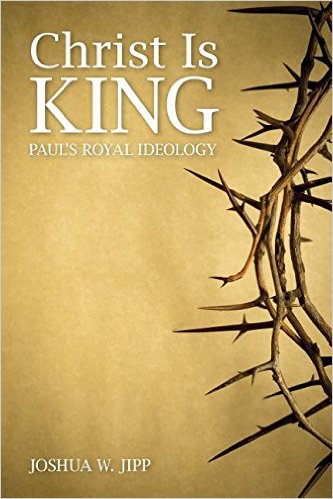 Thanks again for your review and interaction with the fourth chapter (see posts Part 1 and Part 2) of Christ Is King: Paul’s Royal Ideology. I think this was probably also my favorite chapter to write, and I’m glad you enjoyed it. I’m going to simply respond point-by-point to the six questions of your second post.
Psalms of Solomon 17
I have no qualms with you here! I like how you say it: “Notice the relationship between the king’s righteousness on account of his being “taught by God” and the people’s. The righteousness of the people is consequent: as goes the king so go the people.” I’ve always found it funny when people say that so-and-so has anticipated their own argument, but I’m just going to say it: Joel Willitts has anticipated my own argument in chapter 5. There were places where some of the kingship language genuinely illuminated multiple topics, and this is an instance where I kept Psalms of Solomon with the righteousness chapter instead of the participation chapter.
Seriously, I take your point that Psalms of Solomon (esp. chs. 17-18) should receive more play in my book. And I look forward to your take on what I think is probably the most controversial chapter of the book – ch. 5 where I argue for the saving consequences of the Messiah’s own righteousness “given the inextricable relationship between the Messiah and his people” (p. 216).
Why Davidic Messianism? – or to use my language “tradition and innovation”
We keep coming back to this point, which is essentially a hermeneutical issue in my view. I still insist that my argument does not entail Paul speaking outside or above the evidence, although I think I do see Paul’s messianic language as more innovative than you. I do not think there was a singular “Davidic tradition,” but rather all kinds of royal, messianic scriptural texts that were susceptible of being interpreted in a variety of ways. And Paul’s distinctive understanding of a, yes, Davidic Messiah that was crucified, resurrected, enthroned, and poured forth the Spirit, combined with Paul’s own creative theologizing, produces Paul’s innovative articulation of Jesus as the Davidic Messiah.
Let me try to say it this way. Certainly Paul’s understanding of the identity and work of Jesus is constrained by and, in many ways, conforms to the Davidic texts in the OT Scriptures – albeit in a highly creative way! But Paul only understands what those Davidic texts mean in light of his distinctive and particular understanding of the crucifixion, resurrection, and enthronement of Jesus of Nazareth. I think that strong prior commitments to a particular “Davidic tradition” or a particular metanarrative about 2nd Temple Judaism can distort one’s interpretation of Paul.
“according to the flesh” (Rom. 1:3)
First, I do not deny that this phrase refers to Jesus’ family ancestry – my quote of Schlatter (along with references Rom. 4:1; 9:3, 5, 8; 11:14) attempt to get at this. Second, the adjectival participles (τοῦ γενομένου, v. 3; τοῦ ὁρισθέντος, v. 4) which modify “his son” (v. 3) speak of two events in the life of the Son – the Son is born, and he is enthroned – hence, incarnation and enthronement. See now especially Matthew Bates’ excellent article in CBQ (“A Christology of Incarnation and Enthronement”). Perhaps I am too influenced by many of the church fathers who argued with respect to Romans 1:3-4, that what is not assumed is not redeemed. See my article “Ancient, Modern, and Future Interpretations of Romans 1:3-4,” in JTI 2009. Further, immediately after describing the Son’s birth “according to the flesh,” the same figure is found among “the corpses” in 1:4. I don’t want to pin too much on one prepositional phrase, but the Son’s participation on human/Adamic flesh is definitely necessary for his deliverance of the human subject in Romans 5 – 8 – see esp. Rom. 7:17-24 and 8:3-4.
David and Adam
I like how you’re thinking backwards here from David to Adam! Makes sense to me. It’s a good retrospective hermeneutic. I agree with you here, and I could have expanded on this to make the connection more solid. I think Walter Brueggeman and Walter Wifall have some essays on Genesis that argue precisely the point you’re making here. Also, see Scott Hahn’s Kinship by Covenant.
Qumran
Interesting! I wish I’d known about the article, since the notion of sharing in the royal/judicial activities of the Messiah would have aided my argument. Thanks for pointing me to this.
Audience
This is an interesting question. I’m fairly convinced that Romans was written to a Gentile audience and am very sympathetic to the concerns of those within the Paul within Judaism approach [I have learned much from Caroline Johnson Hodge and Stanley Stowers for example!], but all that Paul says, for example, in Rom. 5:12-8:39 seems to also apply to the Jewish Christian as well precisely because he shares in the same bodily predicament as the Gentile. The Jew may not have the faults that the Gentile idolater has in Rom. 1:18-32. But according to Paul, the Jew still inhabits Adamic flesh, is under sin, is not righteous, is under the reign of sin and death, and is in need of God’s pneuma to inhabit his/her body in order to bring life (3:9-20; 5:12-21; 6:6-8; 7:4-6).
I wrote this as a forthcoming response to a set of essays that represent those sympathetic to or within the Paul within Judaism approach.
Undergirding almost everything Paul says in Romans 5 – 8 (and I have argued this also for 3:21 – 4:25) is Christ’s resurrection from the dead as the means whereby both Jew and gentile are liberated from sin and promised future liberation from death. Death and sin are gentile and Jewish problems, and hence Paul’s frequent use of tropes related to old/new humanity (Rom. 5:12-21; 6:5-7; Gal. 3:28-29; 1 Cor. 12:13; Eph. 2:11-21; Col. 3:9-11). In Romans 6:6 Paul speaks of “our old humanity” as inclusive of all people precisely because Paul believes that Jew and gentile are plagued by the same problem of sin and death and therefore are both in need of sharing in Christ’s resurrection (Rom. 6:5b, 9-11).
So would Paul have argued differently? In terms of content and substance, I do not think so.
Previous Post

January 7, 2016
Book Notice: Stan Porter on John, His Gospel, and Jesus
Next Post
January 9, 2016 Book Notice: Wilfried Härle on Outline of Christian Doctrine
Browse Our Archives
Select a Category Bible Lands Blogosphere Book Review Calvinism Colleges & Universities Ecclesiology Emerging Adulthood Evangelicalism Foreign Affairs Gospel of John Greco-Roman World Humor Just War N. T. Wright Old Testament Resurrection Terrorism Theological Education Travel Uncategorized Writing
Select a Month September 2021 July 2021 June 2021 May 2021 April 2021 March 2021 February 2021 January 2021 December 2020 November 2020 October 2020 September 2020 August 2020 July 2020 June 2020 May 2020 April 2020 March 2020 February 2020 January 2020 December 2019 November 2019 October 2019 September 2019 August 2019 July 2019 June 2019 May 2019 April 2019 March 2019 February 2019 January 2019 December 2018 November 2018 October 2018 September 2018 August 2018 July 2018 June 2018 May 2018 April 2018 March 2018 February 2018 January 2018 December 2017 November 2017 October 2017 September 2017 August 2017 July 2017 June 2017 May 2017 April 2017 March 2017 February 2017 January 2017 December 2016 November 2016 October 2016 September 2016 August 2016 July 2016 June 2016 May 2016 April 2016 March 2016 February 2016 January 2016 December 2015 November 2015 October 2015 September 2015 August 2015 July 2015 June 2015 May 2015 April 2015 March 2015 February 2015 January 2015 December 2014 November 2014 October 2014 September 2014 August 2014 July 2014 June 2014 May 2014 April 2014 March 2014 February 2014 January 2014 December 2013 November 2013 October 2013 September 2013 August 2013 July 2013 June 2013 May 2013 April 2013 March 2013 February 2013 January 2013 December 2012 November 2012 October 2012 September 2012 August 2012 July 2012 June 2012 May 2012 April 2012 March 2012 February 2012 January 2012 December 2011 November 2011 October 2011 September 2011 August 2011 July 2011 June 2011 May 2011 January 2011
TAKE THE
Religious Wisdom Quiz
What city is considered holy by Christians, Jews, and Muslims alike?
Select your answer to see how you score.
Antioch Jerusalem Rome Paris
Books by This Author Books by Mike Bird
Related posts from Euangelion

Rom 3:21-26 - Translates, Paraphrase, Notes

Studying the New Testament through Inscriptions


Romans 13:1-7 - Translates, Paraphrase, and Notes
TRENDING AT PATHEOS Evangelical

How the author of the world's best hymn...
I've been working with John Newton for a while now. This makes...

Long before this Lectio Divina, Psalm 130 - the song - started...

What About the Trees? Another Living Parable
After I finished writing the last article about falling leaves as a...

Why Classical Education Is a Conversation, Not a...
Come and Read: Joy in Classical Education When I was a little...

Falling Leaves: A Living Parable on Letting Go
I’ve spent the vast majority of my life in the southeast corner...

Cornell University has received a great deal of negative publicity and intense...
view all Evangelical blogs
Ad-Free & Subscriber Log-In Subscription Support
- About Us
- 2026 Calendar
- Videos
- Podcasts
- Library of World Religions
- Faith In Media Tracker
- Advertise With Us
- Write for Us
- Privacy Policy
- Terms of Service
- Do Not Sell My Data
- Contact Us
- Radiant Digital
- Manage Newsletter Subscriptions
- Unsubscribe From Notifications
- Sitemap
Copyright 2008-2026, Patheos. All rights reserved.
Subscription Support Ad-Free & Subscriber Log-In
Follow Patheos