
BuddhistCatholicContemplativeEvangelicalGeneral ChristianHinduJewishLatter-day SaintMuslimNew VisionsProgressive Christian
Beliefs
- Buddhist
- Catholic
- Contemplative
- Evangelical
- General Christian
- Hindu
- Jewish
- Latter-day Saint
- More Voices
- Muslim
- New Visions
- Pagan
- Progressive Christian
Topics
- Religion News
- Food and Religion
- Sports and Religion
- Religious Art
- Religious Music and Entertainment
- Religious Events
- History and Religion
- Style and Religion
- Politics and Religion
- Women in Religion
- Recreation Outdoors and Religion
- Business Finance and Religion
- Careers Workplace and Religion
- Education and Religion
- Family Parenting and Religion
- Health Fitness and Religion
- Home and Religion
- Relationships and Religion
- Technology and Religion
- Travel and Religion
Columnists
- Buddhist Columnists
- Business Finance and Religion Columnists
- Careers Workplace and Religion Columnists
- Catholic Columnists
- Contemplative Columnists
- Education and Religion Columnists
- Evangelists Columnists
- Family Parenting and Religion Columnists
- General Christian Columnists
- Health Fitness and Religion Columnists
- Hindu Columnists
- History and Religion Columnists
- Home and Religion Columnists
- Jewish Columnists
- More Voices Columnists
- Latter Day Columnists
- Muslim Columnists
- New Visions Columnists
- Nonreligious Columnists
- Pagan Columnists
- Politics and Religion Columnists
- Progressive Columnists
- Recreation Outdoors and Religion Columnists
- Relationships and Religion Columnists
- Religion News Columnists
- Religious Art Columnists
- Religious Events Columnists
- Religious Music and Entertainment Columnists
- Sports and Religion Columnists
- Style and Religion Columnists
- Technology and Religion Columnists
- Travel and Religion Columnists
- Women in Religion Columnists
Resource Library
- 2026 Calendar
- Library of World Religions
- The 100 Most Holy Places on Earth
- Patheos Answers
- Podcasts
- Videos
- Faith Leaders Database
- Anglican Episcopalian
- Bahai
- Baptist
- Buddhism
- Christianity
- Confucianism
- Eastern Orthodoxy
- Hinduism
- Holiness and Pentecostal
- ISKCON
- Islam
- Judaism
- Lutheran
- Methodist
- The Church of Jesus Christ of Latter-day Saints
- New Age
- Paganism
- Presbytarian and Reformed
- Protestantism
- Religion Behind the Scenes
- Roman Catholic
- Scientology
- Shia Islam
- Sikhism
- Sufism
- Sunni Islam
- Taoism
- Zen
- See all religions
Research Tools
 Ad-Free & Subscriber Log-In Subscription Support
Ad-Free & Subscriber Log-In Subscription Support
Follow Patheos 

- Trending:
- Forgiveness
- |
- Marriage
- |
- Consciousness
- |
- Death Penalty
- |
- Election
- |
- Halloween
 Euangelion
- Home
- Evangelical
- Engaging with Josh Jipp and his Christ is King, Josh’s Response
Engaging with Josh Jipp and his Christ is King, Josh’s Response
Last updated on: December 2, 2015 at 9:00 am by Joel Willitts
Engaging with Josh Jipp and his Christ is King, Josh’s Response 2015-11-30T23:29:08-04:00 Joel Willitts
Patheos Explore the world's faith through different perspectives on religion and spirituality! Patheos has the views of the prevalent religions and spiritualities of the world.
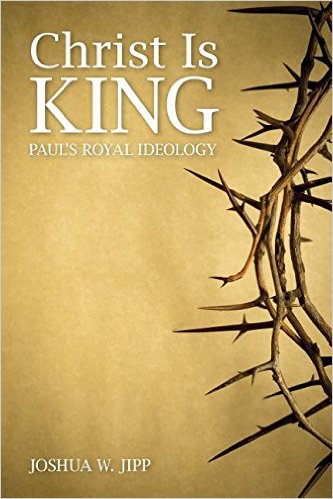 In a previous post I began to engage Josh Jipp’s new book Christ Is King: Paul’s Royal Ideology
First of all, let me say that it is a privilege for me to have the opportunity to reflect upon the arguments of Christ is King with Joel. I’m particularly aware of his excellent work Matthew’s Messianic Shepherd-King, and I had heard from friends that he was planning to do more work on Jesus’ Davidic Messiahship in the New Testament. I think somewhere around a third of my own scholarly articles have been devoted to exploring this theme in Hebrews, Romans, the Gospel of Luke, and Acts, so I’m very much looking forward to Joel’s own NT Christology. I think it’s about time for someone to write this, and I’m glad it will be Joel! In this regard, I’m very tempted to view Joel as an ally, but I can’t get the images of him in a New York Yankees cap out of my head. If the tone of any of my responses is inappropriate, at least you’ll know why.
If I may, let me first indicate what led to this project. In my time at Duke Divinity School I worked with Richard Hays on two essays, one related to Luke-Acts [(“Luke’s Scriptural Suffering Messiah,” CBQ 72 (2010)] and one related to 1 Corinthians 15:20-28 (portions which appear in the book). My broad, and I think largely non-controversial, conclusion in both of these studies was that the Psalter was one of the most significant resources for the development of Luke’s and Paul’s articulation of the identity and work of Jesus of Nazareth.
At the same time as I was discovering the significance of the Psalter for the NT, I was working through Bousset’s Kyrios Christos and its massive influence on those who studied and reconstructed the history of early Christology. I was surprised to find that with Bousset’s division between Palestinian Christianity and Hellenistic Christianity (though he is largely following W. Heitmüller here) came the belief that the title of Christos was of little significance for Gentile/Pauline Christianity. It was also at this time that I was exposed to Erwin Goodenough’s “The Political Philosophy of Hellenistic Kingship” and the abundance of non-Jewish literature devoted to reflections upon the good king. If I may, see now the excellent work of Julien Smith who reads Ephesians in light of these traditions, Christ the Ideal King (Mohr-Siebeck, 2011). I was, then, simultaneously reading the Psalter, Paul’s letters, German history of religions scholarship, and ancient kingship discourse. During my time at Emory, however, I largely focused on the Acts of the Apostles and put these ideas on the back burner.
I was excited, then, when I saw the publication of Matt Novenson’s Christ Among the Messiahs. In my view, Matt has now decisively established that Christos in Paul conforms to everything one would expect for an honorific (e.g., Caesar Augustus, Antiochus Epiphanes, Judah Maccabaeus). I know that this is strong language, but I have not seen any convincing attempts to rebut his argument. Matt makes significant progress in his study of Paul’s Christos language by demonstrating that Paul’s messiah-language does not depend upon its conformity to a Jewish royal/messianic ideal, but rather “could be used meaningfully in antiquity because it was deployed in the context of a linguistic community whose members shared a stock of common linguistic resources” (p. 47). My only substantive criticism was not really a criticism, but simply an observation that if Matt’s claims are right then one can and must go further in examining Paul’s discourse (where appropriate) as messianic-discourse. My book, then, is an attempt to show that significant portions of Paul’s Christ-discourse is illuminated when it is understood as Messianic, that is to say royal or kingly, discourse. While pride of place goes to Israel’s Scriptures in illuminating Paul’s language, however, I understand Paul’s language to make most sense when it is situated within the broader ancient Mediterranean discussions of monarchy.
Now, on to Joel’s questions. Let me begin with his second question. Joel points to pages 11-16 where I suggest that “Paul was attempting to rework the symbolic universe or social imaginary of his churches such that their lives and ultimate allegiances were reordered around the reign of Christ the king.” Joel thinks my methodology may be inaccurate in its granting Paul “too much agency,” instead suggesting that it is more likely that Paul’s Messiah-language is an unconscious, unintentional reflection of a social imaginary and not a deliberate attempt to rework or transform the symbolic universe of Paul’s churches.
The language of “creates” and “invents” with respect to any ideology or social imaginary is admittedly strong language and should rightly raise eyebrows. Joel’s question, thus, is both interesting and highly appropriate. I do not claim, however, anything that would justify Joel’s suggestion that I imagine Paul standing outside his tradition. I argue, rather that, “Paul inhabits these royal scripts.They are, for him, stitched as one important thread within the interwoven fabric of his social imaginary” (p. 13). I affirm that Paul, a Second Temple Jew navigating the complexities of Roman imperial influence, stood within linguistic communities that confessed Jesus as Messiah. So throughout the work, I argue that Paul’s royal ideology was shaped “through the fate of Jesus and the early Christians’ continued experience of him” (p. 9). In other words, Paul had precursors. He did not invent the confession “Jesus is Messiah,” his attraction to Psalm 110 (e.g., Rom. 8:34; 1 Cor. 15:20-28; Eph. 1:20-23) runs across numerous early Christian texts, and it still seems likely that the christological confession in Romans 1:3-4 predates Paul’s use of it.
But I do not think it does justice to Paul’s messiah-language to suggest that he was only unintentionally and unconsciously reflecting prior royal traditions. In fact, many have assumed that Paul’s Christ-language cannot be Messiah-language precisely because of the impressive differences between the two. Ideologies and social imaginaries, in other words, often remain invisible until some kind of pressure is exerted to make them visible. And this is precisely what has happened, I suggest, with the early Christian confession that a crucified criminal had been raised from the dead, exalted to God’s right hand, and is the Lord’s Anointed. Thus, the meaning of the messianic texts from the Greek Old Testament are transformed and reshaped when they are read through the particular fate of Jesus of Nazareth. In other words, the events of Good Friday and Easter have decisively transformed and shaped the meaning of Paul’s royal discourse. The rest of the book is largely an attempt to demonstrate this, so I won’t offer any examples now.
Finally, I find it interesting that in Joel’s call for me to pay more attention to the Chronicler, he says that he sees the Chronicler as attempting “to forge a strong Davidic identity for the returnees in 1-2 Chronicles.” I assume he sees the Chronicler intentionally and consciously shaping and reworking earlier traditions in light of the experience of exile and return. So too I think Paul consciously attempts to forge a Christ-ian identity for his churches as he reworks, adapts, transforms, and passes on royal traditions about Christ the King. I grant that the language of “create” and “invent” is strong (though qualified throughout in such a way that I wouldn’t and don’t use the language of autonomously selecting sources and traditions – see esp. p. 13). But of course I’m trying to show how Paul creates a new discourse or ideology precisely out of previous iterations of kingship discourse – not least of which is Israel’s Scriptures!
Thanks again for taking the time, Joel, my Davidic-kingship ally, to read my book and to ask these excellent questions. I’m looking forward to our conversations over the next five chapters!
Previous Post

November 30, 2015
Engaging with Josh Jipp and his Christ is King, Chapter 1
Next Post
December 3, 2015 Book Notice: Renewing Christian Theology
Browse Our Archives
Select a Category Bible Lands Blogosphere Book Review Calvinism Colleges & Universities Ecclesiology Emerging Adulthood Evangelicalism Foreign Affairs Gospel of John Greco-Roman World Humor Just War N. T. Wright Old Testament Resurrection Terrorism Theological Education Travel Uncategorized Writing
Select a Month September 2021 July 2021 June 2021 May 2021 April 2021 March 2021 February 2021 January 2021 December 2020 November 2020 October 2020 September 2020 August 2020 July 2020 June 2020 May 2020 April 2020 March 2020 February 2020 January 2020 December 2019 November 2019 October 2019 September 2019 August 2019 July 2019 June 2019 May 2019 April 2019 March 2019 February 2019 January 2019 December 2018 November 2018 October 2018 September 2018 August 2018 July 2018 June 2018 May 2018 April 2018 March 2018 February 2018 January 2018 December 2017 November 2017 October 2017 September 2017 August 2017 July 2017 June 2017 May 2017 April 2017 March 2017 February 2017 January 2017 December 2016 November 2016 October 2016 September 2016 August 2016 July 2016 June 2016 May 2016 April 2016 March 2016 February 2016 January 2016 December 2015 November 2015 October 2015 September 2015 August 2015 July 2015 June 2015 May 2015 April 2015 March 2015 February 2015 January 2015 December 2014 November 2014 October 2014 September 2014 August 2014 July 2014 June 2014 May 2014 April 2014 March 2014 February 2014 January 2014 December 2013 November 2013 October 2013 September 2013 August 2013 July 2013 June 2013 May 2013 April 2013 March 2013 February 2013 January 2013 December 2012 November 2012 October 2012 September 2012 August 2012 July 2012 June 2012 May 2012 April 2012 March 2012 February 2012 January 2012 December 2011 November 2011 October 2011 September 2011 August 2011 July 2011 June 2011 May 2011 January 2011
TAKE THE
Religious Wisdom Quiz
Which book prophesies the destruction of Nineveh?
Select your answer to see how you score.
Jonah Nahum Zephaniah Obadiah
Books by This Author Books by Mike Bird
Related posts from Euangelion

Rom 3:21-26 - Translates, Paraphrase, Notes

Studying the New Testament through Inscriptions


Romans 13:1-7 - Translates, Paraphrase, and Notes
TRENDING AT PATHEOS Evangelical

The REST of Your Life: A Creative Wrestles...
This week I had a conversation with a good friend from church....

How the author of the world's best hymn...
I've been working with John Newton for a while now. This makes...

Long before this Lectio Divina, Psalm 130 - the song - started...

What About the Trees? Another Living Parable
After I finished writing the last article about falling leaves as a...

Why Classical Education Is a Conversation, Not a...
Come and Read: Joy in Classical Education When I was a little...

Cornell University has received a great deal of negative publicity and intense...
view all Evangelical blogs
Ad-Free & Subscriber Log-In Subscription Support
- About Us
- 2026 Calendar
- Videos
- Podcasts
- Library of World Religions
- Faith In Media Tracker
- Advertise With Us
- Write for Us
- Privacy Policy
- Terms of Service
- Do Not Sell My Data
- Contact Us
- Radiant Digital
- Manage Newsletter Subscriptions
- Unsubscribe From Notifications
- Sitemap
Copyright 2008-2026, Patheos. All rights reserved.
Subscription Support Ad-Free & Subscriber Log-In
Follow Patheos