
BuddhistCatholicContemplativeEvangelicalGeneral ChristianHinduJewishLatter-day SaintMuslimNew VisionsProgressive Christian
Beliefs
- Buddhist
- Catholic
- Contemplative
- Evangelical
- General Christian
- Hindu
- Jewish
- Latter-day Saint
- More Voices
- Muslim
- New Visions
- Pagan
- Progressive Christian
Topics
- Religion News
- Food and Religion
- Sports and Religion
- Religious Art
- Religious Music and Entertainment
- Religious Events
- History and Religion
- Style and Religion
- Politics and Religion
- Women in Religion
- Recreation Outdoors and Religion
- Business Finance and Religion
- Careers Workplace and Religion
- Education and Religion
- Family Parenting and Religion
- Health Fitness and Religion
- Home and Religion
- Relationships and Religion
- Technology and Religion
- Travel and Religion
Columnists
- Buddhist Columnists
- Business Finance and Religion Columnists
- Careers Workplace and Religion Columnists
- Catholic Columnists
- Contemplative Columnists
- Education and Religion Columnists
- Evangelists Columnists
- Family Parenting and Religion Columnists
- General Christian Columnists
- Health Fitness and Religion Columnists
- Hindu Columnists
- History and Religion Columnists
- Home and Religion Columnists
- Jewish Columnists
- More Voices Columnists
- Latter Day Columnists
- Muslim Columnists
- New Visions Columnists
- Nonreligious Columnists
- Pagan Columnists
- Politics and Religion Columnists
- Progressive Columnists
- Recreation Outdoors and Religion Columnists
- Relationships and Religion Columnists
- Religion News Columnists
- Religious Art Columnists
- Religious Events Columnists
- Religious Music and Entertainment Columnists
- Sports and Religion Columnists
- Style and Religion Columnists
- Technology and Religion Columnists
- Travel and Religion Columnists
- Women in Religion Columnists
Resource Library
- 2026 Calendar
- Library of World Religions
- The 100 Most Holy Places on Earth
- Patheos Answers
- Podcasts
- Videos
- Faith Leaders Database
- Anglican Episcopalian
- Bahai
- Baptist
- Buddhism
- Christianity
- Confucianism
- Eastern Orthodoxy
- Hinduism
- Holiness and Pentecostal
- ISKCON
- Islam
- Judaism
- Lutheran
- Methodist
- The Church of Jesus Christ of Latter-day Saints
- New Age
- Paganism
- Presbytarian and Reformed
- Protestantism
- Religion Behind the Scenes
- Roman Catholic
- Scientology
- Shia Islam
- Sikhism
- Sufism
- Sunni Islam
- Taoism
- Zen
- See all religions
Research Tools
 Ad-Free & Subscriber Log-In Subscription Support
Ad-Free & Subscriber Log-In Subscription Support
Follow Patheos 

- Trending:
- Forgiveness
- |
- Marriage
- |
- Consciousness
- |
- Death Penalty
- |
- Election
- |
- Halloween
 Euangelion
- Home
- Evangelical
- Engaging Josh Jipp and his Christ is King, Chapter 3, Josh’s Response
Engaging Josh Jipp and his Christ is King, Chapter 3, Josh’s Response
Last updated on: December 21, 2015 at 8:09 am by Joel Willitts
Engaging Josh Jipp and his Christ is King, Chapter 3, Josh’s Response 2015-12-21T08:09:30-04:00 Joel Willitts
Patheos Explore the world's faith through different perspectives on religion and spirituality! Patheos has the views of the prevalent religions and spiritualities of the world.
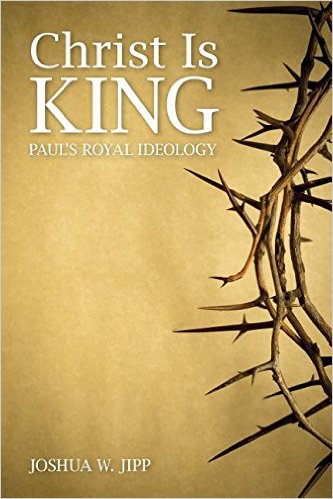 Josh responses to my engagement with his chapter three in Christ Is King: Paul’s Royal Ideology.
–
I’m glad to hear that reading the book is providing further confidence in your own approach to Pauline Christology! I’m looking forward to seeing the reception of chapter 3 given the dominance of understanding Paul’s Christ-hymns (esp. Col. 1) in light of Hellenistic Jewish speculation on Wisdom and Middle Platonic notions of the Logos. You jump in on the exchange between Crispin and me on his blog post. I assume we’ll all continue to engage on this matter in years to come.
As both you and Crispin note, I do not take up the notion of a priestly messiah. Although at the end I do say: “Given that my study has been more illustrative than comprehensive, further studies might examine with profit Paul’s use of priestly metaphors (Rom. 12:1-2; 15:14-29) and his depiction of the church as sacred temple (1 Cor. 3:16; 6:19; 2 Cor. 6:14-7:1; Eph. 2:19-22) in light of the notion of the king as priestly figure and temple builder” (p. 275). I’m not sure how much is really there on this for Paul, but then again I haven’t read Crispin’s book yet and perhaps I’ll be surprised.
You do again mention that our disagreements – even if minor – have largely centered upon my speaking of kingship ideologies in a way that incorporates both Hellenistic and Roman kingship and Jewish messianism, even though as you rightly recognize, I do give primacy to the Greek Old Testament as providing the sources, scripts, and explicit texts for Paul’s kingship language.
As something of a thought experiment, let me mention very, very briefly what I would not have seen in my study of Col. 1 and Phil. 2 if I had focused singularly on the Greek Old Testament.
- I would not have known of the existence of a specific genre of prose composition that set forth how to praise kings and emperors (see here Menander, Quintilian, Aelius Theon, Aphthonius, and others).
- I would not have understood nearly as well that hymns functioned as a form of cultic praise as a form of bestowing divine honors in exchange for powerful and god-like gifts and benefactions.
- I do not think I would have seen or have been convinced of the importance of the head-body language (Col. 1:18a) unless I had seen its prevalence in imperial discourse (close in time to Paul), such as Seneca says to Nero: he is “the bond by which the commonwealth is united, the breath of life which these many thousands draw” (De Clementia 1.4.1); “the commonwealth needs the head” (1.4.2-3); “the gentleness of your mind will be transmitted to others…it will be diffused over the whole body of the empire, and all will be formed in your likeness for health springs form the head” (2.21). The same argument goes for understanding the language of “reconciliation” and “making peace” (1:20) as well as “celebration of a triumph” (2:15) – both of which seem to derive from Hellenistic-Roman kingship ideology (I hesitate to even say it….) and not a Davidic one!
- I don’t think I would have seen how the depiction of Christ in Phil. 2:6-8 depicts Christ as an ideal ruler who rejects the pursuit of god-like status as an act of hubris. Maybe I would have seen it from looking at texts like 2 Macc 9 and Isaiah 14 and 28, but I think I needed to see this trope in depictions of hubristic emperors who were criticized for striving for god-like honors (see esp. Samuel Vollenweider here).
I’m definitely enjoying the level of agreement that we have on these matters, Joel! But I think you’re right that we’re discovering one area of difference. I certainly think that Paul’s belief that Jesus is Israel’s Messiah is the catalyst that causes him to rework and appropriate the Greek Old Testament (and Messiah-texts) in his depiction of Christ and this is clearly evident – as you note – in places like Rom. 1:1-5; 15:7-13; 1 Cor. 15:20-28; 2 Tim. 2:8; and on and on.
But I hesitate to call his Christology “Davidic” for at least two reasons: 1) That language can give the appearance that Paul is simply applying Davidic motifs and language to Christ when, in reality, those Davidic motifs, scripts, stories, and texts are transformed by the Christ-event; 2) As I’ve indicated, it seems to me that – even if pride of place goes to the Greek Old Testament (which will come across even more clearly in chs. 4 and 5, I think), Paul’s belief that Jesus is the King enables him to use, rework, and transform other royal ideologies in service of his depiction of Christ.
By the way, your last example regarding the Psalms of Solomon is really interesting! You’re probably right to smack me around for not doing more with that.
Previous Post

December 20, 2015
The Glory of the Israel's Davidic King and Yahweh
Next Post
December 28, 2015 A Great New Book About Herod the Great
Browse Our Archives
Select a Category Bible Lands Blogosphere Book Review Calvinism Colleges & Universities Ecclesiology Emerging Adulthood Evangelicalism Foreign Affairs Gospel of John Greco-Roman World Humor Just War N. T. Wright Old Testament Resurrection Terrorism Theological Education Travel Uncategorized Writing
Select a Month September 2021 July 2021 June 2021 May 2021 April 2021 March 2021 February 2021 January 2021 December 2020 November 2020 October 2020 September 2020 August 2020 July 2020 June 2020 May 2020 April 2020 March 2020 February 2020 January 2020 December 2019 November 2019 October 2019 September 2019 August 2019 July 2019 June 2019 May 2019 April 2019 March 2019 February 2019 January 2019 December 2018 November 2018 October 2018 September 2018 August 2018 July 2018 June 2018 May 2018 April 2018 March 2018 February 2018 January 2018 December 2017 November 2017 October 2017 September 2017 August 2017 July 2017 June 2017 May 2017 April 2017 March 2017 February 2017 January 2017 December 2016 November 2016 October 2016 September 2016 August 2016 July 2016 June 2016 May 2016 April 2016 March 2016 February 2016 January 2016 December 2015 November 2015 October 2015 September 2015 August 2015 July 2015 June 2015 May 2015 April 2015 March 2015 February 2015 January 2015 December 2014 November 2014 October 2014 September 2014 August 2014 July 2014 June 2014 May 2014 April 2014 March 2014 February 2014 January 2014 December 2013 November 2013 October 2013 September 2013 August 2013 July 2013 June 2013 May 2013 April 2013 March 2013 February 2013 January 2013 December 2012 November 2012 October 2012 September 2012 August 2012 July 2012 June 2012 May 2012 April 2012 March 2012 February 2012 January 2012 December 2011 November 2011 October 2011 September 2011 August 2011 July 2011 June 2011 May 2011 January 2011
TAKE THE
Religious Wisdom Quiz
Who killed his own brother out of jealousy and became the first murderer in the Bible?
Select your answer to see how you score.
Jacob Esau Ishmael Cain
Books by This Author Books by Mike Bird
Related posts from Euangelion

Rom 3:21-26 - Translates, Paraphrase, Notes

Studying the New Testament through Inscriptions


Romans 13:1-7 - Translates, Paraphrase, and Notes
TRENDING AT PATHEOS Evangelical

The REST of Your Life: A Creative Wrestles...
This week I had a conversation with a good friend from church....

How the author of the world's best hymn...
I've been working with John Newton for a while now. This makes...

Long before this Lectio Divina, Psalm 130 - the song - started...

What About the Trees? Another Living Parable
After I finished writing the last article about falling leaves as a...

Why Classical Education Is a Conversation, Not a...
Come and Read: Joy in Classical Education When I was a little...

Cornell University has received a great deal of negative publicity and intense...
view all Evangelical blogs
Ad-Free & Subscriber Log-In Subscription Support
- About Us
- 2026 Calendar
- Videos
- Podcasts
- Library of World Religions
- Faith In Media Tracker
- Advertise With Us
- Write for Us
- Privacy Policy
- Terms of Service
- Do Not Sell My Data
- Contact Us
- Radiant Digital
- Manage Newsletter Subscriptions
- Unsubscribe From Notifications
- Sitemap
Copyright 2008-2026, Patheos. All rights reserved.
Subscription Support Ad-Free & Subscriber Log-In
Follow Patheos