
BuddhistCatholicContemplativeEvangelicalGeneral ChristianHinduJewishLatter-day SaintMuslimNew VisionsProgressive Christian
Beliefs
- Buddhist
- Catholic
- Contemplative
- Evangelical
- General Christian
- Hindu
- Jewish
- Latter-day Saint
- More Voices
- Muslim
- New Visions
- Pagan
- Progressive Christian
Topics
- Religion News
- Food and Religion
- Sports and Religion
- Religious Art
- Religious Music and Entertainment
- Religious Events
- History and Religion
- Style and Religion
- Politics and Religion
- Women in Religion
- Recreation Outdoors and Religion
- Business Finance and Religion
- Careers Workplace and Religion
- Education and Religion
- Family Parenting and Religion
- Health Fitness and Religion
- Home and Religion
- Relationships and Religion
- Technology and Religion
- Travel and Religion
Columnists
- Buddhist Columnists
- Business Finance and Religion Columnists
- Careers Workplace and Religion Columnists
- Catholic Columnists
- Contemplative Columnists
- Education and Religion Columnists
- Evangelists Columnists
- Family Parenting and Religion Columnists
- General Christian Columnists
- Health Fitness and Religion Columnists
- Hindu Columnists
- History and Religion Columnists
- Home and Religion Columnists
- Jewish Columnists
- More Voices Columnists
- Latter Day Columnists
- Muslim Columnists
- New Visions Columnists
- Nonreligious Columnists
- Pagan Columnists
- Politics and Religion Columnists
- Progressive Columnists
- Recreation Outdoors and Religion Columnists
- Relationships and Religion Columnists
- Religion News Columnists
- Religious Art Columnists
- Religious Events Columnists
- Religious Music and Entertainment Columnists
- Sports and Religion Columnists
- Style and Religion Columnists
- Technology and Religion Columnists
- Travel and Religion Columnists
- Women in Religion Columnists
Resource Library
- 2026 Calendar
- Library of World Religions
- The 100 Most Holy Places on Earth
- Patheos Answers
- Podcasts
- Videos
- Faith Leaders Database
- Anglican Episcopalian
- Bahai
- Baptist
- Buddhism
- Christianity
- Confucianism
- Eastern Orthodoxy
- Hinduism
- Holiness and Pentecostal
- ISKCON
- Islam
- Judaism
- Lutheran
- Methodist
- The Church of Jesus Christ of Latter-day Saints
- New Age
- Paganism
- Presbytarian and Reformed
- Protestantism
- Religion Behind the Scenes
- Roman Catholic
- Scientology
- Shia Islam
- Sikhism
- Sufism
- Sunni Islam
- Taoism
- Zen
- See all religions
Research Tools
 Ad-Free & Subscriber Log-In Subscription Support
Ad-Free & Subscriber Log-In Subscription Support
Follow Patheos 

- Trending:
- Forgiveness
- |
- Marriage
- |
- Consciousness
- |
- Death Penalty
- |
- Election
- |
- Halloween
 Euangelion
- Home
- Evangelical
- Engaging Josh Jipp and his Christ is King, Chapter 2: Josh’s Response
Engaging Josh Jipp and his Christ is King, Chapter 2: Josh’s Response
Last updated on: December 7, 2015 at 9:18 am by Joel Willitts
Engaging Josh Jipp and his Christ is King, Chapter 2: Josh’s Response 2015-12-07T08:12:24-04:00 Joel Willitts
Patheos Explore the world's faith through different perspectives on religion and spirituality! Patheos has the views of the prevalent religions and spiritualities of the world.
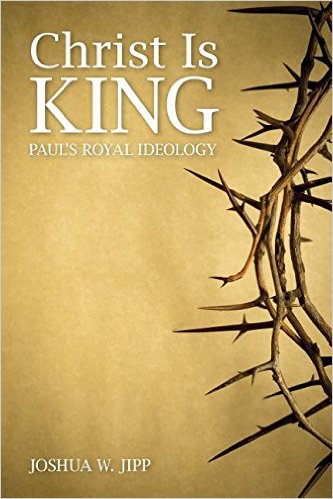 In the last post I engaged Josh’s second chapter in his book Christ Is King: Paul’s Royal Ideology. This is Josh’s response.

Largely In Agreement
Thanks, Joel, for the substantive engagement of my chapter on the law of Christ in Paul! I enjoyed your response – I suppose, in part, because we find ourselves largely to be in agreement with one another, both broadly on the importance of understanding important aspects of Paul’s language within kingship/messianic discourse and, more specifically, with respect to Paul’s depiction of Christ as a royal figure who obeys, instructs, and as the incarnation of Torah (oriented around Lev. 19:18) establishes “the Torah of the Messiah.” I think this helps makes sense, as you note, of the phrase the “the law of Christ” (in Gal. 6:2 and 1 Cor. 9:22) as well as Paul’s argument in Romans 13:8 – 15:13; you’ve presented my argument clearly and accurately so I won’t belabor my argument.
Let me, then, respond to your helpful questions.
Israel’s Scriptures and in Greco-Roman kingship ideology
First, you suggest that further examination of Second Temple traditions would confirm and improve my argument, so why I did not spend more time with these texts in this chapter? I take this as a valid question. As you note, I do spend a lot of space arguing that Israel’s Scriptures present a coherent and unified depiction of the king as one who obeys and embodies God’s Torah (Deut. 17:14-20; Josh. 1:1-9; 2 Kgs. 22-23; Pss. 1-2, 18-19, 118-119). And while I will spend some time on the depiction of the Davidic king in Psalms of Solomon as one who establishes himself in righteousness in my fifth chapter, you are right that I could have fruitfully brought this text (and others!) into play here as well. The same goes for the rabbis. I only wish I would have had access to Christine E. Hayes’ What’s Divine about Divine Law? (Princeton, 2105) when writing this chapter a few years back (see especially her Part III, “The Rabbinic Construction of Divine Law”).
But this leads you to make an interesting point, Joel. You suggest that while my emphasis on Greek, Hellenistic, and Roman texts is illuminating, deepens the study, and shows how Hellenized Judaism had become, that “a focus on Davidic traditions alone would be all one needs to come up with the same conclusions Josh draws” [I guess I don’t have to give a page number since this is a blog??]. I think this may point to a difference – albeit probably minor – between the two of us. I argue that Paul’s belief that “Jesus of Nazareth is Israel’s Messiah…enables Paul to draw upon and rework both the cultural scripts of the good king as seen in Israel’s Scriptures and in Greco-Roman kingship ideology” (p. 281). In other words, Paul undoubtedly believes Jesus to be Israel’s Messiah and this is a crucial part of my argument (e.g., the use of Christos language, Rom. 1:3-14 and 15:7-13, 2 Tim. 2:8, use of Davidic Psalms, etc.). [I could have always fruitfully explored your helpful work on “Davidic Messiahship in Galatians,” in JSP&L!).
But this means that, for Paul, Christ is the singular king of Jew and Gentile, and thereby, the foundation is set for Paul to engage and contextualize multiple kingship discourses with respect to Christ the King. On the one hand, I don’t think this indicates a radical difference between our views. You’ll see that in every chapter I give detailed attention to the Davidic motifs, scripts, and scriptural language, but I also think Paul adapts and reworks other kingship ideologies [plural] to portray Christ as the good king. I give some methodological justification for this on pages 1-16, so I won’t go into that here.
Paul’s positive relationship to the heritage of Israel and the Torah
Your second question concerns whether my language of Christ completing the Torah (with respect to Gal. 5:14 and 6:2) indicates an inappropriate measure of discontinuity between Christ and Torah in such a way that would eradicate the necessity of Jewish-Christian observance of the specific commandments of Torah. This question is deserving of an essay in itself, and I recently completed a 30-page essay on this in a forthcoming response to a group of Pauline scholars who are largely working within the Paul within Judaism approach with respect to Paul’s interlocutor in Romans 1 – 4 (ed. Matthew Thiessen and Rafael Rodriguez; Fortress, 2016). So let me state my response as simply and as clearly as I can. First, I think, as do most, Paul’s audience in Galatians (and Romans too) is non-Jewish. It seems clear to me that Paul expects Jewish believers to relate to the Torah differently than non-Jewish believers. Second, I agree with you that Paul does not argue that the Torah and its specific commands have been eradicated with the coming of Christ. There is no justification, in my view, for arguing that Paul sees the Torah as optional now for Jewish Christians. This view seems to be exactly what Luke’s Paul rejects in Acts 21 – 28. However, and thirdly, the Torah does not mean what it once did, nor does it carry the same freight, as it did (even for Jewish-Christians) before the coming of the Messiah. Trying to do justice to this aspect of Paul’s language in Galatians is probably what pushes me (and many others) to use language of discontinuity here. In other words, the authority of the Torah (for both Jewish/circumcised and Gentile/non-circumcised) resides now, not primarily in Torah, but in Christ. Both the Jewish Christian and Gentile Christian now fulfill the Torah in the same way – by virtue of their participation in Israel’s Messiah (Gal. 2:20; 5:6) they reenact “the same pattern of Christ’s fulfillment of Torah in his self-giving love for others” (p. 67). So, has “the Torah’s theo-culture for Israel…expired” in such a way that it is now made “obsolete and abrogated”? No, it has not. But does it retain the authority and significance that it once did? No, it does not. I think something similar is going on in Matthew’s Gospel with respect to Jesus’ relationship to Torah and “the better righteousness” (especially in Matt. 5-7 and 11:25 – 12:1-14), but that would really take us far afield.
I think my interpretation of Paul on this point – and showing that the phrase “the law of Christ” is not haphazard or ironic! – may have some potential to further show Paul’s positive relationship to the heritage of Israel and the Torah (as opposed to some views which can barely tolerate statements regarding the goodness and validity of Torah and circumcision (Rom. 3:1, 31; 7:7, 12; 9:3-5).
Thanks again, Joel. It’s always a pleasure to find one’s views clearly and accurately represented. And I’m enjoying the opportunity to re-think, clarify, and respond to implications of my argument.
Previous Post

December 7, 2015
Alternative Church Histories
Next Post
December 8, 2015 Book Notice: David Garland on A Theology of Mark's Gospel
Browse Our Archives
Select a Category Bible Lands Blogosphere Book Review Calvinism Colleges & Universities Ecclesiology Emerging Adulthood Evangelicalism Foreign Affairs Gospel of John Greco-Roman World Humor Just War N. T. Wright Old Testament Resurrection Terrorism Theological Education Travel Uncategorized Writing
Select a Month September 2021 July 2021 June 2021 May 2021 April 2021 March 2021 February 2021 January 2021 December 2020 November 2020 October 2020 September 2020 August 2020 July 2020 June 2020 May 2020 April 2020 March 2020 February 2020 January 2020 December 2019 November 2019 October 2019 September 2019 August 2019 July 2019 June 2019 May 2019 April 2019 March 2019 February 2019 January 2019 December 2018 November 2018 October 2018 September 2018 August 2018 July 2018 June 2018 May 2018 April 2018 March 2018 February 2018 January 2018 December 2017 November 2017 October 2017 September 2017 August 2017 July 2017 June 2017 May 2017 April 2017 March 2017 February 2017 January 2017 December 2016 November 2016 October 2016 September 2016 August 2016 July 2016 June 2016 May 2016 April 2016 March 2016 February 2016 January 2016 December 2015 November 2015 October 2015 September 2015 August 2015 July 2015 June 2015 May 2015 April 2015 March 2015 February 2015 January 2015 December 2014 November 2014 October 2014 September 2014 August 2014 July 2014 June 2014 May 2014 April 2014 March 2014 February 2014 January 2014 December 2013 November 2013 October 2013 September 2013 August 2013 July 2013 June 2013 May 2013 April 2013 March 2013 February 2013 January 2013 December 2012 November 2012 October 2012 September 2012 August 2012 July 2012 June 2012 May 2012 April 2012 March 2012 February 2012 January 2012 December 2011 November 2011 October 2011 September 2011 August 2011 July 2011 June 2011 May 2011 January 2011
TAKE THE
Religious Wisdom Quiz
Where was Jesus' first miracle performed?
Select your answer to see how you score.
Nazareth Cana Capernaum Jerusalem
Books by This Author Books by Mike Bird
Related posts from Euangelion

Rom 3:21-26 - Translates, Paraphrase, Notes

Studying the New Testament through Inscriptions


Romans 13:1-7 - Translates, Paraphrase, and Notes
TRENDING AT PATHEOS Evangelical

The REST of Your Life: A Creative Wrestles...
This week I had a conversation with a good friend from church....

How the author of the world's best hymn...
I've been working with John Newton for a while now. This makes...

Long before this Lectio Divina, Psalm 130 - the song - started...

What About the Trees? Another Living Parable
After I finished writing the last article about falling leaves as a...

Why Classical Education Is a Conversation, Not a...
Come and Read: Joy in Classical Education When I was a little...

Cornell University has received a great deal of negative publicity and intense...
view all Evangelical blogs
Ad-Free & Subscriber Log-In Subscription Support
- About Us
- 2026 Calendar
- Videos
- Podcasts
- Library of World Religions
- Faith In Media Tracker
- Advertise With Us
- Write for Us
- Privacy Policy
- Terms of Service
- Do Not Sell My Data
- Contact Us
- Radiant Digital
- Manage Newsletter Subscriptions
- Unsubscribe From Notifications
- Sitemap
Copyright 2008-2026, Patheos. All rights reserved.
Subscription Support Ad-Free & Subscriber Log-In
Follow Patheos