
BuddhistCatholicContemplativeEvangelicalGeneral ChristianHinduJewishLatter-day SaintMuslimNew VisionsProgressive Christian
Beliefs
- Buddhist
- Catholic
- Contemplative
- Evangelical
- General Christian
- Hindu
- Jewish
- Latter-day Saint
- More Voices
- Muslim
- New Visions
- Pagan
- Progressive Christian
Topics
- Religion News
- Food and Religion
- Sports and Religion
- Religious Art
- Religious Music and Entertainment
- Religious Events
- History and Religion
- Style and Religion
- Politics and Religion
- Women in Religion
- Recreation Outdoors and Religion
- Business Finance and Religion
- Careers Workplace and Religion
- Education and Religion
- Family Parenting and Religion
- Health Fitness and Religion
- Home and Religion
- Relationships and Religion
- Technology and Religion
- Travel and Religion
Columnists
- Buddhist Columnists
- Business Finance and Religion Columnists
- Careers Workplace and Religion Columnists
- Catholic Columnists
- Contemplative Columnists
- Education and Religion Columnists
- Evangelists Columnists
- Family Parenting and Religion Columnists
- General Christian Columnists
- Health Fitness and Religion Columnists
- Hindu Columnists
- History and Religion Columnists
- Home and Religion Columnists
- Jewish Columnists
- More Voices Columnists
- Latter Day Columnists
- Muslim Columnists
- New Visions Columnists
- Nonreligious Columnists
- Pagan Columnists
- Politics and Religion Columnists
- Progressive Columnists
- Recreation Outdoors and Religion Columnists
- Relationships and Religion Columnists
- Religion News Columnists
- Religious Art Columnists
- Religious Events Columnists
- Religious Music and Entertainment Columnists
- Sports and Religion Columnists
- Style and Religion Columnists
- Technology and Religion Columnists
- Travel and Religion Columnists
- Women in Religion Columnists
Resource Library
- 2026 Calendar
- Library of World Religions
- The 100 Most Holy Places on Earth
- Patheos Answers
- Podcasts
- Videos
- Faith Leaders Database
- Anglican Episcopalian
- Bahai
- Baptist
- Buddhism
- Christianity
- Confucianism
- Eastern Orthodoxy
- Hinduism
- Holiness and Pentecostal
- ISKCON
- Islam
- Judaism
- Lutheran
- Methodist
- The Church of Jesus Christ of Latter-day Saints
- New Age
- Paganism
- Presbytarian and Reformed
- Protestantism
- Religion Behind the Scenes
- Roman Catholic
- Scientology
- Shia Islam
- Sikhism
- Sufism
- Sunni Islam
- Taoism
- Zen
- See all religions
Research Tools
 Ad-Free & Subscriber Log-In Subscription Support
Ad-Free & Subscriber Log-In Subscription Support
Follow Patheos 

- Trending:
- Forgiveness
- |
- Marriage
- |
- Consciousness
- |
- Death Penalty
- |
- Election
- |
- Halloween
 Euangelion
- Home
- Evangelical
- DJG Edition Comparison: Gospel of Matthew
DJG Edition Comparison: Gospel of Matthew
Last updated on: January 5, 2014 at 9:47 am by Joel Willitts
DJG Edition Comparison: Gospel of Matthew 2014-01-05T09:47:46-04:00 Joel Willitts
Patheos Explore the world's faith through different perspectives on religion and spirituality! Patheos has the views of the prevalent religions and spiritualities of the world.
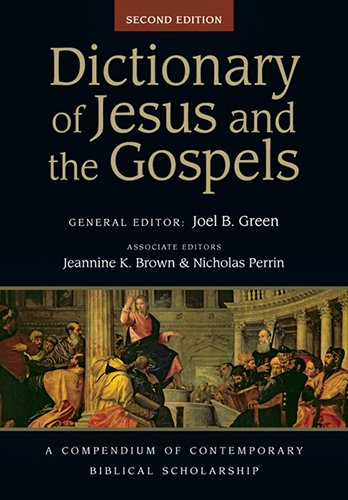 Awhile ago I introduced the brand new second edition of the Dictionary of Jesus and the Gospels (IVP Bible Dictionary)
What is most evident when comparing these two articles is that one was written by at Redaction Critic (at the time!) and the other by a Narrative Critic. These distinct approaches clearly affect the way each talks about Matthew and where specific emphasis is placed in the introduction. This alone observation reveals the need for this new edition of the DJG: Gospel scholarship has moved on quite far from the methods of the late 1980’s and early 1990’s when Scot wrote his article. This is not to say that the information in Scot’s essay is not useful or is outdated. It, in fact, is a foundation for Jeannine’s article. There is clearly a progressive relationship between the two.
Scot’s Article (1st Ed)
Scot’s essay is strong on the tradition criticism and highly influenced by it. This is seen in his careful and lengthy discussions of origin of the Matthew as well as his interest in source and redaction criticism. It is not to say that Jeannine doesn’t discuss historical questions, but the manner of her discussion of these is quite different. Scot’s piece is a clear reflection of its time. Knowing Scot as well as I do, we’ve talked about his early work on Matthew. His SBL paper on Matt 10:23 is an example par excellence of source and redaction criticism – it is an amazing example of just how far evangelical gospel scholarship had come by the late 1980’s since Ladd’s attempt to “sit at the table”. Scot possessed outstanding ability to apply the methods of gospel criticism with evangelical conviction. His gospel scholarship is some of the best there was. He is of that generation of North American gospel scholars like Hagner, Blomberg, Green and Bock. Although unlike them, Scot became bored with Gospel scholarship and began pursing Historical Jesus research in the 1990s (along with a lot of others!) when historical concerns gave way to literary ones among gospel critics. Each in my list has written important commentaries on the Gospels, but not Scot. Scot tells me he was contracted to write a “big” Matthew commentary and started it even, but gave the contract back eventually. When reading both Scot’s dissertation (unpublished) on the Mission Discourse (written by the way under Jimmy Dunn) and that SBL paper you feel just how dated the methodology now is. I’m told there is something of a resurgence of interest in source criticism (Watson’s new book Gospel Writing: A Canonical Perspective

Jeannine’s Article (2nd Ed)
Jeannine’s article on the other hand as a much greater literary sensitivity. She has a strong emphasis on the narrative-critical side with lengthy discussion of the plot. She begins her article with an overview of Matthew’s literary features and his plot. Even when McKnight discusses the plot is it described to in less literary ways. This is seen even when handling the historical questions. For example on the question of authorship, Scot works carefully through the Papias quotation offering the three primary approaches and evaluating them. Jeannine deals with the Papias quotation too, but with less detail and analysis. And both deal with the typical issues of the supposed use of Mark by Matthew on the apostolic authorship. Scot is more definitive in his conclusion, though cautiously so. Jeannine leans toward a traditional authorship given her placement of Hagner’s opinion. However, for her it matters little. What she is concerned about more is the “implied author” drawn from the artifact of the text itself and not the “empirical author” of speculation behind the text. This opinion was likely not at hand for McKnight in the late 80’s. “Implied”, “ideal” or “model” authors and readers were not a consideration of gospel’s scholarship at that time. These are the gifts of narrative criticism which only began to gain currency in the mid-1990’s.
Some Distinctives.
On Matthew’s Structure, Scot is more comprehensive in his description of the proposals. Jeannine provides primarily a description of the two most widely used models today based on preference for either one of two formulas: “And it happened that when Jesus had finished [these teachings]” which expresses an alternating narrative/discourse structure or the formula “From that time on Jesus began . . .” which gives a three-part structure. Jeannine attempts to synthesize the two while favoring the three-part structure, while Scot favors an organizational structure around the five alternating narrative-discourse units. Both set aside a structure that focuses on the geographical settings of Matthew, moving as it does clearly from Galilee to Judea and Jerusalem. I however think this may be the most straightforward and potentially effective way to follow Matthew’s biographical plot.
On Matthew’s theology both emphasize the topics of Jesus, Kingdom and Discipleship. But they discuss each in a unique manner. For example in the discussion of Jesus, Scot deals with the topics of (1) Jesus as Messiah, as (2) teacher and preacher and as (3) inaugurator of the Kingdom. Jeannine, in contrast, discusses Jesus more specifically as (1) “the Davidic Messiah” (which blesses my soul!!), as (2) Torah fulfilled and Wisdom embodied, as (3) representative of Israel and as (4) the embodiment of Yahweh.
Additionally, Jeannine draws insights from socio-rhetorical and empire criticism that provide an important context for Matthew within the Greco-Roman world of the late first century. Methods that had yet to be employed when Scot wrote his article. So the emphasis on the affect of Hellenism, Roman imperial power and the honor-shame currency of the first century Mediterranean world is helpful information for an introduction to Matthew.
Scot, in contrast to Jeannine, offers a lengthy discussion of the concept of salvation history in Matthew, a subject important at the time in Matthean scholarship. After sketching various proposals, Scot offers his own six-phase schema. I think that these kinds of discussions often work at such a high level of abstraction that they are more ciphers for the interpreter’s own theological presuppositions. Matthew obviously has a perspective on time; and one can query, “what time is it” for Matthew? This continues to be a concern for scholars as evidenced by the recent SBL session co-sponsored by the Matthew section and the Pauline Soteriology seminar where Matthew and Paul’s view of time were compared.
Conclusion. The comparison then reveals that while the second edition is an improvement on the first, both are indispensable as introductions to the First Gospel. But Jeannine’s is an advance on Scot’s. And if you only had one introductory article, better off you’d be with hers over his.
Previous Post

January 5, 2014
The Perfect Introduction to the Perfect Tense Debate
Next Post
January 5, 2014 The New Calvinists in the NYT
Browse Our Archives
Select a Category Bible Lands Blogosphere Book Review Calvinism Colleges & Universities Ecclesiology Emerging Adulthood Evangelicalism Foreign Affairs Gospel of John Greco-Roman World Humor Just War N. T. Wright Old Testament Resurrection Terrorism Theological Education Travel Uncategorized Writing
Select a Month September 2021 July 2021 June 2021 May 2021 April 2021 March 2021 February 2021 January 2021 December 2020 November 2020 October 2020 September 2020 August 2020 July 2020 June 2020 May 2020 April 2020 March 2020 February 2020 January 2020 December 2019 November 2019 October 2019 September 2019 August 2019 July 2019 June 2019 May 2019 April 2019 March 2019 February 2019 January 2019 December 2018 November 2018 October 2018 September 2018 August 2018 July 2018 June 2018 May 2018 April 2018 March 2018 February 2018 January 2018 December 2017 November 2017 October 2017 September 2017 August 2017 July 2017 June 2017 May 2017 April 2017 March 2017 February 2017 January 2017 December 2016 November 2016 October 2016 September 2016 August 2016 July 2016 June 2016 May 2016 April 2016 March 2016 February 2016 January 2016 December 2015 November 2015 October 2015 September 2015 August 2015 July 2015 June 2015 May 2015 April 2015 March 2015 February 2015 January 2015 December 2014 November 2014 October 2014 September 2014 August 2014 July 2014 June 2014 May 2014 April 2014 March 2014 February 2014 January 2014 December 2013 November 2013 October 2013 September 2013 August 2013 July 2013 June 2013 May 2013 April 2013 March 2013 February 2013 January 2013 December 2012 November 2012 October 2012 September 2012 August 2012 July 2012 June 2012 May 2012 April 2012 March 2012 February 2012 January 2012 December 2011 November 2011 October 2011 September 2011 August 2011 July 2011 June 2011 May 2011 January 2011
TAKE THE
Religious Wisdom Quiz
Which prophet said, "I desire mercy, not sacrifice"?
Select your answer to see how you score.
Joel Amos Daniel Hosea
Books by This Author Books by Mike Bird
Related posts from Euangelion

Rom 3:21-26 - Translates, Paraphrase, Notes

Studying the New Testament through Inscriptions


Romans 13:1-7 - Translates, Paraphrase, and Notes
TRENDING AT PATHEOS Evangelical

The REST of Your Life: A Creative Wrestles...
This week I had a conversation with a good friend from church....

How the author of the world's best hymn...
I've been working with John Newton for a while now. This makes...

Long before this Lectio Divina, Psalm 130 - the song - started...

What About the Trees? Another Living Parable
After I finished writing the last article about falling leaves as a...

Why Classical Education Is a Conversation, Not a...
Come and Read: Joy in Classical Education When I was a little...

Cornell University has received a great deal of negative publicity and intense...
view all Evangelical blogs
Ad-Free & Subscriber Log-In Subscription Support
- About Us
- 2026 Calendar
- Videos
- Podcasts
- Library of World Religions
- Faith In Media Tracker
- Advertise With Us
- Write for Us
- Privacy Policy
- Terms of Service
- Do Not Sell My Data
- Contact Us
- Radiant Digital
- Manage Newsletter Subscriptions
- Unsubscribe From Notifications
- Sitemap
Copyright 2008-2026, Patheos. All rights reserved.
Subscription Support Ad-Free & Subscriber Log-In
Follow Patheos