
BuddhistCatholicContemplativeEvangelicalGeneral ChristianHinduJewishLatter-day SaintMuslimNew VisionsProgressive Christian
Beliefs
- Buddhist
- Catholic
- Contemplative
- Evangelical
- General Christian
- Hindu
- Jewish
- Latter-day Saint
- More Voices
- Muslim
- New Visions
- Pagan
- Progressive Christian
Topics
- Religion News
- Food and Religion
- Sports and Religion
- Religious Art
- Religious Music and Entertainment
- Religious Events
- History and Religion
- Style and Religion
- Politics and Religion
- Women in Religion
- Recreation Outdoors and Religion
- Business Finance and Religion
- Careers Workplace and Religion
- Education and Religion
- Family Parenting and Religion
- Health Fitness and Religion
- Home and Religion
- Relationships and Religion
- Technology and Religion
- Travel and Religion
Columnists
- Buddhist Columnists
- Business Finance and Religion Columnists
- Careers Workplace and Religion Columnists
- Catholic Columnists
- Contemplative Columnists
- Education and Religion Columnists
- Evangelists Columnists
- Family Parenting and Religion Columnists
- General Christian Columnists
- Health Fitness and Religion Columnists
- Hindu Columnists
- History and Religion Columnists
- Home and Religion Columnists
- Jewish Columnists
- More Voices Columnists
- Latter Day Columnists
- Muslim Columnists
- New Visions Columnists
- Nonreligious Columnists
- Pagan Columnists
- Politics and Religion Columnists
- Progressive Columnists
- Recreation Outdoors and Religion Columnists
- Relationships and Religion Columnists
- Religion News Columnists
- Religious Art Columnists
- Religious Events Columnists
- Religious Music and Entertainment Columnists
- Sports and Religion Columnists
- Style and Religion Columnists
- Technology and Religion Columnists
- Travel and Religion Columnists
- Women in Religion Columnists
Resource Library
- 2026 Calendar
- Library of World Religions
- The 100 Most Holy Places on Earth
- Patheos Answers
- Podcasts
- Videos
- Faith Leaders Database
- Anglican Episcopalian
- Bahai
- Baptist
- Buddhism
- Christianity
- Confucianism
- Eastern Orthodoxy
- Hinduism
- Holiness and Pentecostal
- ISKCON
- Islam
- Judaism
- Lutheran
- Methodist
- The Church of Jesus Christ of Latter-day Saints
- New Age
- Paganism
- Presbytarian and Reformed
- Protestantism
- Religion Behind the Scenes
- Roman Catholic
- Scientology
- Shia Islam
- Sikhism
- Sufism
- Sunni Islam
- Taoism
- Zen
- See all religions
Research Tools
 Ad-Free & Subscriber Log-In Subscription Support
Ad-Free & Subscriber Log-In Subscription Support
Follow Patheos 

- Trending:
- Forgiveness
- |
- Marriage
- |
- Consciousness
- |
- Death Penalty
- |
- Election
- |
- Halloween

- Home
- General Christian
- Truth-Rooted Ecumenical Dialogue
Truth-Rooted Ecumenical Dialogue
Last updated on: June 17, 2026 at 5:12 pm by Jordan Bennett
Truth-Rooted Ecumenical Dialogue 2026-06-17T17:12:01-04:00 Jordan Bennett
Patheos Explore the world's faith through different perspectives on religion and spirituality! Patheos has the views of the prevalent religions and spiritualities of the world.
In his encyclical, Ut Unum Sint, Pope John Paul II writes that the unity to which God calls His Church:
“can be attained only by the adherence of all to the content of revealed faith in its entirety. In matters of faith, compromise is in contradiction with God who is Truth. In the Body of Christ, “the way, and the truth, and the life (Jn 14:16), who could consider legitimate a reconciliation brought about at the expense of truth?”
While I am not Catholic, I am convinced that John Paul II expresses here a proper posture toward Christian unity. If unity among Christians is to be genuine and perfect, it must be established in truth. In the same way, the path toward a perfected oneness cannot be traveled unless Christ’s followers also strive to grasp the truth that God has revealed. 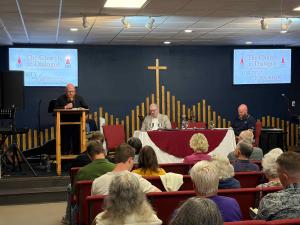
In fact, the latter necessarily precedes the former; it would not be possible for believers to attain a compromise free communion that did not resolve contradictions in faith and practice beforehand. Thus, if the furtherance of authentic unity among Christians is truly the goal of any given ecumenical exercise, it follows that such an endeavor could succeed only if it made truth a priority.
A Commitment to Hard Questions
So what does it mean to be committed to truth-rooted ecumenical dialogue? For one, I believe it means that individuals who facilitate dialogue among Christians must be willing to propose those theological subjects that have been historically divisive; hard questions need to be asked with the expectation that hard answers will be given. How else will agreement ever be reached among estranged Christian brethren if disagreements are not first expressed, and expressed faithfully?
To draw back from tough topics is to dialogue for dialogue’s sake, and not for the sake of Christian unity. Indeed, genuine unity among the faithful will not advance so long as easy conversations are valued over those that are honest, albeit uncomfortable. For this reason, let Southern Baptists and Roman Catholics, for example, dialogue over questions that concern: assurance of salvation, baptismal regeneration, structures of ecclesial authority, etc. These are the kinds of discussions that must be had if authentic unity among Christians is to be accomplished.
To Commend Truth When It Is Heard
Furthermore, to prioritize truth in ecumenical dialogue is to be forthright about agreement when it is found. Dialogue that is responsible cannot be incessantly polemical. Those who enter into ecumenical exchanges must be willing to acknowledge correct doctrines—regardless of their source—if those exchanges are to be effective. That is, they must commend truth when they hear it. When agreement is suppressed, on the other hand, ecumenical advances lose their forward momentum, and confusion is likely sown within the Body.
I am thinking here of those instances in which entire theological systems are written off on account of perceived soteriological disagreements. Accusations that certain Christians believe in a ‘different gospel’ or worship a ‘different Jesus’ merely because they disagree with another tradition’s understanding of free will could lead the regular churchman who agrees with such accusations to develop heretical views in other areas.
“Surely a Wesleyan cannot be right about theology proper if they actually believe that one can resist God’s grace,” some might say. “We must rethink what we share with this tradition in light of the ‘authentic gospel.’” This kind of problem runs counter to the objective of Christian unity all by itself. If Christians drift farther from truth due to their overreacting against existing disagreements, they are widening the gap of division and likely creating entirely new disputes.
A Disposition Toward Agreement
Recognizing theological truths regardless of their source is essential for an ecumenical dialogue that is oriented around truth. Yet, alongside this principle, truth-rooted dialogue must also be characterized by a disposition toward agreement. As one might expect—and as was discussed earlier—I do not mean by this that dialogists should remain open to compromise in matters of faith if it serves the cause of Christian unity.
Those who represent different communions of Christ-followers in ecumenical dialogue, like those who facilitate and shape dialogue, must never gloss over theological disparities if they are truly seeking unity in truth. What I am suggesting by a “disposition toward agreement” is rather that any given ecumenical exchange should be honest about its aims.
If ecumenism’s goal is to heal Christian division, then, simply put, healing division must be the focus of ecumenical dialogue. Those believers who engage in discussions with Christians of other traditions shouldn’t just agree with their dialogue partners when it is absolutely obvious, nor should they recognize what is of value in the other’s tradition only when it is convenient to do so. Rather, they should be eager to probe further to explore what hidden theological agreements lie beyond current discovery.
The opposite of this would obviously be a dialogue disposed toward disagreement. And I see this often today in the form of many unhelpful debates that betray an unconcern for Christian unity. These debates are instead focused on bolstering the walls of divided Christian camps and reaffirming the identities of those who find themselves seated at the discussion table, as well as the onlookers who cheer from and for one side or another.
If a dialogist is more inclined to locate new disagreements than agreements, the spirit of truth-seeking ecumenism is replaced with the attitude of a warrior who prioritizes victory over unity. Personally, I don’t believe that the way forward consists of conversions to this or that church. The path toward greater unity is, alternatively, the fraternal journey of divided Christians together toward Him who is truth, the Lord Jesus Christ.
Having Christ as the Center
Truly, the center of all truth-rooted ecumenical dialogue is the Chief Cornerstone. It is on Him that the life of the Christian is built; thus, he is the foundation upon which we must begin and end our work of Christian unity. If we desire to conduct our ecumenical efforts rightly, it is essential that we prioritize growth in holiness. The more Christ-like that Christians become, the more they will love their brothers and sisters just as Jesus has loved them. When the image of Christ is cultivated in believers by God’s grace, holding steadfast to the truth will become a greater priority; Christians will seek not their own will, but the will of their Father who is in heaven.
On account of these effects, it is no great revelation to assert that ecumenical dialogues are transformed when their participants pursue personal holiness and strive after Him who is perfectly holy. Discussion partners become more charitable and more likely to attend to truth when it takes hold of them. Yet, they remain uncompromising in matters of revealed faith.
The Work of the Holy Spirit
Over the last few paragraphs, I have detailed several principles that I am convinced characterize truth-rooted ecumenical dialogue. And while it may seem difficult for believers to hold to all of these principles faithfully, and at all times, we can find comfort in knowing we are not alone in our efforts; we have been sent a helper. The same person by whom the Lord Jesus Christ was miraculously conceived also bears witness about Him. The Spirit of Truth will guide us, followers of Jesus, into all truth if we remain open to the work that He conducts in our midst.
This Spirit, who was received by the Apostles with a great spectacle of fire in the form of flaming tongues, is Himself the great refiner’s fire of Christian unity. Because truth cannot help but be aired among the faithful when those of different traditions dialogue with one another, the Spirit of God will use these instances to uplift truth and convict those who are lacking in it.
He will illuminate the riches of each communion and arouse divided Christians to recognize these treasures. Above all, when believers are gathered together, the Spirit will shine His light on the one who suffered for our salvation, was raised on the third day, and now sits at the right hand of God the Father Almighty. To Him be the glory forever.
Previous Post

January 26, 2026
Christ in the Second Psalm
Recent Comments
Browse Our Archives
Select a Category Baháʼí Biblical Interpretation Christianity Church Fathers Comparative Religion Eastern Orthodox Ecclesiology Ecumenism Hues of Moshe Judaism LDS Mormonism Protestant Rastafarianism Santo Daime Uncategorized
Select a Month June 2026 January 2026 June 2025 January 2025 October 2024 July 2024 May 2024 January 2024 November 2023 October 2023 August 2023 July 2023 June 2023 February 2023 December 2022 November 2022 October 2022 September 2022 August 2022 July 2022 June 2022 May 2022
Follow Us!
TAKE THE
Religious Wisdom Quiz
What Christian holiday celebrates Jesus' resurrection?
Select your answer to see how you score.
Easter Pentecost Good Friday Christmas
Related posts from Essence of the Altar
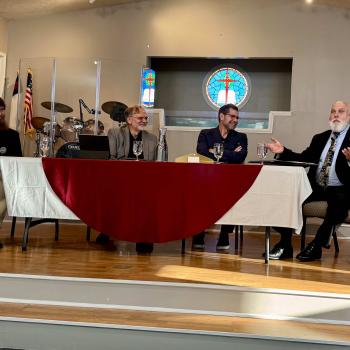
Why Ecumenical Dialogue Should Be Done in Person

The Church and Noah's Ark Pt. 2

Carried Across the Lake of Fire: The Church...

The Significance of Baptists in Dialogue
TRENDING AT PATHEOS General Christian

Seventy and Five Years Old: God Still Starts...
There is a small detail tucked into Genesis 12 that I skipped...

A Biblical Vision of Success in Christian Life...
The Concern and Quest Recent trends and tendencies I note around me...

Indigenous Peoples’ Day and the Church
Indigenous' Peoples Day or Columbus Day? Depending on where you live...

When Spiritual Growth Looks Like Losing Ground
Four Passive Spiritual Disciplines: An Introduction When I was a college freshman,...

Faith and Finding Your Current Season
“To everything there is a season,” Ecclesiastes tells us, “and a time...

Did Jesus Fear God's Wrath in Gethsemane?
That Time Jesus Was Terrified Before we begin, let me say at...
view all General Christian blogs
What Are Your Thoughts?leave a comment
Ad-Free & Subscriber Log-In Subscription Support
- About Us
- 2026 Calendar
- Videos
- Podcasts
- Library of World Religions
- Faith In Media Tracker
- Advertise With Us
- Write for Us
- Privacy Policy
- Terms of Service
- Do Not Sell My Data
- Contact Us
- Radiant Digital
- Manage Newsletter Subscriptions
- Unsubscribe From Notifications
- Sitemap
Copyright 2008-2026, Patheos. All rights reserved.
Subscription Support Ad-Free & Subscriber Log-In
Follow Patheos