
BuddhistCatholicContemplativeEvangelicalGeneral ChristianHinduJewishLatter-day SaintMuslimNew VisionsProgressive Christian
Beliefs
- Buddhist
- Catholic
- Contemplative
- Evangelical
- General Christian
- Hindu
- Jewish
- Latter-day Saint
- More Voices
- Muslim
- New Visions
- Pagan
- Progressive Christian
Topics
- Religion News
- Food and Religion
- Sports and Religion
- Religious Art
- Religious Music and Entertainment
- Religious Events
- History and Religion
- Style and Religion
- Politics and Religion
- Women in Religion
- Recreation Outdoors and Religion
- Business Finance and Religion
- Careers Workplace and Religion
- Education and Religion
- Family Parenting and Religion
- Health Fitness and Religion
- Home and Religion
- Relationships and Religion
- Technology and Religion
- Travel and Religion
Columnists
- Buddhist Columnists
- Business Finance and Religion Columnists
- Careers Workplace and Religion Columnists
- Catholic Columnists
- Contemplative Columnists
- Education and Religion Columnists
- Evangelists Columnists
- Family Parenting and Religion Columnists
- General Christian Columnists
- Health Fitness and Religion Columnists
- Hindu Columnists
- History and Religion Columnists
- Home and Religion Columnists
- Jewish Columnists
- More Voices Columnists
- Latter Day Columnists
- Muslim Columnists
- New Visions Columnists
- Nonreligious Columnists
- Pagan Columnists
- Politics and Religion Columnists
- Progressive Columnists
- Recreation Outdoors and Religion Columnists
- Relationships and Religion Columnists
- Religion News Columnists
- Religious Art Columnists
- Religious Events Columnists
- Religious Music and Entertainment Columnists
- Sports and Religion Columnists
- Style and Religion Columnists
- Technology and Religion Columnists
- Travel and Religion Columnists
- Women in Religion Columnists
Resource Library
- 2026 Calendar
- Library of World Religions
- The 100 Most Holy Places on Earth
- Patheos Answers
- Podcasts
- Videos
- Faith Leaders Database
- Anglican Episcopalian
- Bahai
- Baptist
- Buddhism
- Christianity
- Confucianism
- Eastern Orthodoxy
- Hinduism
- Holiness and Pentecostal
- ISKCON
- Islam
- Judaism
- Lutheran
- Methodist
- The Church of Jesus Christ of Latter-day Saints
- New Age
- Paganism
- Presbytarian and Reformed
- Protestantism
- Religion Behind the Scenes
- Roman Catholic
- Scientology
- Shia Islam
- Sikhism
- Sufism
- Sunni Islam
- Taoism
- Zen
- See all religions
Research Tools
 Ad-Free & Subscriber Log-In Subscription Support
Ad-Free & Subscriber Log-In Subscription Support
Follow Patheos 

- Trending:
- Forgiveness
- |
- Marriage
- |
- Consciousness
- |
- Death Penalty
- |
- Election
- |
- Halloween

- Home
- General Christian
- The Significance of Baptists in Dialogue
The Significance of Baptists in Dialogue
Last updated on: May 16, 2024 at 8:42 pm by Jordan Bennett
The Significance of Baptists in Dialogue 2024-05-16T20:42:11-04:00 Jordan Bennett
Patheos Explore the world's faith through different perspectives on religion and spirituality! Patheos has the views of the prevalent religions and spiritualities of the world.
Is it possible for someone to facilitate ecumenical dialogue without involving the participation of more than one Christian tradition? Such a thought certainly seems contrary to the pursuits of Christian unity, doesn’t it? I think in one sense it is, but taken in another, perhaps this variety of dialogue could actually contribute to the aims of the greater ecumenical project.

PC | Jordan Bennett
Unilateral Dialogue
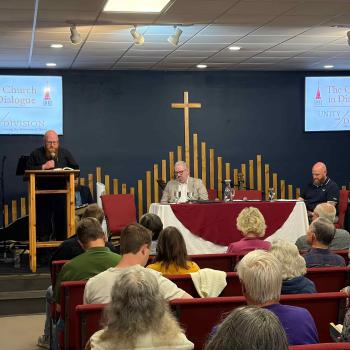
In December of 2022, I ran with this concept, and organized a panel discussion event called, “Baptists in Dialogue.” In the words that follow, I will briefly describe this endeavor, lay out why it was important, and divulge the reason for which it successfully contributed to the goal of a Church visibly united—at least on a local level.
To put it succinctly, Baptists in Dialogue (BID) was a live panel discussion that incorporated elements of worship and included different orthodox Baptists, all of whom hold to the authority of Scripture and adhere to the fundamental tenets of the historic Christian faith. In this way, the event shared much with its interdenominational parent project, “The Church in Dialogue (TCID).” The only substantial difference that separated them was the tradition pool from which its speakers were drawn.
TCID (see more info here) is an ongoing interdenominational event series that includes nearly every orthodox Christian tradition, while Baptists in Dialogue incorporated only Baptists. This solitary distinction didn’t change much, but it did modify the goals of The Church in Dialogue to some extent. Let’s take a brief look at the aspirations of this Baptists-only ecumenical project.
The Aims of “Baptists in Dialogue”
Like TCID, Baptists in Dialogue (BID) sought to teach. It was a project that pursued classification as a theology course of sorts and included studied speakers from different churches and seminaries who prepared presentations in accordance with their theological convictions. One of the overarching goals of the event (and others within TCID series) was for attendants to leave with at least some new knowledge concerning the topics that were discussed; through either the panel discussion, the layout of the questions, or the concluding time of fellowship, we wanted the event to contribute to the theological education of all those who were present.
Indeed, BID was an opportunity for Christians to discover more about certain aspects of Christian belief that are heard less often during standard church services—but we didn’t intend for the learning to stop there. BID also aimed to be a vehicle by which believers could attain a greater awareness of, and appreciation for, the convictions of those Baptists who are near to them.
What this particular gathering showed was that even within the same congregation you might find Christians who hold to a variety of beliefs concerning certain theological topics, and that is assuredly permissible. With respect to some subjects—such as eschatology—you can be a legitimate Baptist, and have an opinion that differs from your brothers and sisters who are also Baptists.
Caveats aside, as long as one clings wholly to Christian orthodoxy, while additionally working within the bounds of his/her church’s creedal formulas, obtaining an opinion which is divergent from the convictions of one’s fellow congregants is absolutely no reason to severe communion. One of the reasons BID existed was to help people learn more about their differences despite their similarities with the major hope of deepening their relationships with others. This event, like TCID, was an exercise in Christian unity.
Pursuing Greater Unity
Baptists in Dialogue also sought to make a contribution to the larger project of conservative Christian ecumenism. While it certainly wasn’t a typical ecumenical endeavor, it nevertheless made an effort toward the goals of ecumenism; BID attempted to bring separated brethren together by means of what it revealed. Unlike TCID, Baptists in Dialogue did not include panelists from a host of different denominations. It did, however, include speakers from the same tradition who hold diverse convictions.
What resulted was an immense opportunity for reflecting on what separates us Bible-believing brethren. If several panelists can uphold opposing beliefs regarding some topics, and still potentially be members of the same church body, how might this inform our relationship with other orthodox Christian denominations? Now I’m not suggesting that we immediately dissolve the boundaries that separate us from Lutherans just because Baptists can have conflicting eschatological views.
Instead, I am simply recommending to the reader that the event that I’m describing was an opportunity for attendants to think critically about what divides us Christians today. Clearly not all subjects merit separation; perhaps there are more theological topics that could be reevaluated so as to heal the visible Church of some of its severed communions.
Previous Post

January 31, 2024
When Man Becomes Beast
Next Post

July 31, 2024 Archetypal Abraham: The Binding of Isaac and Christians
Recent Comments
Browse Our Archives
Select a Category Baháʼí Biblical Interpretation Christianity Church Fathers Comparative Religion Eastern Orthodox Ecclesiology Ecumenism Hues of Moshe Judaism LDS Mormonism Protestant Rastafarianism Santo Daime Uncategorized
Select a Month June 2026 January 2026 June 2025 January 2025 October 2024 July 2024 May 2024 January 2024 November 2023 October 2023 August 2023 July 2023 June 2023 February 2023 December 2022 November 2022 October 2022 September 2022 August 2022 July 2022 June 2022 May 2022
Follow Us!
TAKE THE
Religious Wisdom Quiz
What city did David capture and make his capital?
Select your answer to see how you score.
Gibeon Hebron Bethlehem Jerusalem
Related posts from Essence of the Altar
Truth-Rooted Ecumenical Dialogue

Why Ecumenical Dialogue Should Be Done in Person


Reflections on TCID: Protestant-Orthodox Dialogue
TRENDING AT PATHEOS General Christian

Seventy and Five Years Old: God Still Starts...
There is a small detail tucked into Genesis 12 that I skipped...

A Biblical Vision of Success in Christian Life...
The Concern and Quest Recent trends and tendencies I note around me...

Indigenous Peoples’ Day and the Church
Indigenous' Peoples Day or Columbus Day? Depending on where you live...

When Spiritual Growth Looks Like Losing Ground
Four Passive Spiritual Disciplines: An Introduction When I was a college freshman,...

Faith and Finding Your Current Season
“To everything there is a season,” Ecclesiastes tells us, “and a time...

Did Jesus Fear God's Wrath in Gethsemane?
That Time Jesus Was Terrified Before we begin, let me say at...
view all General Christian blogs
What Are Your Thoughts?leave a comment
Ad-Free & Subscriber Log-In Subscription Support
- About Us
- 2026 Calendar
- Videos
- Podcasts
- Library of World Religions
- Faith In Media Tracker
- Advertise With Us
- Write for Us
- Privacy Policy
- Terms of Service
- Do Not Sell My Data
- Contact Us
- Radiant Digital
- Manage Newsletter Subscriptions
- Unsubscribe From Notifications
- Sitemap
Copyright 2008-2026, Patheos. All rights reserved.
Subscription Support Ad-Free & Subscriber Log-In
Follow Patheos