
BuddhistCatholicContemplativeEvangelicalGeneral ChristianHinduJewishLatter-day SaintMuslimNew VisionsProgressive Christian
Beliefs
- Buddhist
- Catholic
- Contemplative
- Evangelical
- General Christian
- Hindu
- Jewish
- Latter-day Saint
- More Voices
- Muslim
- New Visions
- Pagan
- Progressive Christian
Topics
- Religion News
- Food and Religion
- Sports and Religion
- Religious Art
- Religious Music and Entertainment
- Religious Events
- History and Religion
- Style and Religion
- Politics and Religion
- Women in Religion
- Recreation Outdoors and Religion
- Business Finance and Religion
- Careers Workplace and Religion
- Education and Religion
- Family Parenting and Religion
- Health Fitness and Religion
- Home and Religion
- Relationships and Religion
- Technology and Religion
- Travel and Religion
Columnists
- Buddhist Columnists
- Business Finance and Religion Columnists
- Careers Workplace and Religion Columnists
- Catholic Columnists
- Contemplative Columnists
- Education and Religion Columnists
- Evangelists Columnists
- Family Parenting and Religion Columnists
- General Christian Columnists
- Health Fitness and Religion Columnists
- Hindu Columnists
- History and Religion Columnists
- Home and Religion Columnists
- Jewish Columnists
- More Voices Columnists
- Latter Day Columnists
- Muslim Columnists
- New Visions Columnists
- Nonreligious Columnists
- Pagan Columnists
- Politics and Religion Columnists
- Progressive Columnists
- Recreation Outdoors and Religion Columnists
- Relationships and Religion Columnists
- Religion News Columnists
- Religious Art Columnists
- Religious Events Columnists
- Religious Music and Entertainment Columnists
- Sports and Religion Columnists
- Style and Religion Columnists
- Technology and Religion Columnists
- Travel and Religion Columnists
- Women in Religion Columnists
Resource Library
- 2026 Calendar
- Library of World Religions
- The 100 Most Holy Places on Earth
- Patheos Answers
- Podcasts
- Videos
- Faith Leaders Database
- Anglican Episcopalian
- Bahai
- Baptist
- Buddhism
- Christianity
- Confucianism
- Eastern Orthodoxy
- Hinduism
- Holiness and Pentecostal
- ISKCON
- Islam
- Judaism
- Lutheran
- Methodist
- The Church of Jesus Christ of Latter-day Saints
- New Age
- Paganism
- Presbytarian and Reformed
- Protestantism
- Religion Behind the Scenes
- Roman Catholic
- Scientology
- Shia Islam
- Sikhism
- Sufism
- Sunni Islam
- Taoism
- Zen
- See all religions
Research Tools
 Ad-Free & Subscriber Log-In Subscription Support
Ad-Free & Subscriber Log-In Subscription Support
Follow Patheos 

- Trending:
- Forgiveness
- |
- Marriage
- |
- Consciousness
- |
- Death Penalty
- |
- Election
- |
- Halloween

- Home
- General Christian
- Reflections on TCID: Protestant-Orthodox Dialogue
Reflections on TCID: Protestant-Orthodox Dialogue
Last updated on: February 13, 2023 at 9:37 pm by Jordan Bennett
Reflections on TCID: Protestant-Orthodox Dialogue 2023-02-13T21:37:50-05:00 Jordan Bennett
Patheos Explore the world's faith through different perspectives on religion and spirituality! Patheos has the views of the prevalent religions and spiritualities of the world.
For those among my readership who consider themselves Christians of any ilk, please take a few moments to reflect on the following three questions:
- Should we pray for a united Church?
- What steps would need to be taken for the Church to dissolve its divisions?
- If the Church were to become whole once again, who would be among its members?
These are significant questions, some of which form the very foundation of ecumenism; their purpose with regard to this essay will become evident shortly.

What is The Church in Dialogue?
This post constitutes the second in a set of reflections concerning a conservative ecumenical project that I am deeply involved in (view pt.1 here); it is called “The Church in Dialogue,” and it is a series of interdenominational panel discussions and joint worship services that seeks to do that which its name suggests—to bring together orthodox Christian traditions to thoughtfully discuss crucial theological matters of common conviction and brotherly disagreement.
It is an ecumenical project that stands on certain principles, and therefore grants unambiguous answers to the questions posed above. Indeed, the very existence of TCID answers the first inquiry in the affirmative; we certainly should pray for a united Church. It is a God-honoring endeavor, making this petition, and its goal is something that would benefit the entire Christian collective. TCID exists with this goal as its foremost objective; it strives to be one effort among many that pursues the reunification of the Body of Christ.
Concerning the second question, The Church in Dialogue’s being asserts yet another reply. For I believe that one of the steps that should be taken in order to help dissolve our splintered Church’s divisions is the local community’s effort toward ecumenical dialogue; grassroots movements, like TCID, are an essential part of the equation. The event series also—as you might have already guessed—has something to say about question #3. Not by the nature of its very existence, though, but by the broad roster of participants that it has included over the last few years.
What Denominations are Included?
So who has a place at the discussion table? Or, rather, who would be among the members of a united Church? TCID seeks to be a microcosm of what an undivided Church might look like, should it come to pass, and has therefore included religiously conservative Protestant, Roman Catholic, and Orthodox speakers since its inception in 2020. Yes, you read that correctly, the event series asserts—as do I—that all three represent authentic expressions of the Christian faith; be on the lookout for future posts where I will justify this uncommon conviction.
The project began as an interprotestant endeavor, but this was never its end goal; starting with The Church in Dialogue III, the series expanded to include panelists from the Eastern Orthodox Church in addition to that of Protestants. This was a first for our particular series of discussions, yet it in no way marked an innovation in interdenominational dialogue. Truly, the correspondence between the various Protestant branches and the Church of the East is nearly as old as the Reformation itself; and I think it is important that we now take an extremely brief look back at its inauguration with the hope that such an exercise might shed new light upon the goals of TCID, as well as modern ecumenism as a whole.
The Origins of Protestant-Orthodox Dialogue
It was in 1573, only a mere 56 years after the Protestant Reformation first commenced, that advantageous dialogue between early Lutherans and the Eastern Orthodox began. Although it is believed that earlier contact between the two Christian pillars was sought by noted Lutheran Philip Melanchthon in 1559, efficient and effective connections weren’t made until a tactful group of theologians at the University of Tübingen dispatched Stephen Gerlach to hold the post of Lutheran chaplain in Constantinople; he was to be a theological go-between, mediating the conversation amidst the German thinkers and the Eastern Patriarchate.
Through Gerlach, a new relationship was invoked when then Patriarch, Jeremiah II, received several items in 1573 including: letters of recommendation for the young chaplain, two short homilies on Luke 10:9 and John 10:11 by Jacob Andreae (one of the Tübingen theologians), a Greek translation of the monumental Augsburg Confession, and a cordial personal letter written by both Andreae, and Martin Crucius—another from the abovementioned University. What followed was Jeremiah II’s compassionate and gracious response to the theologians, the first of a series of return letters that began with a transcription of his feelings toward the homilies that he was gifted. While the Patriarch did not agree with the entirety of their explication, he answered back with love whilst giving a different interpretation. And Andreae and Crucius welcomed his paternal wisdom, but continued to grasp tightly to what they believed to be true.
After a length of time—and as they continued their correspondence — the Patriarch succeeded in dispatching his lengthy and exhaustive commentary to the Lutheran confession of faith by way of Gerlach. Jeremiah’s response was thoughtful, answering each and every article of the Augsburg; the eastern Christian leader sought true comprehension regarding the beliefs of the German protestants and it was evident in his reply to a profound extent.
Common Conviction & Brotherly Disagreement
Was there common ground? Of course, but there were also points of departure regarding some matters. The Tübingen theologians and the Patriarch disagreed about the legitimacy of the addition of the Filioque in the Nicene Creed, the extent of emphasis on tradition in the formulation of Church doctrine, the nature of free will, aspects of justification, certain complexities regarding baptism, and other items. But the two theological camps found harmony in the authority and inspiration of holy Scripture, the doctrine of God and of the Trinity, the inherent sinfulness of man due to the Fall of the first humans, the unity of the two natures of Christ in one person, the second coming of Jesus our Lord, and other pillars of the faith.
Jeremiah II and these early Lutherans respected and loved each other as brothers should, despite their theological discrepancies, but they did not ignore that which was and is significant. In a similar manner, The Church in Dialogue encourages its attendees to learn about their dissimilarities because the way in which we understand our Lord and His righteous will for our lives is of the utmost importance, but difference is not our focus. Now please allow me to quote—as I am sure you are interested—the beginning of two letters from the early dialogue that I have just examined. May the spirit of these words act as a guiding light for all future Protestant-Orthodox theological interaction as their tone is crucial for its success. In his first answer to the Augsburg Confession, Patriarch Jeremiah II writes:
“We received the letters which your love sent us and the booklet which contains the articles of your faith. We accept your love, and in compliance with your request we shall endeavor to clear the issues in which we agree and those in which we disagree. The expression of love is the fulfillment of the Law and Prophets (Rom 13:10). Indeed it is fulfilled, we may say, not only by mere words, but proven by the very facts themselves and by deeds. Even as the most precious stones that need no words of praise, yet they are looked upon with admiration because of their own intrinsic worth by those who know their value. You have displayed such a love, most wise German men, bereft of pride in those matters which you have communicated to us.” [i]
And Initiating their response to Jeremiah’s assessment, the German theologians replied:
“We received, All-holy Sir Patriarch, the honorable letter of your holiness which is most courteous, or rather (we should say) of Christian love, together with the most valuable book of your holiness on the 18th of the month of June of last year. Nothing could have been more joyful, nor desirable, than that written by the excellent man, holding the highest degree of office, father and the most reverend bishop.” [ii]
In Conclusion
It is my prayer that TCID—and all ecumenical efforts—would possess a comparable humility to these who have come before as we continue to reignite this age-old discussion of Christian doctrine. The ideas behind the project are far-flung from revolutionary; nor, as I have said, are they novel. They stand upon a deep traditional groundwork of concurrence and respectful disagreement. But I suppose something similar could be said, at least to a far lesser degree, about The Church in Dialogue itself; now approaching its sixth installment, the event series still pursues the goals and purposes of the first:
- That we would learn more about ourselves and the traditions in which we profess with earnest conviction,
- Provide instruction and receive it so that we may deepen our awareness and understanding of those who are near to us,
- Passionately affirm that there is but one fixed absolute truth and way of understanding reality and even though we cannot all be right, to acknowledge the pursuit of that truth even among those orthodox Christians who we disagree with,
- Capitalize on the fundamental tenets of our Christian religion that knit us to together and grant us—by the grace of the Holy One—the banner of the body of our Beloved, Christ Jesus,
- And above all to give glory to and worship the one God, Father, Son, and Holy Spirit, with the entirety of our gifted existence. For there is no comfort in anything apart from enjoying Him. He is the author and finisher of our faith and the whole work of redemption is His alone.
Follow The Church in Dialogue on Facebook here
[i] Ieremias, & Mastrantonis, G. (1982). Augsburg and Constantinople: The Correspondence Between the Tubingen Theologians and Patriarch Jeremiah II of Constantinople on the Augsburg Confession. Holy Cross Orthodox Press, 31.
[ii] Ibid, 106.
Evangelical
Previous Post

October 18, 2022
How Could Humanity Fall? Pt. 2
Next Post
December 20, 2022 Lost in Translations: Biblical Languages and Extra-Literal Exegesis
Browse Our Archives
Select a Category Baháʼí Biblical Interpretation Christianity Church Fathers Comparative Religion Eastern Orthodox Ecclesiology Ecumenism Hues of Moshe Judaism LDS Mormonism Protestant Rastafarianism Santo Daime Uncategorized
Select a Month June 2026 January 2026 June 2025 January 2025 October 2024 July 2024 May 2024 January 2024 November 2023 October 2023 August 2023 July 2023 June 2023 February 2023 December 2022 November 2022 October 2022 September 2022 August 2022 July 2022 June 2022 May 2022
Follow Us!
TAKE THE
Religious Wisdom Quiz
According to Hebrews, Jesus is the same yesterday, today, and when?
Select your answer to see how you score.
Forever Until the end of the age Throughout all generations In all eternity past
Related posts from Essence of the Altar
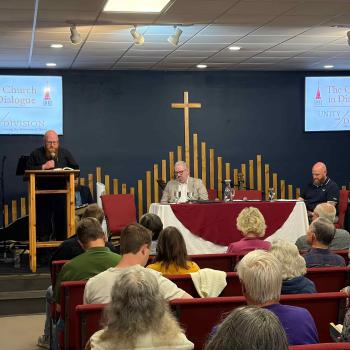
Truth-Rooted Ecumenical Dialogue
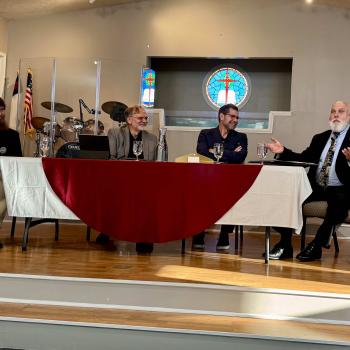
Why Ecumenical Dialogue Should Be Done in Person
Archetypal Abraham: The Binding of Isaac and Christians
The Significance of Baptists in Dialogue
TRENDING AT PATHEOS General Christian

Seventy and Five Years Old: God Still Starts...
There is a small detail tucked into Genesis 12 that I skipped...

A Biblical Vision of Success in Christian Life...
The Concern and Quest Recent trends and tendencies I note around me...

Indigenous Peoples’ Day and the Church
Indigenous' Peoples Day or Columbus Day? Depending on where you live...

When Spiritual Growth Looks Like Losing Ground
Four Passive Spiritual Disciplines: An Introduction When I was a college freshman,...

Faith and Finding Your Current Season
“To everything there is a season,” Ecclesiastes tells us, “and a time...

Did Jesus Fear God's Wrath in Gethsemane?
That Time Jesus Was Terrified Before we begin, let me say at...
view all General Christian blogs
Ad-Free & Subscriber Log-In Subscription Support
- About Us
- 2026 Calendar
- Videos
- Podcasts
- Library of World Religions
- Faith In Media Tracker
- Advertise With Us
- Write for Us
- Privacy Policy
- Terms of Service
- Do Not Sell My Data
- Contact Us
- Radiant Digital
- Manage Newsletter Subscriptions
- Unsubscribe From Notifications
- Sitemap
Copyright 2008-2026, Patheos. All rights reserved.
Subscription Support Ad-Free & Subscriber Log-In
Follow Patheos