
BuddhistCatholicContemplativeEvangelicalGeneral ChristianHinduJewishLatter-day SaintMuslimNew VisionsProgressive Christian
Beliefs
- Buddhist
- Catholic
- Contemplative
- Evangelical
- General Christian
- Hindu
- Jewish
- Latter-day Saint
- More Voices
- Muslim
- New Visions
- Pagan
- Progressive Christian
Topics
- Religion News
- Food and Religion
- Sports and Religion
- Religious Art
- Religious Music and Entertainment
- Religious Events
- History and Religion
- Style and Religion
- Politics and Religion
- Women in Religion
- Recreation Outdoors and Religion
- Business Finance and Religion
- Careers Workplace and Religion
- Education and Religion
- Family Parenting and Religion
- Health Fitness and Religion
- Home and Religion
- Relationships and Religion
- Technology and Religion
- Travel and Religion
Columnists
- Buddhist Columnists
- Business Finance and Religion Columnists
- Careers Workplace and Religion Columnists
- Catholic Columnists
- Contemplative Columnists
- Education and Religion Columnists
- Evangelists Columnists
- Family Parenting and Religion Columnists
- General Christian Columnists
- Health Fitness and Religion Columnists
- Hindu Columnists
- History and Religion Columnists
- Home and Religion Columnists
- Jewish Columnists
- More Voices Columnists
- Latter Day Columnists
- Muslim Columnists
- New Visions Columnists
- Nonreligious Columnists
- Pagan Columnists
- Politics and Religion Columnists
- Progressive Columnists
- Recreation Outdoors and Religion Columnists
- Relationships and Religion Columnists
- Religion News Columnists
- Religious Art Columnists
- Religious Events Columnists
- Religious Music and Entertainment Columnists
- Sports and Religion Columnists
- Style and Religion Columnists
- Technology and Religion Columnists
- Travel and Religion Columnists
- Women in Religion Columnists
Resource Library
- 2026 Calendar
- Library of World Religions
- The 100 Most Holy Places on Earth
- Patheos Answers
- Podcasts
- Videos
- Faith Leaders Database
- Anglican Episcopalian
- Bahai
- Baptist
- Buddhism
- Christianity
- Confucianism
- Eastern Orthodoxy
- Hinduism
- Holiness and Pentecostal
- ISKCON
- Islam
- Judaism
- Lutheran
- Methodist
- The Church of Jesus Christ of Latter-day Saints
- New Age
- Paganism
- Presbytarian and Reformed
- Protestantism
- Religion Behind the Scenes
- Roman Catholic
- Scientology
- Shia Islam
- Sikhism
- Sufism
- Sunni Islam
- Taoism
- Zen
- See all religions
Research Tools
 Ad-Free & Subscriber Log-In Subscription Support
Ad-Free & Subscriber Log-In Subscription Support
Follow Patheos 

- Trending:
- Forgiveness
- |
- Marriage
- |
- Consciousness
- |
- Death Penalty
- |
- Election
- |
- Halloween

- Home
- General Christian
- Dread Moses: The Prophet and Rastafari
Dread Moses: The Prophet and Rastafari
Last updated on: August 17, 2022 at 2:35 pm by Jordan Bennett
Dread Moses: The Prophet and Rastafari 2022-08-17T14:35:07-04:00 Jordan Bennett
Patheos Explore the world's faith through different perspectives on religion and spirituality! Patheos has the views of the prevalent religions and spiritualities of the world.
On the third reverb and incense soaked track arising from The Congos’ revolutionary 1977 recording, Heart of the Congos, vocalist Cedric Myton laments the state of Africans in captivity. To him, and most, if not all, Rastas, the African diaspora is but a suffering group treading upon foreign soil; they are Jah’s children sitting by the rivers of Babylon. Myton and his bandmates are well aware of “where the black man stands,”[i] in the western world, but they do not sing entirely of dismal affairs; the reggae musicians have faith that God will return them to the promised land—to Ethiopia or Africa more broadly.
Expressing such a belief, The Congos vocalize, quoting Isaiah 43: “Jah said unto the south ‘give up!’ To the west ‘keep not back!’ Send my sons from afar and my daughters from the end of the world.”[ii] Here the band’s lyrics adapt a passage which is most assuredly ancient, yet they retain a profound relevance, for Rastafari see these words as foreshadowing the upcoming deliverance of all those who have been severed from the lands of Zion. And like the Israelites of old, today’s predicament demands a deliverer, a new Moses, or many, to bring about God’s plan for the abovementioned who long for the continent which flows with milk and honey.
As with Baháʼís and Latter-day Saints (see part I & part II), the prophet Moses is highly revered among those within the Rastafari fold, but unlike members of these faiths, Rastafarians haven’t conferred much additional information with respect to the Biblical figure in question (I propose that this is due in large part to a lack of religious texts unique to the movement.).
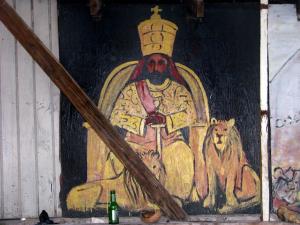
Flicker | Dubdem
Nevertheless, much can be said regarding the prophet’s role within this young Abrahamic religion. In the paragraphs that follow, I shall conclude my first trilogy of Moses posts with an excessively brief synopsis of a few major tenets of the Rasta faith all while continuing to seek out the many luminous faces of the Israelite redeemer.
The Conquering Lion
Emanating from Jamaica during the first half of the twentieth century, Rastafarianism coalesced as a uniquely Caribbean back-to-Africa movement which displayed daring beliefs concerning the last emperor of Ethiopia, Haile Selassie I. According to Rastafari theology, the monarch—now considered deceased or concealed since 1975—was either an exemplary human being, radiating prophet-like qualities, or remains a divine black messiah who had “appeared in the flesh for the redemption of all” those of African descent who have been exiled from their homeland.
Within today’s Rasta milieu there are plenty of exceptions and variations concerning these two convictions, but generally speaking, the latter accurately describes the majority of Rasta adherents, and it is with the words of Christian Scripture that they make such a bold claim. Rastafari point to the King James translation of Revelation 5:5 to substantiate their assertion; it is as follows: “and one of the elders saith to me, ‘Weep not; behold, the Lion of the tribe of Judah, the Root of David, hath prevailed to loose the seven seals thereof.‘”[iii]
The illustrious designations mentioned in this verse were the titles bestowed upon the emperor at his coronation and thus Rastas see Selassie as having fulfilled a long-awaited prophecy. He “is indeed King of kings and Lord of lords, the Messiah returned, the dread Jah Rastafari, come now to judge creation.”[iv]
In addition to messianic speculations—and as alluded to previously—Rastafarians possess yet another crucial conviction that represents much of their worldview: that those who reside within the African Diaspora are doomed to fall short of their intrinsic potential unless they repatriate back to the African continent; it is with this notion that we establish our connection to Moses.
Leaving Babylon
The conception of the Biblical Moses among Rastas is very similar to that broadcasted by those within the Christian fold and differs nearly only in the color of the prophet’s skin. The Rastafari allege that they themselves are the genuine descendants of the Israelites and that “the original Hebrews were black.”[v] By holding to such a doctrine, followers of the Rastafarian religion embrace the designation of Jah’s chosen people, the “reincarnation of ancient Israel.”[vi]
Rastas look back to an African Moses and look forward to an era in which a new Israelite commander—or many—will do as the ancient Hebrew lawgiver did and return God’s followers to Zion. For this reason, the Moses of the Old Testament is significant to Rastafari not only for his admirable attributes and closeness to Jah, but also on account of his holy role; he is the archetype for an essential aspect of the Rastafarian mode of being.
Although “most Rastafarians hold that repatriation is in principle and in fact outside of their control,”[vii] in some sense, all are called unto Moseshood. For repatriation signifies more than just a physical return to the land; it entails a return to African culture as well, “a liberation from the alienation of the west.”[viii] And this is to be initiated by the individual Rasta, not a single overshadowing chief; every person must cling to the staff of Moses as they emancipate themselves from the crutch of western culture.
While it is true that the importance laid upon the individual is foundational and considerable to the Rastafarian message, for many, a leader of sorts is yet crucial to God’s plan and is eagerly awaited along with that of a physical return to the Promised Land. As a superlative example of this battle cry for holy redemption (and cultural freedom), soak in the inquiring words of Robert Nesta Marley: “Are you satisfied with the life you’re living? We know where we’re going; we know where we’re from. We’re leaving Babylon. We’re going to our Father’s land.” And petitioning Jah for a leader he sings: “Send us another brother Moses from across the Red Sea.”[ix]
The Rastafari movement sees universal “repatriation as a must”[x] and awaits the reemergence of the divine Messiah, Selassie, or the arrival of another Moses-like figure to lead a “wholesale exodus from all Western countries”[xi] to that of the promised land. For Rastas, the great Israelite in question was a meritorious African who additionally foreshadowed the coming of others who will act as conduits through which Jah Rastafari is to save the true Hebrews from the clutches of Babylon.[xii]
For more information on the Rastafari Movement, check out my previous post: “A Most Holy Herb: The Rastafari and Marijuana.”
[i] The Congos, “Open Up the Gate,” track #3 on Heart of the Congos, VP Music Group, 1977, Spotify
[ii] Ibid.
[iii] Revelation 5:5 KJV
[iv] Joseph Owens, Dread: The Rastafarians of Jamaica (London: Heinemann, 1976), 90
[v] Ibid., 96
[vi] Barrett, Rastafarians, 104
[vii] Owens, Dread, 237
[viii] Ibid., 230
[ix] Bob Marley, “Exodus,” track #5 on Exodus, UMG Recordings, 1977, Spotify
[x] The Congos, “Open Up the Gate”
[xi] Barrett, Rastafarians, 1
[xii] Exodus 14:30 NIV
More Voices
Previous Post

June 30, 2022
A Most Holy Herb: The Rastafari and Marijuana
Next Post
July 26, 2022 Reflections on The Church in Dialogue Pt. 1
Browse Our Archives
Select a Category Baháʼí Biblical Interpretation Christianity Church Fathers Comparative Religion Eastern Orthodox Ecclesiology Ecumenism Hues of Moshe Judaism LDS Mormonism Protestant Rastafarianism Santo Daime Uncategorized
Select a Month June 2026 January 2026 June 2025 January 2025 October 2024 July 2024 May 2024 January 2024 November 2023 October 2023 August 2023 July 2023 June 2023 February 2023 December 2022 November 2022 October 2022 September 2022 August 2022 July 2022 June 2022 May 2022
Follow Us!
TAKE THE
Religious Wisdom Quiz
Who became king after David and built the first Temple in Jerusalem?
Select your answer to see how you score.
Rehoboam Absalom Solomon Adonijah
Related posts from Essence of the Altar

A Most Holy Herb: The Rastafari and Marijuana
The Prophet As Mirror: Moses in the Baháʼí...
A Prophet Among Saints: Moses in the LDS...

Truth-Rooted Ecumenical Dialogue
TRENDING AT PATHEOS General Christian

Seventy and Five Years Old: God Still Starts...
There is a small detail tucked into Genesis 12 that I skipped...

A Biblical Vision of Success in Christian Life...
The Concern and Quest Recent trends and tendencies I note around me...

Indigenous Peoples’ Day and the Church
Indigenous' Peoples Day or Columbus Day? Depending on where you live...

When Spiritual Growth Looks Like Losing Ground
Four Passive Spiritual Disciplines: An Introduction When I was a college freshman,...

Faith and Finding Your Current Season
“To everything there is a season,” Ecclesiastes tells us, “and a time...

Did Jesus Fear God's Wrath in Gethsemane?
That Time Jesus Was Terrified Before we begin, let me say at...
view all General Christian blogs
Ad-Free & Subscriber Log-In Subscription Support
- About Us
- 2026 Calendar
- Videos
- Podcasts
- Library of World Religions
- Faith In Media Tracker
- Advertise With Us
- Write for Us
- Privacy Policy
- Terms of Service
- Do Not Sell My Data
- Contact Us
- Radiant Digital
- Manage Newsletter Subscriptions
- Unsubscribe From Notifications
- Sitemap
Copyright 2008-2026, Patheos. All rights reserved.
Subscription Support Ad-Free & Subscriber Log-In
Follow Patheos