
BuddhistCatholicContemplativeEvangelicalGeneral ChristianHinduJewishLatter-day SaintMuslimNew VisionsProgressive Christian
Beliefs
- Buddhist
- Catholic
- Contemplative
- Evangelical
- General Christian
- Hindu
- Jewish
- Latter-day Saint
- More Voices
- Muslim
- New Visions
- Pagan
- Progressive Christian
Topics
- Religion News
- Food and Religion
- Sports and Religion
- Religious Art
- Religious Music and Entertainment
- Religious Events
- History and Religion
- Style and Religion
- Politics and Religion
- Women in Religion
- Recreation Outdoors and Religion
- Business Finance and Religion
- Careers Workplace and Religion
- Education and Religion
- Family Parenting and Religion
- Health Fitness and Religion
- Home and Religion
- Relationships and Religion
- Technology and Religion
- Travel and Religion
Columnists
- Buddhist Columnists
- Business Finance and Religion Columnists
- Careers Workplace and Religion Columnists
- Catholic Columnists
- Contemplative Columnists
- Education and Religion Columnists
- Evangelists Columnists
- Family Parenting and Religion Columnists
- General Christian Columnists
- Health Fitness and Religion Columnists
- Hindu Columnists
- History and Religion Columnists
- Home and Religion Columnists
- Jewish Columnists
- More Voices Columnists
- Latter Day Columnists
- Muslim Columnists
- New Visions Columnists
- Nonreligious Columnists
- Pagan Columnists
- Politics and Religion Columnists
- Progressive Columnists
- Recreation Outdoors and Religion Columnists
- Relationships and Religion Columnists
- Religion News Columnists
- Religious Art Columnists
- Religious Events Columnists
- Religious Music and Entertainment Columnists
- Sports and Religion Columnists
- Style and Religion Columnists
- Technology and Religion Columnists
- Travel and Religion Columnists
- Women in Religion Columnists
Resource Library
- 2026 Calendar
- Library of World Religions
- The 100 Most Holy Places on Earth
- Patheos Answers
- Podcasts
- Videos
- Faith Leaders Database
- Anglican Episcopalian
- Bahai
- Baptist
- Buddhism
- Christianity
- Confucianism
- Eastern Orthodoxy
- Hinduism
- Holiness and Pentecostal
- ISKCON
- Islam
- Judaism
- Lutheran
- Methodist
- The Church of Jesus Christ of Latter-day Saints
- New Age
- Paganism
- Presbytarian and Reformed
- Protestantism
- Religion Behind the Scenes
- Roman Catholic
- Scientology
- Shia Islam
- Sikhism
- Sufism
- Sunni Islam
- Taoism
- Zen
- See all religions
Research Tools
 Ad-Free & Subscriber Log-In Subscription Support
Ad-Free & Subscriber Log-In Subscription Support
Follow Patheos 

- Trending:
- Forgiveness
- |
- Marriage
- |
- Consciousness
- |
- Death Penalty
- |
- Election
- |
- Halloween

- Home
- General Christian
- Beyond the Amazon: Santo Daime and Ayahuasca
Beyond the Amazon: Santo Daime and Ayahuasca
Last updated on: August 17, 2022 at 2:34 pm by Jordan Bennett
Beyond the Amazon: Santo Daime and Ayahuasca 2022-08-17T14:34:28-04:00 Jordan Bennett
Patheos Explore the world's faith through different perspectives on religion and spirituality! Patheos has the views of the prevalent religions and spiritualities of the world.
For some who seek to tear the veil between material reality and what lies beyond, a mere silent mind is of little value. To seize their heart’s desire, to break the surf of the ample oceanic nature of Being, a more potent remedy is required. Although it may seem rather contrary to the quest at hand, the use of visionary plants for sacramental purposes (i.e. entheogens) is a preferred avenue for part of the world’s religious adherents as they pursue the unending aisle towards glimpsing the vestiges of God.
Beginning with the discourse that follows, I shall attempt to describe the ritual use of two consciousness-altering substances within two distinct religious traditions—both of which blossomed in the tropical climates of the Western Hemisphere during the
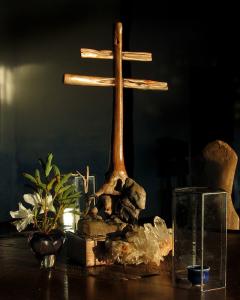
Flicker | Lou Gold
twentieth century.
The psychedelically-essenced items to be dealt with are: the Amazonian visionary brew known as ayahuasca, and a psychoactive herb acknowledged by many titles, but is more formally christened as cannabis.
The former will be discussed as an essential component within the Santo Daime faith and the latter a significant, but not necessarily mandatory, element used by those within the Rastafari fold. As a way of coaxing the handling of these plant-based remedies into more familiar territory, I will include within this undertaking very brief allusions to that of the Christian Eucharist.
A Mysterious Brew
Representing a crucial apportionment of the faith’s practice, ayahuasca saturates the building blocks of the Santo Daime religion; the substance is the cornerstone of Daimista worship.
Before I examine the paramount role of this “entheogen” in its respective spiritual conclave, please allow me to speak about the substance itself. Ayahuasca is a South American concoction synthesized from a vine known as Banisteriopsis caapi and various other plants rich in the chemical compound and extraordinary hallucinogen DMT. The vine itself is unable to adequately produce the intense visionary experiences associated with the rainforest broth in question and so its true power lies in its ability to perform as an “effective short-acting monoamine oxidase inhibitor.”[i]
Indeed, the dimethyltryptamine (DMT) inhabiting the additional ingredients of the brew would typically be rendered impotent when passing through the gut if it weren’t for the capabilities of the Banisteriopsis vine.[ii] Caapi opens up the body and allows it to fully embrace the work of DMT.
Since the ayahuasca blend is ingested rather than smoked, its hallucinogenic effects can last for hours, allowing the mental adventurer to coast along its lengthy visionary waves for an optimum eye-opening mystical experience. It is with little doubt that this Amazonian beverage is a profound chemical revelation, but it is not a new discovery; it is an age-old act of chemistry, having been performed by indigenous South Americans for generations.
As a result of its longevity, many shamanic traditions throughout history have laid claim to this entheogenic brew and have successfully incorporated its use into their rituals. The influence of this substance doesn’t end at the borders of tribal encampments, however, as several syncretic religions have also found life by combining ayahuasca consumption with religious symbols and prayers derived from other faiths. One such example of substance-induced syncretism is the belief system molded by the late Raimundo Irineu Serra.
Santo Daime
Master Irineu, an Afro-Brazilian originating from the town of Sao Vicente, initiated the Santo Daime religion in May of 1930.[iii] This budding faith began as a form of religiosity that cleaved to native shamanist traditions all while devouring a host of influences ranging from folk Catholicism to that of European esotericism.[iv]
Consuming ayahuasca is the leading ritual amongst followers of the faith—who refer to it as simply “Daime”— as they consider it to be “a substance in which a sacred, universal and all-embracing cosmic life-force is found in an especially (but not exclusively) concentrated form.”[v] For the Daimistas, the brew is an instructor whose lessons vary in appearance, structure, and philosophical interpretation from student to student and atmosphere to atmosphere, but all who participate in Santo Daime gatherings are expected to partake of this sacrament of a dingy-brown color.
Unlike the Christian communion cup, Daime is taken not only once, but multiple times throughout the duration of a given event. It is received at the onset of rituals and “at intervals thereafter of anything between 90 minutes and 2 hours.”[vi] By absorbing smaller doses, those who consume the beverage usher in disunion with emotions and allow themselves to delve deep within to reexamine memories and past thoughts without attachment.
At the climax of higher doses, visionary experiences, vivid images, and momentous insights occur and a more intoxicating effect grabs ahold of the voyaging mind and body. Such otherworldly perceptions can even conclude—as some have described—“journeys to other realms and dimensions where an assortment of spiritual beings are met and engaged.”[vii]
The consumption of ayahuasca is not without overt physical effects, however, as the Daime often induces a mild form of emesis, but even this is viewed in a positive light by followers of Master Irineu’s religion. According to Daimistas, the purging of abdomen occupants is “a physical manifestation of inner spiritual cleansing.”[viii] It reveals to the participant and his/her surrounding community that the Daime is enacting a purifying work and is indeed fulfilling its spiritual purpose.
Despite it being displayed upon an immensely high pedestal, the Amazonian brew is not the only ritual practice exhibited at a Santo Daime gathering, nor is it the only sacrament. Daimistas also engage in ceremonial hymn singing—where much of the faith’s theology and philosophy is laid bare— and partake in the smoking of “Santa Maria.”[ix] I now turn to this particular substance known to the Rastas as “ganja” in an attempt to explore its significance within a religious framework originating on the Caribbean island of Jamaica…
To continue this thread, please check out my next entry on the use of hallucinogens in the Rastafari Movement.
[i] Terence McKenna, Food of the Gods: The Search For the Original Tree of Knowledge (New York: Bantam, 1992), 225
[ii] Ibid., 226
[iii] Andrew Dawson, Santo Daime: A New World Religion (Bloomsbury, 2013), 8
[iv] Ibid., 14
[v] Ibid., 54
[vi] Ibid.
[vii] Ibid., 56
[viii] Ibid.
[ix] Ibid., 57
More Voices
Previous Post

June 3, 2022
The Prophet As Mirror: Moses in the Baháʼí Faith
Next Post
June 30, 2022 A Most Holy Herb: The Rastafari and Marijuana
Browse Our Archives
Select a Category Baháʼí Biblical Interpretation Christianity Church Fathers Comparative Religion Eastern Orthodox Ecclesiology Ecumenism Hues of Moshe Judaism LDS Mormonism Protestant Rastafarianism Santo Daime Uncategorized
Select a Month June 2026 January 2026 June 2025 January 2025 October 2024 July 2024 May 2024 January 2024 November 2023 October 2023 August 2023 July 2023 June 2023 February 2023 December 2022 November 2022 October 2022 September 2022 August 2022 July 2022 June 2022 May 2022
Follow Us!
TAKE THE
Religious Wisdom Quiz
Who was Boaz's kinsman-redeemer?
Select your answer to see how you score.
Unnamed relative Elimelech Ruth Naomi
Related posts from Essence of the Altar

A Most Holy Herb: The Rastafari and Marijuana
Truth-Rooted Ecumenical Dialogue
Why Ecumenical Dialogue Should Be Done in Person
TRENDING AT PATHEOS General Christian

Seventy and Five Years Old: God Still Starts...
There is a small detail tucked into Genesis 12 that I skipped...

A Biblical Vision of Success in Christian Life...
The Concern and Quest Recent trends and tendencies I note around me...

Indigenous Peoples’ Day and the Church
Indigenous' Peoples Day or Columbus Day? Depending on where you live...

When Spiritual Growth Looks Like Losing Ground
Four Passive Spiritual Disciplines: An Introduction When I was a college freshman,...

Faith and Finding Your Current Season
“To everything there is a season,” Ecclesiastes tells us, “and a time...

Did Jesus Fear God's Wrath in Gethsemane?
That Time Jesus Was Terrified Before we begin, let me say at...
view all General Christian blogs
Ad-Free & Subscriber Log-In Subscription Support
- About Us
- 2026 Calendar
- Videos
- Podcasts
- Library of World Religions
- Faith In Media Tracker
- Advertise With Us
- Write for Us
- Privacy Policy
- Terms of Service
- Do Not Sell My Data
- Contact Us
- Radiant Digital
- Manage Newsletter Subscriptions
- Unsubscribe From Notifications
- Sitemap
Copyright 2008-2026, Patheos. All rights reserved.
Subscription Support Ad-Free & Subscriber Log-In
Follow Patheos